
CRYPTO
Trump Threatens Iran Strikes as Bitcoin’s War Reflex Fades
Trump warned of more strikes on Iran after an alleged assassination plot, and Bitcoin fell as the U.S. seized $1 billion in Iranian crypto.

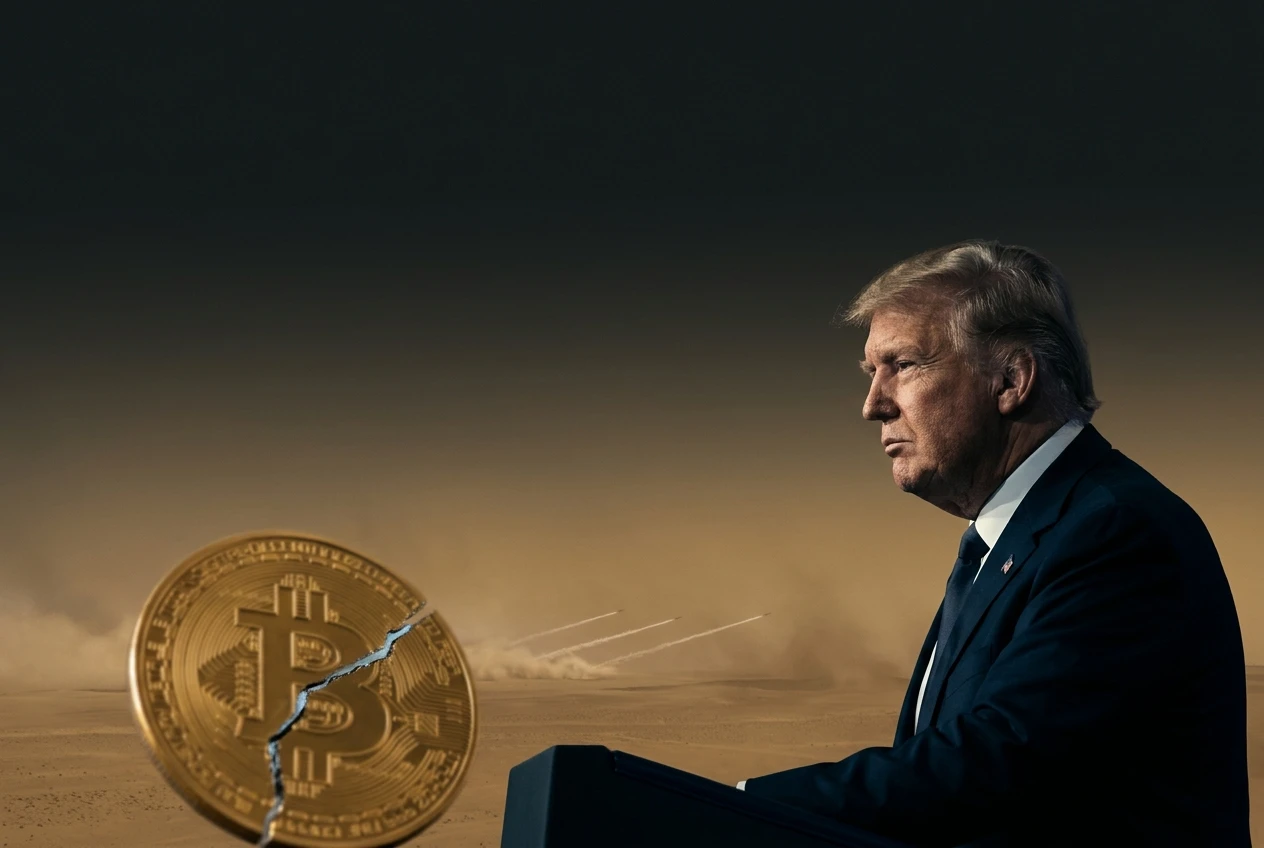
President Trump says the United States has “1,000 missiles locked and loaded” for Iran, a warning posted after Israeli intelligence reportedly flagged a fresh plot against his life. Bitcoin slid alongside it, extending a selloff that started the moment Trump called the ceasefire with Iran dead.
Washington has already turned crypto into a weapon against Tehran, seizing roughly $1 billion in Iranian digital assets since the spring. And each new round of this war is moving Bitcoin’s price less than the last one did.
A Ceasefire Ends, Then an Assassination Plot Surfaces
The war traces back to February 28, 2026, when the U.S. and Israel launched what Trump called “major combat operations,” a coordinated strike on Iranian nuclear, missile and government sites. Iran’s Supreme Leader at the time, Ayatollah Ali Khamenei, was killed in the opening strikes.
A ceasefire followed, built around a memorandum of understanding (MOU). It didn’t survive July.
Trump declared the truce over on July 8 at a NATO summit in Ankara, Turkey, after Iran struck three commercial ships in the Strait of Hormuz. The U.S. answered with strikes on roughly 90 Iranian military targets along the coast, including air defense systems and missile storage sites, according to U.S. Central Command (Centcom). Iran’s Revolutionary Guard retaliated against American bases in Kuwait and Bahrain.
“I say we hit them 20 to 1, every time they hit us, we’re going to hit them 20, and we did it last night,” Trump told reporters aboard Air Force One. Centcom said the two rounds of strikes since have hit close to 170 targets in total.
Strikes have continued since. Multiple explosions hit the southern port city of Chabahar this week, with videos verified by NBC News showing a fireball near the port and a wrecked maritime traffic control tower.
Iran’s own crypto market has been rattled too. The blockchain intelligence firm TRM Labs has tracked an 80% drop in transaction volume inside Iran between February 27 and March 1, as the regime imposed internet blackouts.
Trump’s newest warning followed something more personal. Israeli intelligence reportedly flagged a new plot to assassinate him, and Iran’s current Supreme Leader, Mojtaba Khamenei, who succeeded his father after the February strikes, said avenging his father’s death “must certainly” happen.
- What we know: Trump posted that “1,000 missiles are locked and loaded” for Iran after intelligence reports of a plot on his life.
- What we know: Strikes hit Chabahar this week, and Iran’s Revolutionary Guard has targeted U.S. bases in Kuwait and Bahrain.
- What’s unconfirmed: The specific details of the alleged assassination plot.
- What’s unconfirmed: Whether Iran’s new Supreme Leader ordered or even knew about it.
Bitcoin’s Shrinking War Reflex
This isn’t Bitcoin’s first brush with Israel-Iran hostilities. When Israel struck Iranian nuclear sites in June 2025, the coin fell almost 4% in a day, from $107,000 to $103,000.
The current war set up fresh comparisons. On June 8, 2026, when the two countries traded their biggest strikes up to that point, Bitcoin dropped more than 2% from a starting price of $63,700. By July 8, when Trump called the ceasefire dead, the drop was smaller still, about 3%, to roughly $61,691, according to Bloomberg.
Two days later, with missiles “locked and loaded” and an assassination plot in the headlines, Bitcoin hadn’t broken new lows. The Motley Fool noted the ceasefire’s collapse “hasn’t had the same effect on cryptocurrencies as the prior rounds of the war.”
| Date | Trigger | Bitcoin’s Move |
|---|---|---|
| June 13, 2025 | Israel strikes Iranian nuclear sites | Fell almost 4%, from $107,000 to $103,000 |
| June 8, 2026 | Biggest strikes of the war to that point | Dropped more than 2% from $63,700 |
| July 8, 2026 | Trump declares the ceasefire “over” | Fell more than 3% to about $61,691 |
| July 10-11, 2026 | “1,000 missiles” warning, assassination plot reports | Held in the low $60,000s; no comparable drop yet |
Retail traders haven’t panicked either. Sentiment on Stocktwits stayed bullish through the July 8 drop, even as social media chatter about Bitcoin overall fell 18% from the prior week, according to the analytics firm Santiment.
The war headlines also buried a quieter story. Strategy Inc.’s latest sale of the token earlier in the week had barely moved the market before Iran took over the conversation, Bloomberg noted. Traders were also digesting minutes from the Federal Reserve’s June meeting, with odds of a September rate hike ticking up on CME Group’s FedWatch tool, giving risk assets another reason to wobble beyond the war itself.
Operation Economic Fury Turns Transparency Into a Weapon
While traders watch the chart, the Treasury Department has been running a parallel campaign against Iran’s finances. Officials call it Operation Economic Fury, and it treats Iran’s crypto wallets as a target list.
By late May, Treasury Secretary Scott Bessent said the campaign had seized roughly $1 billion in Iranian cryptocurrency, building on an earlier freeze of $344 million in USDT on the Tron blockchain back in April.
Just outright grabbed the wallets. Some of them may be typing in right now and might not realize their wallet had been grabbed.
Bessent said that of the seizures, speaking at the Reagan National Economic Forum in May. He also said the U.S. was working with European allies to seize villas and properties tied to Iranian officials, alongside sanctions on shadow banking networks and pressure that has pushed inflation in Iran past 200%, with unpaid military personnel and food vouchers replacing normal wages.
The same blockchain ledger that lets anyone verify a Bitcoin transaction also lets a government trace it, freeze it and take it. Iran built a multibillion-dollar sanctions workaround on those same rails, and the workaround turned out to be traceable too.
Iran’s total crypto footprint dwarfs the seized amount. A separate estimate from the Gulf International Forum puts the country’s domestic crypto ecosystem at $7.78 billion, even after years of sanctions and, more recently, war.
The Exchanges Iran Can’t Quit
Nobitex is Iran’s largest crypto exchange, and by Treasury’s own count it handled more than half of the country’s digital asset inflows in 2025.
The U.S. sanctioned Nobitex on June 2, along with three smaller platforms, saying the network helped Iran’s central bank and the Islamic Revolutionary Guard Corps (IRGC), a paramilitary force Washington has designated a terrorist organization, move money outside the reach of sanctions.
- Nobitex – handled more than 50% of Iran’s digital asset inflows in 2025, according to Treasury.
- Wallex – processed about 12% of Iranian inflows.
- Bitpin – accounted for roughly 10% of inflows.
- Ramzinex – has moved more than $2.45 billion since 2018.
Smaller platforms filled the gap left behind. CoinEx became one of Iran’s main crypto gateways as Binance pulled its exposure back from the country.
Sanctioning the exchanges doesn’t only squeeze the regime. Funds that pass through a blacklisted platform become effectively tainted, creating compliance obstacles for international transfers, RFE/RL reported, since ordinary Iranians increasingly rely on crypto to protect savings as the rial collapses to record lows.
Does a Ceasefire Still Have a Chance?
Some chance remains. Delegations from the U.S. and Iran met in Oman this weekend without a breakthrough, and Trump said Wednesday that Tehran had called wanting a deal, though he doubts Iran would honor one. Analysts see Bitcoin’s downside capped near $50,000 to $52,000 if fighting drags on.
One proposal on the table, brought by Oman, would let ships use the strait’s southern lane freely while requiring approval, but not a toll, for the northern lane running through Iranian waters. Roughly a fifth of the world’s oil supply moves through the Strait of Hormuz. No breakthrough emerged, and the Iranian delegation went home to consult leadership.
Trump’s own signals stayed mixed. “They called a little while ago. They want to make a deal so badly,” he told reporters, before adding, “I don’t know that they’re going to honor the deal. That’s the problem.”
In Washington, a divide has opened among some Republicans in Congress over whether Trump has legal authority to continue strikes without a war-powers vote.
Crypto analyst Merlijn The Trader has flagged $50,000 to $52,000 as a likely floor if hostilities grind on. Analyst Michaël van de Poppe called $61,000 “the crucial level” to hold. Previous diplomatic breakthroughs have lifted Bitcoin’s price before without pulling in matching demand, a pattern that repeated when Bitcoin’s price broke past $65,500 on the previous Iran deal without fresh ETF inflows behind it.
For now, the delegations that met in Oman are the closest thing to an off ramp, and neither government has said when talks might resume.
Frequently Asked Questions
Why does Bitcoin react so fast to Iran war headlines?
Bitcoin trades 24 hours a day across global exchanges, unlike stocks or oil futures, so it absorbs geopolitical headlines the moment they break. The U.S. Dollar Index climbed above 101 during the July 8 selloff, a sign investors were rotating into cash broadly, not just avoiding crypto specifically.
What is Operation Economic Fury?
It’s the Trump administration’s financial pressure campaign against Iran, run through the Treasury Department. Beyond wallet seizures, it targets shadow banking networks, oil-linked sanctions and overseas properties, including European villas and real estate tied to Iranian officials.
Does Iran hold Bitcoin as a national reserve?
No. Iran doesn’t officially hold Bitcoin, and there’s no significant Bitcoin mining inside the country, unlike some other sanctioned states. Iran’s crypto exposure runs mainly through exchanges like Nobitex and a bitcoin-based option for Strait of Hormuz transit tolls that Iran began offering in March 2026.
Has the U.S. imposed a naval blockade on Iran?
Yes. Washington imposed a naval blockade on Iranian ports and vessels on April 13, disrupting oil exports that fund the country’s economy, after Iran seized control of parts of the Strait of Hormuz. The blockade was lifted as part of the ceasefire deal before hostilities resumed in July.
Disclaimer: This article is for informational purposes only and does not constitute financial or investment advice. Cryptocurrency markets are volatile and carry significant risk, particularly during periods of geopolitical conflict. Consult a licensed financial advisor before making investment decisions. Figures are accurate as of publication and may change as the situation develops.


Apple must neutralise ATT prompts after German cartel probe

FiiO FG3 cracks open budget gaming headsets at seventy dollars

Glodon QuantifAI launch pushes Malaysian quantity takeoff into AI judgment work

Samsung Galaxy A08 Nears Launch With Larger Battery Same Chip

PepsiCo AI Marketing Review Forces Agencies to Prove Platform Power

Phantom Blade Zero’s 66-day clock rewrites action RPG stakes

India AI Data Centre Stocks Face a Power Reality Check

RT-One Certifies AI Stack Once to Unlock Multi-Country Campuses

Payop Sponsors Gamescom Cosplay Village to Make Payments Invisible

Lava Virat V1 5G Bets Clean Android Can Beat Thin Specs

Fable 5 and Mythos 5 Return as US Lifts Anthropic Export Controls

Oracle Cuts 21,000 Jobs in a Year, Cites AI in 10-K Filing

SpaceX’s Google Deal Turns a Rocket Company Into a Cloud Landlord

CD Projekt Red Co-CEO: Redemption Arc Isn’t Done, Witcher 4 in 2027

XPL Rallies 30% Ahead of Plasma One Card Tier Launch

Google Search Profiles Build a Follow Graph Inside Discover

DGO App Brings Rs 549 Mobile Pass for FIFA World Cup 2026 in Nepal

Moonshot AI Targets $30 Billion in China’s Fastest AI Funding Sprint

Microsoft Xbox Layoffs Start in July as Sharma Slams 3% Margin

Oppo’s ColorOS 17 Eligibility List Leaves A-Series Buyers Behind
-
 AI2 months ago
Fable 5 and Mythos 5 Return as US Lifts Anthropic Export Controls
-
 AI2 months ago
Oracle Cuts 21,000 Jobs in a Year, Cites AI in 10-K Filing
-
 AI2 months ago
SpaceX’s Google Deal Turns a Rocket Company Into a Cloud Landlord
-
 GAMING2 months ago
CD Projekt Red Co-CEO: Redemption Arc Isn’t Done, Witcher 4 in 2027
-
 CRYPTO2 months ago
XPL Rallies 30% Ahead of Plasma One Card Tier Launch
-
 NEWS2 months ago
Google Search Profiles Build a Follow Graph Inside Discover
-
 APPS2 months ago
DGO App Brings Rs 549 Mobile Pass for FIFA World Cup 2026 in Nepal
-
 AI2 months ago
Moonshot AI Targets $30 Billion in China’s Fastest AI Funding Sprint