
NEWS
iPhone 17 Price Hike in India Reveals the Chip Crunch’s Winners
Apple is reportedly raising iPhone 17 prices in India by about ₹12,000 from August, the latest sign of a memory chip supercycle favoring Apple and Samsung.

Apple is set to raise iPhone 17 prices in India by roughly ₹12,000 within two weeks, according to a tipster who says the company has already briefed its retail partners on the new numbers. Gadgets360 first reported the leak, which lands days after Apple lifted iPhone prices in Japan by as much as 11.3 percent and five weeks after it raised Mac, iPad and HomePod prices across India.
Every one of those increases traces back to the same source: a global memory chip shortage that is quietly deciding who profits and who loses in the smartphone business. Apple and Samsung are coming out ahead of it. Budget Android brands, and the Indian shoppers who rely on them, are the ones absorbing the difference.
Dealers Get Word of a ₹12,000 Jump
Tipster Abhishek Yadav wrote on X that Apple told iPlanet, an authorized reseller network in India, to expect a price revision across the iPhone 17 lineup starting the first week of August. The base iPhone 17 with 256GB of storage would climb from its launch price of ₹82,900 to about ₹94,990, an increase of nearly 15 percent.
Yadav’s post detailing the dealer briefing also flagged similar hikes coming for the iPhone 17 Pro and iPhone 17 Pro Max, though he did not share exact figures for either model. Both currently start at ₹1,34,900 and ₹1,49,900 in India. There is no word yet on the iPhone Air.
| Model | Launched September 2025 | Tipped From August 2026 |
|---|---|---|
| iPhone 17 (256GB) | ₹82,900 | Around ₹94,990 |
| iPhone 17 Pro (256GB) | ₹1,34,900 | Not yet disclosed |
| iPhone 17 Pro Max (256GB) | ₹1,49,900 | Not yet disclosed |
Yadav also pointed to a supply crunch behind the scenes. He said Apple has told its supply chain that fresh iPhone 17 inventory should reach Indian dealers by the following weekend, which suggests current stock is already running thin ahead of the change.
What we know:
- The base iPhone 17 (256GB) is expected to rise from ₹82,900 to about ₹94,990 starting the first week of August.
- Fresh iPhone 17 inventory is expected to reach Indian dealers by the following weekend, easing a current supply disruption.
What’s unconfirmed:
- The exact new prices for the iPhone 17 Pro and iPhone 17 Pro Max.
- Whether the iPhone Air’s India price will move at all.
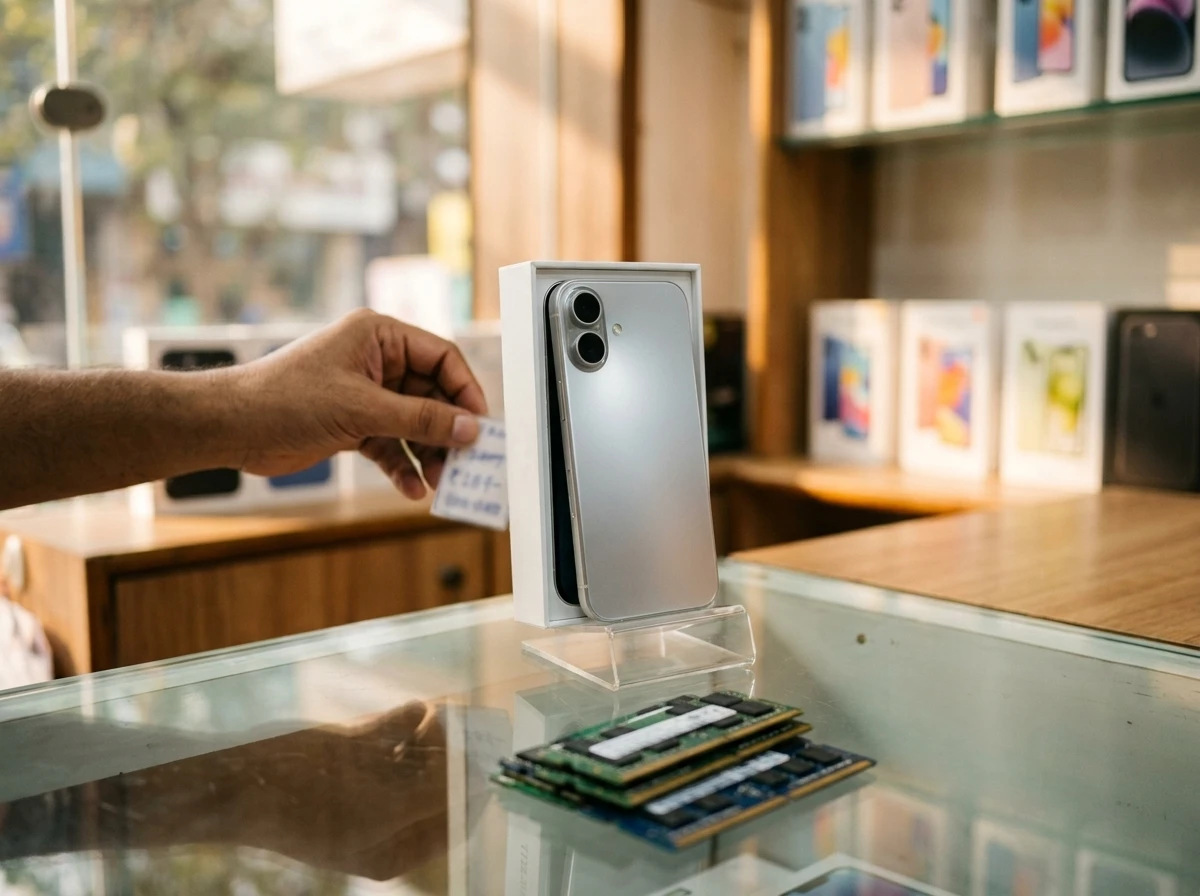
The Memory Chip Supercycle Behind the Sticker Shock
Apple’s own explanation for last month’s India price hikes was blunt: rising DRAM and NAND flash storage costs, driven by demand for the same components from the AI industry. That isn’t corporate spin. It’s the same story showing up in earnings calls and research notes across the entire chip industry.
Since the second half of 2025, memory has entered what suppliers call a supercycle. Samsung, SK Hynix and Micron have redirected manufacturing capacity toward high bandwidth memory chips that feed AI data centers, leaving less conventional DRAM and NAND flash for phones and laptops. TrendForce’s latest memory pricing survey projects DRAM contract prices rising another 13 to 18 percent this quarter, even as the pace slows from the near doubling seen earlier this year.
- 90 to 95 percent: how much DRAM contract prices jumped quarter over quarter in early 2026, the largest single-quarter spike on record, according to TrendForce.
- 13 to 18 percent: the further DRAM increase TrendForce still expects this quarter, even as consumer demand cools the pace.
- 246 percent: how much memory maker Kingston has said its own NAND flash costs rose in 2025 alone.
- $523: the global average smartphone selling price IDC expects in 2026, up roughly 14 percent as brands pass costs through.
This is not temporary belt tightening. Suppliers are chasing AI data center margins that consumer electronics simply can’t match, and that reallocation of factory capacity is structural, not seasonal.
Apple and Samsung Cash In as Rivals Retreat
Not every phone maker is absorbing this the same way. Some are passing costs straight to shoppers. Others are cutting production instead.
Apple and Samsung are best positioned to weather the next few quarters. But it will be tough for others that don’t have as much wiggle room to manage market share versus profit margins.
MS Hwang, research director at Counterpoint Research, said in a note reported by CNBC. His point is already showing up in the shipment data. Xiaomi had to slash its 2026 shipment target twice earlier in the year before recently raising it from 90 million to 110 million units, and it’s aiming most of that recovery at entry level phones, the segment hit hardest by expensive memory. Oppo and Vivo have pushed back on Samsung’s component pricing, a sign that patience with the chip suppliers is running out further down the food chain. Sony has also raised phone prices this year, joining Apple, Samsung and Xiaomi on the list of brands passing costs on.
Apple’s own numbers back up Hwang’s read. “In a year when the broader smartphone market records its steepest decline in history, iOS will deliver its highest annual share ever, at 22 percent,” said Francisco Jeronimo, an IDC analyst who tracks the global device market. IDC projects worldwide smartphone shipments will contract by roughly 13 percent in 2026, while CCS Insight has forecast an even steeper drop, calling it the steepest annual decline on record. Two different research houses, pointing at the same shrinking pie, with Apple still growing inside it.
India’s Own Numbers Already Show the Squeeze
India isn’t a side note in this story. Counterpoint Research now expects the country’s overall smartphone shipments to fall 13 to 14 percent in 2026, landing around 133 million to 134 million units, according to estimates cited this week by Business Standard.
The pain isn’t evenly spread. Counterpoint data shows the ultra premium segment above ₹45,000 captured 17 percent of India’s smartphone market in the final quarter of 2025, its highest share ever, with the iPhone 16 the single highest shipped device in the country for three straight quarters. Meanwhile Counterpoint’s own tracker found India’s smartphone sales down 9 percent year over year in the first nine weeks of 2026, with the firm naming rising memory prices directly as the drag on demand.
Put plainly, the cheap end of India’s market is shrinking while the expensive end keeps setting records. An iPhone price hike lands squarely on the side of the market that’s still growing.
Japan Already Paid This Price
India isn’t even the first market to get this treatment. Apple raised Japanese iPhone prices by up to 11.3 percent, with the standard iPhone 17 rising from JPY 129,800 (roughly ₹76,900) to JPY 142,800 (roughly ₹84,600), a jump of about 10 percent on that model alone. Similar revisions reportedly hit the iPhone Air, iPhone 17 Pro and iPhone 17 Pro Max in Japan too.
India got its own preview last month, just not on phones. Apple pushed through price increases across Mac, iPad, Apple TV and HomePod models, with individual jumps ranging from ₹5,000 to ₹1 lakh. Apple’s Watch lineup and AirPods were spared that round, and so was the iPhone, for a few more weeks at least. The reprieve looks less like a policy and more like a timing gap before the same DRAM and NAND math caught up with the phones.
Will the iPhone 17 Pro Max Cost More Too?
Almost certainly, though nobody outside Apple and its dealer network has said by how much. Yadav’s leak names the Pro and Pro Max as next in line without attaching numbers, and Apple has not commented publicly on any of it.
What’s clearer is the timing. New stock is expected at Indian dealers within days, and the price change is pegged to the first week of August, roughly two weeks out. That gives shoppers a narrow window to buy at today’s prices before the adjustment lands, assuming the current inventory crunch doesn’t clear first. Festive season buying in India typically ramps up from September, meaning Apple would enter its busiest retail stretch of the year already at the higher price.
Frequently Asked Questions
Will the iPhone 17 Pro and Pro Max see the same size price hike?
That isn’t confirmed. Tipster Abhishek Yadav’s leak says both models will get similar increases to the standard iPhone 17, but he has not published specific new prices for either. Both currently start at ₹1,34,900 and ₹1,49,900 in India.
Is Sony also raising phone prices because of the memory shortage?
Yes. Industry reporting names Sony alongside Apple, Samsung and Xiaomi as manufacturers that have raised device prices in 2026 to offset surging DRAM and NAND costs tied to AI data center demand.
Will the iPhone Air’s price rise in India too?
There’s no confirmation either way in India. Japan’s iPhone Air reportedly did get a similar revision alongside the Pro and Pro Max there, which suggests India’s Air pricing could follow, but nothing has leaked on it yet.
Which Apple products escaped India’s price hikes so far?
The Apple Watch lineup and AirPods were spared during last month’s broader India price revision, along with the iPhone at the time. Mac, MacBook, iPad, Apple TV and HomePod models were the ones that went up.
Has Apple officially confirmed the iPhone 17 price increase?
No. The report rests on tipster Abhishek Yadav’s account of an internal briefing to iPlanet dealers, first surfaced on X and reported by Gadgets360. Apple India has not issued a public statement on the iPhone 17 series pricing.


Sony’s 10 Percent Disc Drop Leaves the 2028 Cutoff Intact

Chip Allocation Sidelines the Base iPhone 18 This Fall

Miami-Dade Fights the Vice City Brand It Already Wears

IFA 2026 Awards Put Tecno Ahead of Flagship Phones

USB-C Gadgets Made the Junk Drawer Rechargeable

Pixel 11 Pro Asks $1,099 for a Light Google Locked

The iPhone Ultra Sells Two Retired Minis as One Foldable

Google Opens Gmail to Voice and Gates Docs Live

Lenovo Prices the IdeaPad Vibe Against Apple’s $699 Neo

Xbox Caps Game Pass Cloud Gaming at 15 Hours

Oracle Cuts 21,000 Jobs in a Year, Cites AI in 10-K Filing

Fable 5 and Mythos 5 Return as US Lifts Anthropic Export Controls

SpaceX’s Google Deal Turns a Rocket Company Into a Cloud Landlord

CD Projekt Red Co-CEO: Redemption Arc Isn’t Done, Witcher 4 in 2027

XPL Rallies 30% Ahead of Plasma One Card Tier Launch

Google Search Profiles Build a Follow Graph Inside Discover

DGO App Brings Rs 549 Mobile Pass for FIFA World Cup 2026 in Nepal

Moonshot AI Targets $30 Billion in China’s Fastest AI Funding Sprint

Oppo’s ColorOS 17 Eligibility List Leaves A-Series Buyers Behind

Microsoft Xbox Layoffs Start in July as Sharma Slams 3% Margin
-
 AI3 months ago
Oracle Cuts 21,000 Jobs in a Year, Cites AI in 10-K Filing
-
 AI2 months ago
Fable 5 and Mythos 5 Return as US Lifts Anthropic Export Controls
-
 AI3 months ago
SpaceX’s Google Deal Turns a Rocket Company Into a Cloud Landlord
-
 GAMING3 months ago
CD Projekt Red Co-CEO: Redemption Arc Isn’t Done, Witcher 4 in 2027
-
 CRYPTO3 months ago
XPL Rallies 30% Ahead of Plasma One Card Tier Launch
-
 NEWS3 months ago
Google Search Profiles Build a Follow Graph Inside Discover
-
 APPS3 months ago
DGO App Brings Rs 549 Mobile Pass for FIFA World Cup 2026 in Nepal
-
 AI3 months ago
Moonshot AI Targets $30 Billion in China’s Fastest AI Funding Sprint