
AI
Progressive Democrats’ Primary Wins Could Freeze AI Data Centers
Progressive primary winners want Congress to pause new AI data center construction, turning a revived Green New Deal into a direct fight over the AI boom.

A wave of insurgent Democrats who just knocked off sitting House members wants Congress to freeze new artificial intelligence data center construction. Their platform pushes the Green New Deal past its 2018 roots in climate policy and into a direct confrontation with the AI boom. At least four of these newcomers have already won primaries in safe blue seats this year.
Their timing is awkward for party leaders. Those leaders want the midterms fought on grocery prices and health care costs, not a rebooted climate platform that Republicans have already branded the “Green New Scam.”
The Insurgents Who Just Remade the House Left
The clearest example is Melat Kiros, an attorney who beat Colorado Rep. Diana DeGette in last month’s primary. Kiros argues the 2019 Green New Deal resolution set a starting point, not a finish line, for what Democrats should be pursuing now.
She is not alone. A handful of progressive challengers have already toppled incumbents or claimed open seats this year, several campaigning explicitly on an expanded Green New Deal:
- Melat Kiros – the Colorado attorney who unseated Rep. Diana DeGette, says the party has to choose between corporate donors and voters on climate.
- Brad Lander – the former New York City comptroller who defeated Rep. Dan Goldman in a closely watched primary.
- Darializa Avila Chevalier – ousted longtime Rep. Adriano Espaillat in New York, campaigning on a “Green New Deal for public housing.”
- Adam Hamawy – won the primary to replace retiring Rep. Bonnie Watson Coleman in New Jersey, telling voters “we need to pass the Green New Deal.”
Each is backed by the Sunrise Movement, the youth climate group that has championed the Green New Deal since its 2018 debut.
Why Are Data Centers Suddenly a Climate Issue?
Data centers now sit at the center of climate politics because AI computing is pushing electricity demand from these facilities sharply higher this decade, straining power grids and raising arguments the original Green New Deal never had to address about server farms.
The International Energy Agency projects data center electricity demand doubling to 945 TWh by 2030, with AI-optimized facilities driving most of that growth. That single forecast explains why Sunrise Movement folded data centers into its platform.
- 945 TWh: global data center electricity demand the International Energy Agency expects by 2030, roughly double current levels.
- More than quadruple: how much demand from AI-optimized data centers alone could grow in that same window, per the agency’s modeling.
- 8 years: how long it has been since Alexandria Ocasio-Cortez’s 2018 win first pushed the Green New Deal into the national conversation.
- 30-plus states: where lawmakers introduced data center legislation in just six weeks this year.
“We’re seeing new issues emerge that were not present when the Green New Deal was first launched, like data centers and AI,” said Denae Ávila-Dickson, a Sunrise Movement spokesperson. “AI is probably going to be one of the biggest issues of our generation.”
From H.Res.109 to a New Floor
The Green New Deal carries no legal force. The 2019 resolution, recognizing the federal government’s duty to create a Green New Deal, never got a floor vote in the House or Senate.
Even so, its ideas helped shape the climate laws Biden signed during his presidency. Progressives now want a sequel that goes further, and AI is the piece they say is missing.
The Green New Deal, frankly, is a floor now, not a ceiling, for what we need to actually be looking at doing.
Kiros said that in an interview, describing how her generation of candidates views the original resolution. She pointed to “the missing component of AI, and how that all factors into all of our legislation, specifically when it comes to the climate, that we need to be focused on.”
“Our party has a choice to make,” Kiros said, “whether we’re going to continue listening to these corporations and taking these donations, or whether we’re going to take a stand alongside the people of this country and fight back in a way that they want to see us fighting for them.”
States Are Already Pulling the Plug
Kiros is not just describing a future Congress. Many of the incoming progressives, including her, back a federal moratorium on new AI data center construction over its energy and environmental impact, a position most House Democrats do not currently share.
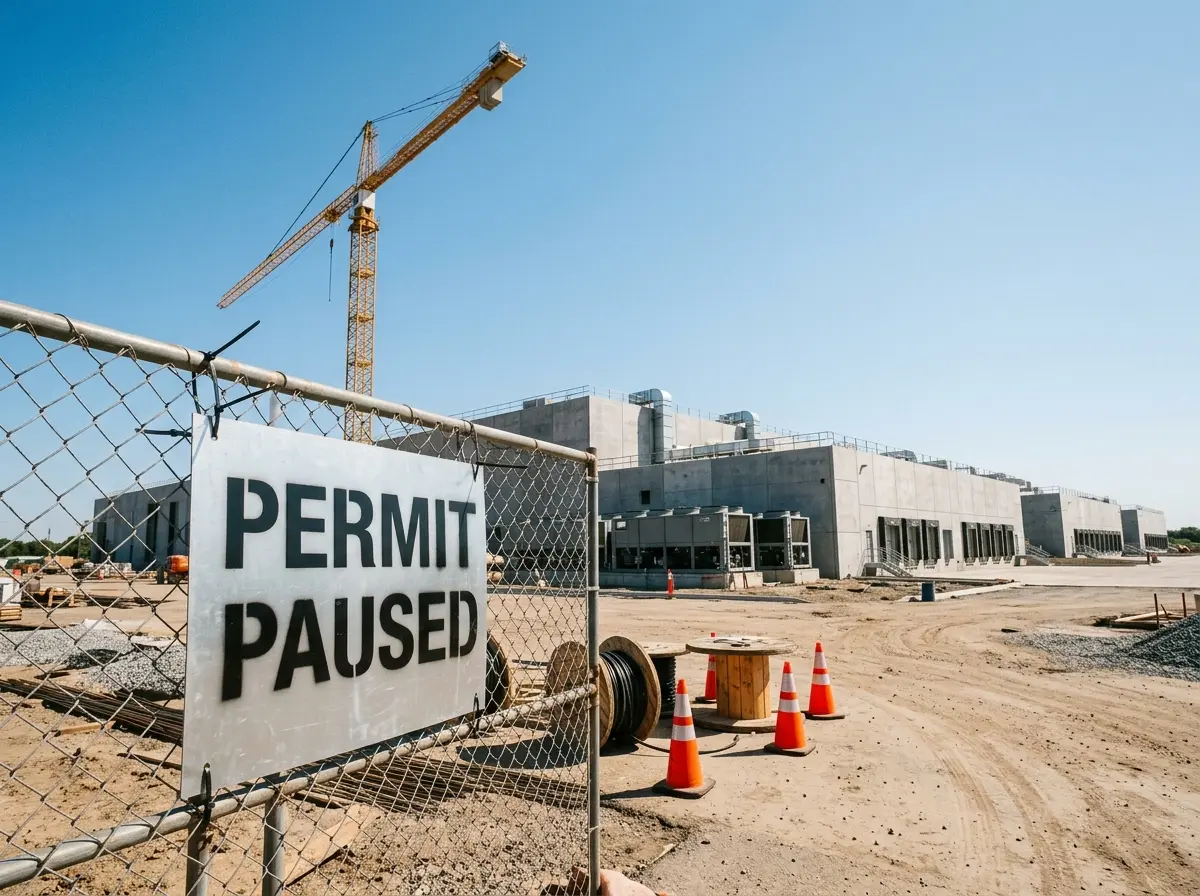
State governments are not waiting on Washington. Several have already moved to pause or restrict new data center permits this year.
| Jurisdiction | Action | Status |
|---|---|---|
| New York | A one year pause state lawmakers approved in June, followed by Gov. Kathy Hochul’s executive order pausing permits for facilities of 50 megawatts or larger. | In effect |
| Georgia | HB 1012 would block new county and city permits for data centers, pausing approvals until March 2027, with an exception for projects cleared before July 2026. | Filed |
| Maryland | HB 120 would restrict new data center construction statewide. | Filed |
| U.S. Congress | Sen. Bernie Sanders and Rep. Alexandria Ocasio-Cortez introduced companion bills to pause data center projects. | Introduced |
These state actions don’t bind Congress. But they show the moratorium idea already carries real legislative weight outside Washington, exactly the kind of precedent Kiros and the incoming class point to.
Hakeem Jeffries Isn’t Buying the Moratorium
House Minority Leader Hakeem Jeffries (D-N.Y.), who would likely become speaker if Democrats retake the chamber, has called climate change a “crisis.” He has kept his distance from the Green New Deal itself and from a data center moratorium specifically.
Asked directly about pausing AI data center construction, Jeffries said it is “not a position that I’ve articulated at this moment.”
He has instead framed the party’s energy message around cost, pushing for renewable energy tax incentives to return and blaming President Donald Trump for higher prices. Jeffries dismissed talk of party division last month. “We’ve been very clear. What brings us together is a focus on driving down the high cost of living, fixing our broken health care systems, and cleaning up corruption,” he told reporters.
House Speaker Mike Johnson (R-La.) sees an opening. He told reporters after the New York primaries that Democrats had nominated “some of the most radical candidates to ever run for office” and declared “the insurgent left is on the rise.” Republicans have folded that message into their midterm playbook alongside the “Green New Scam” label.
Kiros dismissed advice to soften climate talk before November. “It’s being said by a lot of folks who aren’t actually talking to voters,” she said.
What a Federal Pause Would Cost the AI Boom
A federal moratorium is still a long way from House votes, let alone a presidential signature. But a bloc of incoming Democrats wanting one changes the calculus for an AI industry that has bet hundreds of billions of dollars on uninterrupted data center growth.
Hyperscale operators are racing to secure land, power and permits years ahead of demand. A congressional pause, even a temporary one modeled on New York’s, would land on top of permitting and grid interconnection delays hyperscalers already face in several regions.
The politics are moving in a different direction than the Trump administration’s approach so far. Rather than restrictions, the White House has pursued voluntary AI model standards for frontier systems, leaving data center energy policy largely to states and utilities.
Sunrise Movement argues that gap is exactly the point. Aru Shiney-Ajay, the group’s executive director, said the organization has seen “a surge of interest in data center fights around the country,” as reported by People’s World. Ávila-Dickson framed the stakes in generational terms, asking what a new Green New Deal must say about both data centers and the jobs AI could eliminate.
If Democrats retake the House this November, the newcomers take their seats in January, whatever the party’s platform says between now and then.
Frequently Asked Questions
Did the Original Green New Deal Resolution Ever Get a Vote in Congress?
No. H.Res.109 was referred to six House committees, including Energy and Commerce and Science, Space, and Technology, but never received a floor vote in the House. A companion measure, S.Res.59, met the same fate in the Senate.
What Would the Sanders-Ocasio-Cortez Data Center Bill Actually Do?
The companion bills from Sen. Bernie Sanders and Rep. Alexandria Ocasio-Cortez would pause new data center construction until Congress passes comprehensive federal AI regulation. Neither chamber has scheduled a vote on the measures.
How Much Could Data Center Demand Grow Beyond 2030?
Brookings Institution analysts, citing the same International Energy Agency data, project global demand climbing further to 1,200 TWh by 2035, with Deloitte forecasting a similar trajectory to roughly 1,065 TWh by 2030.
Which States Beyond New York Have Moved to Pause Data Centers?
South Dakota and Oklahoma have also introduced data center moratorium bills this year, joining Maryland and Georgia in trying to slow new projects, according to a review of state legislative filings.


D&D Bets Big on WoW and Star Wars to Grow Its Tables

Game Pass Drops Celeste and Crusader Kings on First Net-Loss Day

Gemini Breaks Basic Calls on Foldable Phones in Android Auto

Citadel Clears AI Fund Overhang While Crypto Stays Flat

Morgan Stanley Staking ETPs Crack Open Crypto Yield for Wealth Clients

Snapdragon Price Hike Forces Premium Buyers Toward Last Year’s Phones

Croc 2 Remaster Unlocks Argonaut’s Full Revival Path

Scale AI Names Google Cloud Veteran deSouza CEO for Enterprise Push

Epic Store Hits Brazilian iPhones Amid Apple’s Familiar Friction Play

LORDNINE Helena Server Races Players Toward Real USDT Rewards

Fable 5 and Mythos 5 Return as US Lifts Anthropic Export Controls

SpaceX’s Google Deal Turns a Rocket Company Into a Cloud Landlord

Oracle Cuts 21,000 Jobs in a Year, Cites AI in 10-K Filing

CD Projekt Red Co-CEO: Redemption Arc Isn’t Done, Witcher 4 in 2027

XPL Rallies 30% Ahead of Plasma One Card Tier Launch

DGO App Brings Rs 549 Mobile Pass for FIFA World Cup 2026 in Nepal

Google Search Profiles Build a Follow Graph Inside Discover

Moonshot AI Targets $30 Billion in China’s Fastest AI Funding Sprint

Microsoft Xbox Layoffs Start in July as Sharma Slams 3% Margin

Oppo’s ColorOS 17 Eligibility List Leaves A-Series Buyers Behind
-
 AI1 month ago
Fable 5 and Mythos 5 Return as US Lifts Anthropic Export Controls
-
 AI2 months ago
SpaceX’s Google Deal Turns a Rocket Company Into a Cloud Landlord
-
 AI1 month ago
Oracle Cuts 21,000 Jobs in a Year, Cites AI in 10-K Filing
-
 GAMING1 month ago
CD Projekt Red Co-CEO: Redemption Arc Isn’t Done, Witcher 4 in 2027
-
 CRYPTO2 months ago
XPL Rallies 30% Ahead of Plasma One Card Tier Launch
-
 APPS2 months ago
DGO App Brings Rs 549 Mobile Pass for FIFA World Cup 2026 in Nepal
-
 NEWS2 months ago
Google Search Profiles Build a Follow Graph Inside Discover
-
 AI2 months ago
Moonshot AI Targets $30 Billion in China’s Fastest AI Funding Sprint