
CRYPTO
Winklevoss Twins Bank $10M MAGA Gift After Gemini Penalty Erased
Cameron and Tyler Winklevoss sent $10 million in bitcoin to MAGA Inc. 23 days after the CFTC joined their bid to vacate a $5 million Gemini order.

Cameron and Tyler Winklevoss liquidated more than $10 million in bitcoin to MAGA Inc. on June 19, 2026, according to Federal Election Commission filings. The gift landed 23 days after the CFTC joined Gemini in asking a court to erase a $5 million Biden-era penalty.
The twins, already frequent White House guests and Trump backers, turned a regulatory reversal into fresh campaign cash for the president’s main super PAC. Process watchdogs call the sequence a textbook thank-you. Crypto builders call it proof the old enforcement model is dead.
The Bitcoin That Hit MAGA Inc.
MAGA Inc.’s June report lists the transfers as non-contributions of liquidated bitcoin sold through Gemini Trust Company. Exact figures from the FEC Schedule A itemized bitcoin sales show Cameron Winklevoss at $5,006,604.47 and Tyler at $5,011,860.44. Four Gemini rows total precisely $10,018,464.91.
Each entry notes bitcoins sold via the exchange to unknown purchasers. Matching memo entries prevent double-counting. The Lever first matched the dates to the CFTC filing.
The structure itself is deliberate. By routing through Gemini sales rather than direct coin transfers, the twins convert an asset the PAC might otherwise struggle to hold into immediately spendable dollars. The exchange handles the liquidation, the FEC sees clean cash figures, and the original bitcoin leaves the donors’ wallets in one recorded step.
Other large June checks on the same report include $1 million each from QOL Medical’s Derick Cooper, NASA Administrator Jared Isaacman, private-equity investor Konstantin Sokolov, and several more. MAGA Inc. has raised hundreds of millions since late 2024.
| Date | Donor / Entity | Amount | Form |
|---|---|---|---|
| June 19, 2026 | Cameron Winklevoss | $5,006,604.47 | BTC liquidated via Gemini |
| June 19, 2026 | Tyler Winklevoss | $5,011,860.44 | BTC liquidated via Gemini |
| June 19, 2026 | Gemini Trust (matching sales) | $10,018,464.91 total | 79+ BTC sold |
| Aug 2025 | Both brothers | $21 million | BTC to Digital Freedom Fund PAC |
| 2024 campaign | Each brother | $1 million | BTC to Trump |
The twins did not respond to comment requests from The Lever or Truthout.
Silence is itself a data point. In earlier cycles the brothers posted lengthy threads explaining each major gift. This time the FEC filing stands alone, leaving outsiders to map the calendar themselves.
A Joint Motion Erases the $5 Million Order
On May 28, 2026, the CFTC and Gemini filed a joint Rule 60(b) motion to vacate the January 6, 2025 Consent Order. That order imposed a $5 million civil penalty and a permanent injunction against false statements after Gemini settled without admitting guilt.
The new filing argues the case would never have been brought under current standards. It cites President Trump’s January 2025 Executive Order on digital financial technology and a full internal review of the Division of Enforcement’s tactics.
- Reliance on a whistleblower the agency knew lacked credibility
- Withholding of evidence from a commissioner before the filing vote
- Charging Gemini, itself a fraud victim, instead of the actual wrongdoers
- Improper leverage over a separate prediction-market approval (Gemini Titan cleared in December 2025)
- Invocation of deliberative-process privilege after putting internal talks at issue
Each bullet rewrites the agency’s own prior narrative. The original order treated Gemini as the primary wrongdoer. The motion now frames the exchange as a victim that was pressured into a settlement the staff should never have sought. That shift does more than erase a fine; it signals that future targets can demand the same second look if political conditions change.
The penalty has already been paid. Whether it will be refunded remains unclear from the papers. CNBC and Reuters both reported the joint request the same day.
Refund or not, the injunction’s disappearance matters more for day-to-day operations. A permanent bar on false statements creates ongoing compliance friction and disclosure risks. Vacating it clears the path for new product filings without the old order hanging over every conversation with staff.
Texts That Sidelined a Nominee
The twins had lobbied hard for the reversal. In 2025, then-CFTC chair nominee Brian Quintenz shared Signal screenshots in which Tyler Winklevoss pressed him to treat vacating the Gemini order as a top priority and offered to raise it with the president.
Quintenz declined to commit. Days later the White House delayed his Senate vote. Trump ultimately withdrew the nomination and installed Michael Selig. Sen. Elizabeth Warren later cited the episode in a letter to Selig, writing that the nomination was withdrawn after the refusal.
The episode shows how personal access now intersects with formal personnel decisions. A nominee who will not pre-commit on a live enforcement matter loses momentum. The replacement arrives already briefed on the preferred outcome. That dynamic travels beyond one exchange and one fine.
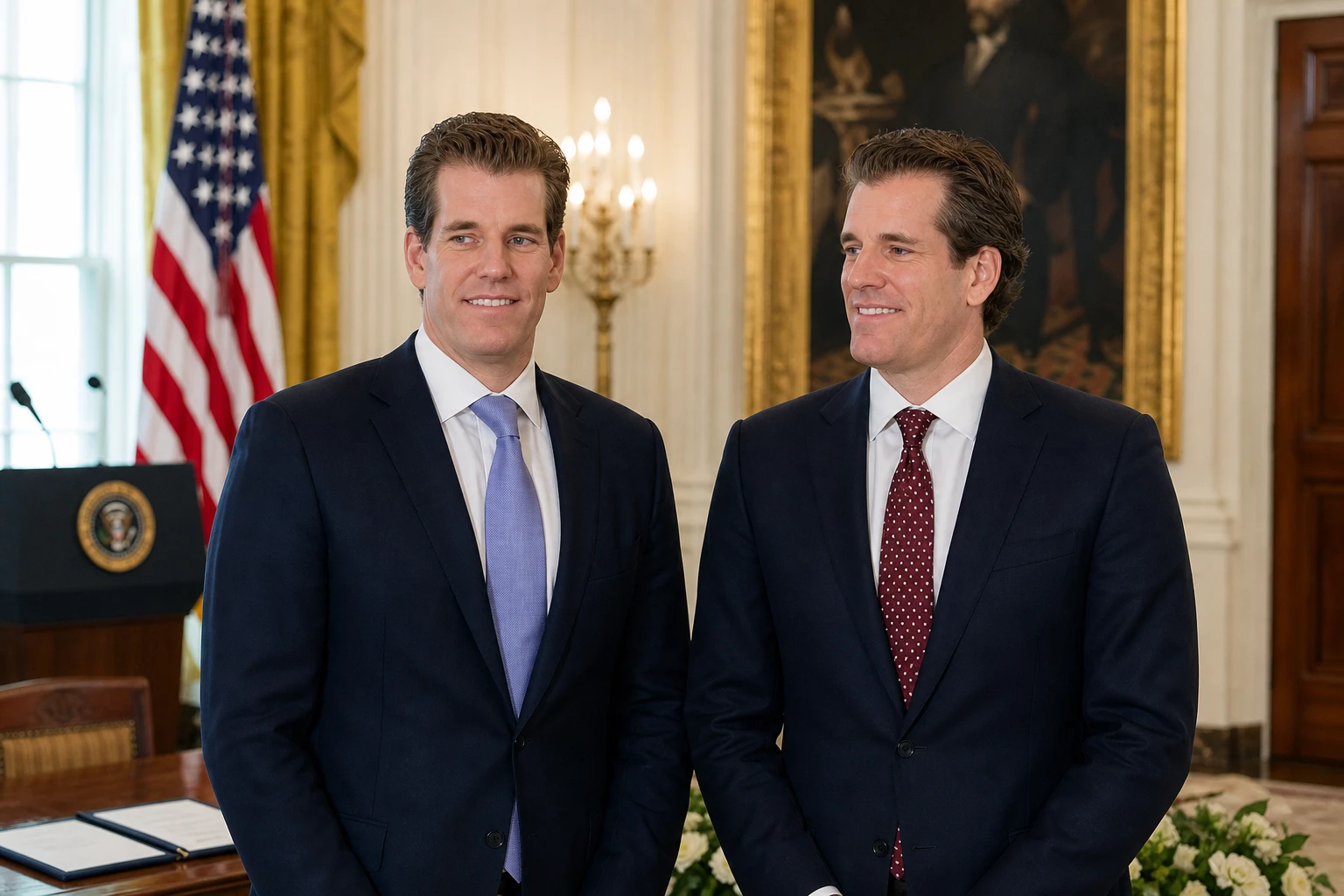
The twins attended the July 18, 2025 White House signing of the GENIUS Act stablecoin framework signed into law. That bill creates the first federal rules for payment stablecoins and fits the broader Project Crypto push.
Presence at the signing ceremony places them inside the celebratory frame rather than the petitioning frame. The same faces that once sought meetings now appear in the official photographs. That visual shift reinforces the message that the industry’s early backers have become fixtures of the new order.
Earlier Bets on Trump Already Paid
The June gift is not an isolated check. Each brother gave $1 million in bitcoin to the 2024 Trump campaign. Early 2025 brought roughly $500,000-plus each to MAGA Inc. plus RNC money. In August 2025 they sent $21 million in bitcoin (188.45 BTC) to the Digital Freedom Fund PAC.
Tyler Winklevoss posted the rationale himself: win the 2026 midterms so Democrats cannot slow the agenda, pass a “skinny” market-structure bill with a Bitcoin & Crypto Bill of Rights, ban CBDCs, protect developers, and reject regulatory capture. The post drew thousands of likes and quotes from industry allies.
They also invested in American Bitcoin, the mining firm co-founded by Eric Trump. Crowd commentary on X noted the pattern of successive large bitcoin transfers timed to policy milestones; some called it conviction, others called it access insurance. That observation lands either way: the twins now sit inside the room where crypto rules are rewritten.
Comparable PAC fights appear elsewhere in tech. OpenAI staff, for example, have been employees funding a rival PAC against internal leadership bets. Money follows power in both cases.
The cumulative total across these gifts now exceeds $30 million in disclosed bitcoin and cash. Each tranche arrives after a concrete policy step: the campaign win, the executive order, the GENIUS Act, the enforcement retreat. The pattern turns political giving into a paced series of confirmations rather than a single bet.
Other Donors on the Same June Report
The Winklevoss total dwarfs most single gifts, yet the report shows a cluster of seven-figure checks from people with federal business. QOL Medical faces FDA advertising scrutiny. Sokolov received a State Department trade-project role the same month. Isaacman runs NASA.
Michael Beckel of Issue One put the dynamic bluntly:
Nothing says thank you after a favorable regulatory or enforcement action like massive super PAC contributions.
Beckel, the group’s Money in Politics Reform director, warned that megadonors who receive favorable results then invest larger sums for still more treatment create a cycle of cynicism.
Some states already ban crypto political donations over opacity fears. Maryland, Michigan and North Carolina are among them. Federal rules still allow the bitcoin sales listed here.
The state bans highlight a split in how jurisdictions treat the same asset. At the federal level the liquidation-through-exchange method satisfies disclosure rules and converts volatility into fixed dollar amounts. States that prohibit the donations outright treat the tracing problem as unsolvable. That patchwork leaves national PACs free to accept what several large states reject.
How the Old Enforcement Model Collapsed
The joint motion and the personnel change together dismantle the prior playbook. Whistleblower-driven cases, aggressive charging of platforms that were themselves victims, and leverage over unrelated approvals all appear on the list of practices the agency now disowns.
Under the earlier model a settlement without admission of guilt still carried a permanent injunction and a public penalty. Those residual sanctions shaped how boards and counterparties priced risk. Removing them after the fact tells every other firm that today’s consent order may become tomorrow’s vacated filing if the political winds shift.
The new baseline runs on policy memos and joint motions rather than staff-level charging decisions. That elevates the importance of White House executive orders and legislative vehicles such as the GENIUS Act. Firms that can align with those documents gain a clearer path. Firms that cannot must wait for the next memo.
Prediction-market approvals illustrate the practical difference. Gemini Titan cleared in December 2025 while the old order was still notionally in force. The motion later cited improper leverage over that approval as one reason to vacate. Future applicants will read that sequence as evidence that product permissions and enforcement posture now travel together.
What the Sequence Means for Remaining Competitors
Competitors without equivalent access face a harder reading of the new rules. The twins converted early political bets into regulatory relief and a larger war chest. Others still operating under older consent orders or pending investigations lack the same calendar of White House visits and public bill signings.
The midterm math sharpens the gap. A Republican hold keeps the legislative runway open for the skinny market-structure bill and the Bitcoin & Crypto Bill of Rights that Tyler Winklevoss listed. A flip hands Democrats committee chairs and subpoena power that could reopen settled matters or slow new product approvals.
Europe’s parallel track under MiCA already splits winners from losers on licensing and stablecoin rules. The U.S. version is moving faster under the current administration, yet speed favors those already inside the conversation. Outsiders must either build comparable political capital or accept a slower, more uncertain queue.
The older enforcement culture loses twice: once when its signature cases are vacated, and again when the replacement process privileges firms that can mobilize both capital and personal access. That double loss is the clearest signal the June gift sends to the rest of the industry.
The Midterm War Chest Grows
MAGA Inc. enters the 2026 cycle with hundreds of millions already banked. The twins’ Digital Freedom Fund is explicitly built to back primary and general candidates who protect the Trump crypto agenda. A Republican hold of House or Senate keeps the legislative runway open; a flip hands Democrats tools to slow or reverse pieces of it.
For Gemini the practical upside is clear: the injunction disappears, the penalty cloud lifts, and prediction-market and other products face a friendlier CFTC. For firms without equivalent access the new baseline is harder to read. Enforcement that once ran on whistleblowers and aggressive charging now runs on policy memos and joint motions.
Europe’s parallel track under MiCA already splits winners from losers on licensing and stablecoin rules; the U.S. version is moving faster under the current administration. Readers tracking both can start with the MiCA rules and GENIUS Act comparison for the cross-border picture.
The twins have converted early political bets into regulatory relief and a larger war chest. The losers are the older enforcement culture and any competitor still waiting for the same courtesy.
Frequently Asked Questions
How much bitcoin did the Winklevoss brothers actually transfer on June 19?
Roughly 158.7 bitcoins across the reported lots (79.28 + 79.3465 plus tiny residual amounts), valued at the moment of sale at just over $10.018 million after Gemini liquidated them for the PAC. Exact satoshi-level figures appear only in the FEC memos.
Will Gemini get its $5 million penalty refunded?
The joint motion notes the civil monetary penalty has already been satisfied but does not request or guarantee a refund. Court papers and contemporaneous reporting leave the question open; no public order has ordered repayment as of late July 2026.
What was the original CFTC allegation against Gemini?
The 2025 settlement resolved claims that Gemini made false or misleading statements about the integrity of its bitcoin futures products. The agency later said the case rested on a non-credible whistleblower and that Gemini itself had been victimized by internal fraud and customer rebates.
Are crypto donations to federal PACs legal?
Yes at the federal level when properly disclosed and valued. Several states prohibit them outright because of tracing difficulties. Super PACs like MAGA Inc. can accept unlimited sums from individuals and companies once reported.
Did the twins attend other Trump crypto events?
Yes. They were present for the GENIUS Act signing ceremony in the East Room on July 18, 2025, and have been described in multiple outlets as regular White House visitors since inauguration.


South Korea Retail Investors Face Reckoning After KOSPI AI Rally Collapses

Surrey AI Maps Three Heart Attack Paths and Their Molecular Roots

Germany Locks Neutral Apple ATT Prompts Across Most of Europe

Apple’s 5% EU Fee Quietly Rewrites Alternative App Store Math

Apple’s EU Fee Truce Cuts Complexity but Leaves Rivals Fuming

Pixel 11 Pro Fold Trades Thinness for Durability and Seven-Year Stay

Mayo AI Flags HCM Obstruction From Everyday Ultrasound Videos

Indian Brands Quietly Scale Landmark Screens and Home Tech

Navin Vatsa Turns Grief Into a Lifetime of Quiet Seeing

Google Bets Pixel 11 Agentic AI Will Redefine Phones

Oracle Cuts 21,000 Jobs in a Year, Cites AI in 10-K Filing

Fable 5 and Mythos 5 Return as US Lifts Anthropic Export Controls

SpaceX’s Google Deal Turns a Rocket Company Into a Cloud Landlord

CD Projekt Red Co-CEO: Redemption Arc Isn’t Done, Witcher 4 in 2027

XPL Rallies 30% Ahead of Plasma One Card Tier Launch

Google Search Profiles Build a Follow Graph Inside Discover

DGO App Brings Rs 549 Mobile Pass for FIFA World Cup 2026 in Nepal

Moonshot AI Targets $30 Billion in China’s Fastest AI Funding Sprint

Oppo’s ColorOS 17 Eligibility List Leaves A-Series Buyers Behind

Microsoft Xbox Layoffs Start in July as Sharma Slams 3% Margin
-
 AI2 months ago
Oracle Cuts 21,000 Jobs in a Year, Cites AI in 10-K Filing
-
 AI2 months ago
Fable 5 and Mythos 5 Return as US Lifts Anthropic Export Controls
-
 AI3 months ago
SpaceX’s Google Deal Turns a Rocket Company Into a Cloud Landlord
-
 GAMING2 months ago
CD Projekt Red Co-CEO: Redemption Arc Isn’t Done, Witcher 4 in 2027
-
 CRYPTO2 months ago
XPL Rallies 30% Ahead of Plasma One Card Tier Launch
-
 NEWS3 months ago
Google Search Profiles Build a Follow Graph Inside Discover
-
 APPS2 months ago
DGO App Brings Rs 549 Mobile Pass for FIFA World Cup 2026 in Nepal
-
 AI3 months ago
Moonshot AI Targets $30 Billion in China’s Fastest AI Funding Sprint