
AI
Alipay’s New AI Platform Turns Merchants Into Agent Calls
Alipay launched its AI Open Platform on July 7, letting merchants expose services as MCP calls to its Abao agent across a billion users and devices.

Alipay launched its AI Open Platform on July 7, opening invitation-only access to enterprise developers and merchants who want to plug their services into the app’s new AI assistant, Abao. The platform sits on top of a super-app Ant Group says connects more than one billion consumers to over 80 million merchants across China, and the pitch to partners is direct: convert what you sell into something an AI agent can call, and reach that base in one move.
For Ant, this is the next step in a year-long rebuild of Alipay around agentic AI. The app already runs an AI-native payment product, Alipay AI Pay, that the company says passed 100 million users in February 2026 and has processed more than 300 million transactions. The new Open Platform extends that distribution layer to every merchant willing to be exposed to it.
What the AI Open Platform Does
Merchants and institutions can use the platform to add AI capabilities to their services and connect those services to Abao, Alipay’s conversational assistant. The platform is in invitation-only testing for enterprise developers, with Alipay framing access as a way to reach users without building a separate app or distribution channel.
The architecture is what Alipay calls a dual-track approach. On one track, merchants can convert their services into interfaces built on the Model Context Protocol, an open standard that lets AI agents call external tools and data sources directly. On the other, unmodified mini-programs inside Alipay can still be reached by Abao through AI screen-reading, with user authorization, so merchants who do nothing at all still get a path into the assistant.
That second track matters for the long tail. Ant is not asking every small shop in China to rewrite its service as an MCP server before its data is callable. Screen-reading gives the assistant a fallback when no native integration exists, and lets Abao compose actions across apps the same way a person would tap through them.
Alipay’s launch wording is careful about who controls what. The assistant navigates, the user confirms, and the merchant keeps its own service stack intact. That contract is what makes the platform usable for the businesses Ant most wants in the room.
Cross-Device by Default, Not by Partnership
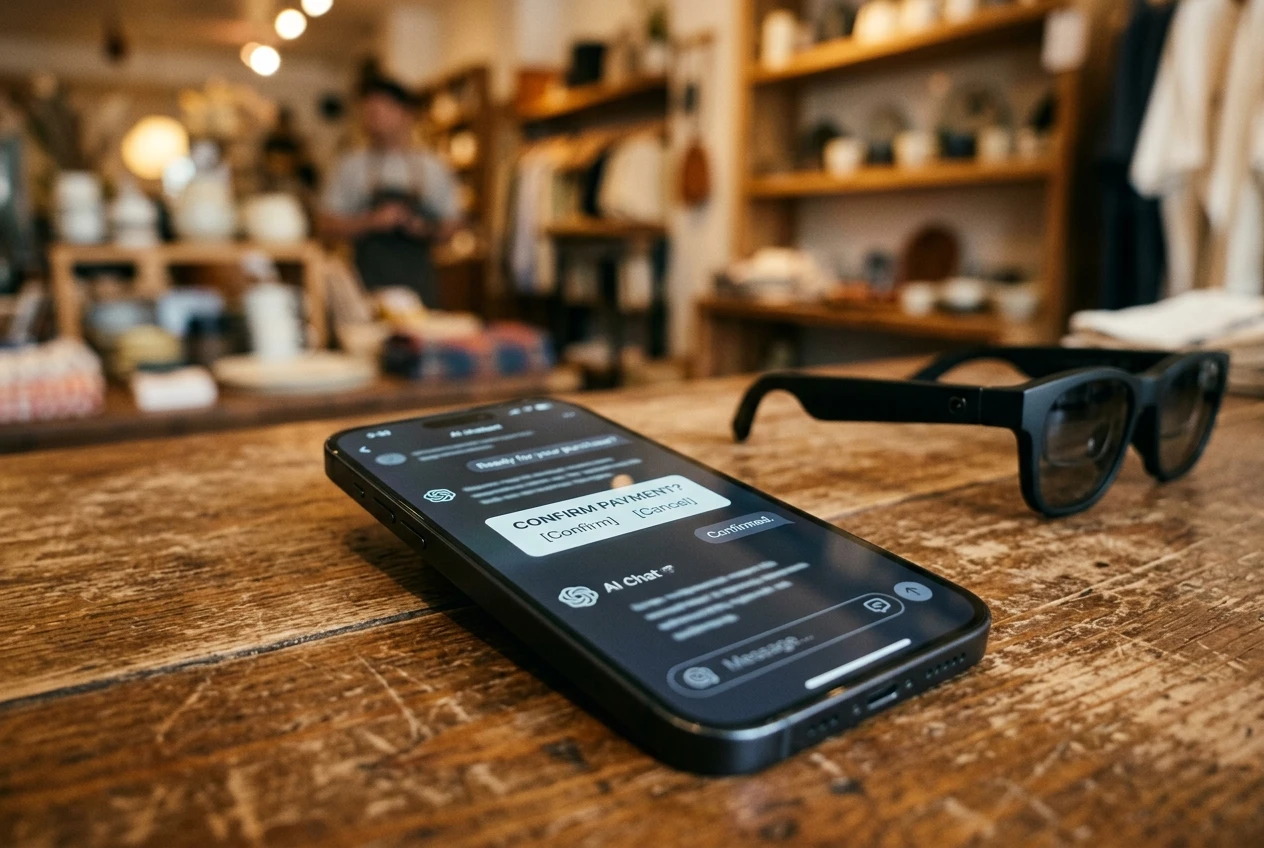
Alipay told developers the platform is built for cross-device connections across five device classes: phones, in-car systems, AI glasses, IoT devices, and large-model platforms. Partners integrate once and Abao distributes their service across each surface, with management in a single place.
The glasses piece is already live. Alipay and Rokid opened their “look-and-pay” smart glasses payment function to developers earlier in the year, using MCP to let apps add hands-free, voice-powered payment capabilities. The feature has since been expanded to other smart glasses brands including Xiaomi and RayNeo, and Ant International, Ant Group’s overseas unit, announced an iris-authentication payment system for smart glasses on top of it.
A Billion Users as the New Agent Surface
Alipay connects more than one billion consumers to over 80 million merchants, integrating over 10,000 services across travel, healthcare, tourism, and entertainment. That user base is the asset Ant is now exposing to AI agents. The platform is the conversion point, with each merchant service a call an AI can make. No other Chinese app combines that scale with a built-in payment rail for autonomous transactions. That combination is what Alipay AI Pay was built to monetize, and what the Open Platform now opens up to every merchant on the app.
Alipay AI Pay passed 100 million users in February 2026 and processed over 120 million transactions during the week of February 5 to 11, 2026, becoming the world’s first AI-native payment product to reach those milestones. It has since cleared 300 million transactions in total, per Ant Group. Alipay AI Pay now supports 95% of OpenClaw-like AI agents in China. The product has expanded across AI agents embedded in retailer apps and mini programs, AI smart glasses, consumer-facing AI applications, smart cockpits, and AI development platforms.
Ant’s longer plan is to position Alipay as the merchant-facing infrastructure for agentic commerce in China. The new Open Platform is the entry point for any business that wants to be reachable by an AI. Both Alipay AI Pay and the agent-level wallet and token settlement layer sit underneath it, handling the payment side once an agent decides what to buy.
What’s Already Plugged In
Bocha, an AI-powered search tool that supports applications including DeepSeek, has deployed a paid web search skill on Alipay Tbox and Hermes Agent, with daily API calls surpassing 30 million. Alipay introduced a developer support program for individual AI developers offering token incentives and zero payment processing fees, lowering the cost of plugging a service into the assistant.
The roster of partners reached at the May AI Payment Ecosystem Conference covers the agent stack from model providers to retail checkout.
| Adopter | What they built on Alipay |
|---|---|
| MiniMax | Token top-ups, membership subscriptions, marketing campaigns |
| Stepfun | Token top-ups, membership subscriptions, marketing campaigns |
| Luckin Coffee | AI agent embedded in app and mini program |
The Trust Layer Around the Agent
Ant has built a security wrapper around Abao. The assistant acts strictly as a process operator, with all final payments and other financial actions requiring explicit confirmation from users to prevent unauthorized transactions, per the company. AI Wallet, a separate product available now inside the app by searching “AI Wallet,” gives individual users visibility and control over payments made through AI agents. Users can review and analyze their spending afterward through the same product.
Two pieces of underlying infrastructure launched alongside the platform. Alipay released what it calls China’s first Agentic Commerce Trust Protocol, a set of rules for how AI agents and service platforms collaborate. The company also launched an intelligent security system for AI payments meant to provide safeguards for every agent-driven transaction.
Token Pay, a separate product aimed at AI model companies, handles global subscription payments, token top-ups inside AI agents, and related transaction needs. It launched alongside AI Wallet at the May AI Payment Ecosystem Conference.
While the essence of commerce remains unchanged in the age of AI, the emergence of AI agents is reshaping everything. Drawing on 22 years of technological expertise and commercial know-how, Alipay is building a new generation of AI payment services to accelerate the growth of the agentic commerce ecosystem.
The Competitive Math Against WeChat and Doubao
Alipay is not alone in this race. Tencent’s WeChat is reportedly building its own AI agent that would let users navigate millions of mini-programs using voice commands, according to the Financial Times. Alibaba Group opened its Qwen platform to third-party branded agents for companies including KFC, putting it in direct competition with ByteDance’s Doubao app for dominance in consumer AI.
Alipay combines payment rails, merchant base, and consumer scale inside one app. The platform is the distribution layer for the world’s first AI-native payment product, sitting on top of an existing relationship with one billion users. That product passed 100 million users in February 2026 and has cleared 300 million transactions. The deals announced at the May AI Payment Ecosystem Conference suggest Ant is shipping infrastructure partners can build on, with integrations reaching model providers, search tools, and retail mini-programs.
Building on an open standard is also a positioning choice. By adopting MCP rather than a proprietary interface, Ant is signaling that the future of agent commerce is not a single walled garden.
Ant is leaving the choice to merchants. The Open Platform’s invitation-only testing is the early test of whether MCP becomes the default way Chinese AI assistants call services. The list of partners that join before general availability will set the tone for the roll-out.
| Platform | Consumer assistant | AI commerce approach |
|---|---|---|
| Alipay | Ah Bao (Abao) | MCP server, AI Pay, Agentic Commerce Trust Protocol |
| AI agent reportedly in build (per FT) | Voice navigation across mini-programs | |
| Alibaba Qwen | Qwen app | Third-party branded agents (KFC and others) |
| ByteDance Doubao | Doubao app | Consumer chat surface for AI agents |
Frequently Asked Questions
What is MCP and why does it matter for Alipay?
MCP, or Model Context Protocol, is an open-source standard that lets AI applications link to external systems and data sources. Alipay’s use of MCP for its AI Open Platform means merchants can expose their services in a way any MCP-compatible AI agent can call, including assistants outside Alipay. That makes the integration reusable across phones, smart glasses, in-car systems, and other surfaces without a separate build for each.
When can regular users access Ah Bao?
The Ah Bao assistant is in invitation-only testing inside Alipay, with a gradual roll-out to the broader user base planned. The current path to the assistant is a right swipe from the Alipay homepage.
Is the Ah Bao assistant the same as Alipay AI Pay?
No. Ah Bao is the conversational assistant inside Alipay that handles tasks like ride-hailing, food ordering, and other services through natural language. Alipay AI Pay is the underlying payment infrastructure that lets AI agents complete transactions, with over 300 million transactions processed to date. Ah Bao sits on top, and routes payments through AI Pay when a transaction is required.
How is this different from WeChat mini-programs?
WeChat mini-programs are the small apps inside WeChat, which users open and navigate manually today. A future WeChat AI agent would reportedly navigate them by voice, per the Financial Times. Alipay’s AI Open Platform is built for AI agents to call merchant services directly through MCP or screen-reading, rather than the user opening a mini-program at all. The interaction model is conversational from the start.


South Korea Retail Investors Face Reckoning After KOSPI AI Rally Collapses

Surrey AI Maps Three Heart Attack Paths and Their Molecular Roots

Germany Locks Neutral Apple ATT Prompts Across Most of Europe

Apple’s 5% EU Fee Quietly Rewrites Alternative App Store Math

Apple’s EU Fee Truce Cuts Complexity but Leaves Rivals Fuming

Pixel 11 Pro Fold Trades Thinness for Durability and Seven-Year Stay

Mayo AI Flags HCM Obstruction From Everyday Ultrasound Videos

Indian Brands Quietly Scale Landmark Screens and Home Tech

Navin Vatsa Turns Grief Into a Lifetime of Quiet Seeing

Google Bets Pixel 11 Agentic AI Will Redefine Phones

Oracle Cuts 21,000 Jobs in a Year, Cites AI in 10-K Filing

Fable 5 and Mythos 5 Return as US Lifts Anthropic Export Controls

SpaceX’s Google Deal Turns a Rocket Company Into a Cloud Landlord

CD Projekt Red Co-CEO: Redemption Arc Isn’t Done, Witcher 4 in 2027

XPL Rallies 30% Ahead of Plasma One Card Tier Launch

Google Search Profiles Build a Follow Graph Inside Discover

DGO App Brings Rs 549 Mobile Pass for FIFA World Cup 2026 in Nepal

Moonshot AI Targets $30 Billion in China’s Fastest AI Funding Sprint

Oppo’s ColorOS 17 Eligibility List Leaves A-Series Buyers Behind

Microsoft Xbox Layoffs Start in July as Sharma Slams 3% Margin
-
 AI2 months ago
Oracle Cuts 21,000 Jobs in a Year, Cites AI in 10-K Filing
-
 AI2 months ago
Fable 5 and Mythos 5 Return as US Lifts Anthropic Export Controls
-
 AI3 months ago
SpaceX’s Google Deal Turns a Rocket Company Into a Cloud Landlord
-
 GAMING2 months ago
CD Projekt Red Co-CEO: Redemption Arc Isn’t Done, Witcher 4 in 2027
-
 CRYPTO2 months ago
XPL Rallies 30% Ahead of Plasma One Card Tier Launch
-
 NEWS3 months ago
Google Search Profiles Build a Follow Graph Inside Discover
-
 APPS2 months ago
DGO App Brings Rs 549 Mobile Pass for FIFA World Cup 2026 in Nepal
-
 AI3 months ago
Moonshot AI Targets $30 Billion in China’s Fastest AI Funding Sprint