
AI
Arm’s AI Licensing Surge Faces a $171.98 Bear-Case Test
Arm closed FY26 with licensing up 29% to $819M and an AGI CPU launch. Bulls price in AI upside; a key narrative pegs fair value at $171.98, 47% below close.

Arm Holdings closed fiscal 2026 with the strongest quarter in its history. Licensing revenue hit $819 million, up 29% year-on-year, and royalty revenue climbed 11% to $671 million. The full-year print reached $4.92 billion, up 23% on the prior year, capping the third consecutive year of greater than 20% growth since the 2023 public listing.
The surge rides on a product the company had never made before. The Arm AGI CPU, Arm’s first self-designed data center processor, is now co-developed with Meta as lead partner, and management has already doubled stated customer demand for the chip from $1 billion to over $2 billion across FY2027 and FY2028. Bears still pin fair value at $171.98 against a closing price of $322.24 on July 7, leaving the AI licensing surge and the bear case on a collision course heading into the Q1 FY2027 print on July 29.
Q4 FY2026 Print: Revenue Records and an AI Royalty Surge
The Q4 FY2026 figures landed on May 6, and the composition of the growth matters more than the headline. Licensing revenue reached $819 million, up 29% year-on-year; royalty revenue came in at $671 million, up 11%, with growth spread across smartphones, edge AI, physical AI, and cloud AI. Data center royalty revenue more than doubled on a year-on-year basis, the line item bulls point to first.
Full-year results followed the same shape. Revenue reached $4.92 billion, up 23%; licensing for the year came in at $2.31 billion, up 25%; royalties finished at a record $2.61 billion, up 21%. Non-GAAP EPS for the quarter was $0.60, ahead of the $0.58 consensus estimate. Full-year EPS reached $1.77.
- Q4 FY2026 revenue: $1.49 billion (record high, up 20% YoY)
- Licensing revenue: $819 million, up 29% YoY
- Royalty revenue: $671 million, up 11% YoY
- Data center royalty growth: more than doubled YoY
- Full-year FY2026 revenue: $4.92 billion, up 23% YoY
The licensing line is the one investors are watching most closely. Arm licenses the architectural IP that goes into chips built by other companies, so a 29% jump signals that more designers are buying into the next generation of Arm designs before any silicon ships. The royalty line, paid on every chip that ships using Arm’s architecture, is what converts last quarter’s licensing wins into this quarter’s revenue, and the data center slice of that royalty base is the one still steeply accelerating.
Inside the AGI CPU: Arm’s First Data Center Silicon
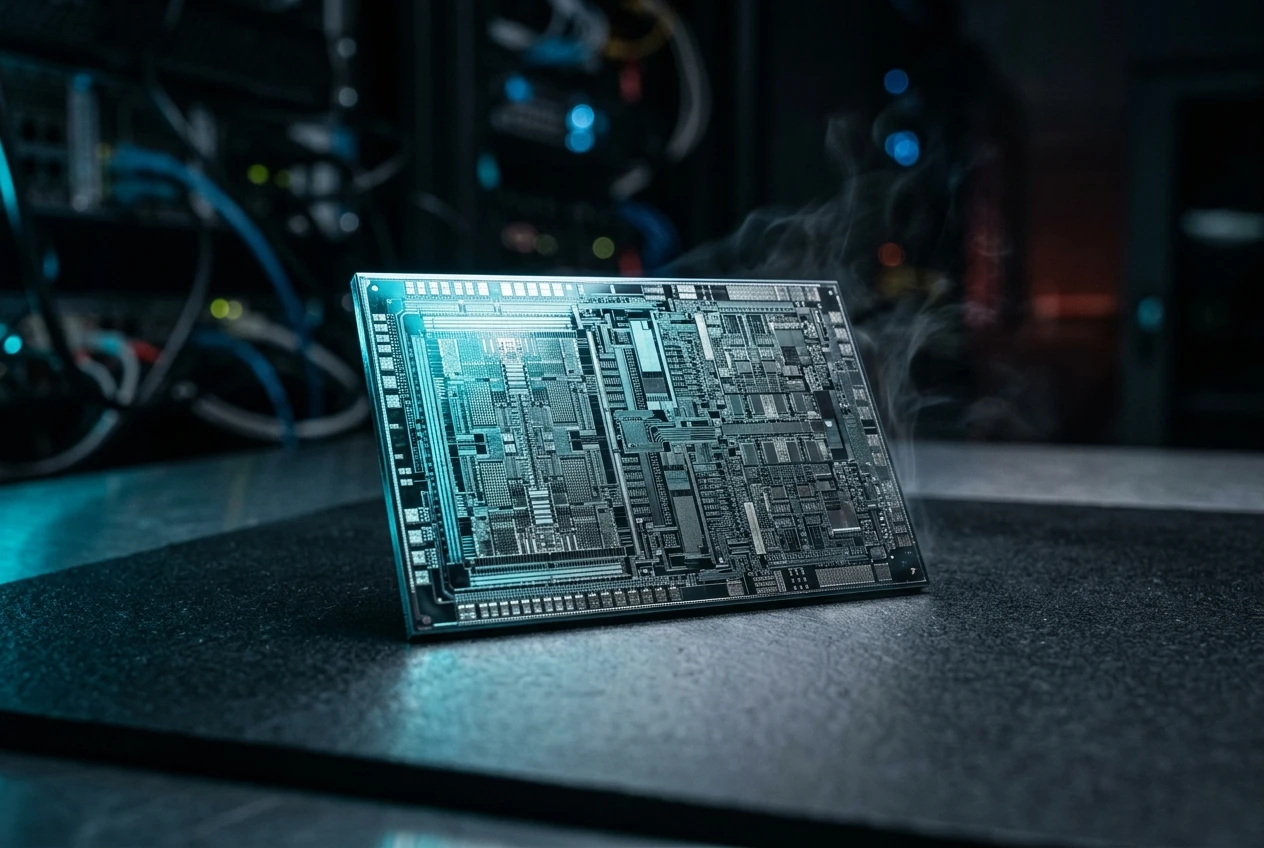
The AGI CPU is the centerpiece of the bull case. Announced at the March 2026 Arm Everywhere event and detailed in Arm’s first data center CPU announcement, the chip is Arm’s first self-designed data center processor and targets agentic AI workloads, extending the company from a pure IP licensor into a manufacturer of finished production silicon. Built around the Neoverse platform with 136 Neoverse V3 cores per chip, it positions itself as a more power-efficient alternative to x86 in AI orchestration racks, with claimed performance of more than 2x per rack at the same power envelope.
The direction is clear. Customers want Arm at the center of the AI data center.
The chip is a different product class than the IP licensing business that built Arm. Every AGI CPU that ships is a finished piece of silicon Arm builds, packages, and delivers to a specific customer, a pivot that pulls the company into a more capital-intensive, lower-margin world than licensing IP alone. Management has guided the longer-term AGI CPU revenue target to $2 billion in customer demand across FY2027 and FY2028, with a $15 billion annual silicon target by FY2031.
Why Meta Is the Partner That Matters
The AGI CPU roadmap is anchored to one customer more than any other. Meta is lead partner and co-developer, with the chip built to run alongside Meta’s own custom MTIA accelerators inside Meta’s data centers. Santosh Janardhan, Meta’s Head of Infrastructure, framed the partnership in production terms when it was announced in March, saying Arm and Meta would co-develop multiple generations of CPUs built for AI-optimized data centers and gigawatt-scale AI deployments. Meta has been the most aggressive of the hyperscalers about in-housing silicon and has committed to a $135 billion AI infrastructure spending plan in 2026, which gives Arm a customer with both the scale and the willingness to take a risk on a new CPU architecture in volumes no one else can match right now.
The full partnership terms, laid out in Meta’s announcement of the AGI CPU partnership, commit both companies to multi-generation development cycles. Meta plans to deploy the AGI CPU alongside its own custom Meta Training and Inference Accelerator (MTIA) silicon inside data centers, and the company plans to release board and rack designs for the chip under the Open Compute Project. Arm gains a customer willing to commit gigawatt-class volumes to a new architecture, and Meta gets a CPU partner with shared incentive to keep scaling the chip family beyond the first generation.
Meta’s deployment pulls the AGI CPU into gigawatt-class fleets at a moment when the rest of the industry is hunting for a credible alternative to x86 in AI orchestration. AWS Graviton, Google Axion, and Microsoft Cobalt all use Arm’s IP, but each is the customer’s own silicon rather than a finished Arm-designed part. The AGI CPU gives a hyperscaler the option to buy a finished Arm-designed CPU directly, and that is the new product line investors are paying for. Oracle and ByteDance, added during Computex in early June, are now on the same AGI CPU customer list alongside Cloudflare, SAP, SK Telecom, Cerebras, OpenAI, and Rebellions.
The Bear Case the Stock Has to Beat
The financials look good. The stock price sits well above what a wide swath of valuation work is willing to underwrite. One consensus narrative on AI upside pegs fair value at $171.98 against a closing price of $322.24 on July 7, 2026, an implied gap of 46.6%.
The model has explicit demands. To justify a price anywhere near today’s quote, the narrative assumes revenue of $9.5 billion and earnings of $2.9 billion by 2029, with a future P/E of 87.2x, above the current 48.1x P/E for the US semiconductor industry. Wall Street’s mean 12-month price target sits at $245 against the same $322.24 close, an implied 24% downside. The highest published target is $500, set by Mizuho on June 4, 2026, citing accelerating agentic AI tailwinds from Computex and a $14 billion AI CPU size estimate by 2030. The consensus rating profile is 21 Buys, 7 Outperforms, 10 Holds, and 1 Underperform, a Buy-majority rating attached to a target list that says the stock is priced ahead of itself.
| Aspect | Bear case thesis | Bull case thesis |
|---|---|---|
| Stock view | Priced ahead of consensus on near-term multiples | Priced for the multi-year AGI CPU ramp |
| Time horizon | Anchored to 2029 earnings | Anchored to FY2031 revenue |
| Top stated risk | Hyperscaler in-house silicon erodes licensing TAM | Supply chain bottleneck on TSMC wafer supply |
| Top stated catalyst | Multiple compression on a softer print | AGI CPU production silicon lands on schedule |
| Customer base | Meta-anchored, single-partner dependence | Multiple named partners across hyperscalers and AI labs |
The contradiction lives in the supply chain, not the business. Even the bull case assumes Arm needs to ramp AGI CPU production into volume without bottlenecks, a point management itself underscored on the most recent call. Arm is holding its $1 billion AGI CPU revenue target for FY2027 while it secures additional wafer supply from TSMC and packaging capacity from Socionext. Each unmet unit of demand is a quarter of revenue that does not arrive on schedule, and at today’s price that bottleneck is the single biggest variable between the $171.98 bear case and the $500 street-high target.
The FTC Cloud Over the Strategy
A US Federal Trade Commission probe, formal since May and detailed in the FTC probe into Arm’s licensing via Bloomberg, is hanging over Arm’s licensing business. The investigation is examining whether Arm intends to degrade or withhold the quality of its CPU blueprints for third-party licensees while scaling its own chip design business at the same time.
The dispute is not new; only the venue is. Qualcomm has filed a parallel complaint with the European Commission accusing Arm of restricting license access, and South Korean authorities conducted inspections at Arm’s Seoul offices last year. Arm has called Qualcomm’s allegations a desperate and underhanded attempt to obtain leverage, and both the FTC and Arm have declined to comment on the US probe, which has a separate Arm FTC antitrust probe coverage page tracking how the case maps to the EU and Korean precedents. A negative finding could force changes to the licensing terms or to Arm’s own design roadmap, an outcome no one is pricing in today.
The probe does not change the near-term earnings math. It does change the strategic ceiling on how aggressively Arm can move from being an IP licensor toward being a finished silicon builder, the pivot that anchors the bull case. Regulators have not yet signalled a timeline for any decision. Investors who want to underwrite the $15 billion FY2031 AGI CPU target are also underwriting a US antitrust review that has never been tested at this scale.
What July 29 Has to Deliver
The next checkpoint is on the calendar. Arm will report Q1 FY2027 earnings on July 29, 2026, after market close, with an audio webcast at 14:00 PT that day. Consensus expects revenue near $1.26 billion and EPS of $0.40 plus or minus $0.04, with both licensing and royalty expected to grow in the 20% range. Investors will be reading for whether data center royalties doubled again, whether AGI CPU demand is still being held back by TSMC wafer allocation, and whether any new hyperscaler joined the customer list.
Management has guided royalty growth in the 20% range for each quarter of FY2027, with licensing roughly 60% weighted to the second half of the fiscal year. A clean print at or above consensus would buy the bull story another quarter and probably nudge the stock back toward the Mizuho $500 high. A miss on AGI CPU demand, or any softening of data center royalty growth, would hand fresh ammunition to the $171.98 crowd at a moment when ARM is already trading below the Wall Street mean target. The full date and webcast details are listed on the Arm Q1 FY2027 release date notice issued earlier this month.
Forward revenue estimates show the bull case is a multi-year ramp, not a single-quarter event. Consensus projects about $1.51 billion for Q3 FY2027, around $1.85 billion for Q4 FY2027, and roughly $1.66 billion for Q1 FY2028 as AGI CPU production silicon revenues begin landing in Q4 FY2027 and build into the following year. The full $15 billion AGI CPU and $10 billion IP revenue targets by FY2031 require that ramp to hold for four straight years, and that is the test the July 29 print has to satisfy.
Frequently Asked Questions
What is the Arm AGI CPU?
The AGI CPU is Arm’s first self-designed data center processor, announced at the March 2026 Arm Everywhere event. It runs 136 Neoverse V3 cores per chip, targets agentic AI workloads, and marks Arm’s strategic move from licensing CPU designs to shipping finished production silicon to cloud and enterprise customers.
Is Arm Holdings stock overvalued right now?
It depends on the methodology. The most-followed consensus narrative pegs fair value at $171.98 against the most recent close near $322. Wall Street’s mean 12-month price target sits at $245, also below the current price. On both those measures, the stock is priced ahead of the consensus.
When does Arm report Q1 FY2027 earnings?
Arm will publish its Q1 FY2027 numbers on Wednesday, July 29, 2026, after the market close on Wall Street. The company will then hold its audio webcast at 14:00 Pacific Time, and consensus expects revenue near $1.26 billion with EPS of $0.40 plus or minus $0.04.
How is the FTC probe different from the Qualcomm dispute?
The US FTC opened a formal antitrust probe in May 2026 to examine whether Arm withholds or downgrades the quality of CPU blueprints sold to outside licensees even as it ramps its own AGI CPU silicon business. Qualcomm had already filed a parallel complaint with the European Commission making a similar claim, and South Korean officials had inspected Arm’s Seoul office. Arm has dismissed Qualcomm’s allegations, while the FTC and Arm have both declined to comment on the US case.
What is the next milestone for the AGI CPU?
Consensus revenue estimates show production silicon revenue beginning to land in Q4 FY2027, with management hinting that a fresh wafer-allocation deal and an expanded customer list could surface at the same Q1 FY2027 print on July 29. The bigger milestone sits further out: Arm’s guided $15 billion annual AGI CPU revenue target by fiscal 2031.
Disclaimer: This article is for informational purposes only and does not constitute financial, investment, or trading advice. Arm Holdings is a semiconductor company whose stock has experienced significant price volatility; investors should consult a qualified financial professional and consider their own circumstances before making any decisions. Forecasts and price targets referenced are as of their stated publication dates and may change without notice.


South Korea Retail Investors Face Reckoning After KOSPI AI Rally Collapses

Surrey AI Maps Three Heart Attack Paths and Their Molecular Roots

Germany Locks Neutral Apple ATT Prompts Across Most of Europe

Apple’s 5% EU Fee Quietly Rewrites Alternative App Store Math

Apple’s EU Fee Truce Cuts Complexity but Leaves Rivals Fuming

Pixel 11 Pro Fold Trades Thinness for Durability and Seven-Year Stay

Mayo AI Flags HCM Obstruction From Everyday Ultrasound Videos

Indian Brands Quietly Scale Landmark Screens and Home Tech

Navin Vatsa Turns Grief Into a Lifetime of Quiet Seeing

Google Bets Pixel 11 Agentic AI Will Redefine Phones

Oracle Cuts 21,000 Jobs in a Year, Cites AI in 10-K Filing

Fable 5 and Mythos 5 Return as US Lifts Anthropic Export Controls

SpaceX’s Google Deal Turns a Rocket Company Into a Cloud Landlord

CD Projekt Red Co-CEO: Redemption Arc Isn’t Done, Witcher 4 in 2027

XPL Rallies 30% Ahead of Plasma One Card Tier Launch

Google Search Profiles Build a Follow Graph Inside Discover

DGO App Brings Rs 549 Mobile Pass for FIFA World Cup 2026 in Nepal

Moonshot AI Targets $30 Billion in China’s Fastest AI Funding Sprint

Oppo’s ColorOS 17 Eligibility List Leaves A-Series Buyers Behind

Microsoft Xbox Layoffs Start in July as Sharma Slams 3% Margin
-
 AI2 months ago
Oracle Cuts 21,000 Jobs in a Year, Cites AI in 10-K Filing
-
 AI2 months ago
Fable 5 and Mythos 5 Return as US Lifts Anthropic Export Controls
-
 AI3 months ago
SpaceX’s Google Deal Turns a Rocket Company Into a Cloud Landlord
-
 GAMING2 months ago
CD Projekt Red Co-CEO: Redemption Arc Isn’t Done, Witcher 4 in 2027
-
 CRYPTO2 months ago
XPL Rallies 30% Ahead of Plasma One Card Tier Launch
-
 NEWS3 months ago
Google Search Profiles Build a Follow Graph Inside Discover
-
 APPS2 months ago
DGO App Brings Rs 549 Mobile Pass for FIFA World Cup 2026 in Nepal
-
 AI3 months ago
Moonshot AI Targets $30 Billion in China’s Fastest AI Funding Sprint