
AI
NeuroBridgeEDU Wins a Small Budget Prize Before It Ships
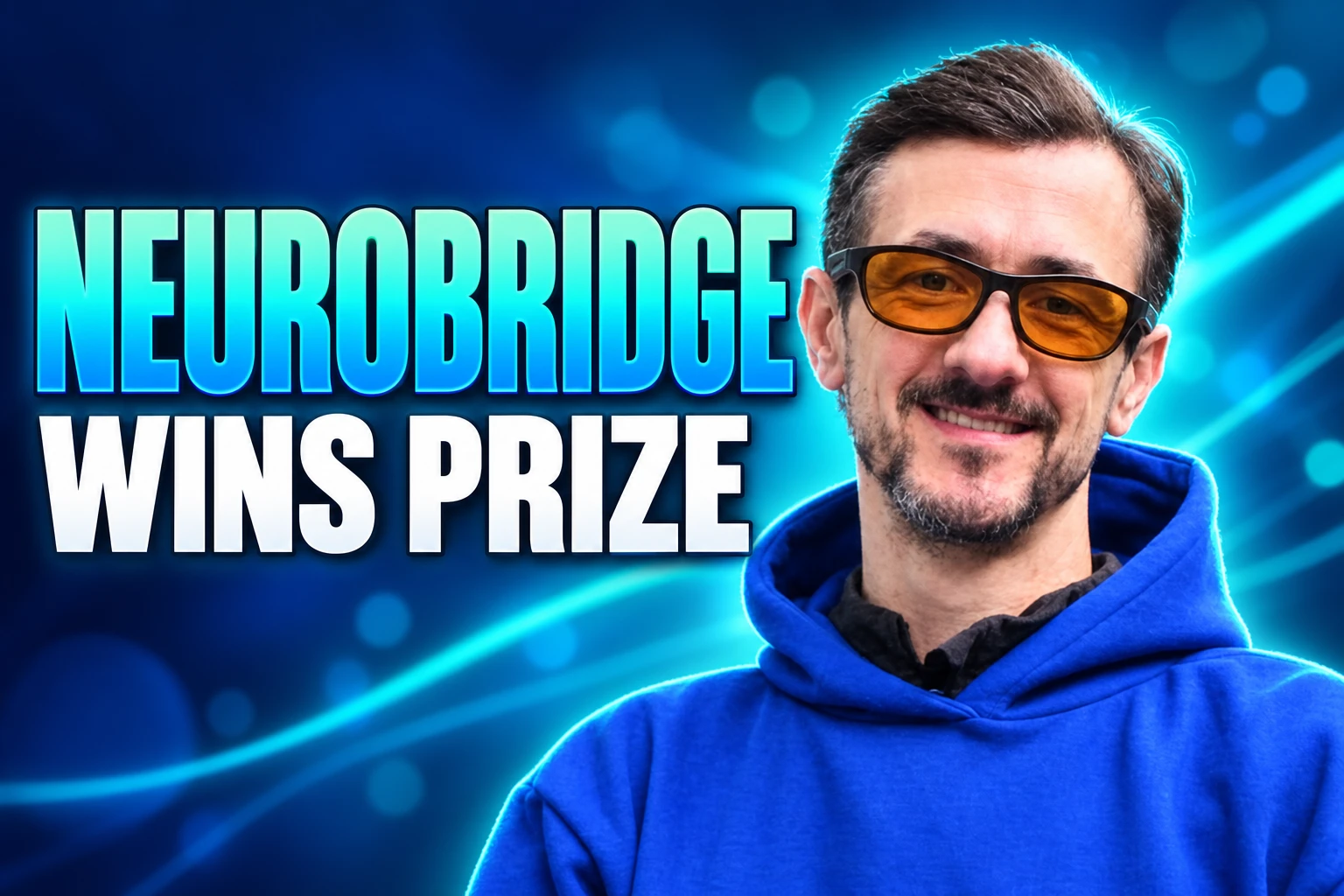
ATU Sligo’s NeuroBridgeEDU won AIB’s small budget prize on under €800 in tools, yet the lecture app is still on a waitlist and already pitches campus servers.

Emanuel Covasa’s NeuroBridgeEDU won AIB’s 2026 Small Budget Project of the Year for a lecture app built on under €800 in tools. Atlantic Technological University says the Computing student at ATU Sligo designed it so neurodivergent and multilingual students get notes that match how they read. On the company site, the desktop app is not released yet. Visitors get a waitlist, a coming Pro tier, and an invite for campuses to talk about pilots.
The prize category celebrated thrift. The product already talks like a vendor that wants to park a larger model on hardware it supplies.
The App That Won Is Still on a Waitlist
AMLÉ, the Union of Students in Ireland, ran the AIB Student Impact Awards as a 27-category programme with a €15,500 prize fund. Shortlisted teams were called to Croke Park on 28 April 2026. Covasa took Small Budget Project of the Year. ATU published its notice on 22 June 2026, and by then the public page for NeuroBridgeEDU still read like a launch teaser rather than a store listing.
The site’s first line is blunt about that gap. “The app is not released yet. The waitlist is how you hear first.” Free use for individuals is promised. Pro is described as coming, with cloud keys you bring yourself, extra study modes, exports, and analytics. Schools and universities are told to get in touch about pilots and how the software would be installed.
That split is the oddity in the small-budget win. A student category rewarded a cheap build. The same brand is already collecting emails for a paid cloud layer and for campus deals.
Local Whisper, Then a Cloud Toggle
NeuroBridgeEDU is a desktop client for macOS, Windows, and Linux. It records a lecture from the microphone and from system audio, writes a live transcript, then turns that transcript into notes. Density is a setting: bullets, a mixed structure, or long-form. A sample on the site, for a photosynthesis class, compresses the hour into numbered points and a short list of terms. Reduced motion, high contrast, a low-stimulation mode, and screen reader support are listed as built in from the start, not added later.
The privacy claim is narrower than the award quotes make it sound. Audio stays on the machine. Summaries do not have to.
HOW THE STACK IS SPLIT
- Capture: One-button recording of the mic and the lecture playback, with a live transcript on screen.
- Speech to text: Recording and transcription run locally with Whisper, and the audio file is never uploaded.
- On-device notes: Built-in summaries download once and run offline. A setup demo with 16 GB of RAM and 10 cores recommends Ministral 3B Instruct.
- Extra providers: Ollama is an optional local choice. Pro cloud is opt-in and, the site says, sends transcript text rather than the sound file.
- Campus pitch: Covasa has described a larger model on hardware his company would provide on site, shaping one transcript for many readers.
While a model downloads, the installer offers a small Tetris board with no online leaderboard. That is the product’s own example of an ADHD-friendly pause, and it is more revealing than another awards paragraph. The company also says the interface and in-app help ship in 32 European languages, that models include Mistral and EuroLLM, and that a free tier is meant to work with no cloud account. Those are design claims on a site that still has nothing to download.
What the €800 Bought
ATU says the project used less than €800 of tools and resources, the same bound Covasa used when he called it a custom AI-orchestration system. That figure is the cost of putting a working local pipeline together, not a sticker price for universities and not a claim that campus servers would come in at the same number. Whisper is open source. Small instruction models now run on a laptop that already has 16 GB of RAM. The scarce part is the interface for dyslexia and ADHD, the language pack, and a story a bank’s student awards can print.
On-device speech is no longer a rare student trick. Builders have been shipping local dictation, local voice clone tools, and offline meeting transcripts for months, and the hard part is rarely getting words off a microphone. The hard part is what happens to the lecture file after that, and whether a disability office can defend the path it took. NeuroBridgeEDU’s bet is that formatted notes plus a local default will sell to campuses that already rejected a cloud bot.
Covasa has said the idea started as personal friction. He is dyslexic and AuDHD, and ordinary productivity apps did not fit how he reads. ATU now describes a wider platform for education, training, and workplaces, with one private transcript turned into many summaries. The €800 line still leads every write-up because it is the line the category asked for.
Luc Dober, Emil Kindl and a Missed Croke Park Night
The AIB notices that travelled in June named Covasa alone. Enterprise Ireland and ATU’s own enterprise desk treat NeuroBridgeEDU as a two-person student firm. Covasa studies Computing in Sligo. Luc Dober studies Business there. An earlier ATU note on the university’s own student-entrepreneur contest, dated 12 March 2026, places Covasa in Drumkeeran, Co. Leitrim, and Dober in Sligo. The business student is the name the small-budget story kept dropping.
Emil Kindl of ATU Sligo Students’ Union collected the AIB trophy with Elaine Purcell, AIB’s chief marketing officer. Covasa was not in the photo. He later wrote that the Croke Park date landed on his mother’s birthday weekend, that family came first, and that the recognition still counted. Kindl had already signed Covasa’s Advocate of the Year certificate for 2025/2026 at an ATU awards night in Sligo, with university president Orla Flynn present. The bank’s student prize was accepted by the campus union, not by the founder whose quote about on-site hardware sat in the same article.
ATU framed the AIB Student Impact Award 2026 as proof that a cheap build can still matter. Covasa’s line for that notice stayed inside the category: the win showed that innovation is not always about bigger budgets, and that it can come from understanding a problem closely enough to build around it.
A Merit Prize of €1,500 and a Shelf of Trophies
The product site lists six awards across 2025 and 2026. Three of those sit on university or state-agency pages. The others are listed by the company, and NeuroBridgeEDU’s name also appears on the 2026 Irish Enterprise Awards winners directory for Best Accessible Education Technology Company and an Ethical AI Excellence Award. Treat that directory as the company’s trophy shelf, not as a peer of Enterprise Ireland.
On 2 June 2026, Enterprise Ireland published the 45th Student Entrepreneur Awards. Ten teams reached the final at Technological University Dublin’s Blanchardstown campus on 29 May 2026. Four took named prizes. The other six finalists received €1,500 each as Merit finalists. NeuroBridgeEDU was in that six, credited to Emanuel Covasa and Luc Dober. ATU’s 15 June 2026 note shows them taking the Merit award from Terri Smith of Enterprise Ireland. ATU also flagged the pair as an EU GREEN alliance student team, which is a university network, not a separate verified “Innovation Days” trophy.
THE CONFIRMED 2026 PRIZES
| Award | Date | What was confirmed |
|---|---|---|
| ATU Student Entrepreneur Awards, Sligo | March 2026 | Covasa and Dober listed for NeuroBridgeEDU as an accessibility platform |
| AIB Student Impact Awards, Small Budget Project of the Year | 28 April 2026, Croke Park | Covasa named winner; Kindl accepted |
| Enterprise Ireland Student Entrepreneur Awards, Merit | 29 May 2026, TUD Blanchardstown | One of six runner-up finalists, €1,500 |
The Student Entrepreneur Awards account posted the Merit six on 2 June 2026, with NeuroBridge EDU in the list beside ATU.
Congratulations also to our six Runner-Up @Entirl Merit Award recipients:
🔹 Represented – @QUBelfast
🔹 Tollo – @ucddublin
🔹 NeuroBridge EDU – @atu_ie
🔹 SwiftTFI – @IADTschools
🔹 Bracie – Your Orthodontic Companion – @UCC
🔹 Eolas Forestry – @ucddublin pic.twitter.com/zoILZOXSTh— Student Entrepreneur Awards (@studententrepr1) June 2, 2026
In October 2025, AI Ireland had already named NeuroBridgeEDU a finalist for Best Application of AI to achieve Social Good. That was a shortlist, not a win, and it is a reminder that the project was being entered as a company-shaped education product well before the bank’s student night.
Campus Servers After the Student Desktop
The quote that travelled with the AIB win is not about a laptop in a lecture hall. It is about a campus install. Covasa said any place that captures information needs summaries that change with the reader, then described the hardware path he wants to sell.
A university lecturer or an HR team transcribes a session once on their device, privately, locally, and our larger model running on hardware we provide on-premises shapes the output for each recipient. Bullet points for dyslexic users, native language for multilingual ones, accessible formatting for ADHD, role-shaped summaries for different teams. Nothing leaves the institution.
Emanuel Covasa, founder, NeuroBridgeEDU
That is a different product from a free desktop app on a waitlist. One transcript, many layouts, model on a box the vendor supplies, data staying inside the college. It is also a different GDPR map from Pro cloud, where the site says opt-in summaries send transcript text to a provider you choose. Local by default, cloud if you pay, on-site model if a campus signs a pilot: three placements sharing one awards story.
The company wraps those placements in compliance labels. It cites GDPR privacy by design, EU AI Act Article 50 for labelling AI output, and WCAG 2.2 Level AA. Study Sage chat, on the same page, is described as showing which model wrote each reply. Automatic update and licence checks are said to carry none of the lecture content. Those are statements on a marketing site, not an audit.
Disability Officers Already Ask About GDPR
Customer-discovery notes on the site, from disability and learning-support staff, put the buying objection in one word: GDPR. A learning-support lead at an Irish further-education body told the company other tools can already turn a lecture into notes, and that they cannot do it in a way that office can stand over. The anonymous line is the company’s own testimonial, so it is a sales clue rather than a measured survey. It still names the buyer that the AIB category never had to face.
Irish campuses already record teaching under their own policies, then worry about voices, names, and where the file goes next. A local Whisper pass removes the easiest leak, the raw audio leaving the room. It does not settle consent for the recording, retention of the transcript, or a Pro user who later pastes that transcript into a cloud model. Covasa’s on-premises line tries to close that last gap by keeping the large model in the building. Until a college actually hosts that box, the live offer is a waitlist for a laptop app.
Setup, the site says, takes less than three minutes after the model is on disk. The download is still the missing step. NeuroBridgeEDU has the student prize, the €1,500 Merit cheque, and a public architecture that already points past the laptop. What it does not have, on its own homepage, is a release.

Instagram Plus Tests a Read-Only Mode That Cuts Stories

Altman Asks the Public to Accept Some AI Harm

Google Freezes OSS VRP Product Reports After AI Flood

AI Agents Make Payment Rails the Scarce Prize

Turkey’s Crypto Boom Now Runs Through Three Banks

Fable 5 Came Back Under a Commerce On-Off Switch

Google’s SpaceX GPU Lease Has a Sept. 30 Deadline

Plasma One’s XPL Locks Face a 1.81 Billion Cliff

DGO’s Rs 549 World Cup Pass Cost Fans Sleep and Data

Moonshot AI’s $30 Billion Ask Became a $35 Billion Close
-
 AI4 months ago
Fable 5 Came Back Under a Commerce On-Off Switch
-
 AI4 months ago
Google’s SpaceX GPU Lease Has a Sept. 30 Deadline
-
 CRYPTO4 months ago
Plasma One’s XPL Locks Face a 1.81 Billion Cliff
-
 APPS4 months ago
DGO’s Rs 549 World Cup Pass Cost Fans Sleep and Data
-
 AI4 months ago
Moonshot AI’s $30 Billion Ask Became a $35 Billion Close
-
 NEWS4 months ago
ColorOS 17 Device List Spans Oppo, OnePlus and Realme
-

 GAMING4 months ago
Xbox Cuts 3,200 Jobs After Five Years of Thin Returns
-

 GAMING4 months ago
The RTX 4050 Under Rs 70,000 Hides a Wattage Gap