
APPS
Mindfulness App Cut Anxiety in Uveitis Without Improving Vision Scores
An eight-week UCSF trial of the Calm Health app reduced anxiety, depression, and stress in uveitis patients, but left vision-related quality of life unchanged.

A daily mindfulness program on the Calm Health app cut anxiety and depression in adults with non-infectious uveitis over eight weeks in a randomized trial at UCSF, but the same intervention failed to shift how those patients rated their own vision-related quality of life. The split result, published in Ophthalmology on 15 June, is the consequential detail most coverage will skim past.
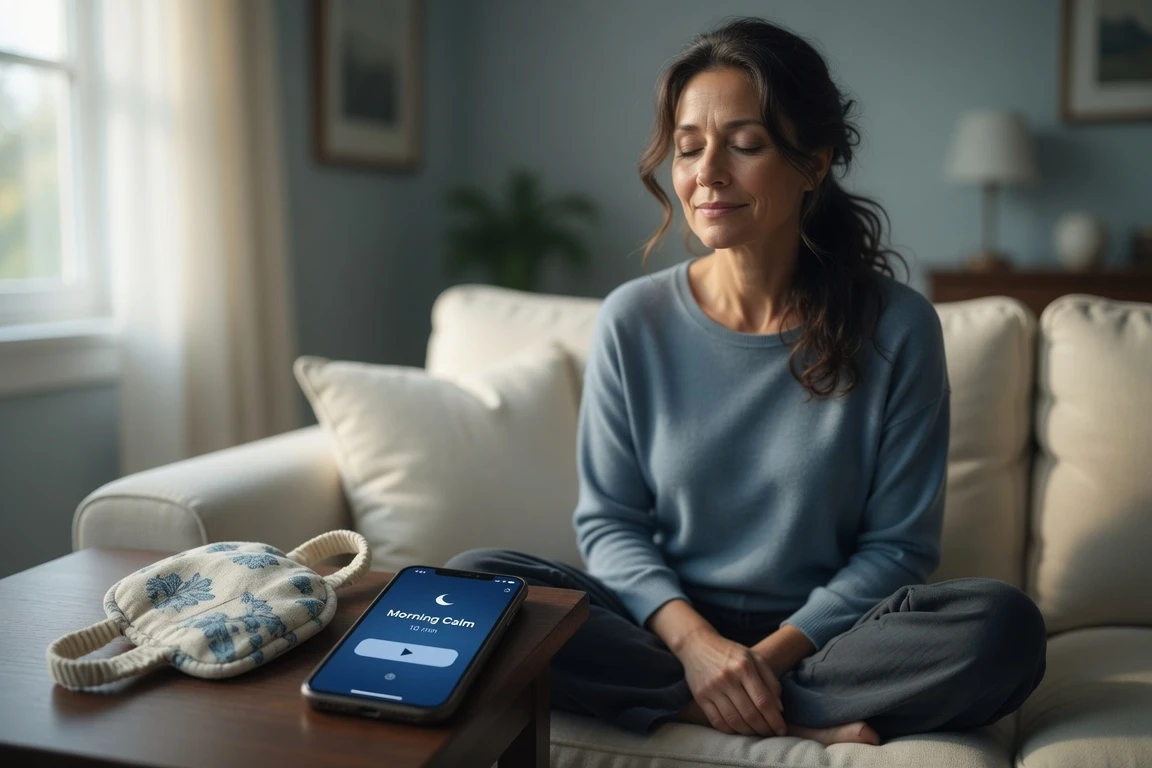
The trial enrolled 100 adults with at least mild baseline anxiety or depression and randomized them to immediate access to the app or to a waitlist. Researchers report significant drops in validated anxiety, depression, and stress scores, while a separate vision-related quality-of-life measure moved by a margin statistically indistinguishable from chance.
What Eight Weeks of Calm Health Changed
The primary endpoint was the Generalized Anxiety Disorder 7-item scale, or GAD-7. After eight weeks and after adjustment for baseline scores, the Calm Health group scored 1.7 points lower than the waitlist group on the GAD-7 (95% CI -3.17 to -0.23, p=0.02). Secondary outcomes also moved: depression measured by the Patient Health Questionnaire-9 fell by 1.90 points (95% CI -3.04 to -0.76, p=0.001), and perceived stress on the Perceived Stress Scale-10 dropped by 3.69 points (95% CI -6.00 to -1.37, p=0.002).
Seventy of 100 randomized participants completed the eight-week primary endpoint assessment. Median app use among those who stayed on the intervention arm was 579 minutes across eight weeks, roughly 9.7 hours of total practice. The cohort skewed working-age: median age 43.5 years, and 75% of participants were female.
- 100 adults randomized
- 70 of 100 completed the eight-week primary assessment
- 579 minutes median total app use over 8 weeks
The Outcome That Stayed Unchanged
The National Eye Institute Visual Function Questionnaire-25, or NEI VFQ-25, asks patients how vision problems affect daily life. On that instrument, the Calm Health group scored 1.98 points higher than the waitlist after eight weeks (95% CI -0.90 to 4.86, p=0.18). The 95% confidence interval crosses zero, so the trial cannot rule out no difference, and the magnitude of any true effect, if real, is small.
Same patients, same trial, opposite result. The instrument that asks specifically about vision-related quality of life did not move, even as three mood and stress instruments did. The disconnect is the consequential finding of the paper, the part the headline number covers over.
The investigators frame their data as a case for adding mental-health tools to uveitis care and as an open question about whether a longer or differently formatted program would close the gap on the vision-function score. The eight-week window, in their own framing, may simply be too short for a measure that captures the cumulative friction of chronic eye disease on daily tasks.
A digital mindfulness-based intervention (Calm Health) significantly reduced anxiety, depression, and perceived stress in adults with NIU. Digital mindfulness tools may serve as a feasible, scalable adjunct to uveitis care, particularly in settings with limited access to traditional mental health services.
That passage appears in the published conclusions attributed to the lead investigator, Jessica G. Shantha, MD, MSc, of Emory University and the F.I. Proctor Foundation at UCSF, and colleagues, in Ophthalmology, online 15 June 2026.
How the Trial Was Built
Design: single-center, single-masked, waitlist-controlled randomized clinical trial at the F.I. Proctor Foundation at UCSF, registered as NCT06585670, with details available in the free abstract of the eight-week Calm Health trial and on the federal trial registry listing for the study. The UCSF Department of Ophthalmology received support from the National Eye Institute and the Research to Prevent Blindness Foundation.
Adults aged 18 and older with active or inactive non-infectious uveitis and at least mild baseline anxiety or depression were randomized 1:1. The intervention arm was instructed to use the Calm Health mobile app for at least 10 minutes daily over 8 weeks; the waitlist received no new mindfulness intervention during that period and was told it would receive access afterward. Outcomes were assessed at baseline and at 8 weeks using four validated surveys, and linear ANCOVA models adjusted for baseline scores. The app offered personalized, evidence-based content drawn from Calm Health’s meditation, mindfulness, and clinical programs.
| Instrument | What it measures | Adjusted mean difference | 95% CI | p-value |
|---|---|---|---|---|
| GAD-7 | Anxiety symptom severity | -1.7 | -3.17 to -0.23 | 0.02 |
| PHQ-9 | Depression symptom severity | -1.90 | -3.04 to -0.76 | 0.001 |
| PSS-10 | Perceived stress | -3.69 | -6.00 to -1.37 | 0.002 |
| NEI VFQ-25 | Vision-related quality of life | +1.98 | -0.90 to 4.86 | 0.18 |
Why Uveitis Already Carries a Heavy Mental-Health Load
Uveitis patients live with elevated rates of anxiety and depression. A 2022 meta-analysis covering 12 studies and 874 patients found overall incidence rates of 39% for anxiety and 17% for depression in uveitis, against world general-population rates of roughly 7.3% and 6%. Detail from that the 2022 meta-analysis of anxiety and depression in uveitis showed the highest rates in unspecified uveitis (59% anxiety, 35% depression) and the lowest in anterior uveitis (33% and 15%).
Uveitis causes roughly 5% to 10% of visual impairment worldwide and accounts for 5% to 20% of legal blindness in developed countries and around 25% in the developing world. Some 60% to 80% of cases affect adults aged 20 to 50, the working-age bracket whose mental-health trajectory carries long-term weight for jobs, families, and disease self-management. The eye-and-mood link runs in both directions, since mood disorders in chronic autoimmune disease correlate with treatment discontinuation.
The published study frames itself as the first randomized clinical trial to test a digital mindfulness-based intervention in non-infectious uveitis. Calm Health has previously collaborated on published clinical work across sleep, oncology, and workplace stress, and the company positions itself as a complement to medical care rather than a replacement, with the caveat that consumer mental-health apps vary widely in the evidence behind them (see, for context, the evidence and privacy trade-offs inside India’s mental health apps).
Where the Findings Stop
The trial ran at a single academic center and enrolled only English-speaking participants who could read the app, so the findings may not generalize across languages, literacy levels, or health systems. With 100 randomized, the sample was too small to compare results by uveitis subtype or underlying cause.
Study coordinators and participants both knew which group they were in, the authors note, which may have shaped how participants reported their own symptoms. One author disclosed consulting fees from Roche unrelated to the study. Calm Health provided the app for the trial but did not provide financial support.
Frequently Asked Questions
What is non-infectious uveitis?
Non-infectious uveitis is an immune-mediated inflammatory disease of the eye that can occur on its own or alongside other autoimmune conditions. It is one of the leading causes of preventable vision loss worldwide and disproportionately affects adults aged 20 to 50.
What is the Calm Health app?
Calm Health is a mobile mental-health platform built around evidence-based meditation, mindfulness, and clinical programs and operated as a sister product to the consumer Calm meditation app. Calm’s own disclosure states that Calm Health is a mental-health wellness product, is not intended to diagnose or treat any disease, and is not a substitute for care by a physician.
How large were the reductions in anxiety and depression?
After adjusting for baseline scores, the Calm Health group scored 1.7 points lower than the waitlist on the GAD-7 anxiety scale (95% CI -3.17 to -0.23, p=0.02), 1.90 points lower on the PHQ-9 depression scale (95% CI -3.04 to -0.76, p=0.001), and 3.69 points lower on the PSS-10 stress scale (95% CI -6.00 to -1.37, p=0.002) at eight weeks.
Why did vision-related quality of life not improve?
The NEI VFQ-25 captures how eye problems affect daily functioning rather than mood, and the eight-week window may be too short for a behavioral intervention to move a functional-vision measure. The investigators describe longer or differently formatted programs as an open question for follow-up work.
Where was the study published and who ran it?
The paper was published online on 15 June 2026 in Ophthalmology, DOI 10.1016/j.ophtha.2026.06.011, PMID 42297306. The corresponding author is Jessica G. Shantha of Emory University and UCSF; the first author is Isabel Ray of UCSF. The trial is registered as NCT06585670.


Sony’s 10 Percent Disc Drop Leaves the 2028 Cutoff Intact

Chip Allocation Sidelines the Base iPhone 18 This Fall

Miami-Dade Fights the Vice City Brand It Already Wears

IFA 2026 Awards Put Tecno Ahead of Flagship Phones

USB-C Gadgets Made the Junk Drawer Rechargeable

Pixel 11 Pro Asks $1,099 for a Light Google Locked

The iPhone Ultra Sells Two Retired Minis as One Foldable

Google Opens Gmail to Voice and Gates Docs Live

Lenovo Prices the IdeaPad Vibe Against Apple’s $699 Neo

Xbox Caps Game Pass Cloud Gaming at 15 Hours

Oracle Cuts 21,000 Jobs in a Year, Cites AI in 10-K Filing

Fable 5 and Mythos 5 Return as US Lifts Anthropic Export Controls

SpaceX’s Google Deal Turns a Rocket Company Into a Cloud Landlord

CD Projekt Red Co-CEO: Redemption Arc Isn’t Done, Witcher 4 in 2027

XPL Rallies 30% Ahead of Plasma One Card Tier Launch

Google Search Profiles Build a Follow Graph Inside Discover

DGO App Brings Rs 549 Mobile Pass for FIFA World Cup 2026 in Nepal

Moonshot AI Targets $30 Billion in China’s Fastest AI Funding Sprint

Oppo’s ColorOS 17 Eligibility List Leaves A-Series Buyers Behind

Microsoft Xbox Layoffs Start in July as Sharma Slams 3% Margin
-
 AI3 months ago
Oracle Cuts 21,000 Jobs in a Year, Cites AI in 10-K Filing
-
 AI2 months ago
Fable 5 and Mythos 5 Return as US Lifts Anthropic Export Controls
-
 AI3 months ago
SpaceX’s Google Deal Turns a Rocket Company Into a Cloud Landlord
-
 GAMING3 months ago
CD Projekt Red Co-CEO: Redemption Arc Isn’t Done, Witcher 4 in 2027
-
 CRYPTO3 months ago
XPL Rallies 30% Ahead of Plasma One Card Tier Launch
-
 NEWS3 months ago
Google Search Profiles Build a Follow Graph Inside Discover
-
 APPS3 months ago
DGO App Brings Rs 549 Mobile Pass for FIFA World Cup 2026 in Nepal
-
 AI3 months ago
Moonshot AI Targets $30 Billion in China’s Fastest AI Funding Sprint