
AI
Huawei’s AI-Centric Network: The Carrier Revenue Bet at MWC Shanghai
Huawei pushes global carriers to monetize AI tokens, not just data, at MWC Shanghai 2026, unveiling an AI-centric target network and a six-imperative roadmap.

Huawei unveiled an AI-centric target network at MWC Shanghai 2026, framing it as the foundation for a new era of carrier revenue defined by AI tokens, not data bytes. The Chinese vendor used its booth and a Rotating Chairman keynote to argue that the next decade of telecom growth runs through networks rebuilt around intelligence rather than throughput.
More than 100 million 5G-A users worldwide already sit on the networks Huawei wants to rebuild. The company is now asking carriers, regulators, and standards bodies to follow. Huawei’s official token-monetization announcement lays out the architecture in three layers and names the spectrum band, the Middle East, and China’s three carriers as the first commercial frontier.
The Three-Layer Network Replacing Traffic-Centric Design
Huawei’s AI-centric target network sits on three distinct layers, each rebuilt around AI rather than throughput. The base layer is a basic communications network, designed for real-time interaction with guaranteed connectivity, high uplink and downlink, and guaranteed quality of service. The middle layer is a computing network that shifts from mere traffic transport to network-wide compute scheduling, with connecting to the network equivalent to accessing compute. The top layer is AI computing infrastructure, emphasizing high performance, efficiency, and support for open-source ecosystems.
In practice, the architecture reframes connectivity. Where a traditional carrier network is optimized to push the most bytes per second to the most users at the lowest cost, the AI-centric model assumes that some of the most valuable bits are the AI tokens generated, transmitted, and consumed by agents running on behalf of users. Huawei’s announcement frames the architecture as the platform carriers need to charge for token production, transmission, and consumption at scale.
The three layers were demonstrated with China’s three major carriers, with cases spanning 5G-A high uplink, experience revenue monetization, and AI-powered business upgrades. The infrastructure shift is the centerpiece of Wang’s pitch: carriers that do not rebuild for AI risk being reduced to dumb pipes carrying token traffic for someone else’s monetization layer.
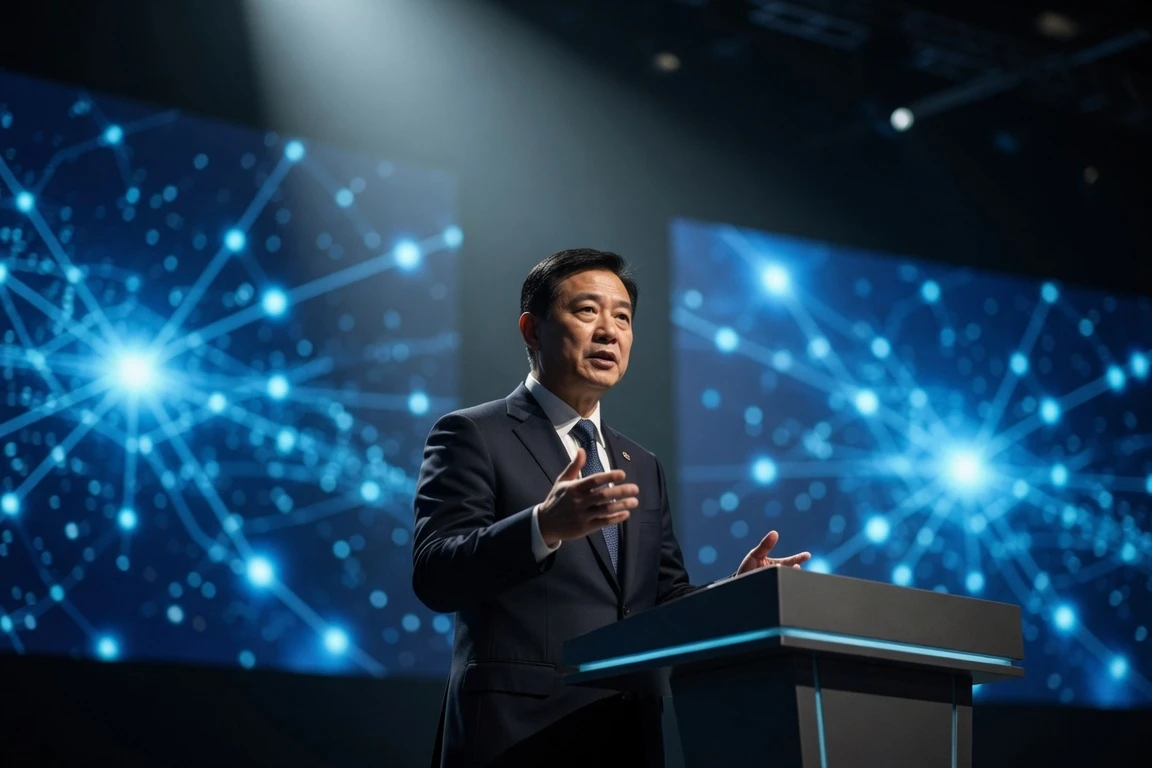
Why Wang Is Targeting the Uplink
Mobile networks have historically been built for downlink-heavy consumers watching video and browsing the web. AI inverts that. AI glasses used for real-time translation and exhibition viewing already require sustained uplink speeds of 20 Mbps, according to Huawei. Multimodal agents that see, hear, and act in real time need to upload as much data as they download.
Wang used his keynote to set new benchmarks. Operators, he said, must plan around 1 Gbps peak uplink capacity and a 20 Mbps universal uplink baseline. To hit those marks, carriers will need to secure continuous bandwidth of 200 MHz to 400 MHz or more per cell. That is well beyond what current mid-band 5G allocations typically allow.
Huawei’s projections behind the push are stark. The company expects the number of AI agents operating worldwide to exceed 100 billion by 2030 and reach the trillions by 2040. In the most densely connected urban environments, agent density is projected to surpass 10 million per square kilometer. The uplink is the bottleneck, and Huawei is selling the fix.
- 20 Mbps uplink: minimum required for AI-glasses real-time multimodal interaction
- 1 Gbps peak uplink: new planning benchmark Wang set at MWC Shanghai
- 20 Mbps universal uplink: baseline target for operators going into token monetization
- 200 MHz to 400 MHz: continuous bandwidth carriers need per cell to hit those targets
- 100 billion AI agents: Huawei’s projection for worldwide agent count by 2030
Upper-6 GHz, Spectrum, and the Middle East’s First-Mover Move
The spectrum Wang is betting on is Upper-6 GHz, the band he called the next-generation golden frequency band for AI-era mobile networks. More than 20 countries and regions have explicitly designated Upper-6 GHz for International Mobile Telecommunications, covering nearly 80% of the world’s population, according to Huawei. The year 2026 marks the band’s commercial debut, with the Middle East expected to deploy the world’s first commercial 5G-A network running on Upper-6 GHz.
Carriers in Hong Kong and Macao of China will also initiate commercial U6 GHz deployment this year. Operators in the UAE and Saudi Arabia have been among the most progressive globally in deploying advanced 5G networks. U6 GHz would unlock substantially higher bandwidth to support the real-time, AI-driven applications placing increasing demand on uplink capacity. Wang’s MWC Shanghai keynote on the Middle East’s U6 GHz lead framed the regional stake bluntly: carriers there are positioned to lead the next phase of global mobile communications, and Huawei’s commercial roadmap runs through that bet.
The subscriber and deployment numbers behind the pitch sit in the table below.
| Market | Subscriber or deployment milestone | Source as of MWC Shanghai 2026 |
|---|---|---|
| Global 5G-A users | more than 100 million | Huawei official release |
| China 5G-A users | surpassed 110 million | David Wang keynote |
| Global 5G subscribers | crossed 3.1 billion | David Wang keynote |
| Hong Kong and Macao | commercial U6 GHz deployment beginning 2026 | Huawei official release |
| Middle East | first commercial 5G-A on U6 GHz in 2026 | Huawei official release |
The Six Imperatives for the Decade Ahead
Wang framed his pitch around a list of six imperatives for the industry’s next decade. They are not forecasts but a list of choices carriers and regulators must make, in Huawei’s telling, if the mobile industry is to keep translating network capability into commercial value. The framing matters: every imperative on the list is something Huawei already sells, from the AI-centric target network to its U6 GHz radios to its standards work inside 3GPP. Items two, four, and five are the most operationally specific, mapping directly onto the AI-centric target network, the U6 GHz push, and the work Huawei says it will lead on AI-native core network specifications. Items one, three, and six are the strategic envelope around them.
The six imperatives, as Wang laid them out, are:
- Develop new services and capabilities for future mobile communications systems.
- Integrate AI with mobile communications to build three distinct layers of intelligence.
- Build network architecture for integrated satellite-ground communications.
- Advocate for sustainable and future-oriented spectrum planning and allocation.
- Clearly define the specifications of AI-native core networks.
- Explore new business models and application scenarios for mobile services.
From Live Networks to Live Numbers
Huawei backed its pitch with deployment cases already running on commercial networks. In Singapore, Singtel’s deployment of agentic AI in customer operations saw its AI assistant handle more than 70,000 customer interactions in six weeks, with 70% of routine queries resolved without human involvement. The deployment is a commercial contract, not a pilot, and Singtel plans to extend it to voice channels.
On the consumer side, Huawei’s Celia assistant is recording three billion daily activations, a figure the company tied to a 4.5-fold increase in agent distribution. In logistics, AI agent networks have demonstrated the ability to cut shipment delays by 15% by replanning delivery routes in real time during weather disruptions. Independent coverage of Huawei’s token-monetization pitch notes that the operator-facing playbook pairs those consumer numbers with a parallel set of business-grade cases.
In China, firefighting robots equipped with 5G-Advanced modules operate on the frontline of emergency response, using China Mobile’s network to stream real-time thermal imagery to cloud-based AI systems that support fire source localisation, remote piloting, and autonomous execution.
These are commercial traffic numbers, not trials. They all run on the same network fabric Huawei is now asking carriers to rebuild.
The Skeptics: Why Tokens Might Not Sell Like Data Plans
Not everyone is buying the monetization math. Suman Kanuganti, founder of Personal AI, told Fierce Network that telcos are uniquely positioned to monetize AI by leveraging network data and offering users personalized AI agents embedded in the network itself, and he expects the first version of a U.S. telco token plan within six to nine months. Kanuganti’s Personal AI has disclosed work with AT&T, T-Mobile, Verizon, and Comcast on related efforts.
There might be ways to sell or bundle access to AI assistants, but I think counting tokens is a particularly bad way to do it. Trying to sell AI applications on token numbers is like trying to sell content by the pixel. Nobody understands it.
Roger Entner, founder and principal analyst at Recon Analytics, argued that a straight by-the-token metering system would not readily find consumer acceptance. He noted Recon Analytics data showing that more than a quarter of mobile customers are already using AI on a daily basis, and many AI companies are selling bucket plans for access. For a telco to be successful, Entner said, it would have to offer a similar structure and combine it with a good AI model. Disruptive Analysis founder Dean Bubley was blunter: very similar queries imply very different numbers of tokens, and different types of tokens relate to different tasks. Analyst doubts on whether token plans can find buyers cuts to the heart of Huawei’s pitch, because if consumers refuse to buy token buckets the way they once bought data buckets, the AI-centric target network becomes a costly capex bet without a matching monetization payoff.
What Huawei Stands to Win, and the China Backstop
Huawei is not pitching this vision from a position of dominance in its carrier business. The company reported 2025 revenue of CNY 880.9 billion ($126 billion), up 2.2% year-on-year. Its ICT infrastructure business, the segment most relevant to the AI-centric push, grew 2.6% to CNY 375.014 billion. The growth is positive, but it is also thin for a category the company is now asking carriers to rebuild around.
China provides the home-field backstop. The country’s total AI capital expenditure reached $98 billion in 2025, on top of $24 billion contributed by internet companies. By the end of 2025, China had over 602 million generative AI users, a 42.8% national penetration rate and 141.7% year-on-year user growth. Carriers in Guangdong, Shanghai, and Hebei are the named partners in Huawei’s 2026 rollout, and Huawei is also working to shape 3GPP Release 21, the standards framework expected to launch in March 2027. China’s $98B AI capex behind the AI-to-C and AI-to-H rollout maps the consumer-facing surface of the same network layer Huawei is now selling to global carriers.
The bet is whether this stack scales globally. If it does, Huawei’s AI-centric target network becomes the template for the AI-era carrier build. If it does not, the company has spent the next decade selling a new network to a customer base still billing the old one.
Frequently Asked Questions
What did Huawei announce at MWC Shanghai 2026?
Huawei launched an AI-centric target network at the show, a three-layer architecture combining a real-time communications network, a network-wide compute scheduling layer, and high-performance AI computing infrastructure. The architecture sits alongside service and business innovations released with China’s three major carriers covering 5G-A high uplink, experience monetization, AI-powered business upgrades, and token monetization.
What is token monetization?
Token monetization is the practice of charging carriers’ customers based on AI-generated tokens, the units of output produced by large language models and AI agents, rather than just on data volume. Huawei argues that as AI agents become embedded across industries, supporting token production, transmission, and consumption becomes a core network differentiator for operators.
How many 5G-A users are there worldwide?
Huawei stated at MWC Shanghai 2026 that the number of 5G-A users worldwide has exceeded 100 million. Rotating Chairman David Wang added that China’s 5G-Advanced user base alone has surpassed 110 million, and global 5G subscribers have crossed 3.1 billion.
What is Upper-6 GHz, and where is it being deployed?
Upper-6 GHz is a frequency band Huawei called the next-generation golden frequency band for AI-era mobile networks. More than 20 countries and regions have designated it for International Mobile Telecommunications, covering nearly 80% of the world’s population. The Middle East is expected to deploy the world’s first commercial 5G-A network on Upper-6 GHz in 2026, with carriers in Hong Kong and Macao also initiating commercial deployment.
Will token plans actually catch on with consumers?
Personal AI founder Suman Kanuganti expects the first U.S. telco token plan within six to nine months, citing his firm’s prior work with AT&T, T-Mobile, Verizon, and Comcast. Recon Analytics’ Roger Entner and Disruptive Analysis’ Dean Bubley are skeptical, arguing that counting tokens is opaque to consumers and that carriers face a market already crowded with standalone AI subscription products.


Sony’s 10 Percent Disc Drop Leaves the 2028 Cutoff Intact

Chip Allocation Sidelines the Base iPhone 18 This Fall

Miami-Dade Fights the Vice City Brand It Already Wears

IFA 2026 Awards Put Tecno Ahead of Flagship Phones

USB-C Gadgets Made the Junk Drawer Rechargeable

Pixel 11 Pro Asks $1,099 for a Light Google Locked

The iPhone Ultra Sells Two Retired Minis as One Foldable

Google Opens Gmail to Voice and Gates Docs Live

Lenovo Prices the IdeaPad Vibe Against Apple’s $699 Neo

Xbox Caps Game Pass Cloud Gaming at 15 Hours

Oracle Cuts 21,000 Jobs in a Year, Cites AI in 10-K Filing

Fable 5 and Mythos 5 Return as US Lifts Anthropic Export Controls

SpaceX’s Google Deal Turns a Rocket Company Into a Cloud Landlord

CD Projekt Red Co-CEO: Redemption Arc Isn’t Done, Witcher 4 in 2027

XPL Rallies 30% Ahead of Plasma One Card Tier Launch

Google Search Profiles Build a Follow Graph Inside Discover

DGO App Brings Rs 549 Mobile Pass for FIFA World Cup 2026 in Nepal

Moonshot AI Targets $30 Billion in China’s Fastest AI Funding Sprint

Oppo’s ColorOS 17 Eligibility List Leaves A-Series Buyers Behind

Microsoft Xbox Layoffs Start in July as Sharma Slams 3% Margin
-
 AI2 months ago
Oracle Cuts 21,000 Jobs in a Year, Cites AI in 10-K Filing
-
 AI2 months ago
Fable 5 and Mythos 5 Return as US Lifts Anthropic Export Controls
-
 AI3 months ago
SpaceX’s Google Deal Turns a Rocket Company Into a Cloud Landlord
-
 GAMING3 months ago
CD Projekt Red Co-CEO: Redemption Arc Isn’t Done, Witcher 4 in 2027
-
 CRYPTO3 months ago
XPL Rallies 30% Ahead of Plasma One Card Tier Launch
-
 NEWS3 months ago
Google Search Profiles Build a Follow Graph Inside Discover
-
 APPS3 months ago
DGO App Brings Rs 549 Mobile Pass for FIFA World Cup 2026 in Nepal
-
 AI3 months ago
Moonshot AI Targets $30 Billion in China’s Fastest AI Funding Sprint