
AI
Microsoft Unveils Seven MAI Models to Cut OpenAI and Anthropic Costs
Microsoft unveiled seven MAI models at Build 2026, including MAI-Thinking-1, a reasoning model that matches Anthropic Claude Opus 4.6 on coding at lower cost.

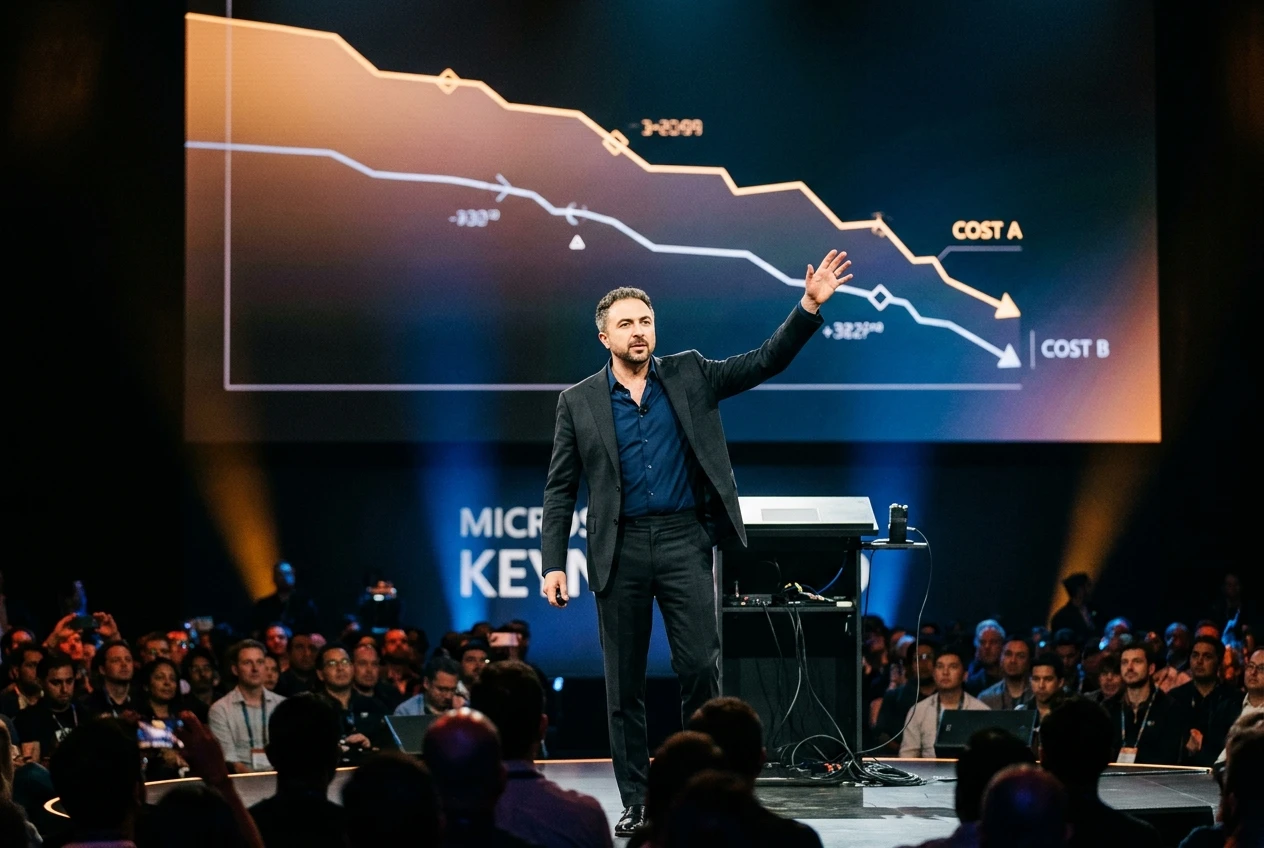
Microsoft unveiled seven in-house MAI models at its Build developer conference in San Francisco on June 2, the clearest signal yet that the company intends to challenge the AI partners it has spent billions backing. The flagship, a reasoning model called MAI-Thinking-1, matches Anthropic’s Claude Opus 4.6 on a widely used coding benchmark at lower cost, and Microsoft AI CEO Mustafa Suleyman told Bloomberg the company aims to phase out its Anthropic spending entirely.
The move reframes one of the tech industry’s defining partnerships. Microsoft has put $13 billion into OpenAI across multiple funding rounds and up to $5 billion into Anthropic, while distributing both companies’ models through Azure. With the new MAI line, Microsoft is shifting from a frontline distributor of other people’s models to a frontier builder that competes with them.
Seven New Models, One Strategic Turn
At the Build keynote in San Francisco, Microsoft unveiled MAI-Code-1-Flash as its first dedicated coding model. The 5-billion-parameter model is already live in Visual Studio Code and GitHub Copilot, putting Microsoft directly in the path of Anthropic’s Claude, which has become the default choice for enterprise AI coding tools.
MAI-Thinking-1 is the headline release. Microsoft built it as a mid-sized reasoning system with 35 billion active parameters and a 256K context window, trained from scratch with no distillation from other companies’ models, per Microsoft’s Build 2026 keynote recap. The clean data lineage is the sales pitch: enterprises concerned about model provenance get a system with no borrowed weights. MAI-Thinking-1 is open now in private preview on Microsoft Foundry.
The remaining five models round out the portfolio. MAI-Image-2.5 and its flash variant cover text-to-image and image-to-image workloads, ranking third and second on Arena AI leaderboards and beating Google’s Nano Banana 2 on the image-to-image test. MAI Transcribe 1.5 supports 43 languages, with streaming coming soon. MAI-Voice-2 and its flash variant ship in 15 additional languages with new voice options. Microsoft also committed to distributing MAI models on Fireworks AI, Baseten, and Open Router, pushing beyond its own catalog.
| Model | Type | Headline spec | Available now |
|---|---|---|---|
| MAI-Thinking-1 | Reasoning | 35B active params, 256K context; preferred to Claude Opus 4.6 on SWE-Bench Pro in Microsoft-stated tests | Microsoft Foundry, private preview |
| MAI-Code-1-Flash | Coding | 5B params, low-token cost | GitHub Copilot, Visual Studio Code |
| MAI-Image-2.5 (and flash) | Image generation | #2 Arena image-to-image, ahead of Nano Banana 2 | PowerPoint live, OneDrive rolling out, Foundry |
| MAI Transcribe 1.5 | Speech-to-text | 43 languages, streaming coming soon | Microsoft channels |
| MAI-Voice-2 (and flash) | Voice synthesis | 15+ new languages | Microsoft channels |
What you just saw is a pretty significant shift. We believe the time has come for every company to just move from consuming a frontier model to fully participating at the frontier in the frontier ecosystem.
Microsoft CEO Satya Nadella said that onstage at Build, framing the model family as a strategic reset rather than a feature update. The pivot is unusual for a company whose AI story has, until now, been told mostly through the models of others.
Anthropic Is the Real Target
Anthropic is the AI partner Microsoft appears most eager to undercut. Suleyman told Bloomberg Anthropic is "extremely expensive" and pointed to his team as the alternative. Microsoft has invested in Anthropic, but the company holds no discounted supply deal for Claude the way it does for OpenAI. That asymmetry is what a cheaper in-house line addresses.
The arithmetic under the rhetoric is uneven. Microsoft has a discounted supply arrangement with OpenAI that runs through 2032, locked in alongside license rights to OpenAI’s technology through the same year. For Anthropic, Microsoft holds only an equity stake with no comparable pricing deal, which makes Claude the unprotected line item on its AI bill. Anthropic’s Claude models are the default choice for enterprise coding tools, the customer base Microsoft is most aggressively chasing with MAI-Code-1-Flash.
The timing lines up with Anthropic’s own corporate moment. Anthropic confidentially filed for an IPO on June 1, one day before Build, with TNW reporting the offering could value the company above $1 trillion. A cheaper in-house alternative, bundled with Azure, is the wedge Microsoft is testing against that status quo.
This is all about long term self-sufficiency for Microsoft and our partners. It’s about models you can trust.
Mustafa Suleyman wrote that in the post announcing the seven-model family. The phrase doubles as the strategic frame: a company that has spent billions to back other people’s models now wants to make its own.
The 2025 Renegotiation That Unlocked the Pivot
Microsoft did not always have room to build frontier models of its own. The OpenAI partnership that began in 2019 had, by late 2025, settled into an exclusivity arrangement that left Microsoft contractually barred from training competing frontier systems. A renegotiation in late 2025 changed the terms. The amended agreement keeps Microsoft’s license to OpenAI’s IP through 2032, but that license is now non-exclusive, and OpenAI can serve its products through any cloud provider.
Four moves bookend the pivot:
- Under the late-2025 renegotiation, Microsoft’s OpenAI license became non-exclusive and runs through 2032, per the renegotiated partnership announcement.
- The same deal removed the clause that had stopped Microsoft from training frontier models of its own.
- In November 2025, Suleyman’s MAI Superintelligence team was formed to do exactly that.
- On June 2, 2026, that team unveiled its first seven public MAI models at Build.
What the Benchmarks Actually Show
The benchmarks Microsoft is leaning on are narrow but verifiable. On SWE-Bench Pro, a coding-focused test, the company says MAI-Thinking-1 matches Claude Opus 4.6. On a separate blind side-by-side test, independent raters preferred MAI-Thinking-1 to Anthropic’s Claude Sonnet 4.6. The framing positions the model as competitive with Anthropic’s prior flagship generation, and as good as or better than a model one step down.
It is a useful line to draw, but it skips a few targets. Suleyman acknowledged to Benzinga that Anthropic has released two more advanced models since Opus 4.6, leaving Microsoft a generation or two behind on raw capability. Anthropic’s Claude Sonnet 4.6 and Claude Opus 4.8 arrived while MAI-Thinking-1 was being finalized, and each of those newer models is the one a sharp-eyed enterprise buyer will compare against, not Opus 4.6. The MAI benchmark lines up the company against a moving competitor.
Cleaner data lineage is the other card Microsoft is playing. MAI-Thinking-1, in Suleyman’s words to GeekWire at Build, was trained without distillation from other companies’ models. That matters for companies in regulated industries where benchmarked origins carry legal weight. The technical claim is hard to verify from outside, but the marketing position it supports is real.
We’ve closed an enormous gap in six months.
Mustafa Suleyman told Benzinga, in coverage carried by TNW, with Anthropic releasing two newer models since the benchmark target Microsoft set for itself.
The benchmark storyline matters because Microsoft’s case to enterprise buyers rests on it. The pitch is that an in-house model can match the partner whose models power the same customer’s coding assistant today, at lower per-token cost, on cleaner data. Anthropic and OpenAI are both pushing toward public offerings this year, Anthropic with a June 1 confidential filing and OpenAI pursuing a 2026 listing. Distribution partners shipping competing models to the same customers are now Microsoft’s competitors, and benchmarks are how that competition gets measured.
The Cost Question Driving All of It
The economics behind the strategy are easier to defend than the benchmarks. Microsoft claims that, after retraining its models for consulting firm McKinsey, it was able to outperform OpenAI’s GPT 5-5 with 10 times better cost efficiency, per CNBC’s coverage of Suleyman’s Build remarks. The figure comes from Suleyman, not a published benchmark, and applies to one customer’s deployment. The reasoning matters more than the number: cheaper in-house inference is a recurring savings line for any AI customer paying list price.
Enterprise customers are already hitting similar walls. Uber burned through its entire 2026 AI coding budget in four months and introduced a $1,500 monthly cap per employee per tool. Walmart capped access to its internal AI assistant after usage exceeded expectations. AI spend has stopped being an experimental line and started becoming a budget item executives have to defend.
Microsoft’s own usage makes the budget tangible. Many people inside Microsoft are spending millions of dollars on AI tokens, Suleyman said at Build. Microsoft invested $13 billion in OpenAI and up to $5 billion in Anthropic, and it pays both for Azure distribution rights and for discounted model access. Replacing a meaningful share of that spend with MAI models is a direct hit to Microsoft’s cost of goods sold.
- 10x: cost efficiency Microsoft claims for its McKinsey-tuned MAI variant against OpenAI’s GPT 5-5 (CNBC, per Suleyman).
- $13 billion: Microsoft’s cumulative OpenAI investment across multiple funding rounds (GeekWire).
- Up to $5 billion: Microsoft’s Anthropic stake (CNBC and GeekWire).
- $1,500 per employee per tool per month: Uber’s new cap on AI coding spend.
For Microsoft, the cheaper path runs through model design choices it controls: smaller active parameter counts for code (5 billion in MAI-Code-1-Flash), distillation-free training for reasoning, and tight integration with Azure for inference economics. Anthropic’s Claude Sonnet 5, launched in late June at a steep discount to its Opus models, signals the same pressure point from the other direction.
Where the Models Are Already Shipping
MAI-Code-1-Flash is the most visible rollout. The coding model is live in GitHub Copilot and Visual Studio Code, and Microsoft has talked to Adobe about using the in-house models. The image models are already in PowerPoint and are rolling out on OneDrive, the kind of placement that turns a research reveal into an everyday feature for hundreds of millions of users. The GitHub Copilot integration matters, given how a head-to-head with Claude Code and OpenAI Codex now defines enterprise coding.
Microsoft Foundry, the service for integrating models into applications, hosts MAI-Thinking-1 in private preview alongside the latest OpenAI and Anthropic models, including the recently released Claude Opus 4.8. That positioning matters: Microsoft is selling third-party models on Azure at the same time it ships its own line to compete with them. Customers can express interest in testing the reasoning model now.
Voice and transcription cap the rollout. MAI Transcribe 1.5 ships with state-of-the-art accuracy across 43 languages, and streaming is coming soon. MAI-Voice-2 adds more than 15 languages with new voice options. MAI models will be available on Fireworks AI, Baseten, and Open Router too, where Microsoft will compete with the cheapest frontier-grade options from the open-source community. The release is broader than a single flagship: it puts Microsoft in five categories at once.
The forward-looking fact worth naming is that Anthropic filed for an IPO on June 1, one day before Build, and released Claude Sonnet 5 in late June. Suleyman’s team is six months old and already shipping; its ability to keep MAI-Thinking-1 and MAI-Code-1-Flash within striking distance of whatever Anthropic ships next will be measured against every Anthropic release from here.
Frequently Asked Questions
What is Microsoft MAI?
MAI is Microsoft’s family of in-house AI models built by the Microsoft AI team under Mustafa Suleyman, with the MAI Superintelligence Team standing up in November 2025. The team shipped its first seven public models at Build on June 2, 2026.
How does MAI-Thinking-1 compare to Claude Opus 4.6?
Microsoft says MAI-Thinking-1 matches Claude Opus 4.6 on SWE-Bench Pro, a coding-focused test, and is preferred to Claude Sonnet 4.6 in blind side-by-side testing. The model does not necessarily match Anthropic’s releases that came after Opus 4.6, including Claude Opus 4.8 and Claude Sonnet 5.
When can developers use the new MAI models?
MAI-Thinking-1 is in private preview on Microsoft Foundry now. MAI-Code-1-Flash is already in GitHub Copilot and Visual Studio Code, per Microsoft. The image, voice, and transcription models are rolling out across PowerPoint, OneDrive, and other Microsoft products. MAI models will also be available on Fireworks AI, Baseten, and Open Router.
Does this end the Microsoft-OpenAI partnership?
No. Microsoft retains license rights to OpenAI’s IP through 2032 and discounted access to OpenAI models under the same amended agreement, per the partnership statement published by OpenAI in late 2025. The restructured deal is non-exclusive, which frees Microsoft to build competing models without breaching the contract.
Why target Anthropic instead of OpenAI?
Microsoft has a discounted supply deal with OpenAI that runs through 2032 but no comparable deal with Anthropic. Mustafa Suleyman told Bloomberg that Anthropic is extremely expensive, and the in-house line is built to be a cheaper alternative for Claude-class workloads that Microsoft currently rents.


South Korea Retail Investors Face Reckoning After KOSPI AI Rally Collapses

Surrey AI Maps Three Heart Attack Paths and Their Molecular Roots

Germany Locks Neutral Apple ATT Prompts Across Most of Europe

Apple’s 5% EU Fee Quietly Rewrites Alternative App Store Math

Apple’s EU Fee Truce Cuts Complexity but Leaves Rivals Fuming

Pixel 11 Pro Fold Trades Thinness for Durability and Seven-Year Stay

Mayo AI Flags HCM Obstruction From Everyday Ultrasound Videos

Indian Brands Quietly Scale Landmark Screens and Home Tech

Navin Vatsa Turns Grief Into a Lifetime of Quiet Seeing

Google Bets Pixel 11 Agentic AI Will Redefine Phones

Oracle Cuts 21,000 Jobs in a Year, Cites AI in 10-K Filing

Fable 5 and Mythos 5 Return as US Lifts Anthropic Export Controls

SpaceX’s Google Deal Turns a Rocket Company Into a Cloud Landlord

CD Projekt Red Co-CEO: Redemption Arc Isn’t Done, Witcher 4 in 2027

XPL Rallies 30% Ahead of Plasma One Card Tier Launch

Google Search Profiles Build a Follow Graph Inside Discover

DGO App Brings Rs 549 Mobile Pass for FIFA World Cup 2026 in Nepal

Moonshot AI Targets $30 Billion in China’s Fastest AI Funding Sprint

Oppo’s ColorOS 17 Eligibility List Leaves A-Series Buyers Behind

Microsoft Xbox Layoffs Start in July as Sharma Slams 3% Margin
-
 AI2 months ago
Oracle Cuts 21,000 Jobs in a Year, Cites AI in 10-K Filing
-
 AI2 months ago
Fable 5 and Mythos 5 Return as US Lifts Anthropic Export Controls
-
 AI2 months ago
SpaceX’s Google Deal Turns a Rocket Company Into a Cloud Landlord
-
 GAMING2 months ago
CD Projekt Red Co-CEO: Redemption Arc Isn’t Done, Witcher 4 in 2027
-
 CRYPTO2 months ago
XPL Rallies 30% Ahead of Plasma One Card Tier Launch
-
 NEWS3 months ago
Google Search Profiles Build a Follow Graph Inside Discover
-
 APPS2 months ago
DGO App Brings Rs 549 Mobile Pass for FIFA World Cup 2026 in Nepal
-
 AI2 months ago
Moonshot AI Targets $30 Billion in China’s Fastest AI Funding Sprint