
AI
Moonshot AI Targets $30 Billion Valuation in Third Funding Round of 2026
Moonshot AI is raising up to $2 billion at a $30 billion valuation, its third round in six months. The deal puts the Kimi maker behind DeepSeek and Zhipu.

Moonshot AI is raising up to $2 billion at a $30 billion valuation, its third funding round in six months, in talks first reported by Bloomberg on June 8, 2026. The targeted price is a sevenfold jump from the $4.3 billion mark Moonshot carried in December 2025, and it lands the Kimi maker behind DeepSeek and Zhipu but ahead of publicly listed MiniMax on China’s AI valuation ladder.
If the round closes at the target, Moonshot joins an increasingly crowded top tier of Chinese AI labs whose combined private valuations have climbed past $180 billion in 2026. The deal is also a signal of where the money is going next: a Hong Kong listing, the dismantling of the offshore corporate structure that long made Chinese AI accessible to US dollars, and the deliberate pricing of a private round high so that any subsequent IPO can clear that bar.
From $4.3 Billion to $30 Billion in Six Months
Bloomberg reported on June 8 that Moonshot had opened early discussions to raise between $1 billion and $2 billion at a $30 billion valuation. The talks began while a separate Meituan-led round valuing Moonshot near $20 billion was still closing, making the new raise the company’s third financing inside roughly six months. Total capital raised across the three rounds sits at approximately $3.9 billion, according to a tally by The Next Web.
The velocity is the headline. Most private AI companies tap the market once a year. Moonshot has done it three times since December 2025, each time at a higher mark, each time while a previous round is still wrapping. A reader who saw only the $30 billion figure would miss the cadence, and the cadence is the news. No lead investors for the new round have been publicly identified, and Moonshot did not immediately respond to requests for comment, according to the June 8 funding-round report on Moonshot’s $30 billion target.
- Target valuation: $30 billion
- Raise size: up to $2 billion
- December 2025 mark: $4.3 billion
- Funding rounds in 2026: three
- Total raised over six months: about $3.9 billion
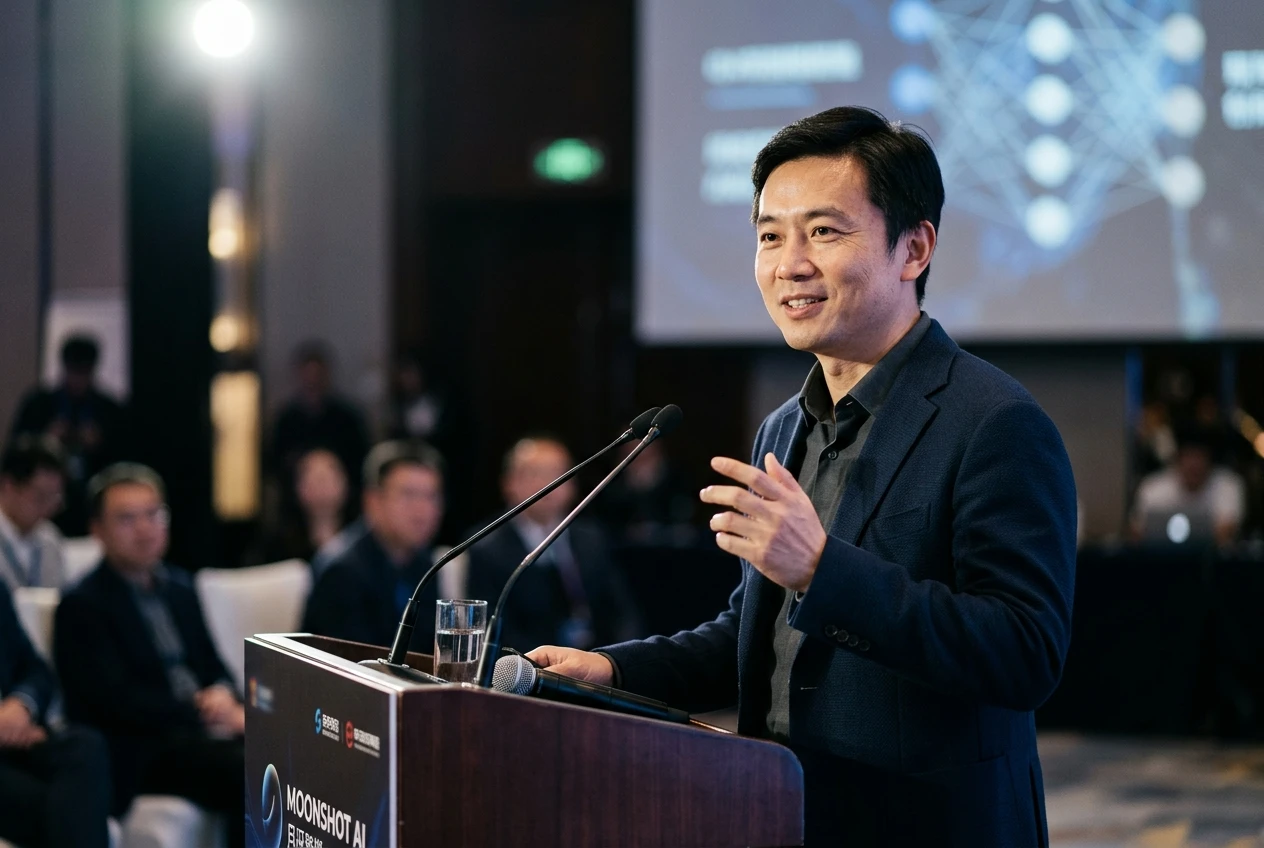
A Founder Who Named His Company After a Pink Floyd Album
The 33-year-old co-founder Yang Zhilin was born in 1992 in Shantou, Guangdong province, and won first prize in the National Olympiad in Informatics in Guangdong after a single year of training, despite no prior programming background, according to his Wikipedia biography. He went on to study computer science at Tsinghua University, where he formed a rock band called Splay with friends. The band’s name was a nod to the Splay tree data structure, and Yang played drums and wrote songs. He earned his bachelor’s degree in 2015 and moved to Carnegie Mellon University for a PhD, completing the four-year programme in four years rather than the usual six. During the doctorate he worked at Google Brain and Meta Platforms and co-authored the Transformer-XL and XLNet papers.
While still studying, Yang co-founded Recurrent AI, a sales-technology company that used the Transformer-XL algorithm. In December 2024, news broke that he was locked in a legal dispute with Recurrent AI investors including GSR Ventures over his departure. He returned to China after his PhD in 2019, led work on the Wu Dao LLM at the Beijing Academy of Artificial Intelligence in 2021, and in March 2023 co-founded Moonshot AI with his former Tsinghua bandmates. The company is named after Pink Floyd’s The Dark Side of the Moon, and it launched on the album’s 50th anniversary.
Yang’s academic and professional pedigree is the kind of résumé US AI labs used to monopolise. Carnegie Mellon PhD. Google Brain and Meta on the CV. Papers with Yoshua Bengio and Yann LeCun. Apple tried to recruit him after graduation, and Stanford and MIT postdoctoral offers were on the table. He chose Beijing instead.
The Revenue Has to Catch the Price Tag
Moonshot’s annual recurring revenue roughly doubled to $200 million by April 2026, up from about $100 million at the start of March, according to a tally by MLQ citing the South China Morning Post. The company sells tiered subscriptions for the Kimi chatbot and licences the underlying technology to enterprise clients. On the underlying technology, the K2 model released in July 2025 with one trillion total parameters, the multimodal K2.5 followed in January 2026, and the K2.6 series currently ranks as the second most-used large language model on OpenRouter, according to The Next Web.
The pace of revenue growth is the strongest argument for the round. Doubling ARR in roughly six weeks is rare even in software, and rarer still for a Chinese AI lab competing against ByteDance and Alibaba. The valuation is the weaker argument. A 150x price-to-sales multiple is frothy by any standard, and The Next Web used that exact phrasing in the funding-pace analysis of Moonshot’s ARR math and Kimi K2 launch history.
Whether $30 billion on $200 million of ARR is sustainable is the question that public markets will eventually be asked to answer. The private market has already chosen not to ask it.
Where Kimi Sits in the Chinese AI Pack
Kimi is a consumer product in a consumer-product market, and it ranks eighth among Chinese AI apps by monthly active users as of April 2026, behind ByteDance’s Doubao, Alibaba’s Qwen, DeepSeek, and Tencent’s Yuanbao, according to the South China Morning Post via MLQ. The latest model, Kimi K2.6, reportedly matches GPT-5.4 and Claude Opus 4.6 on coding benchmarks, and Moonshot launched Kimi Work, a general-purpose AI agent built on K2.6, this month.
The technical performance does not yet translate into category leadership. DeepSeek released V4-Pro, described as the largest open-weights model to date and cheaper to run than Kimi K2.6, putting price pressure on Moonshot’s enterprise licence business on top of the user-rank gap.
| Company | Target valuation | ARR / commercial signal | Product posture | Listing status |
|---|---|---|---|---|
| Moonshot AI | $30 billion (being raised) | $200 million ARR, April 2026 | Consumer chatbot and agents (Kimi Work) | Restructuring VIE for Hong Kong IPO |
| DeepSeek | $52 billion to $59 billion (being raised) | Research-led; revenue undisclosed | Open-weights frontier models | First external round in progress |
Why Now: The Hong Kong IPO Window
Moonshot is dismantling its offshore variable interest entity (VIE) structure to clear a path for a Hong Kong listing, after Beijing tightened its grip on overseas listings, according to The Next Web. The restructuring will not cut off access to US dollar capital: the company is planning a joint-venture structure that lets foreign investors participate.
The timing lines up with two of Moonshot’s peers, which are already public. Zhipu AI listed on the Hong Kong Stock Exchange on January 8, 2026. MiniMax followed a day later on January 9, 2026, and shares doubled on debut. Both listings have since joined the Hang Seng Tech Index, and MiniMax has hired Citic Securities to prepare a mainland share sale, per the South China Morning Post.
The IPO window for Chinese AI is open, and companies want to enter public markets at the highest possible valuation. Raising private capital at $30 billion first sets the benchmark for whatever Hong Kong listing comes next. The January 9 Hong Kong debut report on MiniMax shares doubling is the template Moonshot is positioning itself to follow. Beijing is also restricting US investment in its top AI firms, channelling domestic and allied capital into the sector while limiting foreign influence over governance, and Moonshot’s VIE teardown fits that policy direction. For broader context on how stretched AI valuations have become, the Ikigai warning that AI stock euphoria now outruns Japan’s bubble lays out the macro framing.
The Front Rank of Chinese AI
Moonshot is not the largest of China’s AI startups. It is the most actively capitalised in mid-2026, and the most visible symbol of a hierarchy that has crystallised fast. DeepSeek is raising about 50 billion yuan, equivalent to $7.4 billion, in its first external funding round at a valuation between 350 billion and 400 billion yuan, between $52 billion and $59 billion, according to Reuters via CNBC on June 3. The founder, Liang Wenfeng, has committed 20 billion yuan of his own money; Tencent is considering 10 billion yuan and CATL 5 billion yuan, making them the largest external investors, per the June 3 report on DeepSeek’s $7.4 billion maiden fundraising.
Zhipu AI sits above Moonshot on target valuation, with reports placing the company near $80 billion, and MiniMax trades at roughly $20 billion on the Hong Kong exchange after doubling on its first trading day. Combined target valuations across the four-company front rank exceed $180 billion, per The Next Web. The gap with American peers is still wide: OpenAI is valued above $850 billion and Anthropic at around $965 billion. Three funding rounds in six months is unusual even by AI industry standards, and the velocity is a tell.
What the Pace Tells You About the Race
Two pressures are pushing the cadence, according to The Next Web. Training frontier models is expensive, and Chinese labs face the additional constraint of US export controls on advanced chips. The IPO window is also open, and companies want to enter public markets at the highest possible valuation, raising private capital quickly to establish the benchmark.
The question The Next Web raised in its analysis is not whether these valuations are sustainable; it is whether the companies can grow into them before public markets get to decide.
Frequently Asked Questions
What is Moonshot AI’s new funding round?
Moonshot AI is seeking up to $2 billion at a $30 billion valuation, in talks reported by Bloomberg on June 8, 2026. The raise is the company’s third in roughly six months and represents a sevenfold jump from the $4.3 billion mark Moonshot carried in December 2025.
How much revenue is Moonshot making?
Moonshot’s annual recurring revenue roughly doubled to $200 million by April 2026, up from about $100 million at the start of March, according to the South China Morning Post. The company sells tiered Kimi chatbot subscriptions and licences its models to enterprise clients.
When will Moonshot go public?
Moonshot has begun dismantling its offshore VIE structure to clear a Hong Kong listing, following the template set by Zhipu AI and MiniMax, which both listed in Hong Kong in early January 2026. No listing date has been announced.
How does Moonshot compare to DeepSeek and Zhipu?
On reported target valuations, DeepSeek sits at $52 billion to $59 billion, Zhipu near $80 billion, and Moonshot at $30 billion. By monthly active users, Moonshot’s Kimi ranks eighth among Chinese AI apps as of April 2026, behind ByteDance’s Doubao, Alibaba’s Qwen, DeepSeek, and Tencent’s Yuanbao.


AMD’s Data Center Revenue Jumps 57% as Its Stock Bets on Execution

Microsoft Loses an Xbox Lawsuit Just as Sony Kills Physical Discs

Bethesda Union Says HR Tore Down Its Memorial for Laid-Off Staff

Google Pixel 11 Pro Fold Price Leaks Point Toward a $2,000 Foldable

Smart Scales Promise Lab-Grade Body Fat Numbers, and the Science Pushes Back

Amap’s Ride-Hailing Hits 1,000 Cities Amid Security Warnings

Ulys’s Automatic Toll Billing Draws Scammers to 7 Million Drivers

Google’s Veo AI Video Tools Threaten VFX Jobs Far Beyond Hollywood

Music Industry Unveils AI Labels, but Streaming Giants Haven’t Signed On

Apple Sues OpenAI and Two Ex-Employees Over Stolen Trade Secrets

Microsoft Xbox Layoffs Start in July as Sharma Slams 3% Margin

Google Search Profiles Build a Follow Graph Inside Discover

Oppo’s ColorOS 17 Eligibility List Leaves A-Series Buyers Behind

Oracle Cuts 21,000 Jobs in a Year, Cites AI in 10-K Filing

Google DeepMind and A24 Sign $75 Million AI Partnership Deal

OCC Issues AML Consent Order Against Wise and Crypto.com Sponsor Bank

DGO App Brings Rs 549 Mobile Pass for FIFA World Cup 2026 in Nepal

Anthropic Tells Senators Alibaba Ran the Largest Claude Distillation Attack

Apple Strikes Preliminary Deal For Intel To Make iPhone And Mac Chips

Google Home Spring Update Adds Gemini 3.1 And Old Nest Cam AI
-
 GAMING1 month ago
Microsoft Xbox Layoffs Start in July as Sharma Slams 3% Margin
-
 NEWS1 month ago
Google Search Profiles Build a Follow Graph Inside Discover
-
 NEWS1 month ago
Oppo’s ColorOS 17 Eligibility List Leaves A-Series Buyers Behind
-
 AI3 weeks ago
Oracle Cuts 21,000 Jobs in a Year, Cites AI in 10-K Filing
-
 AI3 weeks ago
Google DeepMind and A24 Sign $75 Million AI Partnership Deal
-
 CRYPTO2 months ago
OCC Issues AML Consent Order Against Wise and Crypto.com Sponsor Bank
-
 APPS1 month ago
DGO App Brings Rs 549 Mobile Pass for FIFA World Cup 2026 in Nepal
-
 AI3 weeks ago
Anthropic Tells Senators Alibaba Ran the Largest Claude Distillation Attack