
AI
Jeppesen ForeFlight Airflow Debuts as Aviation AI Engine
Jeppesen ForeFlight unveiled its Airflow aviation AI engine on July 1, 2026 from Austin, with a ChatGPT MCP connector and planned Gemini and Claude support.

Jeppesen ForeFlight unveiled its aviation-centric AI engine from Austin, Texas on July 1, 2026, calling it Jeppesen ForeFlight Airflow and pitching it as the foundation of a multi-segment AI strategy. The engine is built to plug into OpenAI’s ChatGPT today with Google’s Gemini and Anthropic’s Claude support planned next. The launch comes eight months after the company formally separated from Boeing in a private-equity sale.
“General AI is confident, but often wrong. In our industry, these mistakes cascade into costly, dangerous, or catastrophic outcomes,” chief executive Brad Surak said in the announcement. “Artificial intelligence is not enough for this industry, we need aviation intelligence.” The announcement describes the platform as the agentic AI engine “combining commercially available data, segregated proprietary customer data, and extensive domain knowledge.” Later this year the platform will debut offerings for the Commercial and Business aviation segments, with military-focused capabilities to follow.
What Jeppesen ForeFlight Airflow Actually Is
Airflow is the foundational agentic AI engine that the company says will sit underneath every product it ships across commercial, business, military, and general aviation. The platform is built around three data layers that customers can keep segregated from one another: commercially available datasets like weather, charts, and NOTAMs, each operator’s proprietary fleet and crew information, and a long-running domain layer of safety, certification, and contextual reasoning. Together, those layers give Airflow the kind of certified provenance the company argues general-purpose chatbots lack.
The system runs on an open architecture designed to be model agnostic, letting airlines and operators adopt AI at their own pace. They can plug in Jeppesen ForeFlight’s own agents, layer in third-party agents, or build their own on top of Model Context Protocol standards. “Customers can move at their own pace, at lower cost, and with as much or as little human control over key decisions as their operations require,” the announcement said. That range runs from a fully human-in-the-loop advisor tier up to an L4 autonomous tier, the company said.
Jeppesen ForeFlight says Airflow touches more than 60 million commercial, military, business, and general aviation flights each year. A blog review of the launch from Skyfarer Academy reports that the company’s products are used by more than 75 percent of the world’s pilots. The Airflow product page on Jeppesen ForeFlight’s site describes a context graph built on 90-plus years of certified inputs covering performance models, procedures, optimizers, and aeronautical data across more than 200 countries and ANSPs. On top of that graph, the platform surfaces agents, insights, and simulation through an experience layer that operators can plug into Jeppesen ForeFlight apps or third-party tools. The aviation ontology and reasoning engines underneath have been in development for several years, the company said.
Operators get to choose where they sit on that autonomy scale. The platform supports pre-built, certified agents ready on day one, co-development of bespoke workflows with Jeppesen ForeFlight, or building custom agents on open MCP standards. Either path is meant to layer onto existing operator infrastructure without rip-and-replace.
- 60 million flights served annually across all four aviation segments
- 90-plus years of certified aviation data underpinning the context graph
- 75 percent of the world’s pilots rely on Jeppesen ForeFlight tools
- 1 million-plus pilots use Jeppesen ForeFlight and ForeFlight products
- 200-plus countries and ANSPs covered by the certified aeronautical data layer
- 4 aviation segments: commercial, business, military, and general aviation
The $10.55 Billion Question Behind the Reveal
The Airflow launch lands eight months after Jeppesen ForeFlight formally separated from Boeing. On November 3, 2025, Boeing completed the all-cash sale of the Jeppesen and ForeFlight businesses to private equity firm Thoma Bravo for $10.55 billion, ending a quarter-century under the aerospace prime and a six-year stretch for ForeFlight that began with Boeing’s 2019 acquisition.
The aerospace trade publication that has covered the post-spinoff moment described what it called an “uphill battle” the company has faced “convincing skeptics” the spinoff would deliver innovation. The publication described the first moves after the transaction closed as “straight out of the private-equity playbook”: layoffs and price increases for ForeFlight. “These actions prompted accusations the company was being sucked into private equity’s relentless drive to maximize short-term profits,” the same reporting found. That context frames the Airflow launch as the company’s first major post-spinoff product reveal and a credibility test. The publication noted the test is unusually high-stakes, given that Jeppesen ForeFlight’s tools are used by more than 75 percent of the world’s pilots.
Surak’s framing in the Airflow announcement ties AI directly to that test. “We are leveraging decades of experience delivering data and software solutions globally, which compounds virtually every second on the 60 million flights we serve annually,” he said. “But most importantly, our AI earns trust one decision at a time.” He added that the company’s reach across crew, fleet, operations, and flight deck performance “distinguishes Jeppesen ForeFlight from generic AI platforms and single-point solutions.”
First Products Landing in General Aviation
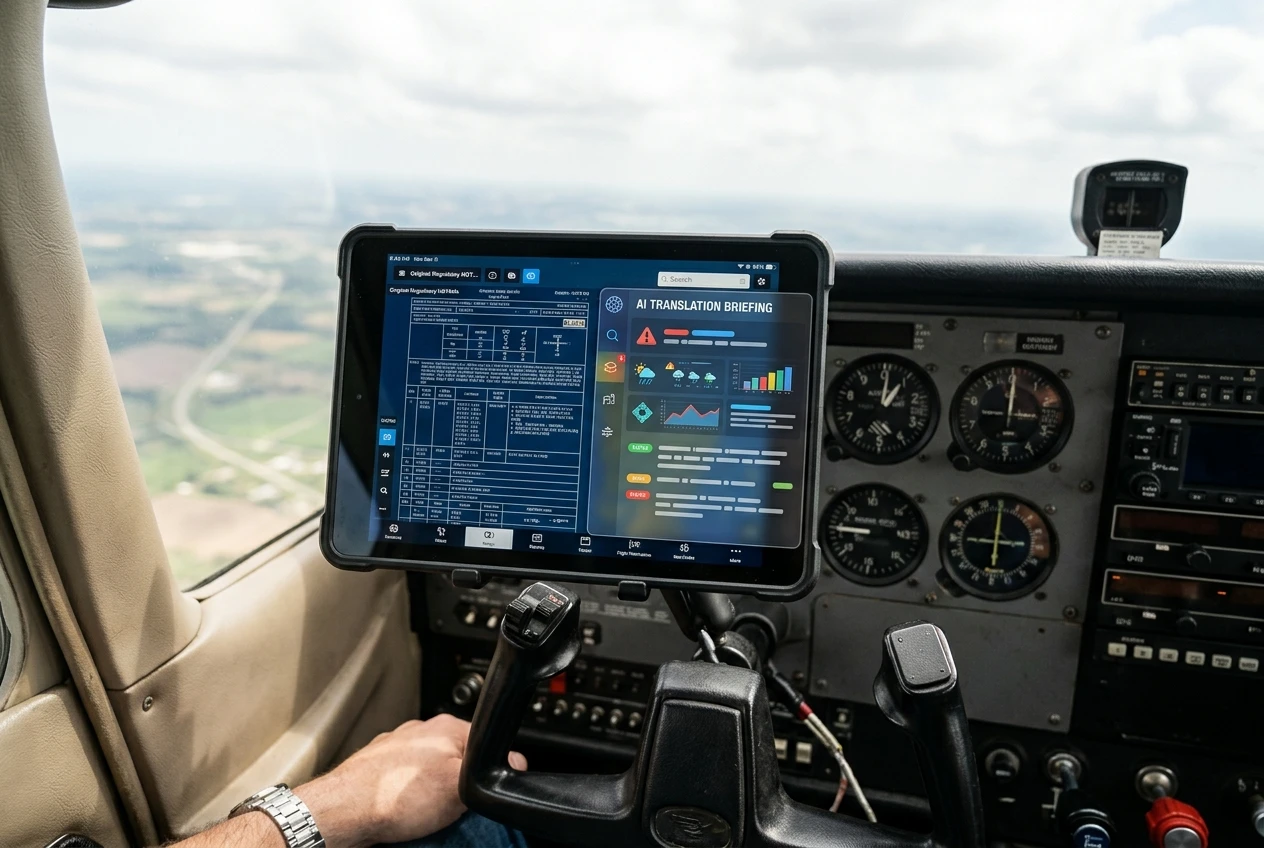
The first two products built on Airflow are aimed at general aviation, the segment where ForeFlight built its name. The first is Clear Notams, an AI translation layer for the FAA’s dense, all-caps NOTAM briefings that pilots have long complained about. The next release, and the more technically novel of the two, is the ForeFlight AI Connector, a Model Context Protocol server that hooks ForeFlight Mobile into a pilot’s existing ChatGPT account.
The product details come from the Clear Notams product feature interview with Sam Taylor, senior product marketing manager for general aviation at Jeppesen ForeFlight. Clear Notams runs every NOTAM through an AI translation that is cross-checked against the source, replacing dense teletype text with a plain-language summary while preserving the original for verification. “Notams… the system as a whole has been sort of the butt of jokes for pilots for decades,” Taylor said. The translation will default to on for premium ForeFlight subscribers when it lands shortly after the EAA AirVenture show in Oshkosh, Wisconsin, near the end of July, with all individual customers getting a three-month trial of the AI feature. If the system cannot properly translate a particular NOTAM, the raw text appears alongside a “ClearNotam not available” message, and pilots who prefer the original format can set the app to display that first.
The ForeFlight AI Connector itself runs as an MCP server that lets a pilot’s ChatGPT account query ForeFlight Mobile data through prompts such as logbook analysis, draft flight plans, refueling optimization, and route comparisons. The connector is in open preview for general aviation pilots at every subscription tier, provided they have a ChatGPT account. Pilots access it through ChatGPT’s apps section by signing into their ForeFlight account. The connector will not file a flight plan on a pilot’s behalf, and any draft logbook entries it creates still require a human to finalize.
The company plans to extend the connector to Google’s Gemini and Anthropic’s Claude “so users can use the experience layer of their choosing.” Beyond the connector preview, Jeppesen ForeFlight has confirmed that Airflow’s first commercial and business aviation offerings will ship later this year, with military-focused capabilities to follow. Pilots and developers interested in early access to co-development can ask their Jeppesen ForeFlight account executive or sign up at the Airflow product site. A short set of example prompts the company highlights for the AI Connector is listed below. Each one pairs an ordinary pilot question with the ForeFlight data needed to answer it.
Four example prompts a pilot can issue through the ForeFlight AI Connector in ChatGPT:
- “How many hours have I flown in the last 12 months, and what percentage was in the Cessna 172?”
- “What flight plans do I have saved for my trip to Colorado this month?”
- “Given my usual routes and typical fuel prices, what would be a good refueling strategy for the next quarter?”
- “Compare my recent instrument approaches at KSAF and KABQ.”
Five Principles and the Patent-Pending Safety Layer
Jeppesen ForeFlight is betting that what separates its AI from a generic chatbot is governance, not raw model capability. The release lists five principles the platform delivers out of the box, with the safety layer flagged as patent-pending and called AI-SMS.
Each output from Airflow carries a “why-trail” showing the inputs, constraints, alternatives, and uncertainty the model considered before recommending a course of action. An example shared on the product page traces a Boeing 737 dispatch decision where the system weighed fuel reserves against an FAA-mandated two-hour duty limit, an inoperative APU, and an ETOPS restriction. The system surfaced a route change it calculated would save $340,000 in fuel while remaining FAR 117 compliant. The operator keeps control of whether to act on the recommendation, ask for an alternative, or downgrade the autonomy level.
The autonomy scale runs from L1, a trusted advisor that surfaces every constraint while a human decides, all the way up to L4, full AI execution inside a certified, audited framework. The launch is sitting at the advisory end today, with general aviation as the early proving ground. Surak told aviation press that the company has been measured on AI so far and would rather move at a pace operators can verify. He framed the bet as building an aviation intelligence layer that earns trust one flight at a time. The “aviation intelligence” framing is the company’s answer to the risk that general-purpose chatbots hallucinate on safety-critical decisions.
| Principle | What it delivers |
|---|---|
| Reasons in Context | Embedded in workflows operators already run, not just historic pattern matching |
| Reasons from Certified Inputs | Every output carries regulatory provenance from 90-plus years of Jeppesen data |
| Carries a Visible Why-Trail | Inputs, constraints, alternatives, and uncertainty surfaced with each recommendation |
| Operates Inside the AI-SMS | Patent-pending AI Safety Management System that mirrors the SMS aviation already runs |
| Human-centered Judgments | Operators choose how much automation they want, and humans stay in control |
What the AI Connector Is Not Allowed to Do
The terms under which pilots can use the AI Connector are unusually direct about what the product is for. The ForeFlight MCP Connector for ChatGPT end-user terms, last updated on June 24, 2026, lead with a section titled NOT FOR FLIGHT. The connector is for “general information, convenience, and situational-awareness purposes only,” the end-user terms state. Pilots are told not to rely on the connector for “flight planning, dispatch, in-flight decision-making, navigation, weather, NOTAMs, fuel, performance, or any other safety-of-flight or operational purpose.” The terms also remind pilots that AI Output “may be inaccurate, incomplete, outdated, or fabricated, and may not reflect current conditions.” ForeFlight does not “create, control, review, endorse, or guarantee” any AI Output ChatGPT produces using the connector.
Operators who want to keep their data out of OpenAI’s training pipeline are required to enable the relevant controls in their ChatGPT account. The connector’s terms forbid using the product to train, fine-tune, distill, or evaluate competing AI models, or to bulk-export ForeFlight data. ForeFlight is explicit that ForeFlight Data is “made available through the Connector solely for your individual, interactive use, and not for any model-development, training, or data-aggregation purpose.”
THE CONNECTOR AND ALL AI OUTPUT ARE PROVIDED FOR GENERAL INFORMATION, CONVENIENCE, AND SITUATIONAL-AWARENESS PURPOSES ONLY. THEY ARE NOT FOR NAVIGATION AND ARE NOT TO BE USED AS A SOURCE OF REAL-TIME OR OPERATIONAL FLIGHT INFORMATION.
The pilot in command retains “ultimate responsibility for the safe conduct of every flight,” the terms make clear, including the duty to verify all data against official and certified sources. The connector is not a certified electronic flight bag function and is not a substitute for the certified ForeFlight application. ChatGPT is treated as a third-party service, with its own terms and privacy policy, and ForeFlight waives all liability for how OpenAI handles Connector data. Pilots who choose to use it must do so on a ChatGPT account that meets the eligibility rules in the EULA, including that they are at least 18 years of age. The connector can be revoked at any time through ForeFlight account settings.
Any use of the connector for navigation, dispatch, real-time operational decision-making, or any safety-of-flight purpose is prohibited under the terms. The connector is also barred in any activity “where inaccurate, delayed, or unavailable data could lead to death, personal injury, or property or environmental damage.” The release mirrors the same caveat, calling pilot reliance on the AI Connector in flight-related use “not for flight.” For an industry that already treats uncertified data as a safety risk, that posture is the policy line the company will need to enforce as the model-agnostic strategy expands.
Skeptics and What Could Still Break
The Airflow strategy has critics, and two technical constraints come with the model-agnostic decision. The connector shipping today hands Jeppesen ForeFlight limited control over the models actually answering pilots’ questions, particularly once Gemini and Claude support ships. ForeFlight can shape the data, the why-trail, and the safety layer, but it cannot patch a hallucinated fuel figure in real time.
The “show your work” framing presupposes that operators can read and audit every recommendation, while the initial rollout is aimed at individual general aviation pilots rather than staffed operations centers. The aerospace trade publication’s post-spinoff assessment of the AI plan framed the Airflow launch as a credibility test on whether a private equity owner of an aviation data backbone can deliver meaningful AI innovation. With tools used by 75 percent of the world’s pilots, the publication noted, the company could either “cement itself as a trustworthy steward of AI in an industry grappling with how to adopt the technology,” or see “a public failure” amplify concerns about both the new ownership and the broader risks of putting AI in cockpits. General aviation pilots in particular are facing the new AI features and the post-spinoff pricing changes at the same time.
The next milestones are tight, and the practical limits of the strategy will be measured against them. Jeppesen ForeFlight has confirmed that Airflow’s commercial and business aviation offerings will ship later this year, with military-focused capabilities to follow. Gemini and Claude support for the AI Connector is on the same overall timeline, with the Airflow product site taking applications for early co-development access through account executives. General aviation pilots are the first cohort measuring whether the “responsible AI” framing matches the experience of opening ChatGPT inside ForeFlight Mobile. The Airflow product page adds that “agents stand up in weeks because they reason on a context graph we’ve built for 90-plus years.”
Frequently Asked Questions
What does Jeppesen ForeFlight Airflow actually do?
Jeppesen ForeFlight Airflow is the aviation-centric AI engine the company unveiled from Austin, Texas on July 1, 2026 that the company says will sit underneath the next generation of ForeFlight and Jeppesen products. It combines commercially available aviation data, segregated proprietary customer data, and certified domain expertise on top of an open architecture that lets operators plug in their own AI agents or use native agents running on OpenAI’s ChatGPT today.
When will the AI Connector add Google Gemini and Anthropic Claude support?
Jeppesen ForeFlight says it “intends to expand this feature to other popular AI applications such as Google’s Gemini and Anthropic’s Claude.” No public date has been given for the expansion beyond the company’s “later this year” timeline for the first commercial and business aviation Airflow offerings.
Who is responsible when AI Connector output is wrong?
The ForeFlight AI Connector end-user terms, last updated June 24, 2026, state that the pilot in command retains “ultimate responsibility for the safe conduct of every flight” and that ForeFlight does not create, control, review, endorse, or guarantee any AI Output from ChatGPT. The terms bar use of the connector for navigation, dispatch, weather, NOTAMs, fuel, performance, or any other safety-of-flight purpose, and require pilots to verify every figure against official sources and the certified ForeFlight app.
What happened to Jeppesen ForeFlight after it left Boeing?
Boeing completed the sale of the Jeppesen and ForeFlight businesses to private equity firm Thoma Bravo on November 3, 2025 in an all-cash deal valued at $10.55 billion. The newly independent company is led by chief executive Brad Surak, who previously ran Boeing’s Digital Aviation Solutions business.


Pixel 11 Trails Galaxy Phones That Last as Long

OpenAI’s Research Intern Arrives With a Warning Attached

Robinhood Prices XRP Into a Two-Cent 9 a.m. Bet

Sony’s 10 Percent Disc Drop Leaves the 2028 Cutoff Intact

Chip Allocation Sidelines the Base iPhone 18 This Fall

Miami-Dade Fights the Vice City Brand It Already Wears

IFA 2026 Awards Put Tecno Ahead of Flagship Phones

USB-C Gadgets Made the Junk Drawer Rechargeable

Pixel 11 Pro Asks $1,099 for a Light Google Locked

The iPhone Ultra Sells Two Retired Minis as One Foldable

Oracle Cuts 21,000 Jobs in a Year, Cites AI in 10-K Filing

Fable 5 and Mythos 5 Return as US Lifts Anthropic Export Controls

SpaceX’s Google Deal Turns a Rocket Company Into a Cloud Landlord

CD Projekt Red Co-CEO: Redemption Arc Isn’t Done, Witcher 4 in 2027

XPL Rallies 30% Ahead of Plasma One Card Tier Launch

Google Search Profiles Build a Follow Graph Inside Discover

DGO App Brings Rs 549 Mobile Pass for FIFA World Cup 2026 in Nepal

Moonshot AI Targets $30 Billion in China’s Fastest AI Funding Sprint

Oppo’s ColorOS 17 Eligibility List Leaves A-Series Buyers Behind

Microsoft Xbox Layoffs Start in July as Sharma Slams 3% Margin
-
 AI3 months ago
Oracle Cuts 21,000 Jobs in a Year, Cites AI in 10-K Filing
-
 AI2 months ago
Fable 5 and Mythos 5 Return as US Lifts Anthropic Export Controls
-
 AI3 months ago
SpaceX’s Google Deal Turns a Rocket Company Into a Cloud Landlord
-
 GAMING3 months ago
CD Projekt Red Co-CEO: Redemption Arc Isn’t Done, Witcher 4 in 2027
-
 CRYPTO3 months ago
XPL Rallies 30% Ahead of Plasma One Card Tier Launch
-
 NEWS3 months ago
Google Search Profiles Build a Follow Graph Inside Discover
-
 APPS3 months ago
DGO App Brings Rs 549 Mobile Pass for FIFA World Cup 2026 in Nepal
-
 AI3 months ago
Moonshot AI Targets $30 Billion in China’s Fastest AI Funding Sprint