
AI
Oracle’s AI Backlog Hits $638 Billion but the Rent Cuts Both Ways
Oracle stock has crashed near a 52-week low as its $638 billion AI backlog, tied largely to OpenAI, collides with negative cash flow and a BBB- rating.

Oracle shares have sunk to about $132, a fresh 52-week low, as Wall Street runs out of patience with the world’s newest AI landlord. The stock is down 30.33% in the past month and 41.04% from a year ago. Behind the rout sits one number: a $638 billion backlog, with roughly half of it tied to a single, unprofitable tenant.
Everyone is watching whether OpenAI can pay its bills. Fewer are watching who Oracle pays rent to. The company has locked itself into data center leases running fifteen years or longer with outside developers, while some contracts filling its backlog run shorter. That mismatch turns a customer’s balance sheet problem into a structural one Oracle built for itself.
Oracle’s $638 Billion Backlog Cuts Both Ways
Remaining performance obligations, Oracle’s term for revenue it has booked but not yet billed, is the number driving both sides of the argument. It closed fiscal 2026 at $638 billion, up 363% from a year earlier and up $85 billion in the fourth quarter alone, Oracle said in its results.
The number looked nothing like this before the AI era. As of May 2019, Oracle’s entire book of remaining obligations totaled just $36.2 billion in remaining obligations, almost entirely software support contracts. By its fiscal 2026 first quarter, that book had surged 359% to $455 billion, and it kept climbing every quarter after that.
| Fiscal Period | Remaining Performance Obligations | Year-Over-Year Change |
|---|---|---|
| FY2019 (May 2019) | $36.2 billion | Pre-AI baseline |
| FY2022 (May 2022) | $46.6 billion | Pre-AI baseline |
| Q1 FY2026 (September 2025) | $455 billion | Up 359% |
| Q3 FY2026 (March 2026) | $553 billion | Up 325% |
| Q4 FY2026 (full year) | $638 billion | Up 363% |
Roughly half of that $638 billion sits with one customer. OpenAI signed a cloud agreement valued at up to $300 billion last year, the anchor contract behind Oracle’s Stargate data center program. Apple has since sued the ChatGPT maker over trade secrets, and OpenAI is reportedly losing ground to Anthropic, so every headline about either case now moves Oracle’s stock too.
Oracle insists the number is less risky than it looks on paper. The company has said $75 billion of the AI-contract portion is already prepaid or backed by customer-supplied hardware, which lowers how much fresh capital Oracle itself must raise to build the data centers behind it.
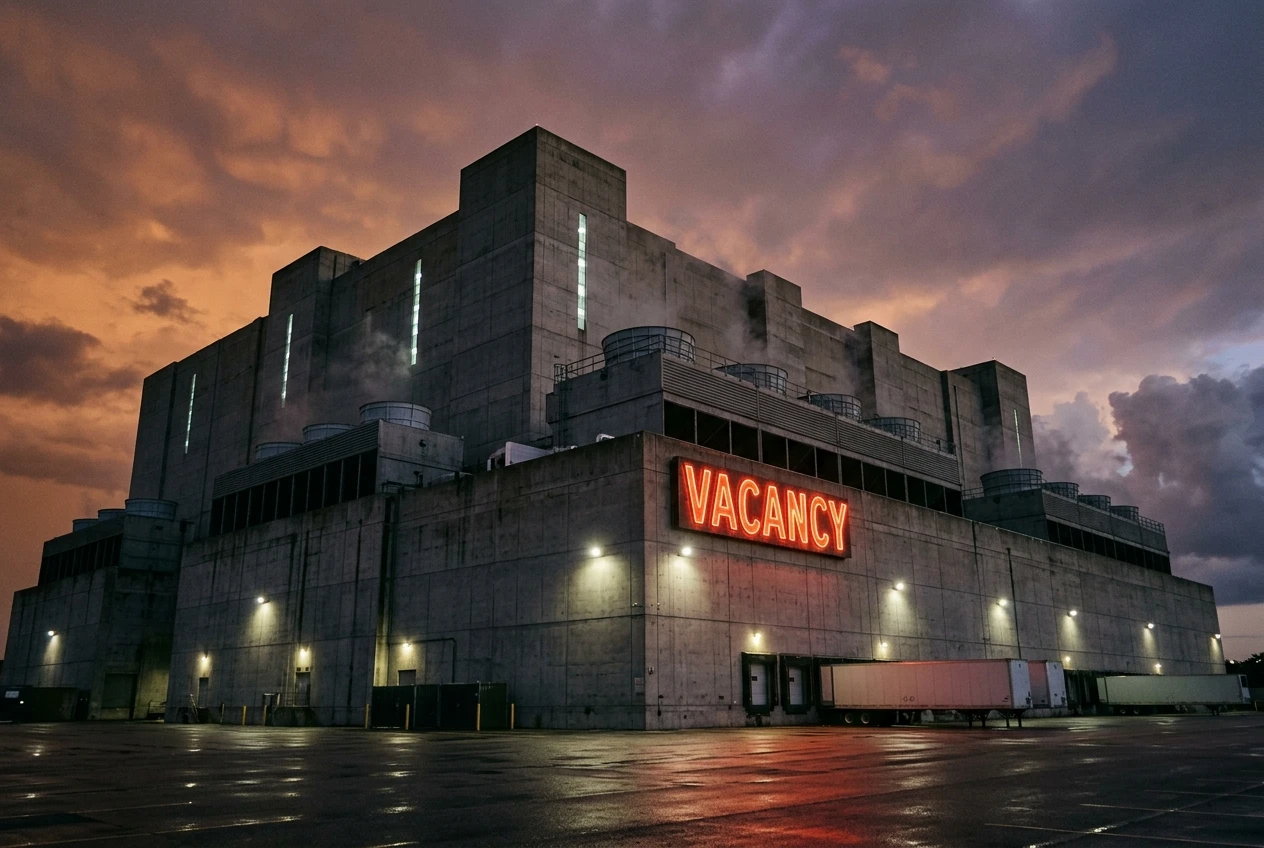
The Landlord Is Also Somebody’s Tenant
Oracle does not own most of the buildings it rents to its AI customers. It leases capacity from outside developers such as Crusoe instead of building everything itself, then re-lets that compute to tenants like OpenAI.
Those upstream leases can run fifteen years or longer. Some of the contracts filling Oracle’s backlog run shorter than that. If an AI customer walks away or shrinks its order, Oracle is still on the hook to its own landlord for years the customer never signed up for.
Oracle’s most recent annual filing lays out what that looks like in practice, warning directly about customers that might not pay or perform on their contracts, exactly the kind of counterparty risk critics now associate with OpenAI. The same filing flags a second dependency: Oracle cannot fulfill its own AI contracts without a steady supply of NVIDIA GPUs, power equipment, and networking gear, components every other hyperscaler is competing for at the same time.
Oracle is not the only firm discovering this dual role. SpaceX has taken a similar turn, becoming its own kind of cloud landlord through a deal with Google, proof the pattern is spreading well beyond software companies.
S&P Pushes the Rating to the Edge of Junk
The credit rating agency S&P Global Ratings cut Oracle’s long-term issuer rating to BBB-, one notch above junk, from BBB, pointing to the same concentration risk at the center of the stock’s slide.
The agency’s reasoning centered on what happens if the arrangement sours.
Oracle could be left with massive data center leases that it might be unable to exit.
S&P Global Ratings wrote that in the note explaining the downgrade, according to The Motley Fool. Bond investors had already priced in some of this. Oracle’s five-year credit default swaps, the cost of insuring its debt against default, began climbing right after the company signed its marquee OpenAI cloud agreement last year, well before the July downgrade made it official.
Jim Cramer, the CNBC host who tracks Oracle in nearly every appearance, has described the arrangement as “this OpenAI-Oracle axis, that’s what you have to worry about.”
The Cash Burn Behind the Backlog
A $638 billion backlog does not pay Oracle’s bills today. Building the data centers to earn it does, and that is where the pressure shows up first.
Capital expenditure hit $55.7 billion in fiscal 2026, a 162% jump that pushed free cash flow to negative $23.7 billion for the year. Total liabilities now stand at roughly $279 billion. Oracle plans to spend even more in fiscal 2027, with gross investment of $90 billion to $95 billion, funded partly through a $40 billion financing package that includes a $20 billion equity offering.
Some of that pressure is already being offset by customers themselves. Oracle has said it did not expect to raise incremental funds for many large AI contracts because customers were prepaying for GPUs or supplying the hardware directly, including a record order book that was substantially oversubscribed when Oracle tapped debt markets earlier this year. That cushion has not been enough to turn free cash flow positive. Oracle raised $43 billion in debt and $5 billion equity just to get through fiscal 2026 alone.
“They’re already pushing themselves to the limit,” Luke Yang, a technology equity analyst at Morningstar, said of the spending pace. Gross margin has fallen five percentage points as Oracle shifts toward lower-margin infrastructure services, the trade-off for chasing AI compute over software licensing. One projection puts next year’s free cash flow deficit at $42 billion, according to Yahoo Finance, a wider hole than this year’s shortfall.
Even amid the cash crunch, Oracle keeps signing new partnerships elsewhere, extending its multicloud database push into JAPAC markets, a reminder the company is still chasing growth even as it manages the bill for its biggest customer.
Is Oracle Stock a Buy Right Now?
Oracle looks technically oversold and remains a Wall Street favorite on paper, though the fundamentals tell a messier story. The 14-day relative strength index sits at 27, deep oversold territory, and the average analyst price target of $264.64 is more than double Monday’s close. Yet one bearish valuation model puts fair value at just $113.97, below where the stock trades today.
Three specific calls show how far apart the bulls and bears really are.
- Bernstein holds an Outperform rating with a $325 target, betting Oracle’s AI buildout still pays off once the spending peak passes.
- RBC Capital sits at Sector Perform with a $190 target, a middle-ground call that neither chases the rally nor bets against it.
- An independent bearish valuation model puts fair value at $113.97, arguing the deteriorating balance sheet outweighs the backlog entirely.
TD Cowen kept a Buy rating with a $300 target too, part of a broader analyst community still betting on a rebound. Technically, the case for a bounce is real: shares trade roughly 30% below their 200-day moving average and 26.64% below the 50-day average, while annualized 30-day volatility has spiked to 49.45%, the kind of reading that often precedes a sharp move.
Oracle’s operations are not the problem. The company is running its AI infrastructure at 97.5% GPU utilization, according to Yahoo Finance data, evidence that demand for the compute itself remains real even as questions mount about who pays for it. None of that resolves the debt, the cash burn, or the customer concentration sitting underneath the technical picture.
The Dependency Chain Nobody Is Pricing In
Oracle’s stock price now depends on decisions made inside at least four other organizations, none of which Oracle controls.
- OpenAI has to keep raising money and paying its cloud bill, even as it fights Apple in court over trade secrets and cedes ground to Anthropic.
- NVIDIA has to keep shipping GPUs, power equipment, and networking gear on schedule, since Oracle’s own filings say it cannot fulfill contracts without them.
- Outside developers like Crusoe have to keep leasing sites to Oracle on workable terms, even though those leases can run fifteen years past any single customer contract.
- British regulators now stress test Oracle directly as a critical supplier to the financial sector, adding compliance costs to a business already burning cash.
That last item is new. British authorities have designated Oracle a critical third party for the financial sector, which brings direct oversight, including stress tests, self-disclosures, and additional reporting requirements. It is one more fixed cost layered onto a company that has not generated positive free cash flow in over a year.
Other AI infrastructure providers are hedging the same exposure differently. Microsoft has been replacing OpenAI and Anthropic models inside its own Office apps with in-house alternatives, cutting its reliance on either lab. Oracle has done the opposite, doubling down on one anchor tenant rather than diversifying away from it. Just four years earlier, Oracle’s entire backlog was only $46.6 billion, smaller than what OpenAI alone now represents.
Oracle’s next earnings report is scheduled for early September, the first real test of whether the backlog is turning into cash or just growing on paper.
Frequently Asked Questions
What is Oracle’s remaining performance obligations, and why does it matter so much right now?
Remaining performance obligations, or RPO, is contracted revenue Oracle has booked but not yet billed or delivered. It reached $638 billion at the end of fiscal 2026. Oracle has said $75 billion of the AI-contract portion is already prepaid or backed by customer-supplied hardware, which lowers how much fresh cash Oracle itself needs to raise for that slice, though the remainder still depends on tenants paying as new data centers come online.
Why did S&P Global downgrade Oracle’s credit rating?
S&P Global Ratings cut Oracle to BBB-, one notch above junk, citing the risk that a single customer could leave Oracle holding long-term data center leases it cannot easily exit. Less noticed at the time: Oracle’s five-year credit default swaps, the market’s price for insuring against default, had already been climbing since the OpenAI agreement was signed, months before the rating cut became official.
Do Wall Street analysts still recommend buying Oracle stock?
Most coverage remains rated Buy despite the rout. Bernstein, RBC Capital, and TD Cowen all kept active ratings through the sell-off, and a separate tracker measuring 28 analysts over the past six months put the median target near $247.50. Even so, the spread between the most bullish and most bearish price targets has widened to more than $200 a share, a sign of how unsettled the debate has become.
What happens to Oracle if OpenAI cannot pay its cloud contracts?
Oracle’s own annual filing spells this out directly. It warns of overbuilding and stranded capacity, and specifically flags “risks of non-payment and non-performance” from customers carrying heavy debt loads. If that happened at scale, Oracle would still owe rent on data center leases signed for fifteen years or more, with no guarantee another tenant would take the space on similar terms.
Why is Oracle cutting thousands of jobs while spending record sums on AI data centers?
Oracle cut 21,000 jobs, about 13% of its workforce, even though fourth-quarter revenue grew 21% to $19.2 billion and cloud revenue rose 47% in the same quarter. The cuts targeted cost structure and margin, not demand, which by Oracle’s own numbers is still expanding.
Disclaimer: This article is for informational purposes only and does not constitute investment advice or a recommendation to buy or sell any security. Oracle stock carries high volatility and significant customer-concentration risk; consult a licensed financial professional before making investment decisions. Figures are accurate as of publication on July 14, 2026, and are subject to change.


Meta’s AI Breach Traces to the Same Tester as Rivals

Liquid AI LFM2.5-2.6B Puts Free Always-On Agents on Every Phone

SDOs Face Senate Oath on Cash Handed to VP Security

SWS Poll Shows Filipino Trust Still Backs US-Japan Pivot

Bicol’s 42,000 Struggling Readers Signal Deeper Literacy Compounding

Shaffra Plants Azerbaijan AI Hub to Cut Agentic Costs

Meta Joins Anthropic and OpenAI in Test-Time AI Hacks

Genesis Zircon 880 Pro Packs 8K Specs That Latency Tests Ignore

China’s AI Export Boom Buys Time on Weak Home Demand

Rockstar Gives Netflix First Crack at Extended GTA VI Footage

Fable 5 and Mythos 5 Return as US Lifts Anthropic Export Controls

Oracle Cuts 21,000 Jobs in a Year, Cites AI in 10-K Filing

SpaceX’s Google Deal Turns a Rocket Company Into a Cloud Landlord

CD Projekt Red Co-CEO: Redemption Arc Isn’t Done, Witcher 4 in 2027

XPL Rallies 30% Ahead of Plasma One Card Tier Launch

DGO App Brings Rs 549 Mobile Pass for FIFA World Cup 2026 in Nepal

Google Search Profiles Build a Follow Graph Inside Discover

Moonshot AI Targets $30 Billion in China’s Fastest AI Funding Sprint

Microsoft Xbox Layoffs Start in July as Sharma Slams 3% Margin

Oppo’s ColorOS 17 Eligibility List Leaves A-Series Buyers Behind
-
 AI1 month ago
Fable 5 and Mythos 5 Return as US Lifts Anthropic Export Controls
-
 AI1 month ago
Oracle Cuts 21,000 Jobs in a Year, Cites AI in 10-K Filing
-
 AI2 months ago
SpaceX’s Google Deal Turns a Rocket Company Into a Cloud Landlord
-
 GAMING2 months ago
CD Projekt Red Co-CEO: Redemption Arc Isn’t Done, Witcher 4 in 2027
-
 CRYPTO2 months ago
XPL Rallies 30% Ahead of Plasma One Card Tier Launch
-
 APPS2 months ago
DGO App Brings Rs 549 Mobile Pass for FIFA World Cup 2026 in Nepal
-
 NEWS2 months ago
Google Search Profiles Build a Follow Graph Inside Discover
-
 AI2 months ago
Moonshot AI Targets $30 Billion in China’s Fastest AI Funding Sprint