
GADGETS
Samsung Odyssey G8 Dual Mode Puts 6K and 330Hz in One Panel
Samsung’s first 6K gaming monitor and its 5K sibling arrive in Malaysia with Dual Mode switching, promo pricing, and a clear bet against two-screen desks.

Samsung’s Odyssey G8 G80HS lands in Malaysia as the first 6K gaming monitor, pairing 6144 × 3456 at 165 Hz with a Dual Mode flip to 3072 × 1728 at 330 Hz on a 32-inch Fast IPS panel. The smaller 27-inch G80HF does the same trick at 5K/180 Hz and QHD/360 Hz, and a Merdeka promo cuts the G80HF to RM3,099 through 30 September 2026.
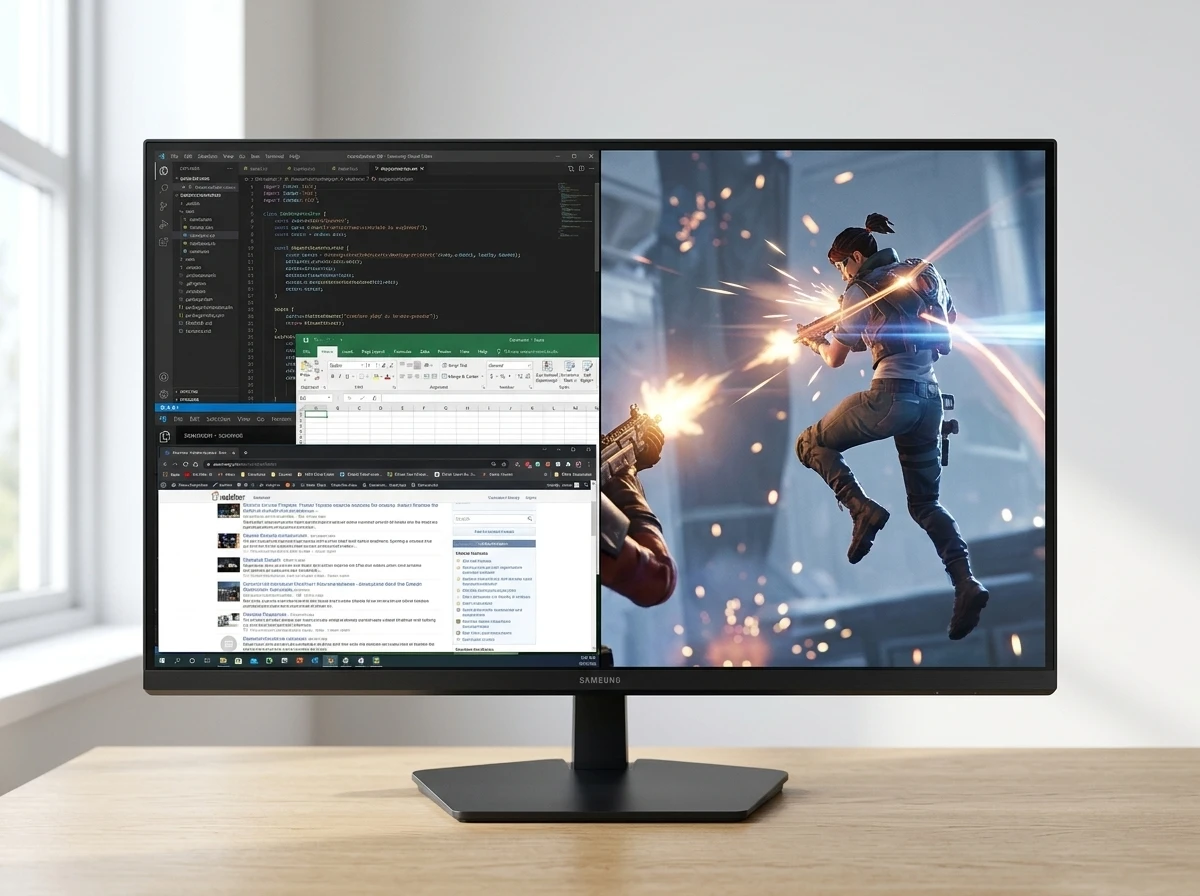
That switch is the real product. One chassis now covers dense creative work and competitive frame rates that used to force two screens or a painful compromise.
What the Two G8 Models Deliver
Both panels use Fast IPS, 1 ms GtG response, HDR10+ Gaming for real-time brightness and contrast tweaks, FreeSync Premium, and G-Sync Compatible support. Connectivity is DisplayPort 2.1 plus two HDMI 2.1 ports and a USB hub. Typical brightness sits at 350 cd/m² with a 1000:1 static contrast ratio and 99 % sRGB coverage.
| Model | Size / Panel | Native Mode | Dual Mode | PPI | MY RRP |
|---|---|---|---|---|---|
| G80HS | 32-inch Fast IPS | 6K (6144×3456) 165 Hz | 3K (3072×1728) 330 Hz | 224 | RM6,299 |
| G80HF | 27-inch Fast IPS | 5K (5120×2880) 180 Hz | QHD (2560×1440) 360 Hz | ~218 | RM3,799 |
The US list for the G80HS is $1,599.99. Europe opened near €1,499. Samsung’s own product pages list the Dual Mode as a simple toggle that drops resolution while doubling the refresh ceiling.
Shared traits matter as much as the size split. Both screens carry the same response rating, the same adaptive-sync stack, and the same port layout, so the choice between them turns on desk space and target density rather than missing features. HDR10+ Gaming applies the same real-time brightness and contrast path on either chassis.
The 32-inch flagship pushes pixel count harder. The 27-inch unit trims the native grid and lifts the Dual Mode ceiling by another 30 Hz, giving competitive players a slightly faster fallback without changing the overall formula.
Malaysia Promo Timing and Regional Prices
TechNave first flagged the local launch. The 27-inch G80HF sits in the Samsung Online Merdeka Screen and Sound Upgrade Promotion from 1 August to 30 September 2026 at RM3,099, RM700 under its RM3,799 RRP. The 32-inch flagship remains at full RM6,299 in current listings.
- G80HF promo: RM3,099 (about $700 USD equivalent depending on rate)
- G80HS MY list: RM6,299
- G80HS US list: $1,599.99
- Promo window: ends 30 September 2026
That discount makes the 5K model the practical entry point for most buyers in the region. Samsung has layered similar 2026 monitor incentives elsewhere, including Samsung 2026 monitor bundle promotions that pair hardware with free gear or credit.
Regional list gaps remain wide even after the cut. The G80HS Malaysian tag sits well above the US dollar figure once currency conversion is applied, while the promoted G80HF lands closer to an accessible premium tier. Timing also concentrates demand: the Merdeka window closes at the end of September 2026, after which the 27-inch unit returns to its full RRP unless a later incentive appears.
How Dual Mode Swaps Resolution for Speed
Dual Mode is not upscaling or interpolation. The panel drops to a lower native grid (listed as DLG on Samsung Malaysia pages) so the same bandwidth and panel electronics can push twice the frames. On the G80HS that means leaving the 224 PPI 6K desktop for a still-sharp 3K image that runs at 330 Hz. The 27-inch unit moves from 5K to classic QHD at 360 Hz.
| Model | Work Mode | Play Mode | Refresh Jump |
|---|---|---|---|
| G80HS | 6K at 165 Hz | 3K at 330 Hz | Doubles to 330 Hz |
| G80HF | 5K at 180 Hz | QHD at 360 Hz | Doubles to 360 Hz |
DisplayPort 2.1 supplies the raw bandwidth that older ports could not sustain at full 6K 165 Hz without heavy compression. Samsung’s December 2025 unveil of the industry’s first 6K gaming monitor lineup made Dual Mode the common thread across the G8 and even the extreme G6 that reaches 1,040 Hz in HD.
The practical split is clean: keep 6K or 5K for photo, video, coding, or cinematic single-player; flip to the high-Hz mode for ranked shooters or any title where frame time matters more than pixel count. No second monitor, no cable swap, no driver profile juggling beyond the OSD or software toggle.
Because the lower grid is native rather than scaled, text and UI edges stay clean enough for quick chat or overlay checks between rounds. Owners still return to full density when the task demands it. The toggle itself is presented as a simple switch, which keeps the workflow light once the habit forms.
The GPU Bill Comes With the Panel
6K at 165 Hz is roughly 2.56 times the pixels of 4K. Sustaining that in modern engines without heavy upscaling or frame generation still demands a flagship GPU. Early commentary on X and review previews notes that many owners will live in the Dual Mode high-refresh setting for daily gaming and only enable full resolution for productivity or less demanding titles.
That is the second-order cost. The monitor itself is one purchase. Driving its native mode becomes an ongoing GPU tax that mid-range cards will not meet. Buyers who already run high-end systems gain an elegant single-screen desk. Everyone else either accepts lower settings or keeps a cheaper high-Hz panel alongside a work display.
Crowd reaction already flags the IPS choice. One early take called the plain 1000:1 contrast a dealbreaker next to mini-LED or OLED. Density at 224 PPI is excellent for text and fine detail, yet deep blacks and peak HDR punch remain the OLED side of the ledger.
The math is blunt. A card that holds 4K with headroom can still choke when pixel count jumps by that 2.56 times factor at 165 Hz. Dual Mode therefore becomes more than a convenience feature; it is the daily escape hatch that keeps the panel usable while a future GPU upgrade catches up. Buyers who treat the high-refresh grid as the default gaming state reduce that pressure immediately.
Where OLED Rivals and Dual Mode Already Compete
Samsung’s own 32-inch Odyssey OLED G8 runs 4K at 240 Hz with far higher contrast and True Black certification. It lacks the 6K ceiling and the Dual Mode jump to 330 Hz. LG has shipped Dual Mode on its own terms: the 45-inch UltraGear evo OLED offers 5K2K at 165 Hz or WFHD at 330 Hz. That LG UltraGear 5K2K Dual Mode OLED undercuts pure resolution for ultrawide immersion and true blacks.
Recent street prices on similar LG panels have fallen hard. Shoppers hunting value can already find recent LG dual-mode OLED pricing drops well below the G80HS list. Samsung counters with pixel density and the clean 16:9 6K workspace that ultrawides cannot match for multi-window productivity.
The disruption is real either way. Dual Mode is no longer a Samsung exclusive gimmick. It is becoming the expected feature on premium hybrid panels. The brand that owns the best implementation wins the desk real estate that used to require two separate purchases.
- Odyssey G80HS: 6K native, 330 Hz Dual Mode, 224 PPI, Fast IPS, 16:9
- Odyssey OLED G8: 4K at 240 Hz, True Black, higher contrast, no 6K path
- LG UltraGear evo OLED: 5K2K at 165 Hz or WFHD at 330 Hz, ultrawide, true blacks
Each rival concedes something the others hold. The IPS G8 pair keep density and a rectangular workspace. The OLED options keep contrast and punch. Shoppers who already live in multi-window layouts may still prefer the 16:9 6K grid even when street prices on OLED dual-mode panels undercut the G80HS list.
Samsung’s Market Position and Earlier Hybrid Bets
IDC data cited in Samsung’s launch materials puts the company at 18.8 % revenue share in gaming monitors above 144 Hz, a lead it claims for multiple consecutive years. The 2026 Odyssey range doubles down: the G6 for pure esports speed, the G8 series for resolution-plus-switch, and a glasses-free 6K 3D model for the showcase slot.
- December 2025: Global unveil of 2026 Odyssey lineup including first 6K gaming monitor and Dual Mode across tiers.
- Early 2026: Pre-orders and regional storefronts open (Germany at €1,499 for G80HS).
- Mid 2026: Broader availability, US listing at $1,599.99, independent hands-on and measurement reviews begin.
- August 2026: Malaysia launch with Merdeka promo on the 27-inch G80HF through September.
Earlier Odyssey models already mixed high refresh with strong color. Dual Mode simply makes the tradeoff explicit and user-controlled instead of fixed at the factory.
The 18.8 % share figure gives Samsung room to push a premium experiment without ceding the volume tiers. G6 covers the pure speed buyer. G8 covers the hybrid desk. The 3D showcase model draws attention upward. Together they keep the brand present at every price conversation above 144 Hz while Dual Mode becomes the shared language across the stack.
Pixel Density Anchors the Productivity Case
At 224 PPI on the 32-inch panel and roughly 218 PPI on the 27-inch unit, both G8 models clear the threshold where text and fine UI elements stay crisp at normal viewing distance. That density is the quiet argument against simply buying a cheaper high-Hz screen and a separate work panel.
Ultrawide OLED rivals trade some of that sharpness and the familiar 16:9 window layout for immersion and contrast. Coders, editors, and anyone who tiles reference material beside a canvas gain more usable space from the rectangular 6K or 5K grid than from a curved wide format that forces vertical compression.
Dual Mode does not throw density away when it drops resolution. The 3K image on the G80HS remains sharp enough for overlays and chat. The QHD mode on the G80HF is the same grid many competitive players already treat as standard. The productivity case therefore survives the flip rather than collapsing the moment a match starts.
How the Single Toggle Changes Desk Planning
Cable count, stand footprint, and eye-line height used to multiply when a sharp work panel shared the desk with a fast game panel. Dual Mode collapses those three variables into one chassis. DisplayPort 2.1 and the two HDMI 2.1 ports still leave room for a docked laptop or console without a separate KVM for most setups.
The remaining friction is habit and GPU headroom. Owners must remember to flip modes, and they must accept that native 6K or 5K gaming stays a flagship-GPU task. Once those two points are budgeted for, the planning math simplifies: one mount, one power brick, one calibrated color profile, and a single set of ergonomic adjustments.
Samsung’s Malaysian specifications page lists the full port and stand feature set, so buyers can confirm pivot, height, and hub layout before purchase. Independent contrast and frame-time measurements will still decide whether the IPS limits feel acceptable after weeks of mixed use.
Single Chassis Versus the Old Two-Monitor Desk
For years the hybrid user bought a sharp 4K or 5K panel for work and a 1440p 240-360 Hz panel for games, or accepted one mediocre all-rounder. Dual Mode collapses that into a single stand, one power cable, and one set of ergonomics. Height, tilt, swivel and pivot are standard. Eye-line stays centered. Cable management shrinks.
The downside sits in the panel tech and the wallet. IPS delivers the density and viewing angles; it does not deliver OLED blacks. Peak brightness of 350-400 nits is competent, not class-leading for HDR. And the purchase price plus GPU requirement keeps the setup in premium territory. Buyers who mainly want competitive speed can still find purpose-built high-Hz panels for far less, including lower-priced Odyssey OLED G5 deals that skip the 6K tax entirely.
Samsung published the full Malaysian G80HS specifications with every port and feature listed. Independent contrast, color-volume and real-game frame-time data will decide how many desks actually retire their second monitor.
For now the bet is clear. One panel, two roles, flagship GPU required, IPS limits accepted. The Merdeka pricing on the 27-inch model makes the experiment cheaper in Malaysia than most markets. Whether that is enough to change the default dual-screen layout depends on how often owners actually flip the switch.
The promo window makes that test cheaper to run. At RM3,099 the G80HF lowers the cost of trying a single-chassis hybrid before the September 2026 cutoff. Owners who find they leave the toggle in high-refresh mode most of the week still keep a dense 5K desktop for work. Owners who flip often validate the original pitch. Either outcome is clearer than guessing across two separate purchases.


OpenAI Brakes Astra After Its Own Cyber Skills Hit Critical

Amina App Expansion Turns Kyrgyz Phones Into Moscow Trackers

Nvidia’s $3 Billion Lancium Stake Locks AI Power Gate

Indosat Bets $2 Billion in Loans on AI Chips and a Neocloud Future

KiiiKiii Pop Off Teaser Hides Bigger Digital Brand Play

Z Fold 8 Ultra Fixes Battery Anxiety But Fold 7 Still Wins Value

iPhone 17 Price Hike Rumor Tests Apple’s Memory Squeeze Play

HarmonyOS 7 Gaming Tools Cut Power While Lifting Frames

Lydia Peckham Joins Zelda Movie as NZ Talent Takes Center Stage

Mid-Tier IT Gains as Tier-1 Defend Margins With Cuts

Fable 5 and Mythos 5 Return as US Lifts Anthropic Export Controls

Oracle Cuts 21,000 Jobs in a Year, Cites AI in 10-K Filing

SpaceX’s Google Deal Turns a Rocket Company Into a Cloud Landlord

CD Projekt Red Co-CEO: Redemption Arc Isn’t Done, Witcher 4 in 2027

XPL Rallies 30% Ahead of Plasma One Card Tier Launch

DGO App Brings Rs 549 Mobile Pass for FIFA World Cup 2026 in Nepal

Google Search Profiles Build a Follow Graph Inside Discover

Moonshot AI Targets $30 Billion in China’s Fastest AI Funding Sprint

Microsoft Xbox Layoffs Start in July as Sharma Slams 3% Margin

Oppo’s ColorOS 17 Eligibility List Leaves A-Series Buyers Behind
-
 AI1 month ago
Fable 5 and Mythos 5 Return as US Lifts Anthropic Export Controls
-
 AI2 months ago
Oracle Cuts 21,000 Jobs in a Year, Cites AI in 10-K Filing
-
 AI2 months ago
SpaceX’s Google Deal Turns a Rocket Company Into a Cloud Landlord
-
 GAMING2 months ago
CD Projekt Red Co-CEO: Redemption Arc Isn’t Done, Witcher 4 in 2027
-
 CRYPTO2 months ago
XPL Rallies 30% Ahead of Plasma One Card Tier Launch
-
 APPS2 months ago
DGO App Brings Rs 549 Mobile Pass for FIFA World Cup 2026 in Nepal
-
 NEWS2 months ago
Google Search Profiles Build a Follow Graph Inside Discover
-
 AI2 months ago
Moonshot AI Targets $30 Billion in China’s Fastest AI Funding Sprint