
AI
Nvidia’s $3 Billion Lancium Stake Locks AI Power Gate
Nvidia commits $2 billion now and $1 billion later for up to 30% of Lancium, securing gigawatts for Stargate while Texas audits every data center interconnection.

Nvidia has agreed to invest up to $3 billion for as much as a 30% stake in Blackstone-backed Lancium, the Texas power developer feeding OpenAI and Oracle’s Stargate campus in Abilene. The Information first reported the terms on August 7, citing people familiar with the talks; Reuters and others confirmed the outline.
The first $2 billion buys roughly 20% equity. Another $1 billion follows if Lancium clears further interconnection and regulatory milestones, lifting ownership near 30%. The deal values Lancium at about $10 billion enterprise value including debt. It is pure equity, not construction guarantees.
How the $3 Billion Check Is Structured
The phased money tracks power delivery, not calendar dates. Sources told The Information the second tranche hinges on campuses hitting grid interconnection and approval thresholds. Nvidia gets no credit guarantees in this package, though the same reporting noted the company is weighing guarantee structures for other hyperscale builds, including a potential 10-gigawatt Ohio project tied to OpenAI and SoftBank.
| Tranche | Amount | Stake Effect | Condition |
|---|---|---|---|
| Initial | $2 billion | ~20% | Closing equity injection |
| Follow-on | $1 billion | Up to ~30% | Interconnection and milestone hits |
| Total possible | $3 billion | ~30% | Full milestone completion |
That structure keeps Nvidia’s capital tied to actual watts reaching the fence. Lancium already holds 4 GW of locked Texas contracts and a land bank that could support another 15 GW once interconnection clears.
Phasing also limits downside if the Texas freeze stretches longer than expected. The first $2 billion locks the core stake and the relationship. The remaining $1 billion stays contingent, so Nvidia avoids paying full freight for capacity that regulators later slow or trim. Pure equity, rather than construction guarantees, further caps the exposure to cost overruns on the generation and transmission side.
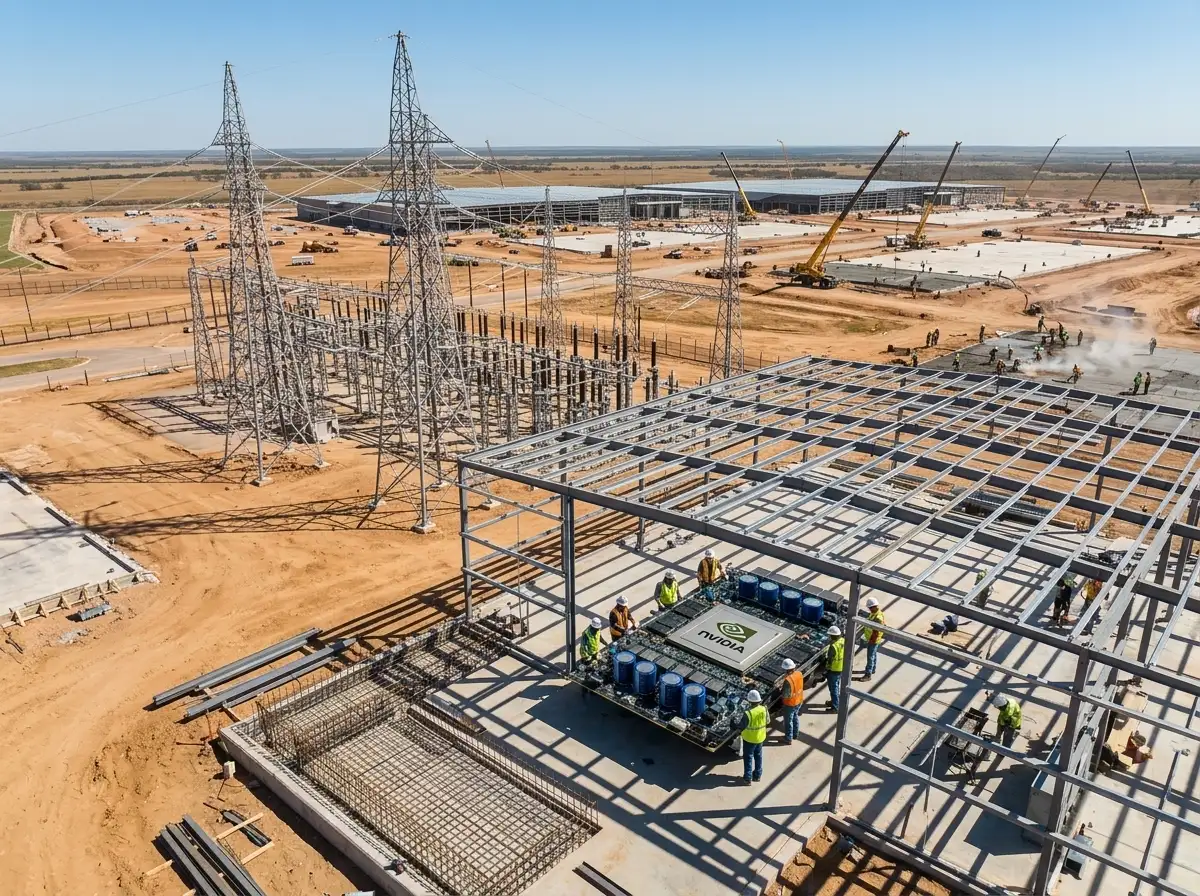
Power Is the New Compute Bottleneck
Large-language-model parameter races have slowed. The binding constraint is now electricity for the clusters that run them. Nvidia’s GPU order book remains full and hyperscalers keep announcing capacity, yet credit default swaps on Nvidia and Oracle have widened and CoreWeave’s financing costs have climbed. Markets have shifted from asking whether models improve to who funds and powers the buildout.
Nvidia has already written $2 billion checks to CoreWeave and Nebius this year and poured capital into networking and semiconductor suppliers. The Lancium move extends that pattern one layer deeper, into the grid itself. One early reaction on X put it plainly: the check says power is the real AI input.
The sequence of capital deployment tells the story. First came money for the clouds that buy GPUs. Then came money for the optical and networking gear those clouds require. Now comes money for the electrons that keep every rack online. Each step moves Nvidia closer to the scarce physical inputs that no software update can invent.
Lancium’s Locked Gigawatts and Pending Pipeline
Lancium’s secured contracts cover several of the heaviest AI and cloud loads in Texas. Its Abilene flagship, home to Stargate, carries a fully approved 1.2 GW interconnect. Official site materials detail the closed-loop cooling, onsite gas generation, and renewable integration that aim for zero impact on local retail customers.
| Project | Power | Notes |
|---|---|---|
| OpenAI / Oracle Stargate (Abilene) | 1.2 GW | Core computing node |
| Crusoe for Microsoft (Abilene) | 900 MW | Same campus cluster |
| QTS (Turkey, Texas) | 1.0 GW | Additional site |
| Crusoe Childress | 1.0 GW | Under construction |
| Total locked | 4 GW | |
| Pending interconnection land bank | 15 GW | Studies already advanced with American Electric Power |
The 1.2GW Abilene interconnect details show ERCOT approval already in hand after formal transmission reviews. That first-mover status matters. Lancium’s partner utility has completed the line studies needed for its pending projects, giving those applications a head start if the current freeze lifts.
Sources say Lancium is eyeing an IPO as early as 2027, following the path of Switch and CyrusOne. Nvidia’s capital and brand strengthen that case with public-market investors.
The locked 4 GW already anchors major customers. The 15 GW land bank is the growth option. Together they give Lancium a contracted base plus a scalable pipeline, a combination few pure developers can match while the queue stays frozen.
Nvidia’s Wider Infrastructure Shopping Spree
This is not an isolated bet. In the quarter that ended in April, Nvidia deployed $18.6 billion into private companies and infrastructure funds, more than its entire prior fiscal year. The list includes the CoreWeave and Nebius $2 billion rounds plus checks to Lumentum, Coherent, Marvell and optical partners such as Corning.
- CoreWeave and Nebius: $2 billion each to scale AI cloud capacity toward multi-gigawatt fleets.
- Optical and networking: investments that secure fiber, lasers and components for the same campuses.
- Semiconductor adjacents: Marvell and others that round out the silicon stack.
Those moves sit alongside Nvidia’s recent string of AI equity bets that already topped tens of billions. The company is no longer only selling accelerators. It is co-owning the factories, the networks and now the electrons that keep the factories running.
Viewed side by side, the checks form a vertical stack rather than a scatter of unrelated bets. Cloud capacity, optical paths, silicon adjacents and now generation all point at the same campuses. Lancium simply completes the lowest layer of that stack.
From Chip Seller to Risk-Bearing Financier
Earlier Nvidia money helped new cloud providers buy GPUs. The Lancium equity and the reported guarantee talks for Ohio projects go further. Nvidia is inserting itself into the financing chain that underwrites the campuses. If a GPU vendor starts carrying customer project risk, the semiconductor business takes on banking attributes.
Chinese model providers continue to undercut API prices. OpenAI and Anthropic keep cutting token rates. Hundreds of billions in data-center capital now face longer payback if inference revenue softens. Oracle’s balance sheet and financing costs draw as much scrutiny as the models themselves. Nvidia’s power stake is a hedge: own the scarce input, and the customers who need your chips have fewer alternative paths.
nvidia just wrote a $2B check that says power is the real AI input.
That reply to The Information’s reporter captured the market’s quick read. Energy and compute look like the durable moats; model weights look more interchangeable.
Equity in the power developer also changes the conversation with other hyperscalers. A customer that needs both GPUs and reliable megawatts now finds Nvidia present on both sides of the negotiation. That dual presence is the practical meaning of the shift from pure seller to risk-bearing financier.
Texas Freeze Hits the Queue at the Worst Moment
Days before the Lancium news, Governor Greg Abbott ordered a full stop on new data-center grid connections. On August 3 he told the Public Utility Commission of Texas and ERCOT to finish a comprehensive verification and audit of every project in the interconnection queue before any further approvals. Abbott directed the comprehensive audit with a simple priority: Texans first.
The queue holds roughly 474 GW of requests, more than five times ERCOT’s record peak demand. About 90% are data centers. ERCOT immediately delayed its Batch Zero transmission planning study. The audit will examine whether projects bring their own generation, reuse water, pay their own way without heavy incentives, mitigate noise and traffic for neighbors, and disclose true ownership.
What we know
- Moratorium covers all data centers still advancing through ERCOT’s process.
- Non-compliant projects must be denied connection.
- Lancium’s existing 4 GW contracts and completed line studies put its 15 GW pipeline in a relatively stronger position than pure greenfield rivals.
What’s unconfirmed
- Exact duration of the pause and when Batch Zero resumes.
- Whether any of Lancium’s pending 15 GW will be delayed or pared.
- Final terms of Nvidia’s second $1 billion tranche if milestones slip.
New York already imposed its own one-year pause. Virginia remains the largest U.S. data-center market, but Texas was the growth story. Developers still expect the state to lead if the audit separates serious projects from speculative ones. Lancium’s closed-loop cooling and claimed zero retail impact are exactly the kind of disclosures the new process will reward or reject.
- August 3: Governor Abbott orders the full stop and comprehensive audit.
- Days later: ERCOT delays its Batch Zero transmission planning study.
- August 7: The Information reports Nvidia’s up-to-$3 billion Lancium terms.
The timing leaves every pending megawatt under review just as the largest new equity check in the sector arrives. Projects that already cleared earlier reviews hold a clearer path than those still waiting for first studies.
Lancium Enters the Audit With Built-In Advantages
The freeze does not erase contracts already signed. Lancium’s 4 GW of locked load and its completed line studies with American Electric Power predate the pause. That history matters when auditors separate real projects from paper ones.
Closed-loop cooling, onsite gas generation and renewable integration appear in the company’s own site materials. Those features map directly onto the audit’s stated tests: own generation, water reuse, limited retail impact, and neighbor mitigation. A developer that already documents those points starts the review with less to prove.
- Fully approved 1.2 GW Abilene interconnect already in hand
- Line studies finished for the broader pending pipeline
- Documented cooling and generation design aimed at zero retail impact
- Named hyperscale tenants already under contract
None of that guarantees a clean pass. It does mean Lancium’s file looks different from a greenfield filing that still needs basic transmission work. Nvidia’s capital and brand arrive on top of those existing advantages rather than in place of them.
Falling Token Prices Stretch Campus Paybacks
Chinese model providers keep undercutting API prices. OpenAI and Anthropic keep cutting token rates. The same campuses that need multi-gigawatt feeds now face softer inference revenue against construction bills that have not fallen.
Hundreds of billions in data-center capital sit in that squeeze. Oracle’s balance sheet and financing costs already draw scrutiny equal to the models themselves. Credit default swaps on Nvidia and Oracle have widened; CoreWeave’s financing costs have climbed. The market is pricing longer paybacks and tighter credit, not faster model gains.
Owning a stake in the power layer is one response. If token revenue per watt declines, control over the watt itself becomes the more durable claim on the value chain. Customers still need the electrons. A chipmaker that also holds equity in the developer feeding those electrons has a second lever when contract talks turn to price and priority.
The Ohio guarantee talks reported alongside the Lancium deal point the same direction. Equity here, potential guarantees there: both move Nvidia from selling components into underwriting the full stack those components require.
Capital and Scarcity Now Set the Pace
Nvidia’s Lancium stake does not create new electrons overnight. It does give the chipmaker a seat at the table that decides which campuses get powered first and on what terms. With 4 GW already contracted and a 15 GW land bank sitting behind advanced studies, Lancium enters the Texas audit with advantages few competitors match. Nvidia’s money and endorsement amplify those advantages.
The same capital that once simply bought GPUs now co-owns the power plants and transmission paths those GPUs require. Rivals without equivalent equity or early interconnection work face a longer, costlier queue. Token prices keep falling while construction bills stay high. The second-order result is simple: the companies that control both silicon and gigawatts will set the tempo of AI expansion for the rest of the decade.
For now the deal is still private and the Texas freeze is live. The next public milestones will be Lancium’s interconnection progress, any formal announcement of the equity close, and the first results of Abbott’s audit. Those dates will tell whether Nvidia’s $3 billion bought a durable gate or simply a very expensive option on Texas power.


OpenAI Brakes Astra After Its Own Cyber Skills Hit Critical

Amina App Expansion Turns Kyrgyz Phones Into Moscow Trackers

Nvidia’s $3 Billion Lancium Stake Locks AI Power Gate

Indosat Bets $2 Billion in Loans on AI Chips and a Neocloud Future

KiiiKiii Pop Off Teaser Hides Bigger Digital Brand Play

Z Fold 8 Ultra Fixes Battery Anxiety But Fold 7 Still Wins Value

iPhone 17 Price Hike Rumor Tests Apple’s Memory Squeeze Play

HarmonyOS 7 Gaming Tools Cut Power While Lifting Frames

Lydia Peckham Joins Zelda Movie as NZ Talent Takes Center Stage

Mid-Tier IT Gains as Tier-1 Defend Margins With Cuts

Fable 5 and Mythos 5 Return as US Lifts Anthropic Export Controls

Oracle Cuts 21,000 Jobs in a Year, Cites AI in 10-K Filing

SpaceX’s Google Deal Turns a Rocket Company Into a Cloud Landlord

CD Projekt Red Co-CEO: Redemption Arc Isn’t Done, Witcher 4 in 2027

XPL Rallies 30% Ahead of Plasma One Card Tier Launch

DGO App Brings Rs 549 Mobile Pass for FIFA World Cup 2026 in Nepal

Google Search Profiles Build a Follow Graph Inside Discover

Moonshot AI Targets $30 Billion in China’s Fastest AI Funding Sprint

Microsoft Xbox Layoffs Start in July as Sharma Slams 3% Margin

Oppo’s ColorOS 17 Eligibility List Leaves A-Series Buyers Behind
-
 AI1 month ago
Fable 5 and Mythos 5 Return as US Lifts Anthropic Export Controls
-
 AI2 months ago
Oracle Cuts 21,000 Jobs in a Year, Cites AI in 10-K Filing
-
 AI2 months ago
SpaceX’s Google Deal Turns a Rocket Company Into a Cloud Landlord
-
 GAMING2 months ago
CD Projekt Red Co-CEO: Redemption Arc Isn’t Done, Witcher 4 in 2027
-
 CRYPTO2 months ago
XPL Rallies 30% Ahead of Plasma One Card Tier Launch
-
 APPS2 months ago
DGO App Brings Rs 549 Mobile Pass for FIFA World Cup 2026 in Nepal
-
 NEWS2 months ago
Google Search Profiles Build a Follow Graph Inside Discover
-
 AI2 months ago
Moonshot AI Targets $30 Billion in China’s Fastest AI Funding Sprint