
APPS
Germany Lets Apple Keep App Tracking Transparency Intact
Germany closed its Apple ATT case with no fine, keeping App Tracking Transparency in force while forcing a neutral iPhone prompt for third-party apps.

Germany’s cartel office closed its Apple App Tracking Transparency case on 17 August 2026 with a no-fine deal that leaves the iPhone tracking gate standing. Apple must rewrite the third-party consent screens. The tracking system itself stays.
The Bundeskartellamt had objected to a split design. Outside apps got a sterner ask than Apple’s own Personalized Ads prompt, and Berlin treated that gap as self-preferencing under German and EU competition law.
Germany Closed the ATT Probe Without a Fine
Apple still says the App Tracking Transparency Framework complies with competition law. It offered commitments anyway. On 17 August 2026 the Bundeskartellamt declared the commitments legally binding and ended the proceeding, case B7-54/25.
There is no fine. There is no formal finding of infringement. The decision is dated 13 August 2026. Apple has four months from service of that decision to put the new screens into iOS and iPadOS, and it must test them with app publishers first. The deal then runs seven years under an independent monitoring trustee.
Andreas Mundt, president of the Bundeskartellamt, drew a hard line around what the office would and would not touch. Privacy protection can exceed the legal minimum, he said. Extra rules inside Apple’s own software may not treat Apple’s offerings better than rivals’.
Apple said the current prompt is already clear and effective, an opinion it said German data protection authorities share, and that it agreed to change the text and formatting at the office’s request. With those commitments, Apple said, it can keep offering the tool in Europe.
THE GERMAN ATT CASE CALENDAR
- April 2021: Apple launches the App Tracking Transparency Framework on iPhone and iPad.
- June 2022: The Bundeskartellamt opens its competition proceeding.
- April 2023: The office designates Apple as a firm of paramount significance across markets under Section 19a of the German Competition Act.
- February 2025: Apple and admitted industry associations receive the office’s preliminary legal view.
- March 2025: The Federal Court of Justice upholds the Section 19a designation.
- 2 December 2025: A market test of Apple’s first package of commitments begins.
- 13 August 2026: The office issues the commitment decision in case B7-54/25.
- 17 August 2026: The proceeding is announced as closed.
The office had already made Apple change its first offer after that December market test. Publishers, media groups, and ad businesses were asked to poke holes in it. Further rewrites followed, then the binding close.
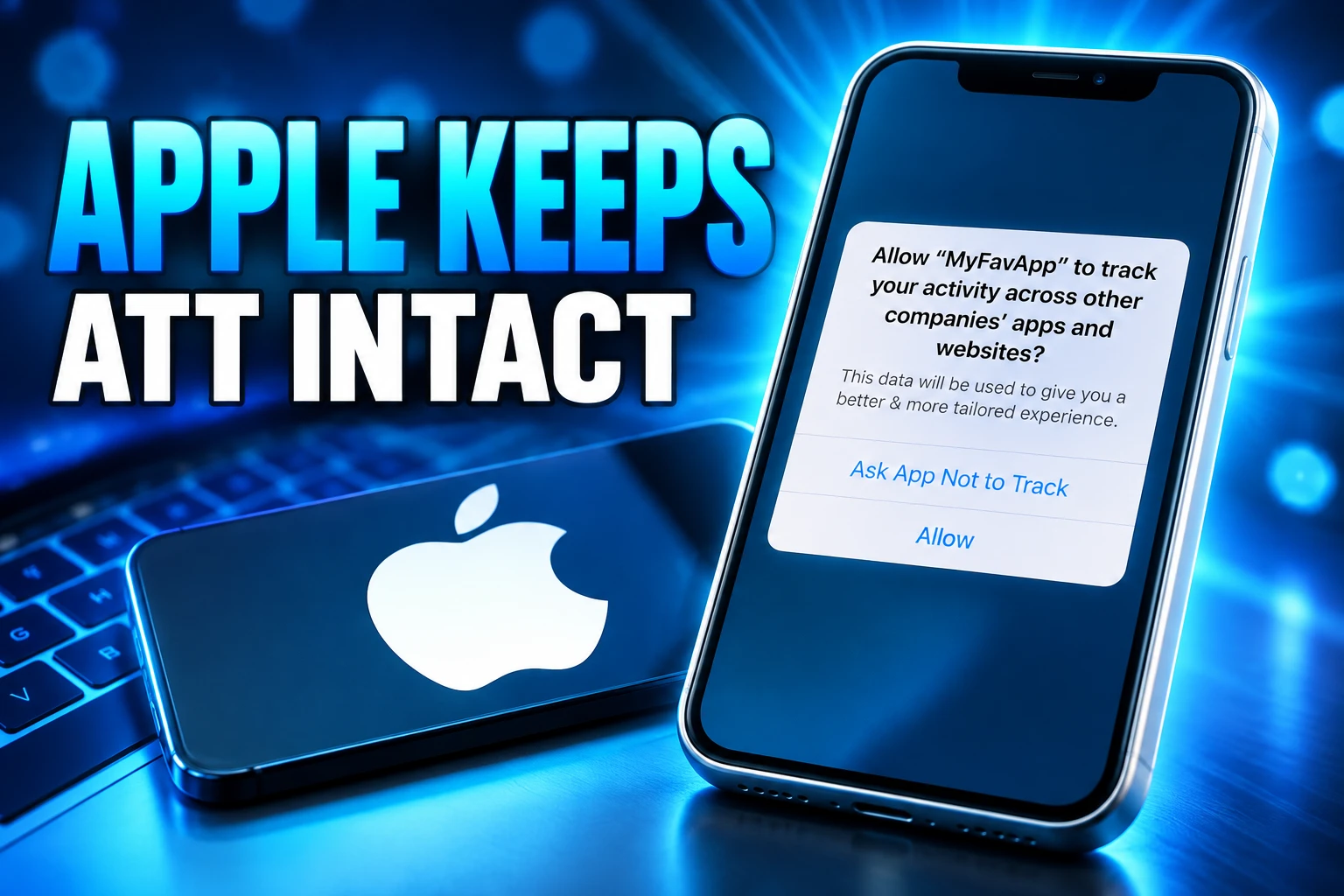
Apple Must Drop the Warning Hand
The office did not object to Apple asking users about tracking. It objected to how the ask was dressed, and to the extra steps piled on third-party apps. In the preliminary view, the third-party screen steered people toward refusal while Apple’s own ads screen steered them toward yes.
That steering, the office said, came from symbols, word choice, thin explanations of the upside, fuzzy descriptions of the data use, and the order of the buttons. Publishers had started adding their own pre-prompt screens just to get a word in before Apple’s system dialog appeared.
WHAT APPLE MUST CHANGE ON THE PROMPT
- The hand icon: The warning hand and the word tracking come off the predefined third-party request.
- Neutral chrome: Content, wording, and layout must be neutral, and the third-party screen must sit much closer to Apple’s own ads prompt.
- Room to explain: App publishers and media publishers get more space to say what personalized ads fund in their product.
- One path, not two: Publishers gain more freedom to combine Apple’s required ask with the consent required under data protection law, or to connect the two so users can follow them.
- Both screens move: Apple’s own Personalized Ads prompt is rewritten too, so the pair no longer pull in opposite directions.
Mundt said the office is not trying to drive consent rates as high as possible. People who want to refuse personalized ads, he said, must be able to do that as freely as people who want to accept them. A flatter screen still has to carry a real choice, not a quieter yes.
A flatter screen will also make refusal look less like a safety step. The old hand icon framed the tap as a hazard. Take that frame away and Allow is just another button, which is exactly why privacy-minded users already read this deal as a win for ad networks rather than for the person holding the phone.
Personalized Ads Never Faced the Same Ask
Since iOS 14.5, third-party apps that want to track a person across other companies’ apps and sites, or to read the Identifier for Advertisers, need permission through the App Tracking Transparency framework. Refuse, and the IDFA comes back as zeros. The office found no equally useful technical substitute for that cross-company match.
Apple’s own personalized ads do not run on that IDFA pipe. They run on data from Apple’s own apps and services, a pool most small publishers do not have. So Apple does not show the ATT prompt for that ads product. It shows a Personalized Ads prompt instead, and it does not add a second consent-management screen on top.
Third-party apps usually do. European data protection law still wants its own yes, often through a consent-management platform that looks like a cookie banner. Apple’s extra ATT prompt then sits beside that legal ask. Users get two decisions for one kind of ads use. Apple, on its own ads product, does not double the ask.
ATT PROMPT VERSUS APPLE’S OWN ADS ASK
| Feature | Third-party ATT prompt | Apple Personalized Ads prompt |
|---|---|---|
| Who sees it | Outside apps that want IDFA or cross-company ads data | Apple’s own personalized ads |
| IDFA access | Blocked unless the user agrees | Not used for this ads product |
| Second legal banner | Usually yes, via a consent-management platform | No extra consent-management screen |
| Tone the office flagged | Steered toward refusal, including the warning hand | Steered toward agreement, using “personalized advertising” |
| After this deal | Neutral chrome, more explanation, combinable with the legal ask | Brought closer in wording, design, and choices |
Apple’s dual role is what turned a privacy screen into a competition file. It ships the operating system and the App Store, and it also sells apps and ads inventory. The designation proceeding found that up to 60 percent of app publishers’ revenues run through that distribution pipe. The house that writes the consent rules also sells against the people who have to show them.
€150 Million in France, €98.6 Million in Italy
Berlin took a redesign. Paris and Rome took cash. The Bundeskartellamt noted that other European competition authorities have already closed ATT cases with large penalties: France imposed €150 million in 2025, and Italy imposed €98.6 million.
Italy’s decision, dated 22 December 2025, is the sharper legal cousin of the German file. The Italian Competition Authority found abuse of a dominant position on iOS under Article 102 of the Treaty on the Functioning of the European Union. It said the ATT prompt does not meet privacy-law requirements, so developers must ask twice for the same profiling purpose, and that a single step could have protected users just as well.
The Italian order named Apple Inc., Apple Distribution International Ltd, and Apple Italia S.r.l. It said the terms were imposed unilaterally and harmed developers who sell ads space, plus advertisers and ads intermediaries. Apple said it strongly disagrees and that ATT gives users a simple way to control cross-app tracking.
THREE EUROPEAN ATT OUTCOMES
| Country | Path | Money | What happens to ATT |
|---|---|---|---|
| Germany | Commitments, proceeding closed | None | Framework stays; prompts and the extra-step architecture change for seven years |
| France | Infringement fine in 2025 | €150 million | Penalty imposed; not part of the German commitment package |
| Italy | Article 102 finding on 22 December 2025 | €98.6 million | Double consent held disproportionate; Apple disputes the decision |
Romania and Poland have run, or are still running, their own ATT cases under the same European abuse rules. The German office coordinated through the European Competition Network, with the European Commission in the room. The solution in Germany, it said, may influence how ATT looks in other member states. That is a forecast, not an order to ship the new prompt to every EU billing address.
Who Pays When Tracking Stays Gated?
Many apps are free at the point of download and live on ads. Personalized ads pay more than broad ones, which is why outside developers, including Meta, want a usable yes. Other apps live on paid downloads and subscriptions. Apple often takes a commission on those payments. It generally does not take a cut of publishers’ ads revenue.
That split is the quiet incentive inside the file. When tracking is hard, ads-funded apps lose yield. Payment-funded apps still owe Apple its share. Media publishers admitted to the German proceeding argued that a gatekeeper should not add extra-statutory rules that shrink those ads businesses, especially as news and other digital products lean on that money.
WHERE THE PARTIES STILL DISAGREE
- Apple: ATT is a lawful privacy measure that also lets the company compete on a high data-protection standard, and the German data protection authorities share the view that the current prompt is clear.
- Brand, media, and advertising associations: A company in Apple’s position should not write extra rules on top of data protection law if those rules restrict other firms’ businesses.
- German data protection offices: ATT is welcome as privacy policy, and they point to weak compliance by some app publishers, but they do not treat ATT as required under data protection law.
The Bundeskartellamt exchanged views with the Federal Commissioner for Data Protection and Freedom of Information and with the Bavarian State Office for Data Protection Supervision so the competition case would not wander into their lane. It still judged ATT only as a competition problem. Tracking after a valid ads consent is, in its telling, a lawful business model in Germany. Apple may still sell extra privacy. It may not write the extra rules in a way that favors its own ads ask.
It is expressly not our aim to help achieve the highest possible levels of consent to personalised advertising. We want to ensure that users can make a free and informed decision. Users who do not wish to allow their data to be used for personalised advertising must be able to make an equally free and informed decision as users who intend to consent to such data use.
Andreas Mundt, President of the Bundeskartellamt
Mobile advertising analyst Eric Seufert argued after the close that a cleaner prompt, plus the chance to bundle other data-use asks with it, will nudge opt-in rates up by a non-trivial amount in the countries that actually see the new chrome. He was skeptical the United States will copy the design, and he noted that old refusals will not reverse in bulk. On that read, the German package matters more as a limit on self-preferencing platform rules than as an immediate reset of the ads market.
German Billing Addresses Get the Neutral Prompt
The proceeding sat on two legal legs: Section 19a of the German Competition Act, the special abuse control for large digital companies, and Article 102 TFEU. The office designated Apple under Section 19a in April 2023. The Federal Court of Justice confirmed that finding in March 2025. Only after that second-step power was locked in did the ATT file move from a warning to a binding rewrite.
The legal lock is the German case. The office describes a solution for Germany that may spill into other EU designs. Apple, for its part, has said the commitments let it keep ATT in Europe. Those are not the same statement. One is a German order with a trustee attached. The other is a product choice about how widely to ship a new screen.
Publishers who think Apple is missing the deal can go to the monitoring trustee. If the trustee cannot settle a dispute, it informs the Bundeskartellamt and consults it on enforcement. The office’s ordinary legal tools remain. That leash lasts seven years after implementation, which is a long time to argue about button order, and a short time in the life of a system that has already run since April 2021.
In early September, developers opened a UK tribunal claim on the same self-preferencing theory, treating the German close as a map rather than a payday. The German file still does not rewind years of “Ask App Not to Track” taps already stored on phones, in Germany or anywhere else. Apple now has four months from service of the 13 August 2026 decision to ship the new screens, after a publisher test, and then seven years of a trustee watching whether the scare copy actually stayed off.
Frequently Asked Questions
Does the German decision remove App Tracking Transparency?
No. The Bundeskartellamt left the App Tracking Transparency Framework in force and changed two pieces of it: the design of the consent screens and the extra-step architecture that made third-party apps ask more than once. German data protection offices, which the cartel office consulted, have treated ATT as useful privacy policy while also saying it is not required under data protection law.
Why does Apple show a different ads prompt in its own apps?
Apple’s personalized ads product does not use the IDFA or cross-company tracking, so the ATT prompt does not apply to it. Apple instead shows a Personalized Ads prompt and does not add a second consent-management banner. Smaller publishers do not have a matching first-party data pool, which is why the office treated the two asks as a competition problem rather than two equal privacy screens.
How can a developer enforce the new ATT rules?
App publishers can take a complaint to the independent monitoring trustee if they think Apple is breaching the commitments to their detriment. If the trustee cannot settle the dispute, it informs the Bundeskartellamt and consults the office on putting the commitments into effect, and the office’s existing legal enforcement routes stay open for the seven-year term.
Will iPhones outside Germany show the new ATT prompt?
The binding German solution is the German proceeding; the office said it may influence ATT’s future design in other EU member states, which is not the same as an EU-wide order. Romania and Poland have conducted or are still conducting their own ATT cases. Apple has said the commitments allow it to keep providing the tool in Europe, which leaves the product rollout wider than the legal map if Apple chooses to ship it that way.
The next visible change is a system dialog, not a court order tearing ATT out of iOS. Publishers get a cleaner ask and a trustee to call. Apple keeps the gate that has sat on the IDFA since April 2021, now with plainer words and seven years of someone checking the chrome.

Instagram Plus Tests a Read-Only Mode That Cuts Stories

Altman Asks the Public to Accept Some AI Harm

Google Freezes OSS VRP Product Reports After AI Flood

AI Agents Make Payment Rails the Scarce Prize

Turkey’s Crypto Boom Now Runs Through Three Banks

Fable 5 Came Back Under a Commerce On-Off Switch

Google’s SpaceX GPU Lease Has a Sept. 30 Deadline

Plasma One’s XPL Locks Face a 1.81 Billion Cliff

DGO’s Rs 549 World Cup Pass Cost Fans Sleep and Data

Moonshot AI’s $30 Billion Ask Became a $35 Billion Close
-
 AI4 months ago
Fable 5 Came Back Under a Commerce On-Off Switch
-
 AI4 months ago
Google’s SpaceX GPU Lease Has a Sept. 30 Deadline
-
 CRYPTO4 months ago
Plasma One’s XPL Locks Face a 1.81 Billion Cliff
-
 APPS4 months ago
DGO’s Rs 549 World Cup Pass Cost Fans Sleep and Data
-
 AI4 months ago
Moonshot AI’s $30 Billion Ask Became a $35 Billion Close
-

 NEWS4 months ago
ColorOS 17 Device List Spans Oppo, OnePlus and Realme
-

 GAMING4 months ago
Xbox Cuts 3,200 Jobs After Five Years of Thin Returns
-

 GAMING4 months ago
The RTX 4050 Under Rs 70,000 Hides a Wattage Gap