
AI
Apple’s Rebuilt Siri Takes Center Stage at WWDC 2026
Apple’s WWDC 2026 kicks off June 8 with a rebuilt Siri, standalone chatbot app, and iOS 27 backed by a reported $1 billion Google Gemini deal.

Apple’s WWDC 2026 keynote kicks off June 8 at Apple Park in Cupertino with the company’s biggest AI push yet: a rebuilt Siri with chatbot capabilities, a standalone Siri app, and iOS 27 across all Apple platforms. Bloomberg’s Mark Gurman reports the overhauled assistant will run partly on a custom Google Gemini model, at a cost of roughly $1 billion per year.
Apple first promised this version of Siri at WWDC 2024, then missed two consecutive launch windows. Monday’s keynote is the third attempt, delivered by Tim Cook in his final WWDC as chief executive, 15 years after he took the role from Steve Jobs.
Two Years Late to the Party
When Apple first unveiled the new Siri at WWDC 2024, the promise was specific: an assistant that could read emails, check calendars, and answer questions about a user’s own data by searching across their apps. Apple called it “personalized Siri” and scheduled delivery for iOS 18 that fall. The feature missed the deadline.
By March 2025, Apple had done something unusual: admitted publicly the overhaul was running behind schedule. Bloomberg’s reporting described teams in conflict, Siri treated internally as a “hot potato” passed between engineering groups for years, and an ad campaign featuring actress Bella Ramsey quietly pulled to avoid a televised promise the company couldn’t keep. In April, John Giannandrea was moved out of Siri’s top leadership role; Mike Rockwell took over, reporting directly to Craig Federighi, Apple’s software chief.
The delay timeline in brief:
- WWDC 2024 – Apple previews personalized Siri for iOS 18: on-screen awareness, deep app integration, and personal context drawn from Mail, Messages and Calendar, all promised for fall 2024.
- March 2025 – Apple officially admits the overhaul is running behind schedule; promised features slip to 2026.
- April 2025 – Giannandrea removed from Siri leadership; Rockwell appointed, reporting to Federighi.
- January 2026 – Apple announces a Google Gemini partnership to provide the cloud AI backbone the rebuilt assistant requires.
Since that January 2026 partnership, the architecture has taken shape: Apple’s own on-device models handle local queries while a custom Gemini model handles cloud inference, routed through Apple’s Private Cloud Compute infrastructure. That Siri delay also held up Apple’s camera-equipped AirPods, which depend on the same rebuilt assistant pipeline; both are expected to arrive together this fall.
Siri Gets Its Own App
A New Home in the Dynamic Island
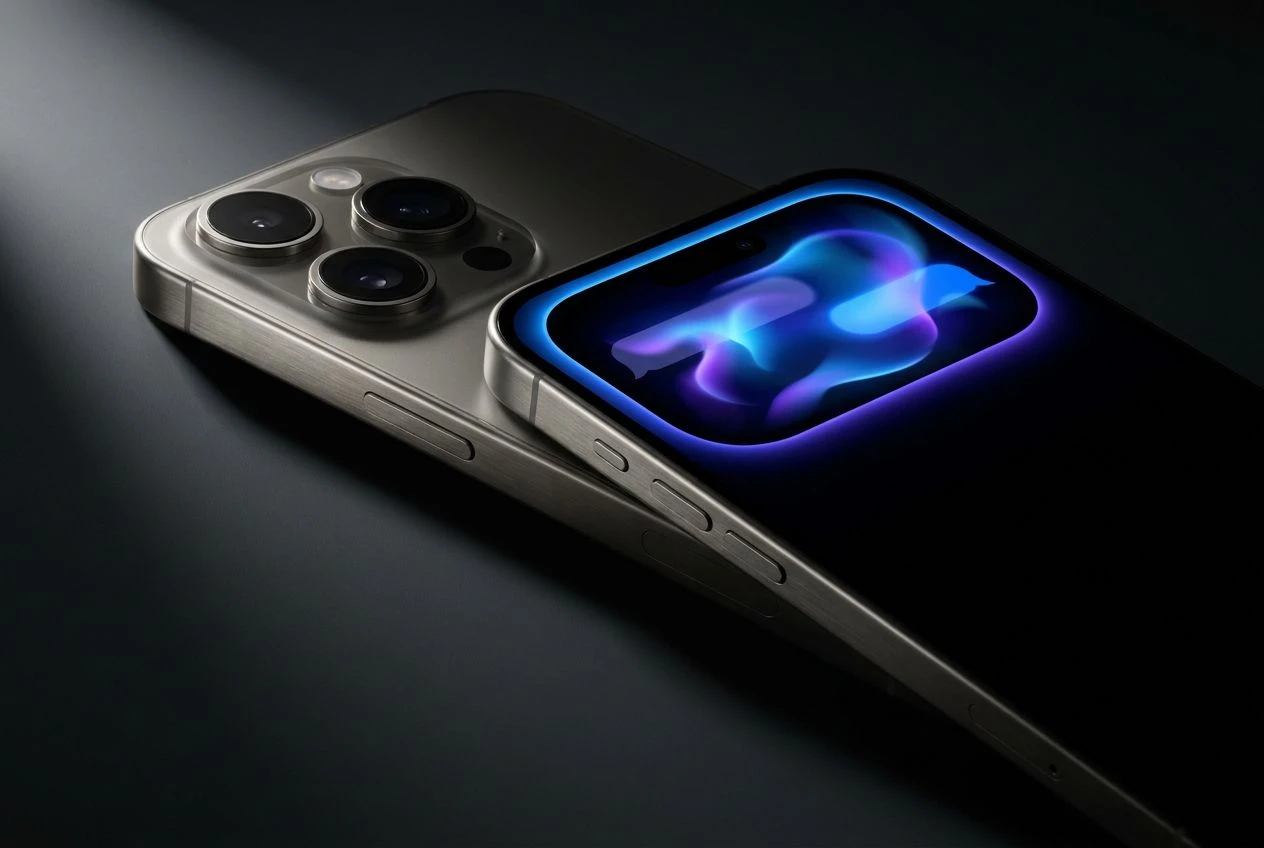
The new Siri interface will live in the Dynamic Island, the oval cutout at the top of iPhone Pro models. A tap or swipe brings up a prompt reading “Search or Ask” alongside a glowing cursor, an interface Apple itself previewed when the WWDC 2026 promotional graphic highlighted the numeral “26” in a matching glow. A dedicated Siri app, appearing on iPhone, iPad and Mac for the first time, turns what was a system shortcut into something closer to the chat interfaces that ChatGPT and Anthropic’s Claude have made familiar.
The app saves conversation history, lets users choose whether Apple stores sessions on iCloud or deletes them automatically after a set period, and supports file and photo uploads for AI analysis. Both voice and text input route through the same interface. Key capabilities reported for launch:
- Dedicated app with saved, searchable chat history across iPhone, iPad and Mac
- Dynamic Island integration with a “Search or Ask” prompt and glowing cursor
- Unified voice and text input from one interface
- File and photo upload for in-conversation AI analysis
- iCloud sync with user-controlled conversation retention settings
Personal Context and Third-Party Models
The rebuilt Siri reads across Mail, Messages, Calendar, Photos and Notes to construct context-aware answers. The demo Apple showed at WWDC 2024 (asking Siri which flight your mother is on by letting it search your inbox) is supposed to finally ship. The rebuilt version processes this on-device, in an architecture Apple says keeps raw personal data from transmitting to external servers.
The iOS 27 Extensions feature opens Apple Intelligence to third-party AI providers. Users can switch the default model across Apple Intelligence features, with OpenAI’s ChatGPT, Google Gemini and Anthropic’s Claude all reportedly available as alternatives. Developers get App Intents 2.0, an expanded framework that lets a rebuilt Siri call directly into third-party apps and execute multi-step tasks across the full App Store catalog.
Apple’s $1 Billion Deal With Google
Apple signed the January 2026 Google deal after years of building its AI capabilities without a full cloud partnership, relying on its own models and an opt-in ChatGPT arrangement for queries outside Siri’s scope. Under the new terms, Apple reportedly pays Google roughly $1 billion annually for access to a custom version of Google’s Gemini, a roughly 1.2-trillion-parameter model per Bloomberg’s reporting, a figure neither company has confirmed.
The first step for Apple to create a foundational AI consumer platform.
Wedbush Securities analyst Dan Ives described the Gemini selection that way ahead of Monday’s keynote. Ives carries an Outperform rating and a $400 price target on Apple shares.
The model runs inside Apple’s Private Cloud Compute infrastructure, meaning user queries route to Google’s hardware without raw personal data leaving Apple’s environment. Nvidia’s GPUs power the cloud inference through Google’s network; Apple’s A-series and M-series chips handle local tasks. The result is a tiered system: fast on-device responses for routine requests, and Gemini-powered responses for multi-step reasoning that demands more compute than a phone chip delivers.
The Wall Street Journal has reported that the standalone Siri app may carry a paid subscription tier comparable to ChatGPT Plus. Wedbush projects the AI expansion could generate an additional $15 billion in annual services revenue for Apple over time as it builds AI-driven features across health, finance and fitness.
The Snow Leopard Underneath
macOS Snow Leopard, released in 2009, was Apple’s operational reset: a version of OS X that cut 6 gigabytes of disk space, eliminated hundreds of bugs, and added almost nothing visible to users. Engineers and reviewers praised it precisely because Apple had found the discipline to ship a cleanup release when the platform needed one.
iOS 27 has attracted the same label inside Apple. After iOS 26 arrived last fall with the Liquid Glass redesign (and brought battery drain, keyboard unreliability and sporadic Face ID delays along with it), the 2026 update’s engineering focus is the codebase itself. Teams are reportedly removing outdated code, reducing memory overhead, and patching what multiple outlets described as disappearing icons and delayed authentication. A Liquid Glass intensity slider is also shipping, giving users control over the transparency level Apple introduced a year ago.
Feature additions appear across the system, most of them practical:
| App | What Changes in iOS 27 |
|---|---|
| Camera | Dedicated Visual Intelligence mode alongside Photo, Video, Portrait and Panorama |
| Photos | New Extend, Enhance and Reframe AI editing tools for expanding borders, adjusting perspective and sharpening quality |
| Wallet | Scan physical tickets, transit cards and gym passes to generate digital equivalents |
| Wallet / Messages | Photograph a receipt to split costs among contacts |
| Shortcuts | Natural language automation: describe the task, the app builds the workflow |
| System | Liquid Glass intensity slider; codebase cleanup targeting bugs and battery drain from iOS 26 |
Shortcuts, a power-user tool most iPhone owners never opened, gets natural language input in iOS 27. Describe the automation you want and the app constructs the workflow. Apple has positioned this as lowering the entry barrier; the ceiling for complex, multi-app automations stays roughly where it was.
What Does Cook Leave for Ternus?
The theme for WWDC 2026 is “All Systems Glow.” That’s tidy marketing copy for a software conference, and the timing gives it a second layer. Apple confirmed in April that Tim Cook will step down as chief executive on September 1, with John Ternus, currently SVP of Hardware Engineering, taking the CEO role. Cook stays as Executive Chairman after 15 years leading the company.
What Ternus inherits is a company in strong financial condition with an AI reputation that still needs delivery. iPhone revenue climbed 23% year-over-year in the first half of Apple’s fiscal year 2026, per Goldman Sachs analyst Michael Ng, who carries a Buy rating and a $340 price target and expects the rebuilt Siri to sustain that demand through the fall iPhone 18 cycle. The AI overhaul announced Monday ships to users only in September.
Apple’s AI hardware pipeline connects directly to Monday’s software announcements. Camera-equipped AirPods relying on the rebuilt Siri for visual intelligence capabilities have reached final testing stages per Bloomberg, tying the wearable schedule to the same September window. Ternus’s first months as CEO run on the product timeline Cook set at this WWDC.
The September Test
Developer betas ship June 8, with a public beta following around mid-July and the full iOS 27 release arriving in September alongside iPhone 18. One caveat runs through all the announcements: iOS 27 itself supports the iPhone 12 and newer, but Apple Intelligence (the layer that powers the rebuilt Siri’s cross-app context and multi-model switching) still requires an iPhone 15 Pro, 15 Pro Max, or any iPhone 16 or later. Users on older devices receive the stability fixes and most new app features, without the chatbot-capable Siri.
The installed base restriction has real commercial weight. Apple has not disclosed what share of its active iPhones qualify for Apple Intelligence; that figure matters directly for the potential paid Siri subscriber pool and for how broadly developers can monetize through App Intents integrations. The central developer question is whether the App Intents framework ships stable enough to build on, with Apple expected to introduce richer entity types, streaming responses and conversational follow-ups that could turn any App Store app into a Siri-addressable capability.
The management reshuffle happened. Google’s deal closed. iOS 27 is reportedly Apple’s most stability-focused release in years. The public beta period runs from mid-July through summer. The full iOS 27 release arrives in September alongside iPhone 18.


Sony’s 10 Percent Disc Drop Leaves the 2028 Cutoff Intact

Chip Allocation Sidelines the Base iPhone 18 This Fall

Miami-Dade Fights the Vice City Brand It Already Wears

IFA 2026 Awards Put Tecno Ahead of Flagship Phones

USB-C Gadgets Made the Junk Drawer Rechargeable

Pixel 11 Pro Asks $1,099 for a Light Google Locked

The iPhone Ultra Sells Two Retired Minis as One Foldable

Google Opens Gmail to Voice and Gates Docs Live

Lenovo Prices the IdeaPad Vibe Against Apple’s $699 Neo

Xbox Caps Game Pass Cloud Gaming at 15 Hours

Oracle Cuts 21,000 Jobs in a Year, Cites AI in 10-K Filing

Fable 5 and Mythos 5 Return as US Lifts Anthropic Export Controls

SpaceX’s Google Deal Turns a Rocket Company Into a Cloud Landlord

CD Projekt Red Co-CEO: Redemption Arc Isn’t Done, Witcher 4 in 2027

XPL Rallies 30% Ahead of Plasma One Card Tier Launch

Google Search Profiles Build a Follow Graph Inside Discover

DGO App Brings Rs 549 Mobile Pass for FIFA World Cup 2026 in Nepal

Moonshot AI Targets $30 Billion in China’s Fastest AI Funding Sprint

Oppo’s ColorOS 17 Eligibility List Leaves A-Series Buyers Behind

Microsoft Xbox Layoffs Start in July as Sharma Slams 3% Margin
-
 AI2 months ago
Oracle Cuts 21,000 Jobs in a Year, Cites AI in 10-K Filing
-
 AI2 months ago
Fable 5 and Mythos 5 Return as US Lifts Anthropic Export Controls
-
 AI3 months ago
SpaceX’s Google Deal Turns a Rocket Company Into a Cloud Landlord
-
 GAMING3 months ago
CD Projekt Red Co-CEO: Redemption Arc Isn’t Done, Witcher 4 in 2027
-
 CRYPTO3 months ago
XPL Rallies 30% Ahead of Plasma One Card Tier Launch
-
 NEWS3 months ago
Google Search Profiles Build a Follow Graph Inside Discover
-
 APPS3 months ago
DGO App Brings Rs 549 Mobile Pass for FIFA World Cup 2026 in Nepal
-
 AI3 months ago
Moonshot AI Targets $30 Billion in China’s Fastest AI Funding Sprint