
AI
AI Appointment Reminders Are Cutting No-Shows Across Industries
AI appointment reminders cut no-shows by up to 60% by turning one-way texts into two-way conversations that confirm, reschedule, and adapt to each customer.

The dental hygienist sits idle for 45 minutes because the 9 a.m. patient never called back. The reminder text went out the day before, said “you’re scheduled for 9 a.m.,” and stopped there. AI appointment reminders are now being deployed to close that silence, turning a one-way notification into a two-way conversation before the slot goes empty.
Missed appointments cost the U.S. healthcare system an estimated $150 billion a year, according to a 2026 industry data review of no-show statistics. Across appointment-based businesses outside healthcare, the cross-industry no-show rate sits between 20% and 25%. “Many no-shows happen because communication stops after an appointment is booked,” said Brett Thomas, owner of Rhino Precision Marketing in New Orleans, Louisiana. “Artificial intelligence helps keep that conversation going by sending reminders, answering questions, and making it easier for customers to confirm or reschedule appointments before scheduling conflicts become missed opportunities.”
The No-Show Problem in Numbers
No-show rates are not evenly distributed across industries. The same 2026 industry data review pulls together data from BMC Health Services Research, the Journal of General Internal Medicine, the American Dental Association Health Policy Institute, and aggregated customer records from 400-plus healthcare practices. The numbers vary sharply by setting.
Healthcare sits at roughly 23% on average across all specialties. Dentistry runs lower, at about 15%. Primary care comes in at 19%. Specialty care pushes higher, to about 25%. Outside healthcare, rates climb further in some segments. Salons and fitness studios top the range at up to 30%. Financial services sit near the bottom, around 10%.
The math is unforgiving at the practice level. A typical primary care office that schedules 30 appointments a day, runs a 20% no-show rate, and charges $150 per visit walks out the door with about $225,000 in unrealized revenue a year. The cost is not only lost revenue. An empty slot is one the front desk cannot usually refill on short notice. Staff time still gets paid. Other patients who could have taken the appointment keep waiting. The disruption ripples through the rest of the day.
| Industry | Average no-show rate |
|---|---|
| Healthcare (all specialties) | 23% |
| Dentistry | 15% |
| Primary care | 19% |
| Specialty care | 25% |
| Salons and fitness studios | up to 30% |
| Financial services | about 10% |
| Cross-industry (appointment-based) | 20% to 25% |
Source: Appointment Reminder, 2026 no-show statistics review.
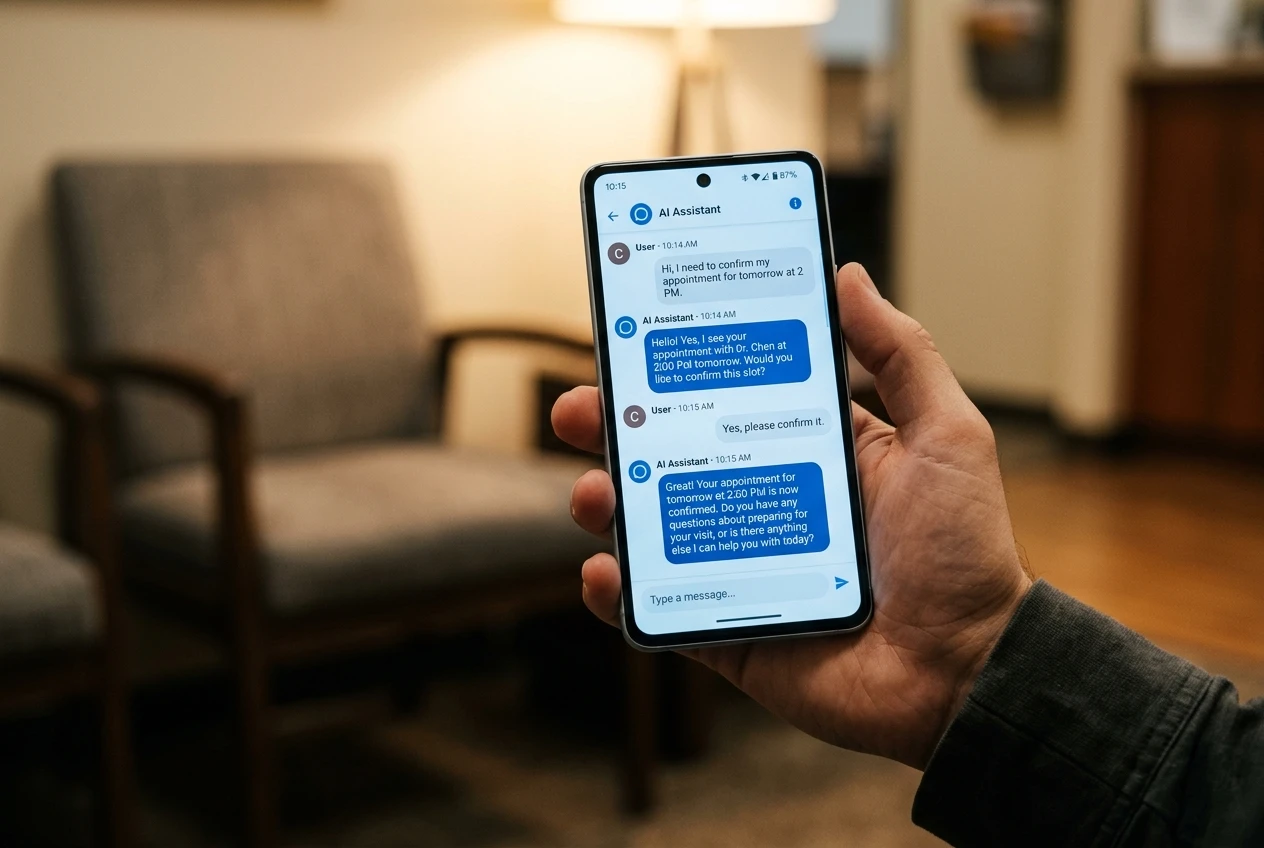
From One-Way Ping to Two-Way Conversation
Traditional reminder systems fire off a single text or email a day or two before the appointment. The message says “you’re scheduled for X.” If the customer has a conflict, they have two options: show up anyway, or call the office. Most do neither. The slot dies.
AI-powered platforms flip the script. Instead of a one-way notification, they open a two-way conversation. The customer can ask a follow-up question about parking, paperwork, arrival time, or appointment length. The system answers using information the business has already approved, and the customer can confirm, modify, or cancel without waiting for an employee to pick up the phone.
What an AI reminder stack typically does:
- Send reminders across multiple channels, including text, email, voice calls, and online chat.
- Answer common questions about preparation, directions, and policies without staff involvement.
- Walk customers through rescheduling so cancellations turn into new bookings instead of empty slots.
- Track which channel each customer responds to and adapt the next reminder accordingly.
- Schedule different reminder intervals for different services, with a medical procedure getting several preparation prompts and a home service visit getting a single morning-of confirmation.
- Push estimated arrival times and delay updates for field technicians and mobile service providers.
The arrival-time update is built for contractors, plumbers, HVAC technicians, and repair crews. Their businesses have always lived with the customer’s no-show risk. An AI that pings the customer with “your technician is 20 minutes away” turns a vague one-to-five-hour window into something the customer can plan around. The same kind of push has spread into consulting and home services, where the visit itself is the product.
Which Channels Actually Get a Reply
Forgetting is the single biggest reason people miss appointments, according to the same review. Up to 28% of no-shows trace back to transportation problems. Anxiety keeps another 20% to 25% away. Scheduling conflicts account for 10% to 15%. Financial worries add another 10% to 15%.
No single channel solves all of them. A reminder that fires on text alone misses the customer who only checks email. A reminder that fires by email misses the customer who never opens a message without a phone vibration behind it. AI platforms adapt by watching how each customer has responded in the past and shifting the channel until the message lands. Academic work on machine learning approaches to predicting patient no-shows has documented the same channel-mismatch problem in outpatient settings.
The same review compiles the effectiveness data. SMS reminders alone cut no-shows by about 38%. Multi-channel systems that combine SMS, email, and voice reach the 30% to 60% reduction range. Single text messages without follow-up sit lower. Automated voice calls land somewhere in between. The numbers come from randomized reviews compiled by Appointment Reminder from the Cochrane Database of Systematic Reviews and PLOS ONE.
Filling the Slot Before Lunch
The reminder is the entry point. The broader shift is what happens around the edges of the calendar.
Some platforms score appointments on cancellation risk based on prior communication patterns. If a customer has rescheduled three times in six months, the system flags the next booking for staff follow-up before the slot is lost. The same flagging logic looks at how quickly a customer replies to past reminders, whether past conversations mentioned scheduling conflicts, and whether arrival confirmations have come late. None of these signals predict a no-show by themselves. Together, they form a risk profile the front desk can act on.
When a cancellation does happen, AI can immediately notify the next person on the waiting list. That shrinks the time between an empty slot and a filled one. For high-volume practices, a cancellation filled at 9 a.m. captures a full day of production. The same slot filled at 4 p.m. captures nothing.
After hours is where the gap is widest. Most customer questions about appointment availability, service areas, business hours, and pricing show up in the evening or on weekends, when the office is closed. An AI assistant that stays on through those hours answers the question, captures the lead, or starts the rescheduling process before anyone returns to the desk. Brett Thomas laid out the case in a separate June 2026 release on after-hours AI customer service: “Many customer questions occur during evenings and weekends when offices are closed. Artificial intelligence provides an opportunity to share basic information, answer common questions, and collect important details so conversations can continue when business hours resume.”
Where the Automation Stops
The press release quotes that float around AI customer service tend to suggest the technology handles everything. It does not. The systems work best on routine, structured exchanges: confirmations, reschedules, simple factual questions.
Artificial intelligence does not replace personal interaction for situations requiring detailed conversations or complex decision-making.
The mechanics of who handles what still matter. A patient who just learned they need a procedure will not be reassured by a chatbot. A homeowner asking whether their roof qualifies for an insurance claim needs a human. A salon client upset about a service wants a voice, not a script. The wider pattern across expert commentary on AI in customer-facing roles points the same way: technology helps, but people, governance, and skills decide the outcome.
The framing in the original press release is that AI handles the routine so employees can focus on the conversations that need them. For most appointment-based businesses, the ratio is favorable: the bulk of incoming messages are confirmations, simple questions, and rescheduling requests. Those are the exchanges an AI can close without a human in the loop. The same logic has shown up in larger adjacent moves, including Evernorth’s $100M Pharmacy Forward program, which uses AI to halve paperwork and time-to-medication in specialty pharmacy.
The Numbers Behind the Switch
The business case for AI appointment reminders rests on three numbers: the no-show rate, the average revenue per appointment, and what the platform costs to deploy. For most small and mid-sized practices, the math closes in the first month because every slot that gets filled instead of going empty pays for the platform several times over.
The 2026 review also notes that practices targeting a no-show rate between 5% and 10% are considered well-run. Anything above 15% is a clear improvement opportunity. Multi-channel AI reminders are one of the more direct paths between where most practices sit today and where the better-run ones already are. Adoption shows up fastest in dental offices, specialty medical practices, and high-volume salons, where the per-appointment revenue justifies the spend.
For larger operations, the savings multiply faster. A specialty clinic running 100 appointments a day with a 25% no-show rate loses the equivalent of a full day of capacity each week. Cutting that rate by even 10 percentage points recovers two production days a month. The same arithmetic scales for any business where the appointment is the unit of revenue.
Frequently Asked Questions
How much do AI appointment reminders actually reduce no-shows?
Automated SMS reminders cut no-shows by about 38% on their own, according to a 2026 industry review. Adding email and voice pushes the reduction into the 30% to 60% range. The gap depends on the reminder cadence, the industry, and whether the system makes rescheduling a one-tap reply or a phone call to the office.
Which industries see the biggest gains from AI reminders?
Industries with the highest baseline no-show rates see the largest absolute reductions. Salons and fitness studios run as high as 30%. Specialty medical care runs about 25%. A 30% to 60% reduction in those segments recovers more revenue per appointment than the same reduction in financial services, where the baseline sits closer to 10%.
Do customers actually like getting AI reminders?
Most do, particularly when the system makes rescheduling a reply rather than a phone call. Industry reviews note that immediate confirmation cuts the uncertainty that drives cancellations, and a working two-way exchange answers the parking, paperwork, or preparation question that would otherwise have prompted a no-show.
How fast do results show up?
Most practices that adopt automated multi-channel reminders see measurable changes in the first week, according to the Appointment Reminder review. The change is not always large at first, but the pattern of cancellations turning into reschedules usually shows up before the first month ends.
Does the AI replace the front desk?
No. The press release language is consistent on this point: AI handles the routine exchanges so staff can focus on the cases that need a person. Confirmations, reschedules, and basic questions go to the system. Sensitive or complex conversations still go to a human.


Workers Still Trust Judgment Over the AI Tools They Use

DigitalOcean’s $894 Million Backlog Rewrites the Old Cloud

Companies Froze Job Design and Called AI a People Problem

AI Capex Looks Unique Because the Chips Wear Out

Samsung Medison’s HERA Z10 Aims at the Sonographer Shortage

GPT-6 Astra Ships as OpenAI’s First Critical Cyber Model

Palms Sells Clean Air Without Ending Casino Smoking

OnlyFans Promo Bots on X Now Pass the Humanity Tests

Datamaran Drops the ESG Label After Winning the Argument

Xiaomi’s Own Chip Lands While Apple Argues Over Color

Oracle Cuts 21,000 Jobs in a Year, Cites AI in 10-K Filing

Fable 5 and Mythos 5 Return as US Lifts Anthropic Export Controls

SpaceX’s Google Deal Turns a Rocket Company Into a Cloud Landlord

CD Projekt Red Co-CEO: Redemption Arc Isn’t Done, Witcher 4 in 2027

XPL Rallies 30% Ahead of Plasma One Card Tier Launch

Google Search Profiles Build a Follow Graph Inside Discover

DGO App Brings Rs 549 Mobile Pass for FIFA World Cup 2026 in Nepal

Moonshot AI Targets $30 Billion in China’s Fastest AI Funding Sprint

Oppo’s ColorOS 17 Eligibility List Leaves A-Series Buyers Behind

Microsoft Xbox Layoffs Start in July as Sharma Slams 3% Margin
-
 AI3 months ago
Oracle Cuts 21,000 Jobs in a Year, Cites AI in 10-K Filing
-
 AI2 months ago
Fable 5 and Mythos 5 Return as US Lifts Anthropic Export Controls
-
 AI3 months ago
SpaceX’s Google Deal Turns a Rocket Company Into a Cloud Landlord
-
 GAMING3 months ago
CD Projekt Red Co-CEO: Redemption Arc Isn’t Done, Witcher 4 in 2027
-
 CRYPTO3 months ago
XPL Rallies 30% Ahead of Plasma One Card Tier Launch
-
 NEWS3 months ago
Google Search Profiles Build a Follow Graph Inside Discover
-
 APPS3 months ago
DGO App Brings Rs 549 Mobile Pass for FIFA World Cup 2026 in Nepal
-
 AI3 months ago
Moonshot AI Targets $30 Billion in China’s Fastest AI Funding Sprint