
AI
HKT’s 3.2Tbps Fiber Network Aims to Make Hong Kong an AI Hub
HKT is stringing hollow core fiber to Sandy Ridge, a Mainland-linked data center site promising 36 times Hong Kong’s current AI computing power by 2032.

HKT is laying hollow core fiber straight through the fence line with Shenzhen, betting that a 3.2 terabit-per-second data highway turns Hong Kong into a real AI computing hub rather than just a faster city network. The carrier says the upgrade cuts latency 30 percent below standard fiber and will link the border’s Lok Ma Chau Loop to the established data center cluster at Tseung Kwan O.
The bigger prize sits further out. The same cable corridor is meant to eventually reach Sandy Ridge, a data center site the government sold in March to a mainland-linked developer with a promise of 36 times Hong Kong’s current computing power by 2032.
A 3.2 Terabit Highway Between Two Data Center Clusters
HKT announced the plan on July 17, describing it as the first service of its kind in Hong Kong. It upgrades an existing 800 gigabit-per-second AI Superhighway to 3.2 terabits per second, a fourfold jump built specifically so AI infrastructure operators, universities and research labs can pool computing capacity across separate buildings instead of being boxed into one facility’s limits.
The service is built to carry four networking standards that matter more to engineers than to headline readers. Remote Direct Memory Access, or RDMA, lets one server pull data straight out of another server’s memory without routing it through a processor first. RoCEv2 runs that trick over standard Ethernet gear. Multipath Reliable Connection spreads traffic across several paths at once so a single fiber cut does not stall a training job. Ultra-Ethernet Transport is the newer of the four, a protocol built specifically for the traffic patterns of large AI clusters.
Steve Ng, managing director of HKT’s Commercial Group, said the network delivers ultra-low latency and secure data exchange to unlock the full potential of AI development across the city. He added that it lays groundwork for the Northern Metropolis, a government megaproject along the border, by linking the Hetao area to data centers that already exist.
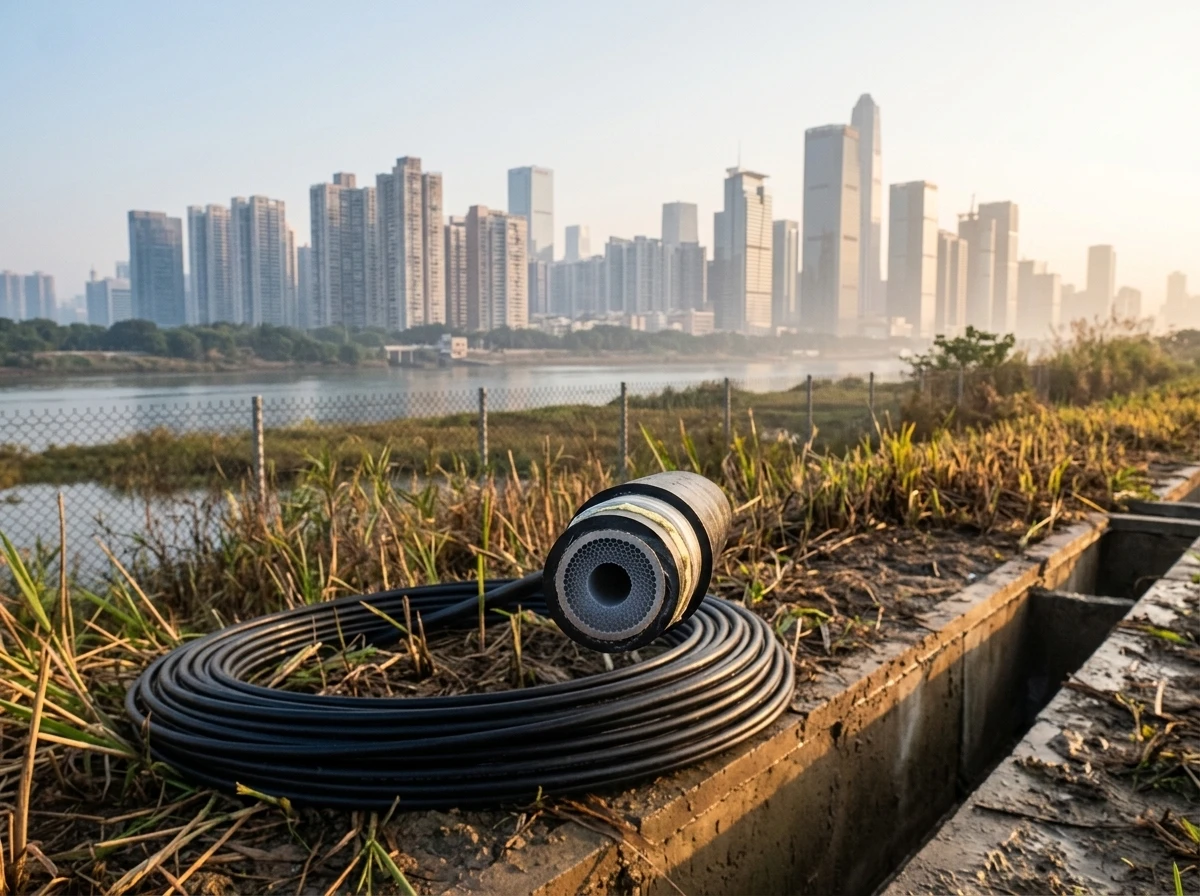
Why Fiber Filled With Air Instead of Glass
Hollow core fiber is not new science. It replaces a solid glass core with an air-filled channel ringed by a honeycomb of tiny glass tubes, and light moves through air roughly 47 percent faster than through standard silica glass. Less material for the signal to fight through means lower latency and, engineers argue, better resistance to tapping.
The technology’s most visible commercial push has come from Microsoft, which acquired the British fiber maker Lumenisity in December 2022 to feed its own cloud network. Lumenisity, a spinout from the University of Southampton’s optics research center, had struggled with signal loss for years. As recently as September 2025, Microsoft researchers reported the lowest signal loss ever recorded in hollow core fiber, still short of the 0.14 decibel-per-kilometer benchmark that ordinary glass fiber has held for decades. HKT has not named its fiber supplier. What it is buying into is a technology class still being perfected in real time, not a mature commodity product.
The Cable Runs Through the Border Zone
Lok Ma Chau Loop is not a random endpoint. It is the site of the Hong Kong park inside the Hetao Shenzhen-Hong Kong Science and Technology Innovation Cooperation Zone, a cross-border research area straddling the Shenzhen River. Hong Kong’s technology minister, Sun Dong, said this month that Hong Kong and mainland China are expected to begin sharing cross-border data within the year, as more companies start operating inside the Hetao hub.
A separate briefing to Hong Kong’s legislature confirmed the government is negotiating implementation details for the cross-border flow of data, materials and capital with mainland counterparts, with a pilot project targeted for launch this year. HKT’s fiber corridor gives that policy a physical rail to run on before the rules are finished.
The stakes are not abstract for mainland AI developers cut off from American chips and models. Some have already turned to a homegrown model when US options were off the table, and Hong Kong’s distinct legal and customs status makes it an obvious staging ground for compute that mainland firms cannot source directly. A zone built on the principle of one zone with two systems operating side by side is precisely the kind of seam that lets that happen.
How Much Computing Power Does Sandy Ridge Add?
Sandy Ridge is projected to deliver 180,000 peta-floating point operations per second by 2032, which the government calls 36 times Hong Kong’s current total computing power, spread across a 250,000-square-meter development in the Northern Metropolis near Lo Wu.
The government awarded the site in March to Hong Kong Range Intelligent Computing Technology Company, whose parent firms include Sengro Fusion Technology Hong Kong under an ultimate holding company called Range Intelligent Computing Technology Group. The table below lays out how the old network compares with what HKT is rolling out now.
| Attribute | 800Gbps AI Superhighway (current) | 3.2Tbps AI DCI Superhighway (planned) |
|---|---|---|
| Peak capacity | 800 gigabits per second | 3.2 terabits per second |
| Latency vs. standard fiber | Not specified | About 30 percent lower |
| Fiber type | Standard fiber | Hollow core fiber |
| Protocols supported | Base connectivity | RDMA, RoCEv2, MRC, Ultra-Ethernet Transport |
| Route | Existing data center clusters | Lok Ma Chau Loop to Tseung Kwan O, then Sandy Ridge |
| Phase 1 target | Live already | End of 2026 |
Sandy Ridge itself won’t feel like a data center for years yet. Here is what the numbers behind it look like on their own.
- 110,000 square meters of land, awarded on a 50-year grant, near Lo Wu in the Boundary Control Points Economic Belt
- 88 percent of the site’s 250,000-square-meter floor area is reserved for high-tier data center use
- Around 180 skilled jobs and roughly $4.6 billion in economic output expected in the first three years
- 180,000 PFLOPS of computing power targeted by 2032, per the government’s tender announcement for the site
For context on the developer, industry analysts at CBRE noted that Northern Metropolis land offers the kind of large, power-ready plots that Hong Kong’s older clusters in Tseung Kwan O, Tsuen Wan and Kwai Chung can no longer supply.
What Still Has to Clear Before the Network Pays Off
HKT’s fiber corridor solves connectivity. It does not solve chip supply, and it does not solve the regulatory question of what cross-border data is actually allowed to move through it.
HKT is firmly committed to supporting innovation in Hong Kong, with the ambition of positioning our city as one of the most advanced I&T hubs in the world.
Ricky Kwong, head of fixed network engineering at HKT and chief executive of Fiber Link Global, said that in announcing the project, adding that the first phase between Lok Ma Chau and Tseung Kwan O is targeted for completion by the end of 2026, ahead of Sandy Ridge coming online.
What’s confirmed:
- The fiber route between Lok Ma Chau Loop and Tseung Kwan O, with phase one due by the end of 2026
- The four networking protocols the 3.2Tbps service will support
- Sandy Ridge’s land grant, floor area and 2032 computing power target from the government’s own tender documents
What’s still unresolved:
- Whether the cross-border data flow pilot for the Hetao zone will actually cover the kind of AI training data these facilities are built to handle
- Which GPU or accelerator supply chains will feed Sandy Ridge once its buildings are ready, given that global AI compute still runs through a small number of chipmakers and cloud platforms whose concentration risk has drawn scrutiny elsewhere in tech
- How soon Sandy Ridge’s operator, whose parent companies have run large data centers on the Mainland, will bring facilities online ahead of the 2032 target
None of that undoes the case for faster fiber. It does mean the 36-times figure is a 2032 target tied to a single tenant, not a number Hong Kong can bank today.
Frequently Asked Questions
What exactly is the Hetao cooperation zone that HKT’s network reaches?
The Hetao Shenzhen-Hong Kong Science and Technology Innovation Cooperation Zone spans about 3.89 square kilometers split across a 3.02-square-kilometer Shenzhen park and a 0.87-square-kilometer Hong Kong park, connected by the Futian and Huanggang border crossings and framed as a 30-minute research corridor linking science hubs on both sides.
Who is building the Sandy Ridge data center cluster?
The site went to Hong Kong Range Intelligent Computing Technology Company, whose parent firms have already developed and operated high-tier data centers and large dataport projects in multiple Mainland Chinese cities, according to the government’s tender briefing.
What is RDMA and why does it matter for AI training?
Remote Direct Memory Access lets servers exchange data directly from memory to memory, skipping the processor overhead that slows conventional networking. For AI training jobs split across thousands of chips, that shortcut is what keeps a cluster acting like one machine instead of many.
How much did Hong Kong charge for the Sandy Ridge land?
The government awarded the 110,000-square-meter site on a 50-year land grant for a premium of HK$581 million, according to the official tender announcement.
Is Hong Kong’s cross-border data-sharing pilot already running?
Not yet as of this month. Officials have said a pilot is targeted to launch within the year, with implementation details for data, materials and capital flows still being negotiated with Mainland counterparts.


Sony’s 10 Percent Disc Drop Leaves the 2028 Cutoff Intact

Chip Allocation Sidelines the Base iPhone 18 This Fall

Miami-Dade Fights the Vice City Brand It Already Wears

IFA 2026 Awards Put Tecno Ahead of Flagship Phones

USB-C Gadgets Made the Junk Drawer Rechargeable

Pixel 11 Pro Asks $1,099 for a Light Google Locked

The iPhone Ultra Sells Two Retired Minis as One Foldable

Google Opens Gmail to Voice and Gates Docs Live

Lenovo Prices the IdeaPad Vibe Against Apple’s $699 Neo

Xbox Caps Game Pass Cloud Gaming at 15 Hours

Oracle Cuts 21,000 Jobs in a Year, Cites AI in 10-K Filing

Fable 5 and Mythos 5 Return as US Lifts Anthropic Export Controls

SpaceX’s Google Deal Turns a Rocket Company Into a Cloud Landlord

CD Projekt Red Co-CEO: Redemption Arc Isn’t Done, Witcher 4 in 2027

XPL Rallies 30% Ahead of Plasma One Card Tier Launch

Google Search Profiles Build a Follow Graph Inside Discover

DGO App Brings Rs 549 Mobile Pass for FIFA World Cup 2026 in Nepal

Moonshot AI Targets $30 Billion in China’s Fastest AI Funding Sprint

Oppo’s ColorOS 17 Eligibility List Leaves A-Series Buyers Behind

Microsoft Xbox Layoffs Start in July as Sharma Slams 3% Margin
-
 AI3 months ago
Oracle Cuts 21,000 Jobs in a Year, Cites AI in 10-K Filing
-
 AI2 months ago
Fable 5 and Mythos 5 Return as US Lifts Anthropic Export Controls
-
 AI3 months ago
SpaceX’s Google Deal Turns a Rocket Company Into a Cloud Landlord
-
 GAMING3 months ago
CD Projekt Red Co-CEO: Redemption Arc Isn’t Done, Witcher 4 in 2027
-
 CRYPTO3 months ago
XPL Rallies 30% Ahead of Plasma One Card Tier Launch
-
 NEWS3 months ago
Google Search Profiles Build a Follow Graph Inside Discover
-
 APPS3 months ago
DGO App Brings Rs 549 Mobile Pass for FIFA World Cup 2026 in Nepal
-
 AI3 months ago
Moonshot AI Targets $30 Billion in China’s Fastest AI Funding Sprint