
AI
Vietnam Coffee Giant Bets $12.3 Million on an AI Research Lab in Gia Lai
Vinh Hiep’s $12.3 million Gia Lai institute aims to out-engineer the drought, aging trees and EU rules squeezing Vietnam’s robusta coffee dominance.

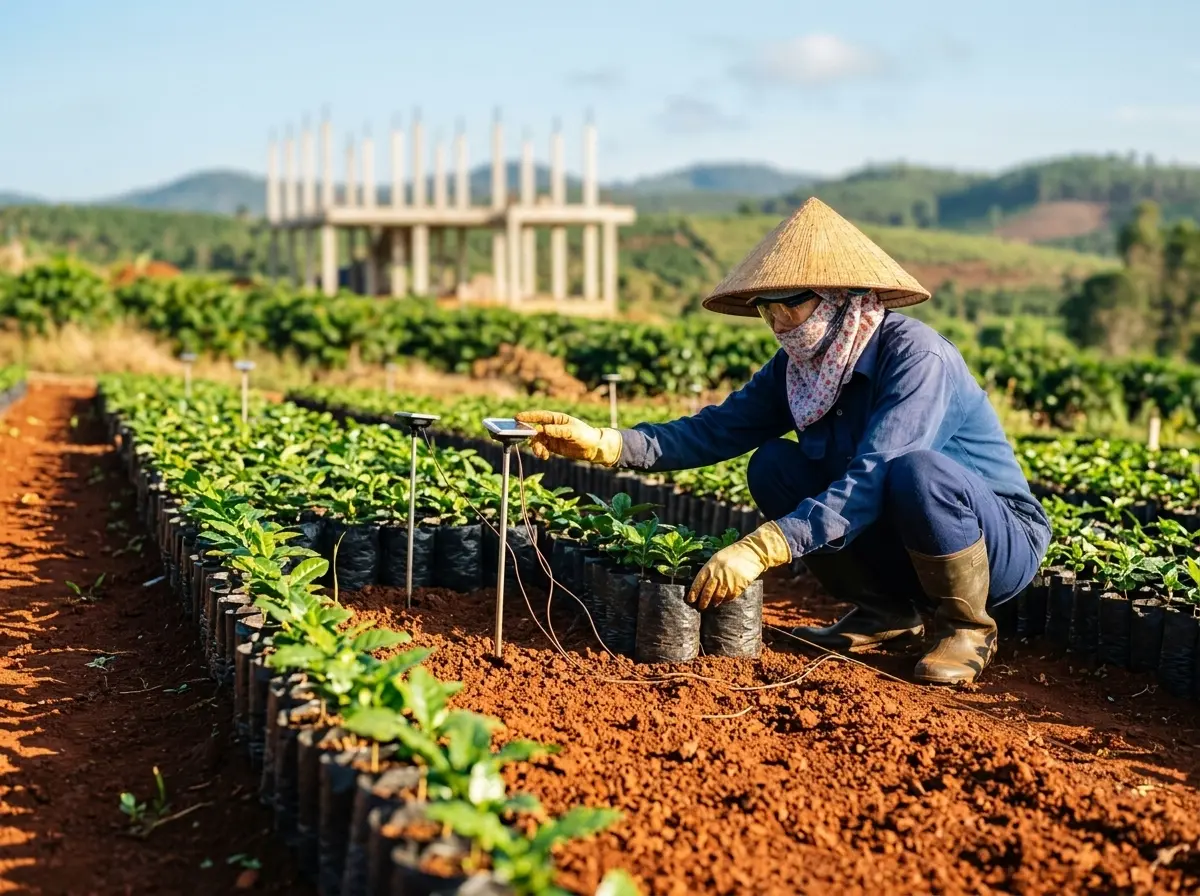
Gia Lai province in Vietnam’s Central Highlands has approved a 326 billion VND ($12.3 million) plan for an AI-powered coffee research institute, funded entirely by coffee and pepper exporter Vinh Hiep Co. The facility will cover 157 hectares, test up to 100 coffee varieties a year, and is targeted to be fully operational by the third quarter of 2028, according to details first reported by Global Coffee Report.
The approval lands as Vietnam’s robusta growers are still absorbing a drought, a price whiplash, and a looming European Union traceability rule that most smallholders are not yet equipped to satisfy. That is the backdrop against which one exporter is choosing to build its own lab rather than wait.
Vinh Hiep’s Three Decades in Robusta
Vinh Hiep is not a startup chasing a trend. The company was founded in 1991 in Pleiku, the Gia Lai provincial capital, and has spent more than three decades processing and exporting green coffee, pepper, roasted coffee and instant coffee, building a customer base that stretches from Japan and Korea to Germany, Spain and the United States.
Growth has accelerated sharply on the back of high global prices. Company director Thai Nhu Hiep, who is also vice president of the Vietnam Coffee and Cocoa Association, said Vinh Hiep’s export turnover reached roughly $550 million in the first half of 2025 alone, up 48 percent year over year, with full-year revenue expected to land between $750 million and $800 million. Much of that jump came from deep-processed products sold under the company’s L’amant Cafe brand into Europe and Japan, markets where Hiep has said buyers increasingly judge coffee on traceability and transparency, not just quality, a shift that lines up with Vietnam’s coffee sector posting a record $8.4 billion in exports over the 2024 to 2025 crop year.
Three Pressures Squeezing Robusta
Vinh Hiep’s bet is arriving at a specific moment for Vietnam’s robusta industry, one shaped by three separate problems converging at once.
- Climate volatility: a prolonged drought cut Vietnam’s 2023/24 crop by roughly 20 percent, its smallest harvest in four years, before a bumper 2025/26 season sent prices sharply back down.
- Aging orchards: close to 30 percent of Vietnam’s coffee area is planted with trees 20 years or older, according to estimates from the Western Highlands Agriculture and Forestry Science Institute, and yields on old trees keep sliding as fertilizer and labor costs climb.
- EU traceability rules: the bloc’s deforestation regulation requires proof that coffee sold into Europe comes from land that was not deforested after December 31, 2020, mapped down to the individual plot, a standard most smallholder farms were never built to meet.
Any one of those would be manageable. Together, they explain why an exporter, rather than a government ministry, is the one writing the check for a research lab.
Robusta’s Price Whiplash
The scale of the shock is visible in the numbers. By December 2024, robusta prices had surged 70 percent in real terms over the previous year, narrowing the price gap with arabica for the first time since the mid-1990s, according to the UN Food and Agriculture Organization’s coffee market note. Limited Vietnamese exports and weather damage in Brazil and Indonesia were named as the main drivers.
That spike did not hold. Robusta fell 4.8 percent in a single session on July 21, 2025, to $3,489 a tonne, its lowest mark since June 2024, as forecasts pointed to a four-year-high harvest. Vietnam’s output has kept climbing since.
| Marketing Year | Total Production (bags GBE) | Exports (bags GBE) | Note |
|---|---|---|---|
| 2024/25 | 29.0 million | 25.2 million | Recovery after the 2023/24 drought |
| 2025/26 | 31.7 million (revised up) | 28.5 million (up 13%) | Four-year-high harvest |
| 2026/27 (forecast) | 32.5 million | 28.95 million (up 2%) | 31.4 million bags robusta, 1.1 million bags arabica |
The United States Department of Agriculture’s Foreign Agricultural Service, which compiled those figures in its May 2026 Coffee Annual report, also flagged that rising global competition and EUDR enforcement will shape how much of that crop actually reaches Europe.
A Replanting Program Still Behind Schedule
Vietnam already has a government answer to aging trees. It just has not kept pace. The Coffee Replanting Program, launched in 2014, set a target of renewing 200,000 hectares of Central Highland coffee, about a third of the region’s growing area, by 2025.
As of the program’s most recent count, only 74,500 hectares had been replanted against a planned 91,000, according to a USDA-sourced production forecast tracking the shortfall. Total Central Highland planting area still sits above 676,500 hectares, most of it outside the renewal program entirely.
That gap is the practical argument for Vinh Hiep’s institute. Between one and five million new seedlings a year, tested across 50 to 100 varieties, would not close the replanting backlog on its own. But it would add capacity a decade-old public program has struggled to deliver at scale.
What Rises on 157 Hectares
The approved project calls for a research campus with an analysis center capable of processing 20,000 to 40,000 samples a year, covering soil, water, leaf, bean, microbiological and product-quality testing. AI tools are meant to help manage growing regions, forecast pests and disease, and feed a regional dashboard system. Vinh Hiep expects the institute to reach 2,000 to 5,000 farmers annually through training courses and technical demonstrations.
- 2014: Vietnam launches the Coffee Replanting Program targeting 200,000 hectares of aging Central Highland trees.
- December 31, 2020: The EU sets its deforestation cutoff date; land cleared after this point cannot supply EU-bound coffee.
- 2023 to 2024: A Central Highlands drought cuts Vietnam’s coffee crop by about 20 percent.
- December 2024: Robusta prices climb 70 percent in real terms year over year.
- July 2025: Robusta falls to $3,489 a tonne on a bumper harvest outlook.
- 2026: Gia Lai authorities approve Vinh Hiep’s AI coffee institute.
- Q2 2027: Construction is due to begin on the 157-hectare campus.
- Q3 2028: The institute is targeted to be fully operational.
None of that construction has started yet. Every figure attached to the project, from seedling counts to sample capacity, is a target for a facility that does not yet have a building on it.
Who Actually Gets the Seedlings?
The institute’s stated reach, 2,000 to 5,000 farmers trained a year, sounds broad until it is set against Vinh Hiep’s existing footprint. The company’s 4C-certified supplier network currently covers around 1,400 farmers across 3,200 hectares, a small slice of a Central Highlands coffee zone that spans hundreds of thousands of hectares. How the new lab’s seedlings and training get distributed beyond that existing network is not yet spelled out.
That question matters most against the EU rule. A 2025 survey by Forest Trends and Tavina, cited by AgTech Navigator’s reporting on Vietnam’s compliance gap, found nearly 60 percent of smallholders surveyed kept no consistent harvest records, and only about 10 percent had plot-level data of the kind the EU now demands. An AI dashboard built for pest forecasting and yield management is not the same tool as a land-registry system, and nothing in the approved plan says it will double as one.
Vinh Hiep’s own growth has depended on being able to answer that traceability question for its European buyers. Whether its new institute closes that same gap for farmers outside its supply chain is the part of this bet still unresolved when the first shovel goes into the ground in 2027.


Sony’s 10 Percent Disc Drop Leaves the 2028 Cutoff Intact

Chip Allocation Sidelines the Base iPhone 18 This Fall

Miami-Dade Fights the Vice City Brand It Already Wears

IFA 2026 Awards Put Tecno Ahead of Flagship Phones

USB-C Gadgets Made the Junk Drawer Rechargeable

Pixel 11 Pro Asks $1,099 for a Light Google Locked

The iPhone Ultra Sells Two Retired Minis as One Foldable

Google Opens Gmail to Voice and Gates Docs Live

Lenovo Prices the IdeaPad Vibe Against Apple’s $699 Neo

Xbox Caps Game Pass Cloud Gaming at 15 Hours

Oracle Cuts 21,000 Jobs in a Year, Cites AI in 10-K Filing

Fable 5 and Mythos 5 Return as US Lifts Anthropic Export Controls

SpaceX’s Google Deal Turns a Rocket Company Into a Cloud Landlord

CD Projekt Red Co-CEO: Redemption Arc Isn’t Done, Witcher 4 in 2027

XPL Rallies 30% Ahead of Plasma One Card Tier Launch

Google Search Profiles Build a Follow Graph Inside Discover

DGO App Brings Rs 549 Mobile Pass for FIFA World Cup 2026 in Nepal

Moonshot AI Targets $30 Billion in China’s Fastest AI Funding Sprint

Oppo’s ColorOS 17 Eligibility List Leaves A-Series Buyers Behind

Microsoft Xbox Layoffs Start in July as Sharma Slams 3% Margin
-
 AI3 months ago
Oracle Cuts 21,000 Jobs in a Year, Cites AI in 10-K Filing
-
 AI2 months ago
Fable 5 and Mythos 5 Return as US Lifts Anthropic Export Controls
-
 AI3 months ago
SpaceX’s Google Deal Turns a Rocket Company Into a Cloud Landlord
-
 GAMING3 months ago
CD Projekt Red Co-CEO: Redemption Arc Isn’t Done, Witcher 4 in 2027
-
 CRYPTO3 months ago
XPL Rallies 30% Ahead of Plasma One Card Tier Launch
-
 NEWS3 months ago
Google Search Profiles Build a Follow Graph Inside Discover
-
 APPS3 months ago
DGO App Brings Rs 549 Mobile Pass for FIFA World Cup 2026 in Nepal
-
 AI3 months ago
Moonshot AI Targets $30 Billion in China’s Fastest AI Funding Sprint