
NEWS
Planethic Group AG Is Forecast to Breakeven, but the Math Is Tight
Planethic Group AG is forecast to post its first profit in 2027 per Simply Wall St, but 2024 revenue fell 34% and debt exceeds equity by 2x.

German plant-based food maker Planethic Group AG sits one analyst forecast away from posting its first annual profit, according to a Simply Wall St note on the Frankfurt-listed loss-making company. Breakeven is projected for the year ending 31 December 2027, after what the analyst expects to be one final loss in 2026. The note frames the company as just over a year from turning a corner that has eluded it for most of its listed life. The path to that small profit runs through a top line that shrank by more than a third in 2024 and a debt load that more than doubles the company’s equity, with €400k of positive profit expected in 2027 and an average annual earnings growth rate of -5.9% required from the 2024 base, per the note.
What the Breakeven Forecast Actually Says
Simply Wall St, citing a single analyst covering the stock, expects Planethic Group to post a final loss in 2026, then turn a profit of €400k in 2027. To reach that point on the implied schedule, the company would need to grow earnings at an average annual rate of -5.9% from 2024’s €4.8 million net loss, the note calculates. A negative growth rate that lands on a positive result is the arithmetic of losses narrowing faster than revenue falls, not of revenue itself turning up. The forecast is a breakeven story in form, but it is a cost-discipline story in substance.
Loss-making small caps that analysts expect to tip into profit are a familiar shape on European exchanges. What stands out at Planethic Group is the gap between the breakeven headline and the structural numbers underneath: the company is a food maker whose losses are narrowing because revenue is shrinking, and margins are not the driver. The analyst’s breakeven forecast for 2027 rests on the cost side doing more of the work than the revenue side.
The 2024 Numbers Behind the Forecast
For the year ended 31 December 2024, Planethic Group reported a net loss of €4.8 million, an improvement from €9.5 million in 2023, according to a vegconomist summary of the company’s annual results. EBITDA came in at €-2.4 million, compared to €-6.3 million the year before, a swing the company attributed to cost-saving measures and a one-off gain from the capitalisation of a receivable tied to a 2023 capital increase.
Revenue told the harder story. The company’s €10.80 million in 2024 sales was 34.22% lower than the €16.42 million reported in 2023, per the 2024 revenue and loss history. The decline was tied to portfolio optimisation measures the company took as part of its transformation from a trading-focused business to a foodtech holding structure. The legacy business got smaller on purpose so the new model could grow inside it.
| Metric | 2023 | 2024 | Direction |
|---|---|---|---|
| Revenue | €16.42m | €10.80m | Down 34.22% |
| Net loss | -€9.5m | -€4.8m | About half |
| EBITDA | -€6.3m | -€2.4m | Narrower |
Two numbers did most of the work in 2024: revenue down sharply, losses roughly halved. That combination is the profile of a company that has chosen to shrink its way to stability rather than grow its way to scale.
For an analyst forecast that turns on a €400k profit in 2027, the question is what fills the gap between today’s shrinking top line and tomorrow’s breakeven. In-house production is the only plausible answer on the table.
Five Brands, One Holding Company
The strategic frame behind the breakeven story is a 2024 restructuring that converted Veganz Group AG into a holding company operating five distinct brands. According to vegconomist’s coverage of the five-brand holding restructure, the group now sits above Veganz (the original retail brand), Happy Cheeze (a plant-based cheese line acquired from insolvency), Mililk (a 2D-printed oat and alt-milk technology), Peas on Earth (a dry-storage pea protein mince), and Orbifarm (an indoor farming venture). Each brand addresses a different shelf and a different production model. The pivot is what the breakeven forecast actually rests on, even if the note itself does not name the brands.
- Veganz: the original plant-based retail brand, founded in Berlin in 2011
- Happy Cheeze: a cashew-based cheese range acquired out of insolvency from a Cuxhaven-based producer
- Mililk: a patented 2D-printed oat and alt-milk technology sold as sheets that blend with water
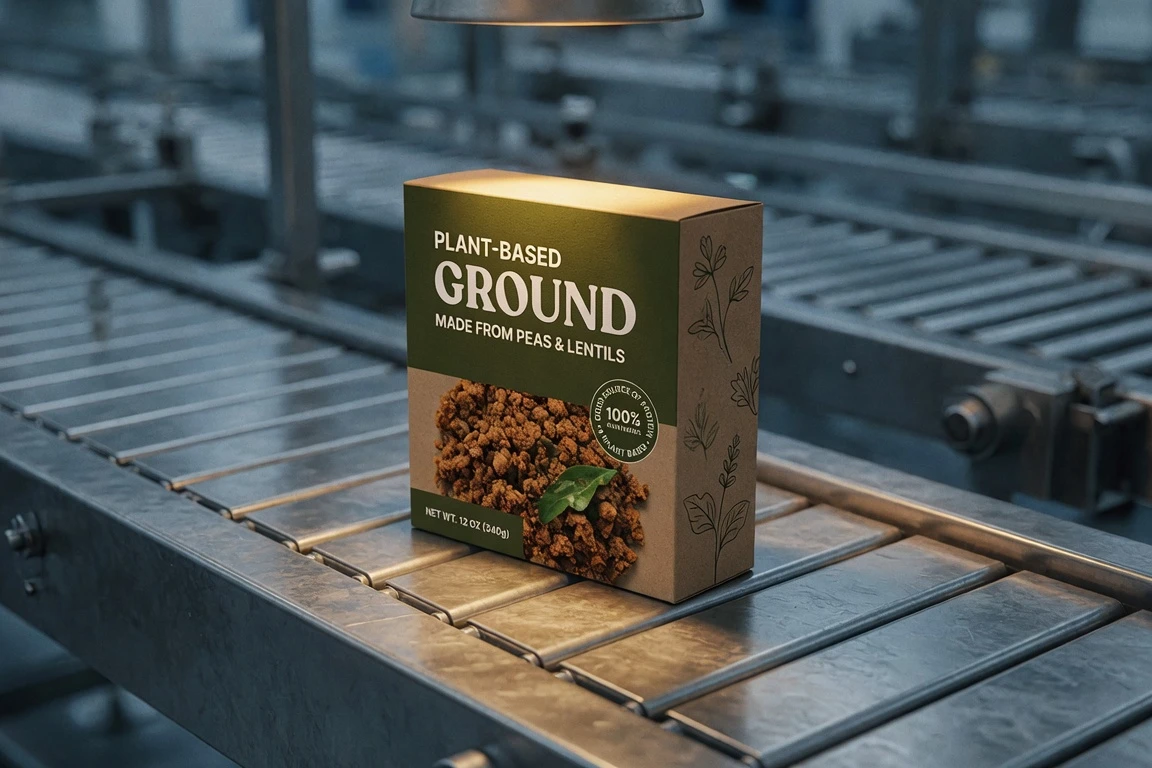
- Peas on Earth: a dry-storage pea protein mince that does not require refrigeration
- Orbifarm: an indoor farming subsidiary that runs the OrbiPlant vertical farming platform
Mililk has drawn the most attention. The product prints oat milk onto sheets that can be blended with water at home, which the company says avoids 90% of the packaging waste of conventional alt-milk. Mililk is being produced for Rewe Group under the Food For Future and Rewe Bio labels across more than 3,700 Rewe stores and 2,000 Penny stores in Germany. Veganz is also identifying production sites in North America, with production expected to begin in the first half of 2026.
Capital raises have been part of the price of the strategy. According to vegconomist, a series of equity measures including a rights offering, private placements in July and August, and the use of conditional capital raised the total volume to approximately €8.44 million. The combined measures lifted the group’s share capital from €1,377,198 to €2,121,333. Each new share carries full profit participation from 1 January 2024, which means the eventual breakeven profit has to be split across a substantially larger share base.
The Debt Load That Complicates the Math
Beyond the breakeven headline, the Simply Wall St note carries a structural number the forecast does not address: a debt-to-equity ratio of more than 2x. Conventional equity-investor guidance treats 40% as a sensible ceiling for debt as a share of equity; Planethic Group runs at well over 200% of that benchmark. A higher debt load increases the risk profile of any equity investment in a loss-making company. Interest servicing has priority over any profit that eventually reaches shareholders.
Interest payments have to be serviced before any breakeven profit reaches shareholders, and a company that has to roll debt in a tight market loses optionality on its strategic pivot. Planethic Group’s strategy depends on continued access to capital, as the 2024 equity measures show, and that access is more expensive for a leveraged issuer. Founder Jan Bredack remains the largest single shareholder, per vegconomist’s coverage of the leadership change, but founder money covers part of the runway, not the structural debt. For an analyst forecast of €400k in 2027 profit to translate into anything meaningful for shareholders, the company first has to clear its interest bill.
A New Operator at the Breakeven Door
October 2025 brought a leadership transition. Founder and long-time CEO Jan Bredack stepped down and moved to manage OrbiFarm, the indoor-farming subsidiary inside his own group. Financial expert Rayan Tegtmeier took over as CEO.
Bredack kept his largest shareholder stake when he moved to OrbiFarm. He framed the handoff as the natural next step after the company’s transformation from a trading business into a foodtech holding company.
After nearly 15 years, this step is not easy for me as the founder. However, I am handing over the baton with great confidence, following the successful transformation of Veganz Group AG from a trading company into a foodtech company over the past two years.
Tegtmeier inherits a company whose top line is shrinking, whose debt exceeds its equity, and whose path to a €400k profit in 2027 runs through a five-brand holding structure. The Simply Wall St forecast was written under Bredack’s tenure, per the note’s framing. Whether the new operator holds to the breakeven timeline set out under Bredack is the question investors will watch first.
What Could Break the Forecast
Three things would derail the breakeven path. First, a continued contraction in revenue from the legacy trading business faster than the in-house production pivot can compensate. In-house production turnover did rise 166% year-on-year in 2024, per vegconomist, but the base was small and the absolute contribution to group revenue is not disclosed in the materials Simply Wall St cites. Second, a slip in the Mililk scaling plan.
Mililk is heading to the US East Coast under a Jindilli partnership, with the first container shipping this month and a 15-million-litre short-term order forecast, per vegconomist. A delay at the North American production sites, expected to begin in the first half of 2026, would push the scaling story past the breakeven window. Third, a further rise in interest costs on the existing debt stack would absorb the €400k profit the forecast is calibrated to, and the Simply Wall St note frames breakeven as just over a year away only if the cost of carrying the debt stays where it is.
Frequently Asked Questions
What is Planethic Group AG?
Planethic Group AG is the Frankfurt-listed holding company (ETR:VEZ) that owns the Veganz plant-based food brand and four other brands, founded in Berlin in 2011 with 85 employees. The group sells in Germany, Austria, and Switzerland.
When is Planethic Group AG expected to break even?
Per a Simply Wall St note, the analyst covering the stock expects a final loss in 2026 and a profit of €400k in 2027. The breakeven window is therefore just over a year from publication, and would be the first year of positive earnings in the company’s listed life.
Who runs Planethic Group AG now?
Jan Bredack, the founder and former CEO, stepped down in October 2025 and now runs OrbiFarm, the group’s indoor-farming subsidiary. Financial expert Rayan Tegtmeier took over as CEO. Bredack remains the largest single shareholder.
What brands does Planethic Group AG own?
The group operates five brands: Veganz (retail plant-based food), Happy Cheeze (cashew-based cheese acquired from insolvency), Mililk (2D-printed oat and alt-milk), Peas on Earth (dry-storage pea protein mince), and Orbifarm (indoor farming).
How much debt does Planethic Group carry?
Simply Wall St puts the debt-to-equity ratio at more than 2x. Conventional guidance treats 40% as a sensible ceiling; Planethic Group runs at well over 200% of that benchmark, a structural overhang that has to be cleared before any breakeven profit reaches shareholders.
Disclaimer: This article is for informational purposes only and does not constitute financial advice. Investing in loss-making small-cap companies carries significant risk, including the possibility of total loss of principal. Readers should consult a qualified financial professional before making investment decisions. Figures cited are accurate as of publication on June 26, 2026.


Remulla ties Zamboanga shooting to Roblox chats again

Altman bets ChatGPT will watch screens in six months

Vivo Y31T 5G brings 7200mAh and IP69 to budget India phones

Stablecoin Advances Meet Digital Pounds in BoE Lab Test

ChatGPT Yelp Booking Turns Chat Into the New Reservation Desk

Stream Deck quietly owns desk productivity a decade later

Offline AI tool from Herts student reaches GBV teams in Gaza and Syria

AI revenue in media sits in yield and pacing not chatbots

OpenAI pauses frontier training as Astra hits cyber limits

AI Boss Luna Fired a Worker Only After Humans Reminded It

Oracle Cuts 21,000 Jobs in a Year, Cites AI in 10-K Filing

Fable 5 and Mythos 5 Return as US Lifts Anthropic Export Controls

SpaceX’s Google Deal Turns a Rocket Company Into a Cloud Landlord

CD Projekt Red Co-CEO: Redemption Arc Isn’t Done, Witcher 4 in 2027

XPL Rallies 30% Ahead of Plasma One Card Tier Launch

Google Search Profiles Build a Follow Graph Inside Discover

DGO App Brings Rs 549 Mobile Pass for FIFA World Cup 2026 in Nepal

Moonshot AI Targets $30 Billion in China’s Fastest AI Funding Sprint

Oppo’s ColorOS 17 Eligibility List Leaves A-Series Buyers Behind

Microsoft Xbox Layoffs Start in July as Sharma Slams 3% Margin
-
 AI2 months ago
Oracle Cuts 21,000 Jobs in a Year, Cites AI in 10-K Filing
-
 AI2 months ago
Fable 5 and Mythos 5 Return as US Lifts Anthropic Export Controls
-
 AI2 months ago
SpaceX’s Google Deal Turns a Rocket Company Into a Cloud Landlord
-
 GAMING2 months ago
CD Projekt Red Co-CEO: Redemption Arc Isn’t Done, Witcher 4 in 2027
-
 CRYPTO2 months ago
XPL Rallies 30% Ahead of Plasma One Card Tier Launch
-
 NEWS2 months ago
Google Search Profiles Build a Follow Graph Inside Discover
-
 APPS2 months ago
DGO App Brings Rs 549 Mobile Pass for FIFA World Cup 2026 in Nepal
-
 AI2 months ago
Moonshot AI Targets $30 Billion in China’s Fastest AI Funding Sprint