
AI
South Korea’s $576B AI Chip Plan Splits Seoul and the Southwest
South Korea rolled out a $576B AI-chip investment plan on June 29, anchored by Samsung and SK Hynix. The opposition calls the southwest pivot political.

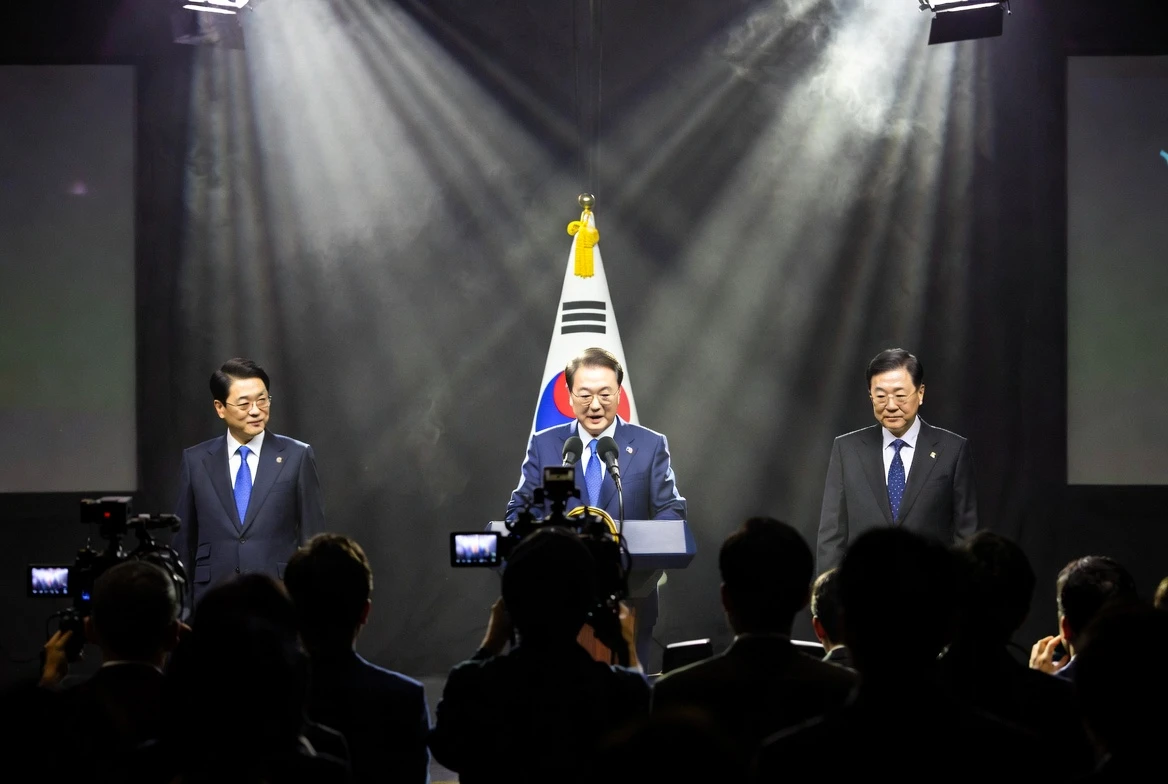
South Korea on Monday unveiled more than $576 billion in AI-chip investment, anchored by Samsung Electronics and SK Hynix, in what President Lee Jae Myung cast as a “triple axis” push for semiconductors, physical AI, and AI data centres. The package is also the country’s largest regional rebalancing play in decades, and it has put the country’s two biggest memory chipmakers at the centre of an escalating fight over who actually wins.
The $576B Bet on a Triple Axis
South Korea unveiled more than $576 billion in AI-chip investment on Monday, a package President Lee Jae Myung framed as a “triple axis” built around semiconductors, physical AI, and AI data centres. The bulk of the money is private: Samsung Electronics and SK Hynix have together committed 800 trillion won ($517.87 billion) with their suppliers.
The two memory giants will build two new chip fabrication sites each in the country’s southwest region, with Gwangju and South Jeolla province adding a further 5 to 20 trillion won of regional investment. Another 81 trillion won is earmarked for a chip packaging cluster in the Chungcheong area near Seoul. The southwestern expansion sits alongside a separate plan announced Monday to double South Korea’s dynamic random-access memory output within five years by accelerating fab construction in the Seoul metropolitan area into the mid-2030s. Industry minister Kim Jung-kwan set the DRAM target at the same televised event.
- $576 billion: total AI-chip package Lee announced Monday
- 800 trillion won ($517.87 billion): Samsung plus SK Hynix commitment with suppliers
- 85%: share of southwest voters who backed Lee in 2025
- 46.5%: Lee’s approval rating, sixth straight weekly decline
- 900 trillion won ($617 billion): combined commitments already booked at the Yongin cluster
The investment lands at a moment when high-bandwidth memory chips made by Samsung and SK Hynix have become pivotal to the global buildout of advanced AI systems. Both companies already run their largest fabs in and around the Seoul metropolitan area, the densest memory manufacturing corridor in the world. Monday’s announcement effectively redraws that map by adding a second, politically contested frontier in the southwest.
Why the Southwest, Why Now
Lee’s justification for the southwestern push is operational. He said existing sites around Yongin and Pyeongtaek have already “reached their limits,” and that the country needs “overwhelming production capacity in advance” to keep pace with AI demand. The southwest, he argued, has “abundant, underused power” that the capital region no longer offers. He also pitched the move as regional rebalancing, an unusually explicit framing from a president who usually speaks about industrial policy in supply-chain terms.
We must secure the core elements of AI faster than any other country. Semiconductors, physical AI, and AI data centres are the triple axis for our great leap forward.
The political backdrop is hard to miss. About 85% of voters in the southwest backed Lee in last year’s presidential election, and the conservative People Power Party has accused the president of steering investment toward a region that delivered his margin of victory. The PPP’s chair, Jang Dong-hyeok, has framed any talk of relocating existing Yongin capacity as “election-driven rhetoric” that could destabilize a project already central to the country’s chip supply.
Lee has rejected the accusation in a series of posts on X, defending the proposal as a “national cause” rather than a regional favour. His chief of staff for policy, Kim Yong-beom, called establishing a major semiconductor cluster outside the capital region “a very powerful national strategy,” and industry minister Kim Jung-kwan cited the southwest’s electricity self-sufficiency and water resources as concrete reasons for the choice.
The investment also revives a long-running fault line in Korean politics, the Jeolla-Yeongnam divide between the southwest and the southeast that has shaped the country’s party map for decades. Until now, the southwest has largely missed out on the densest concentration of fabs, packaging plants, and supplier ecosystems clustered closer to Seoul. Lee’s plan flips that pattern by anchoring the new memory frontier in Gwangju and the Jeolla provinces. Whether that rebalancing survives the next election cycle is a question both Samsung and SK Hynix are now pricing into their corporate roadmaps.
Samsung Picks Gwangju, SK Hynix Holds Back
Samsung has moved faster. Chairman Lee Jae-yong used the same televised event to name Gwangju as the company’s next chip cluster site, a step that lands inside Samsung and SK Hynix’s $646B decade investment plan. Samsung’s total domestic commitment now stands at 2,655 trillion won, with 2,030 trillion won parked in Pyeongtaek and Yongin and 625 trillion won spread across Honam, Chungcheong, and Yeongnam. Inside that regional envelope, Honam alone takes 425 trillion won, of which 400 trillion won is earmarked for semiconductors. The Honam package also funds a Samsung SDS-led AI data centre in Haenam, billed as the centrepiece of a “sovereign AI” buildout, plus smart-appliance and heat-pump plants tied to AI data centre demand.
SK Hynix, by contrast, has been more cautious. Chairman Chey Tae-won told the briefing the group would invest about 400 trillion won in a new southwestern cluster, but stopped short of picking a specific site, citing the time and infrastructure a leading-edge fab demands. “It took nine years for us to create a cluster in Yongin,” Chey said, and “a chip factory requires massive land, power, water and talent.” The cautious tone is consistent with SK Hynix’s earlier decision to push Yongin’s completion forward by 12 years to 2033, while committing roughly 600 trillion won there and another 100 trillion won to its Cheongju high-bandwidth memory complex.
| Company | Southwest / Honam commitment | Site decision | Anchor capital project |
|---|---|---|---|
| Samsung Electronics | 425 trillion won in Honam, including 400 trillion won for semiconductors | Gwangju named as next chip cluster | 56 trillion won for HBM fabs in Cheonan and Onyang; 67 trillion won for displays in Asan |
| SK Hynix | About 400 trillion won in new southwestern cluster | Site not yet chosen | Yongin completion moved up 12 years to 2033 |
The Opposition’s ‘Election-Driven’ Charge
The political temperature around the southwest plan spiked immediately. The People Power Party’s Jang, after visiting the Yongin construction site on Friday, called any talk of relocating fabs from the capital region “political agitation aimed at winning votes in local elections.” He framed the existing Yongin site, 11 million square metres in Gyeonggi Province designed to host ten fabrication plants, as “the future of South Korea.” The PPP’s Ahn Sang-hoon separately told local press that steering Samsung and SK Hynix toward Honam was “a major policy mistake” that risked weakening one of South Korea’s most globally competitive industries.
Lee has not proposed relocating Yongin. Presidential spokesperson Kim Nam-joon said at a briefing that “the relocation of companies in the cluster, including Samsung Electronics and SK hynix, is not under consideration,” adding that “decisions on corporate relocation should be made by the companies themselves.” Cheong Wa Dae also stressed it is not reviewing any plan to shift Yongin operations. The clarification followed remarks by Climate Minister Kim Sung-whan, who said on a radio show last month that “companies should go where electricity is abundant,” a line the opposition treated as an opening bid for relocation.
Lee’s own framing has done little to cool the row. He cast the southwest buildout as a “national cause” on X over the weekend, rejecting the charge that it favours a liberal stronghold. The opposition has read that as confirmation rather than reassurance. Both sides are heading into a fresh election cycle after the June 3 local vote, and industrial policy is now firmly inside that campaign frame.
Lee’s approval, meanwhile, slipped to 46.5% in a Realmeter poll released Monday, the sixth straight weekly decline. The numbers behind the political charge are themselves the dispute. The PPP says the southwestern project is rushed, under-specified, and too tightly bound to ruling-party incentives. Lee and his industry minister say the country cannot afford to wait: AI-driven memory demand is rising faster than Yongin and Pyeongtaek can expand.
Where the Engineering Reality Bites
The hardest part of the southwestern bet is not land. Lee’s team has pointed to dams, agricultural reservoirs, and reclaimed wastewater as evidence the region can supply fab-grade water at scale. Presidential aides have argued that the southwest has underused hydrological and electrical capacity that the capital region no longer offers. Chey Tae-won gave the most candid version of the same point on Monday, saying SK Hynix will build plants only “in locations that meet the necessary conditions.”
It took nine years for us to create a cluster in Yongin. Also, a chip factory requires massive land, power, water and talent.
Industry analysts echo the warning. Reporting from the briefing quoted experts cautioning that building cutting-edge fabs requires vast electricity and water, advanced logistics, deep supplier networks, and highly skilled labour that may not scale quickly enough in a new region to meet surging AI demand. Existing fabs around Yongin, Pyeongtaek, Icheon, and Cheongju have accumulated decades of supplier clustering, talent pipelines, and grid upgrades that cannot be replicated overnight.
The Yongin cluster alone has already absorbed more than 900 trillion won ($617 billion) in combined commitments from the two chipmakers, and it is not yet finished. The original investment blueprint for that buildout is laid out in SK Hynix’s approved Yongin cluster plan, and even that site has spent years wrestling with licensing, water procurement, and grid expansion. The southwestern push has a packaging dimension too: Lee said 81 trillion won will go to a chip packaging cluster in the Chungcheong area near Seoul, where suppliers and labour pools already exist.
The plan therefore spreads new investment across at least three regions, not just one, a structure that looks more like a national industrial mesh than a single regional giveaway. That is also why the engineering case for delay will not go away.
- Water: industrial-grade supply, treatment redundancy, discharge management, drought resilience
- Power: stable, high-capacity electricity with transmission expansion
- Talent: specialized engineering workforce trained for yield-critical precision
- Suppliers: deep networks of specialized contractors and cleanroom construction capacity
The Global Stakes for HBM and DRAM
The global stakes behind the southwestern bet are unusually concrete. High-bandwidth memory chips, the DRAM stacks Samsung and SK Hynix build by layering multiple die on top of each other, are now the gating component for training and running the largest AI models. Samsung and SK Hynix together hold the dominant share of the global HBM market, and the entire hyperscaler buildout now rests on them.
The DRAM side adds urgency of its own. South Korea’s industry minister set a target on Monday to double domestic DRAM output within five years by accelerating Seoul-area fab construction into the mid-2030s. Memory pricing has been volatile through 2026, including a US class action filed June 25 in California accusing Samsung, SK Hynix, and Micron of colluding to restrict supply and inflate prices. The new fabs are designed to expand total addressable supply at a moment when AI accelerators are pulling DRAM and HBM off the market faster than capacity can be added.
SK Hynix’s deeper co-design role with Nvidia, formalized in Seoul earlier this year and detailed in SK Hynix’s new Nvidia AI memory partnership, has positioned the company as the lead external partner for next-generation HBM roadmaps. South Korea’s $576 billion figure is, in effect, an attempt to widen that lead before competitors catch up.
Taiwan is expanding advanced packaging on its own soil, Japan is rebuilding legacy logic capacity, and the United States has anchored a parallel fab buildout through the CHIPS Act. None of those efforts directly threatens the Korean memory duopoly, but all of them compete for the same finite pool of semiconductor equipment, cleanroom construction crews, and HBM engineering talent.
What Remains Undecided
Several pieces of the package are still unresolved. SK Hynix has not named a southwestern site, and its 400 trillion won commitment is conditional on infrastructure the company says it needs years to assemble. The 81 trillion won Chungcheong packaging cluster has a funding figure but no published construction start date. The 5 to 20 trillion won in Gwangju and South Jeolla is a range, not a fixed contribution. And Lee’s industry ministry has not said whether the DRAM doubling target will be met by pulling forward existing Yongin and Pyeongtaek timelines, by greenfield construction, or both.
The political clock is moving faster than the engineering one. Lee’s approval rating slipped to 46.5 percent in the Realmeter poll released the same day as his announcement, a six-week slide that gives the opposition a fresh line of attack. Local elections in early June already sharpened the regional framing; the next national vote cycle is now within sight. Samsung and SK Hynix have publicly committed to the southwest, but both have also made clear that the final pace will be set by water, power, and labour, not by presidential speeches. Chey Tae-won put it bluntly on Monday: SK Hynix will build its southwestern plants only “in locations that meet the necessary conditions,” and the company is still looking.
Frequently Asked Questions
What exactly did South Korea announce on June 29, 2026?
President Lee Jae Myung unveiled a chip and AI mega-package worth more than $576 billion over several years. Samsung Electronics and SK Hynix together committed 800 trillion won ($517.87 billion) with their suppliers to build two new fabrication sites each in the southwest, plus a packaging cluster in Chungcheong and new HBM lines in Cheonan and Onyang.
How is Samsung’s plan different from SK Hynix’s?
Samsung named Gwangju as its next cluster site and committed 2,655 trillion won in domestic investment, including 425 trillion won for Honam. SK Hynix committed about 400 trillion won to a new southwestern cluster but has not yet chosen a site, with chairman Chey Tae-won citing the nine years needed to prepare Yongin.
What role does the Yongin cluster still play?
Yongin is still the centrepiece of South Korea’s chip strategy. It spans more than 11 million square metres in Gyeonggi Province, is designed to host ten fabrication plants (six by Samsung, four by SK Hynix), and has already absorbed more than 900 trillion won ($617 billion) in combined commitments from the two chipmakers.
Why is the southwest plan politically controversial?
About 85% of voters in the southwest backed Lee in the 2025 presidential election. The main opposition People Power Party has called the package “election-driven rhetoric,” though the presidential office says corporate relocations from Yongin are not under consideration.
When will the new capacity actually come online?
SK Hynix’s first Yongin factory is targeted to start operations next year, and SK Hynix has moved Yongin’s full completion up by 12 years to 2033. Samsung’s Yongin mass production is planned for 2030. The new southwestern sites have no published construction start dates.


Workers Still Trust Judgment Over the AI Tools They Use

DigitalOcean’s $894 Million Backlog Rewrites the Old Cloud

Companies Froze Job Design and Called AI a People Problem

AI Capex Looks Unique Because the Chips Wear Out

Samsung Medison’s HERA Z10 Aims at the Sonographer Shortage

GPT-6 Astra Ships as OpenAI’s First Critical Cyber Model

Palms Sells Clean Air Without Ending Casino Smoking

OnlyFans Promo Bots on X Now Pass the Humanity Tests

Datamaran Drops the ESG Label After Winning the Argument

Xiaomi’s Own Chip Lands While Apple Argues Over Color

Oracle Cuts 21,000 Jobs in a Year, Cites AI in 10-K Filing

Fable 5 and Mythos 5 Return as US Lifts Anthropic Export Controls

SpaceX’s Google Deal Turns a Rocket Company Into a Cloud Landlord

CD Projekt Red Co-CEO: Redemption Arc Isn’t Done, Witcher 4 in 2027

XPL Rallies 30% Ahead of Plasma One Card Tier Launch

Google Search Profiles Build a Follow Graph Inside Discover

DGO App Brings Rs 549 Mobile Pass for FIFA World Cup 2026 in Nepal

Moonshot AI Targets $30 Billion in China’s Fastest AI Funding Sprint

Oppo’s ColorOS 17 Eligibility List Leaves A-Series Buyers Behind

Microsoft Xbox Layoffs Start in July as Sharma Slams 3% Margin
-
 AI3 months ago
Oracle Cuts 21,000 Jobs in a Year, Cites AI in 10-K Filing
-
 AI2 months ago
Fable 5 and Mythos 5 Return as US Lifts Anthropic Export Controls
-
 AI3 months ago
SpaceX’s Google Deal Turns a Rocket Company Into a Cloud Landlord
-
 GAMING3 months ago
CD Projekt Red Co-CEO: Redemption Arc Isn’t Done, Witcher 4 in 2027
-
 CRYPTO3 months ago
XPL Rallies 30% Ahead of Plasma One Card Tier Launch
-
 NEWS3 months ago
Google Search Profiles Build a Follow Graph Inside Discover
-
 APPS3 months ago
DGO App Brings Rs 549 Mobile Pass for FIFA World Cup 2026 in Nepal
-
 AI3 months ago
Moonshot AI Targets $30 Billion in China’s Fastest AI Funding Sprint