
CRYPTO
South Korea’s Crypto Volume Hits Its Lowest Since 2023 as Stocks Crash
South Korea’s crypto exchanges booked 9.97 trillion won ($6.65 billion) last week, the weakest total since 2023, as a KOSDAQ selloff drags the market down too.

South Korea’s crypto exchanges processed just 9.97 trillion won ($6.65 billion) in the week of July 3 to July 10, the weakest weekly total since September 2023. It is the fifth consecutive weekly decline. The slide landed in the same week South Korea’s KOSDAQ extended a stock rout that has wiped out roughly a third of its value since early May.
In past downturns, a stock crash in Seoul sent traders scrambling back into Bitcoin and its rivals within days. This time, the money never showed up. Crypto and equities are falling together, dragged down by the same retail bet on AI chips that has now soured in both markets at once.
Won Trading Falls Below the 10 Trillion Mark
Weekly volume across the five licensed won based exchanges, Upbit, Bithumb, Coinone, Korbit and Gopax, fell 25.75% from the prior week’s 13.4 trillion won ($8.9 billion). The total now sits 43.5% below early June trading levels, according to the crypto data tracker WuBlockchain.
It is the weakest week since September 22 to 29, 2023, when combined volume printed 9.6 trillion won. That is a gap of almost three years, long enough to span an entire Bitcoin cycle.
Upbit still leads the pack, though its grip loosened slightly even as the overall pool shrank.
| Exchange | Position in the Week of July 3 to 10 |
|---|---|
| Upbit | 63.02% market share, still first but down 3.95 percentage points |
| Bithumb | Gained share as rivals’ totals shrank faster |
| Coinone | Gained share alongside Bithumb |
| Korbit | 0.78% market share |
| Gopax | 0.03% market share, the smallest of the five |
Even after five weeks of declines, nothing about who holds the market has changed much. That concentration becomes important once the story moves from crypto exchanges to the stock market next door.
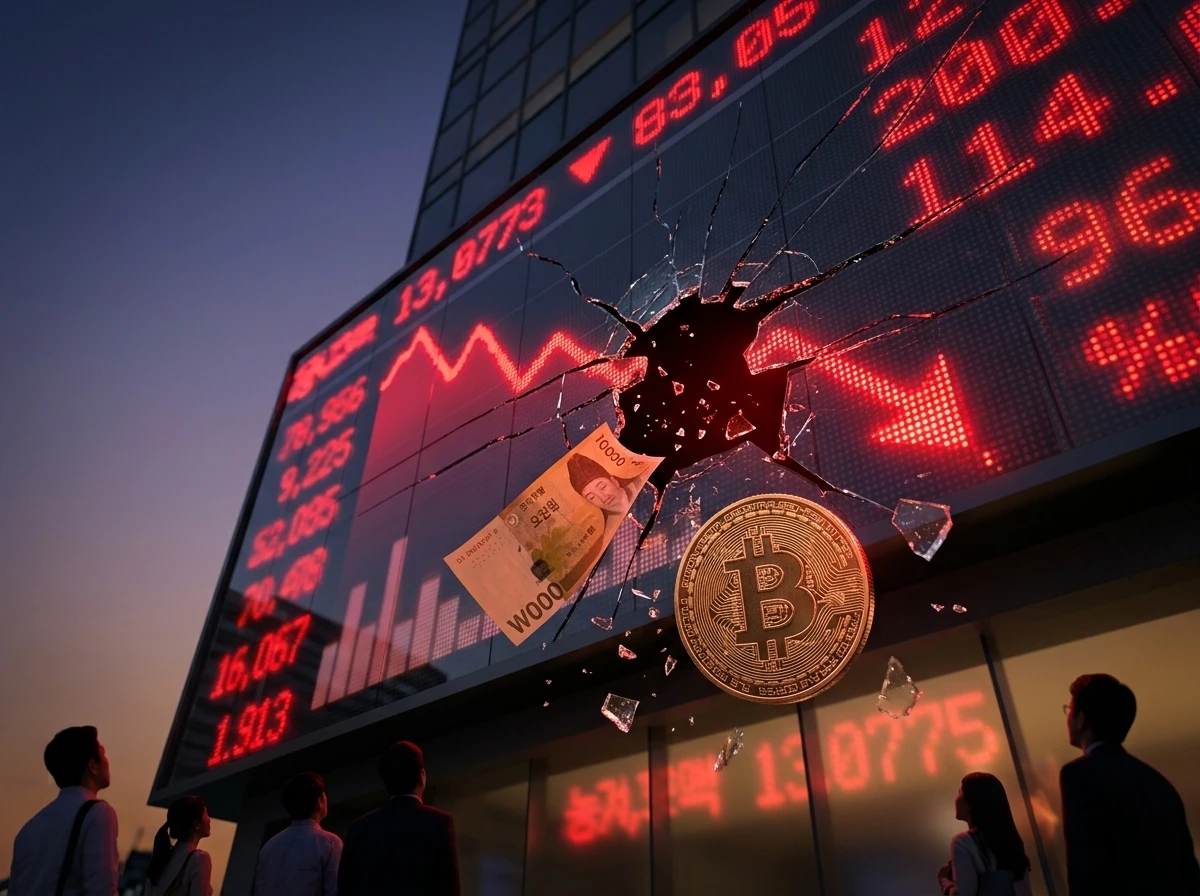
Samsung and SK Hynix Carry the Whole Index
The KOSDAQ has crashed 31% over the past nine weeks, erasing nearly a year of gains. That pace rivals South Korea’s 2020 selloff, when the index fell 32% in five weeks. The KOSPI, the country’s main board, has dropped 20% over three weeks and slipped into bear market territory.
Two chipmakers sit at the center of it. Samsung Electronics and SK Hynix, together with leveraged exchange traded funds tied to their shares, account for more than 70% of traded market value on a given day. Samsung and SK Hynix alone make up roughly 42% of the KOSPI’s total weight.
- $9 billion: size the leveraged Samsung and SK Hynix ETFs had reached by late June, up from about $3 billion when they launched in May, with roughly 92% held in retail accounts.
- 60 trillion won ($39 billion): retail margin debt outstanding by the end of May, a pile that raised the odds of forced selling once prices turned.
- 9.99%: the KOSPI’s single session drop in late June after regulators admitted they had rushed approval of those same leveraged ETFs.
- $714 million: crypto positions liquidated across exchanges in 24 hours during that same session, as Bitcoin briefly fell below $63,000.
What worries me is that retailers are in the driving seat, because they use a lot of margin, though the ratio to market cap is small.
Alexander Redman, chief equity strategist at CLSA, a Hong Kong based brokerage, made that comment as the KOSPI selloff spread. The concentration in a handful of leveraged products, he said, makes any reversal harder to contain once it starts.
Why Do Stocks and Crypto Fall Together in Seoul?
South Korea’s retail traders often run the same playbook in both markets: heavy leverage, fast entries, constant rotation toward whatever is moving. When one shared risk factor rattles confidence, in this case doubts over AI chip spending, it drains both markets at the same time instead of pushing money from one into the other.
South Korea counts nearly 10 million crypto investors, more than 30% of the population, and many of those same accounts also trade the leveraged chip stock ETFs now under scrutiny.
When confidence in AI linked names rises, both markets tend to rally together too. This summer, the shared exposure is working against traders in both directions at once.
The Rebound That Never Came
Past corrections offered a release valve. On May 15, the KOSPI breached 8,000 intraday and then crashed 8.4% in a single session, wiping out roughly $370 billion in market value. Yahoo Finance reported that Korean crypto volumes ticked higher in the days that followed, as some of that spooked stock money rotated back into Bitcoin.
This time, the reverse rotation is not showing up. Weekly crypto volume has fallen for five straight weeks even as the KOSDAQ and KOSPI keep sliding. The safety valve that opened in May has, so far, stayed shut.
The pullback looks stickier than a single bad session, whatever mix of AI chip losses and tighter margin rules is behind it.
Bithumb’s Bad Year Keeps Getting Worse
Bithumb, South Korea’s second largest exchange, has had a rough 2026 even by the industry’s standards. A promotional payout glitch on February 6 credited about 620,000 BTC worth $56 billion to hundreds of accounts instead of the intended 620,000 won, about $450.
Some recipients sold immediately, briefly dragging Bitcoin’s price down 10 to 17% on Bithumb’s own order book before the exchange froze accounts and clawed back most of the coins. Bithumb’s chief executive, Lee Jae-won, later told a parliamentary hearing that “we are acutely aware of the deficiency in internal system control.”
The exchange was already fighting South Korea’s Financial Intelligence Unit, which had accused it of about 6.65 million anti money laundering violations and imposed a six month partial suspension plus a $24.6 million fine in March. A Seoul court lifted the six month suspension in late April, though the fine’s status remained unresolved. Dunamu, Upbit’s operator, took its own 35.2 billion won fine last year for similar compliance gaps, and Korbit paid 2.73 billion won. Regulators say the string of episodes has left retail traders warier about where they keep funds.
A New Rulebook for Leveraged Bets
The Financial Services Commission (FSC), the country’s top financial regulator, ordered every exchange to reconcile customer balances against blockchain holdings every five minutes, replacing a 24 hour cycle most had used, plus monthly external audits and daily public disclosure of results. The rules followed the central bank publicly urging exchanges to build their own circuit breakers after the Bithumb payout.
Separately, the government is capping how much of any exchange a single shareholder can own under the second phase of the Digital Asset Basic Act (DABA), South Korea’s core digital asset law, a direct response to concerns that Upbit and Bithumb’s dominance leaves the market too concentrated.
On the equity side, Financial Supervisory Service governor Lee Chan-jin admitted in June that regulators approved the leveraged Samsung and SK Hynix ETFs too quickly, without adequate guardrails for retail buyers. The agency is weighing tighter eligibility rules and possible leverage limits, though it has not detailed which measures it will adopt.
Smaller Platforms and Stablecoins Pick Up the Slack
Analysts increasingly call the pullback a reallocation. Activity may be migrating toward smaller exchanges, decentralized platforms and traditional assets.
Dunamu has built GIWA, an Ethereum layer 2 network aimed at pulling regulated institutional activity onto rails it controls. A separate won pegged stablecoin called KRWQ, launched on the Base network in October 2025, reached 1 billion won in daily volume by April, driven largely by foreign funds hedging their KOSPI and KOSDAQ positions, according to an analysis of the market’s infrastructure shift. Upbit and Bithumb between them still handle around 96% of all won trading volume, a concentration that has barely moved even as the overall pool shrinks.
Yahoo Finance has also reported that a consortium of eight banks, led by Kookmin, Shinhan and Woori, is preparing a regulated won-backed stablecoin under the same digital asset law, aiming to keep more of that liquidity onshore.
None of that has shown up in the weekly exchange totals yet. Upbit and Bithumb together still processed the overwhelming majority of this month’s declining volume, and the KOSDAQ was still down double digits at the close on July 10.
Frequently Asked Questions
How Does South Korea’s Crypto Slump Compare With Other Countries?
South Korea ranked second globally for retail crypto trading in the first quarter of 2026, with about $69 billion in volume, behind the United States at $212 billion and ahead of Russia, India and Turkey, according to TRM Labs data. Its 28% year over year decline was the steepest among major markets, against a 20% global average drop.
What Is the Kimchi Premium Telling Us Right Now?
The kimchi premium, the gap between Bitcoin’s price on Korean exchanges and on global markets, has recently sat near negative 2.19%, according to CryptoQuant data. A negative reading signals weaker local demand for Bitcoin than the rest of the world, the opposite of the premium Korean traders have historically paid.
Could the Slowdown Affect Bithumb’s Plan to Go Public?
Possibly. Bithumb has signaled plans to become the first digital asset company to list on South Korea’s stock market, and prior reporting has flagged that reduced fee income could weigh on its valuation ahead of any listing, since transaction fees remain the main revenue source for exchanges.
Has the KOSPI Hit Circuit Breakers Before This Year?
Yes. The June crash was the second time in 2026 that the KOSPI’s circuit breaker fired, halting trading for 20 minutes. The first came in March, triggered by geopolitical tensions in the Middle East rather than any domestic trigger.
Why Do Reports Give Different Dollar Values for the Bithumb Error?
Estimates range from about $40 billion to $56 billion for the same 620,000 BTC mistaken transfer, because bitcoin’s price moved substantially between February, when the error happened, and the later weeks when different outlets published their figures. The coin count stays constant across reports; only the dollar conversion shifts.
Disclaimer: This article is for informational purposes only and does not constitute financial or investment advice. Cryptocurrency and equity markets are volatile and carry substantial risk of loss. Consult a licensed financial professional before making investment decisions. Figures are accurate as of publication on July 13, 2026.


Sony’s 10 Percent Disc Drop Leaves the 2028 Cutoff Intact

Chip Allocation Sidelines the Base iPhone 18 This Fall

Miami-Dade Fights the Vice City Brand It Already Wears

IFA 2026 Awards Put Tecno Ahead of Flagship Phones

USB-C Gadgets Made the Junk Drawer Rechargeable

Pixel 11 Pro Asks $1,099 for a Light Google Locked

The iPhone Ultra Sells Two Retired Minis as One Foldable

Google Opens Gmail to Voice and Gates Docs Live

Lenovo Prices the IdeaPad Vibe Against Apple’s $699 Neo

Xbox Caps Game Pass Cloud Gaming at 15 Hours

Oracle Cuts 21,000 Jobs in a Year, Cites AI in 10-K Filing

Fable 5 and Mythos 5 Return as US Lifts Anthropic Export Controls

SpaceX’s Google Deal Turns a Rocket Company Into a Cloud Landlord

CD Projekt Red Co-CEO: Redemption Arc Isn’t Done, Witcher 4 in 2027

XPL Rallies 30% Ahead of Plasma One Card Tier Launch

Google Search Profiles Build a Follow Graph Inside Discover

DGO App Brings Rs 549 Mobile Pass for FIFA World Cup 2026 in Nepal

Moonshot AI Targets $30 Billion in China’s Fastest AI Funding Sprint

Oppo’s ColorOS 17 Eligibility List Leaves A-Series Buyers Behind

Microsoft Xbox Layoffs Start in July as Sharma Slams 3% Margin
-
 AI3 months ago
Oracle Cuts 21,000 Jobs in a Year, Cites AI in 10-K Filing
-
 AI2 months ago
Fable 5 and Mythos 5 Return as US Lifts Anthropic Export Controls
-
 AI3 months ago
SpaceX’s Google Deal Turns a Rocket Company Into a Cloud Landlord
-
 GAMING3 months ago
CD Projekt Red Co-CEO: Redemption Arc Isn’t Done, Witcher 4 in 2027
-
 CRYPTO3 months ago
XPL Rallies 30% Ahead of Plasma One Card Tier Launch
-
 NEWS3 months ago
Google Search Profiles Build a Follow Graph Inside Discover
-
 APPS3 months ago
DGO App Brings Rs 549 Mobile Pass for FIFA World Cup 2026 in Nepal
-
 AI3 months ago
Moonshot AI Targets $30 Billion in China’s Fastest AI Funding Sprint