
COMPUTERS
Southside Data Centre Plan Tests Scotland’s Green Charter
The £2bn Southside data centre in the Scottish Borders wants to soak up wasted wind power. A 7,000-signature petition says no. The new green charter decides.

A £2 billion proposal for the Southside data centre in the Scottish Borders now sits at the centre of a confrontation between Sunlaws Development Company, the landowner Roxburghe Estates, and a campaign that gathered nearly 7,000 signatures in a week. Sunlaws wants three two-storey data centre buildings on a 151-hectare campus at Clawbare Cottage near Longformacus, between the villages of Longformacus and Westruther on the Lammermuir Hills. The plan, which the developer says would create 145 long-term jobs and inject £12 million a year into the Borders economy, is one of a growing list of large Scottish data centre proposals now working their way through planning. The campus, if approved, would draw 225MW from a site 9.4km from the 144MW Fallago Rig wind farm, the same wind farm that EDF is paid to switch off when the National Grid cannot absorb its output.
The submission landed the same week that Scottish energy and data centre industry groups published a five-principle green data centre charter that will shape how Scottish Borders Council weighs applications of this kind. The five principles cover renewable energy, energy efficiency, water consumption, district heat networks and community benefits, and the charter’s backers are positioning it as the test each new project will be measured against. EDF’s UK chief executive Simone Rossi told The Telegraph this month that Britain should “stop building wind farms” and “focus instead on raising demand” by, among other things, approving new data centres to soak up the surplus. The curtailment bill behind Rossi’s argument is large: the UK paid out almost £1.4 billion to switch off turbines in 2025, and was on course to beat that figure in 2026. Roxburghe Estates managing director Jaap Röell, who has framed the Southside site as a way to use power that would otherwise be curtailed, is the same Röell now defending the proposal at packed consultation halls.
The £2 Billion Plan at Longformacus
The plan filed with Scottish Borders Council, set out in the planning filing at Clawbare Cottage, is for a campus of three two-storey data centre buildings, each up to 24m tall, on a site 9.4km to the south east of the 48-turbine Fallago Rig wind farm. The developer describes each building as having an internal floor space of 54,000m², with half of it IT floor space and half electrical and mechanical infrastructure. The three buildings together would cover a ground footprint of 8.1 hectares on a wider 151-hectare site, with construction pencilled in to start in 2029 for a 2030 launch.
Sunlaws Development Company, the vehicle behind the proposal, is the property management firm Roxburghe Estates working with the local landowner. An Environmental Impact Assessment request was submitted to Scottish Borders Council, and the development was determined on 27 February 2026 to be one that “will be required to have an EIA.” A Proposal of Application Notice was filed afterwards, and on 3 June 2026 the council’s principal planning officer Scott Shearer confirmed that the initial consultation satisfied the legal minimum, with a full planning application unable to be submitted before 17 August 2026. The developer says the data centre represents a £2 billion investment in the Scottish economy, with 145 long-term jobs and £12 million a year for the Borders, and up to 1,000 jobs during the construction phase.
Roxburghe Estates managing director Jaap Röell has been the public face of the proposal at two drop-in sessions in the area. “Secure data centres are absolutely at the heart of our economies and are required for economic growth, and we discovered that we happen to have one of the best sites in Scotland, to create such a data centre,” he told visitors at the Longformacus consultation. He added that the site “can easily be connected to multiple wind farms, as well as a battery energy storage system,” a point the developer has leaned on heavily in the planning documents.
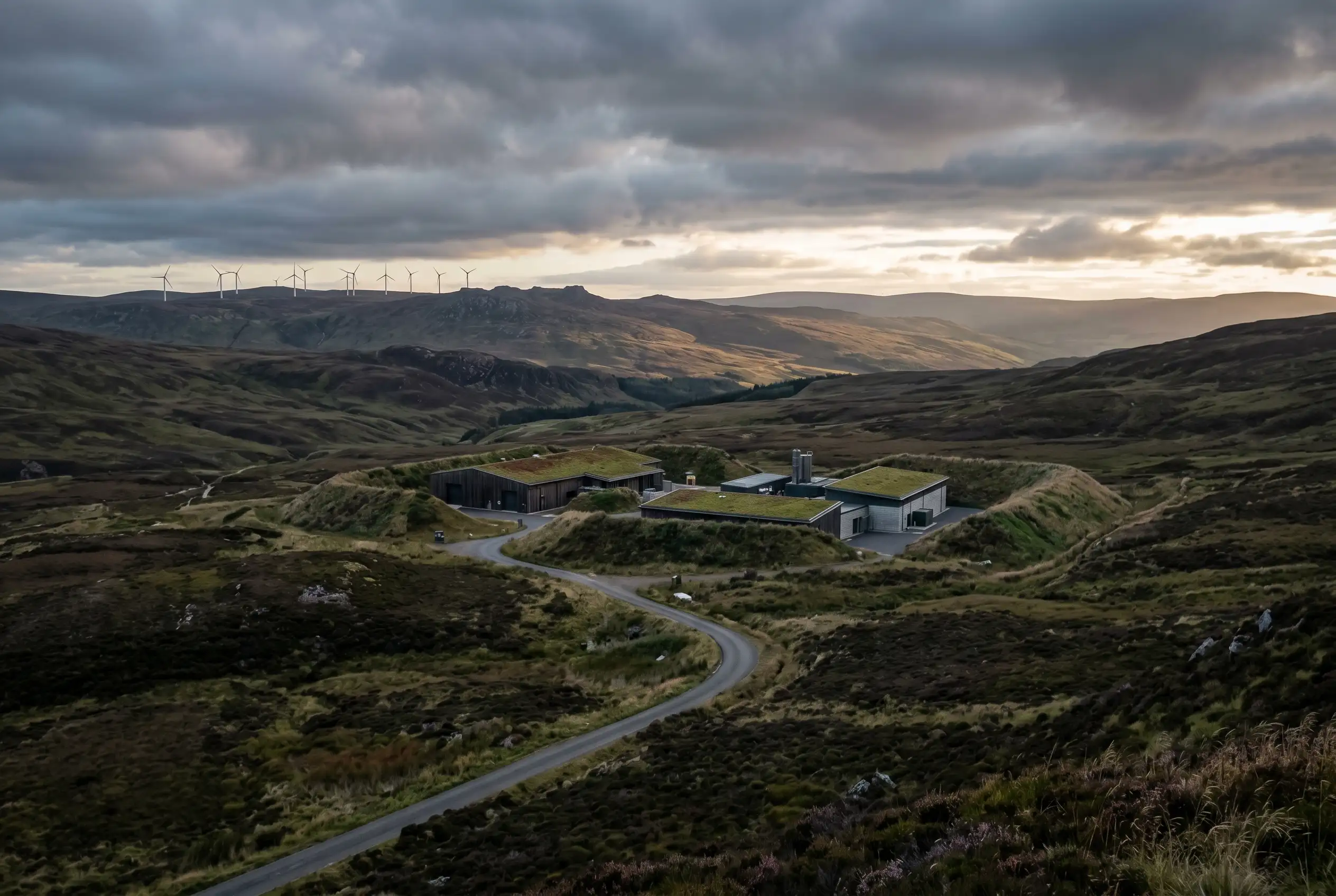
The Hidden Stakeholder Next Door
EDF owns and operates the Fallago Rig wind farm on the Lammermuir Hills, on land owned by the Duke of Roxburghe’s estate. The 48-turbine site was officially opened in 2013 by the Duke of Roxburghe and has a combined electrical capacity of 144 Megawatts. As far back as 2013, EDF received £2.99m in six months to halt production at Fallago Rig under curtailment payments, compensation for the hours when the National Grid could not absorb its output. Fallago Rig sits on the same Roxburghe Estate land that Sunlaws now wants to host a 225MW data centre campus, and the same energy economics that drove the original wind farm are now the headline justification for the new one.
EDF’s UK chief executive Simone Rossi has been unusually public about the chain. In an interview with The Telegraph published on 11 June 2026, Rossi said that Ed Miliband’s expansion of wind and solar power was creating “far more electricity generation capacity than needed” and called on ministers to stop approving new wind farms and to raise demand instead.
We should stop building wind farms and focus instead on raising demand for electricity. As a country we don’t need more electricity generation capacity. We need to use the generation capacity we have already got.
Simone Rossi, chief executive of EDF Energy, gave the statement to The Telegraph on 11 June 2026.
Rossi singled out data centres by name. He called on the Government to “accelerate the rollout of electric vehicles, heat pumps and approvals for new data centres to mop up the UK’s surplus electricity supplies.” The numbers behind his argument are large: almost £800 million has been spent on curtailment payments so far in 2026, putting the year on course to eclipse the £1.4 billion paid to switch off turbines in 2025. Röell has argued in the same vein that the Longformacus site, sitting 9.4km from Fallago Rig, can help prevent approximately £50 million of lost energy potential every year, a figure he and the developer have used to frame the project as a way to use power that would otherwise be wasted. EDF itself did not respond to a request to comment specifically on the Southside proposal.
A Petition That Reached 7,000 in a Week
Opposition to the Southside data centre has hardened into a recognisable local campaign. The campaign group Save the Lammermuirs, Stop the Data Centre, described the plans as the “wrong development in the wrong place” and launched a formal campaign on the site at the weekend, gathering nearly 7,000 signatures in the space of a week. A separate change.org petition linked to the same group picked up over 2,000 signatures within 48 hours, and the campaign’s Facebook group has grown to 243 members.
Save the Lammermuirs members Kathleen White and Zach Pygall gave the campaign’s two clearest public statements. “It’s an area where you can’t imagine any other development of any size being permitted by SBC, let alone an industrial-scale data centre, 24m (80ft) high. So we are calling on SBC to oppose it, if a full planning application is lodged,” White said. “We believe that the data centre will be a monster, consuming vast resources of electricity, and draining the life and beauty from the landscape. We think it is the wrong development in the wrong place.” Pygall framed the scale differently: “It’s the size of 11 football pitches and it’s going to be completely covered in concrete. And it doesn’t matter if they put grass on the roof or surrounded by a hill, it’s still a massive, massive impact on the local environment as well as the people who live here.”
Roxburghe Estates has pushed back on the framing. Röell said the description of the data centre as a “monster” was not accurate and pointed to the site’s proximity to nearby wind farms as one of the key reasons for choosing it. “In our view this would be a sustainable and sensitively-designed installation that would not detrimentally affect the landscape,” he said, adding that the consultation events had been “very successful and worthwhile” and that more were planned.
The Green Charter Landing the Same Week
The Southside submission arrived the same week that Scottish energy and data centre industry groups launched a document called “Delivering green data centres in Scotland.” The framework, set out in the five-principle charter for Scottish data centres, is backed by Prosper, the Renewable Energy Association, Ravenscraig, Heat Network Scotland and Apatura Energy.
Apatura Energy’s chief executive Giles Hanglin spoke for the charter’s supporters. “Data centres are an established and essential feature of daily life, underpinning the way we shop, communicate and learn, as well as lifesaving medical research, climate modelling, and the systems that support banking, transport, and telecommunications,” he said. He pointed to the policy framing around the technology: data centres are listed in Scotland’s Fourth National Planning Framework (NPF4) as a national development and as a “utility considered important to the country’s economic and social needs,” and they are identified as a target industry for investment in the Scottish Government’s Green Industrial Strategy.
| Principle | What it requires |
|---|---|
| Renewable energy | Maximise low-carbon electricity, with direct connection to renewable generation where feasible. |
| Energy efficiency | High energy-efficiency standards and full compliance with the Building (Scotland) Regulations, including Energy Performance Certificates on completion. |
| Water consumption | Siting in water-abundant areas and use of closed-loop cooling systems where possible to minimise water demand. |
| District heat networks | All new data centres to be “district heat ready,” with the offtake technology needed for nearby users to connect. |
| Community benefits | Maximise net economic benefit, including local employment and supply chain opportunities. |
The UK Government recognises data centres as ‘Critical National Infrastructure’, putting them on a par with energy, water, and emergency services, while the Scottish Government views green data centres as ‘essential infrastructure’ which, if designed sustainably, can deliver secure, low-carbon operations, support local communities, boost employment, and drive economic growth.
Giles Hanglin, chief executive of Apatura Energy, gave the statement on behalf of the charter’s supporters.
Hanglin also addressed the most consistently cited public concern: water. “A lot of the information on water use is based on historical US data where evaporative cooling has been used in some locations. However, a modern green data centre in Scotland, using a closed-loop cooling system, would have a ‘first fill’ equivalent to the annual water use of 44 homes, with less ongoing water use thereafter.” The charter requires data centres to be located in water-abundant areas and to use closed-loop cooling “where possible.” Whether Southside meets that test is one of the planning questions Scottish Borders Council will have to weigh once the full submission lands.
The Energy Stack: Wind, Battery, Gas, Grid
Roxburghe Estates has spent two years building out a layered power story for the site. The Shielburn Energy Park, a 49.5MW battery energy storage system on land adjacent to the Fallago Rig 400kV substation on the Roxburghe Estate, was granted planning permission by Scottish Borders Council on 8 December 2025 after an application validated on 1 April 2025. The site sits at grid reference NT 58449 59127, on the same estate land, with the closest town, Duns, around 21km away.
The Shielburn application, documented on the Shielburn Energy Park application page as a stand-alone scheme, is now part of the back-up story Sunlaws has built around Southside. The 49.5MW battery can soak up wind power at peak generation and discharge it when the wind drops, smoothing out one of the variables that makes intermittent renewable supply hard to use directly. For a 225MW data centre load, the smoothing role matters: it converts an intermittent renewable feed into something closer to a baseload-quality supply for the IT halls. The proposal is to be built next to the existing 400kV substation, giving the data centre a direct grid connection to the same transmission infrastructure that already handles Fallago Rig’s output.
Below the battery, the developer’s planning documents add a third layer: a mains gas connection to the site, with an emergency power supply from back-up and balancing gas generation supplied from the gas network, “used only in the event of an emergency power outage, and for generator testing.” Röell has presented this as the reserve, the “final layer” of power resilience, with the gas main running near the site, in place of the diesel back-up generators used at some US facilities. The top of the stack is the wind resource itself: Southside is sited 9.4km from Fallago Rig and within reach of multiple other wind farms whose output is regularly curtailed.
What 145 Jobs and £12m a Year Buys
The economic case the developer is selling to Scottish Borders Council rests on three numbers and a labour-force claim. The site represents a £2 billion investment in the Scottish economy, with 145 long-term, high-quality local jobs once operational, and a £12 million-a-year boost to the Borders economy. Sunlaws also says the project could create 1,000 jobs in the construction phase, the number campaigners have used most often to ask whether a rural site can absorb that workforce. Röell has pointed to the wider Roxburghe Estates operation, an estate of more than 50,000 acres that already includes Floors Castle, a luxury hotel and a championship golf course, as the reason the developer can run a project of this scale at all.
Those headline figures are still developer estimates, not independently audited numbers. The same planning documents describe the buildings as three two-storey data centre buildings, each up to 24m tall, with a combined ground footprint of 8.1 hectares, a 151-hectare campus, and a 225MW capacity. They are also the numbers the council will have to weigh against the objections that have already collected nearly 7,000 signatures in a week, against a UK-wide data centre regulatory backdrop that now includes the £17m penalty written into the new NHS data centre bill.
- EIA request submitted to Scottish Borders Council for the Southside Data Centre at Clawbare Cottage, Longformacus.
- EIA screening decision on 27 February 2026 confirms the development will be required to have a full Environmental Impact Assessment.
- Proposal of Application Notice submitted, with first consultation planned at Longformacus Village Hall on 4 June 2026.
- Scottish Borders Council confirms on 3 June 2026 that the PAN satisfies the minimum statutory consultation activities.
- Second consultation held at Westruther Village Hall on 10 June 2026.
- Planning application for the major development cannot be submitted before 17 August 2026, twelve weeks after the PAN.
The clock for Scottish Borders Council to consider the application is now running. The Proposal of Application Notice was accepted on 3 June 2026, and the council’s planning officer set 17 August 2026 as the earliest date a full planning application can be submitted. That gives the developer at least 12 more weeks of consultation before any formal application lands. If the application is validated, the wider regulatory question of whether the project meets the new green data centre charter’s five principles will move into the formal planning process.
Sunlaws has said further consultation events will be held as the company moves towards that submission. The earliest possible council decision will come well after that date.
Where the Southside Proposal Stands Now
Southside is one of a fast-growing list of large data centre projects now moving through Scottish planning. Foxglove, a local opposition group, has identified 11 proposed data centres ranging from 200MW to 550MW across Edinburgh, North Lanarkshire, East Ayrshire, the Scottish Borders, Fife, West Lothian, East Dunbartonshire and South Lanarkshire. Industry analysis of the wider Scottish data centre pipeline at 4.8GW puts the announced total at more than 4.8GW, with several more proposals in the wings that could more than double that figure.
Sunlaws has the £2bn investment claim, the 145 long-term jobs, the £12m-a-year Borders boost and the wind farm proximity story. Campaigners have the 7,000 signatures, the “monster” label, the 24m height and the 11 football pitches argument. EDF has Rossi publicly calling for approvals of new data centres to use surplus renewable electricity. The new green data centre charter is in place to set the standards each project will be tested against. The earliest a full Southside application can land with Scottish Borders Council is 17 August 2026, and the rest of the year will be a contest between those four positions.
Frequently Asked Questions
What are the five principles of Scotland’s green data centre charter?
The charter “Delivering green data centres in Scotland,” published in June 2026 and backed by Prosper, the Renewable Energy Association, Ravenscraig, Heat Network Scotland and Apatura Energy, sets five principles for new data centres. They cover renewable energy, with direct connection to renewable generation where feasible, energy efficiency, with full compliance with the Building (Scotland) Regulations, water consumption, with sites located in water-abundant areas and closed-loop cooling where possible, district heat networks, with all new data centres built “district heat ready,” and community benefits, with a focus on local employment and supply chain opportunities. The document’s backers, led by Apatura Energy chief executive Giles Hanglin, have set it out as the framework that will be used to judge whether individual applications meet a common standard. The charter’s arrival the same week as the Southside consultation makes it the most relevant yardstick for the Borders application.
How big is the proposed Southside data centre in the Scottish Borders?
Sunlaws Development Company is proposing a 225MW campus on a 151-hectare site at Clawbare Cottage in Longformacus, made up of three two-storey data centre buildings, each up to 24m tall. The combined ground footprint of the three buildings is 8.1 hectares, and each building has an internal floor space of 54,000m² split evenly between IT floor space and electrical and mechanical infrastructure. Construction is pencilled in to start in 2029, with a 2030 launch date.
Who is behind the Southside proposal and who is opposing it?
Sunlaws Development Company, the vehicle formed by Roxburghe Estates and the local landowner, is the developer. Jaap Röell, managing director of Roxburghe Estates, has been the public face of the proposal at two consultation events. The opposition is led by Save the Lammermuirs, Stop the Data Centre (SLSDC), a campaign group whose petition gathered nearly 7,000 signatures in a week, with Kathleen White and Zach Pygall among the named campaigners quoted in local media. Action to Protect Rural Scotland is also tracking the proposal as part of its wider data centre opposition work.
Why is EDF interested in data centres near wind farms?
EDF owns and operates the 144MW Fallago Rig wind farm on land owned by the Duke of Roxburghe’s estate, the same land the Southside data centre is being proposed on. Wind farms on constrained grid connections are routinely paid curtailment fees to switch off when the National Grid cannot absorb their output, and EDF received £2.99m in six months to halt production at Fallago Rig as far back as 2013. EDF’s UK chief executive Simone Rossi told The Telegraph on 11 June 2026 that the UK should “stop building wind farms” and “focus instead on raising demand” by, among other things, approving new data centres near renewable sites to use surplus electricity that would otherwise be curtailed.
When could the Southside planning application be submitted?
A full planning application for Southside cannot be submitted before 17 August 2026, twelve weeks after the council accepted the Proposal of Application Notice on 3 June 2026. The earliest a development of this scale could be in front of Scottish Borders Council’s planning committee is later in 2026, and if the application is validated it will then be tested against the new green data centre charter’s five principles as part of the formal planning process.


South Korea Retail Investors Face Reckoning After KOSPI AI Rally Collapses

Surrey AI Maps Three Heart Attack Paths and Their Molecular Roots

Germany Locks Neutral Apple ATT Prompts Across Most of Europe

Apple’s 5% EU Fee Quietly Rewrites Alternative App Store Math

Apple’s EU Fee Truce Cuts Complexity but Leaves Rivals Fuming

Pixel 11 Pro Fold Trades Thinness for Durability and Seven-Year Stay

Mayo AI Flags HCM Obstruction From Everyday Ultrasound Videos

Indian Brands Quietly Scale Landmark Screens and Home Tech

Navin Vatsa Turns Grief Into a Lifetime of Quiet Seeing

Google Bets Pixel 11 Agentic AI Will Redefine Phones

Oracle Cuts 21,000 Jobs in a Year, Cites AI in 10-K Filing

Fable 5 and Mythos 5 Return as US Lifts Anthropic Export Controls

SpaceX’s Google Deal Turns a Rocket Company Into a Cloud Landlord

CD Projekt Red Co-CEO: Redemption Arc Isn’t Done, Witcher 4 in 2027

XPL Rallies 30% Ahead of Plasma One Card Tier Launch

Google Search Profiles Build a Follow Graph Inside Discover

DGO App Brings Rs 549 Mobile Pass for FIFA World Cup 2026 in Nepal

Moonshot AI Targets $30 Billion in China’s Fastest AI Funding Sprint

Oppo’s ColorOS 17 Eligibility List Leaves A-Series Buyers Behind

Microsoft Xbox Layoffs Start in July as Sharma Slams 3% Margin
-
 AI2 months ago
Oracle Cuts 21,000 Jobs in a Year, Cites AI in 10-K Filing
-
 AI2 months ago
Fable 5 and Mythos 5 Return as US Lifts Anthropic Export Controls
-
 AI3 months ago
SpaceX’s Google Deal Turns a Rocket Company Into a Cloud Landlord
-
 GAMING2 months ago
CD Projekt Red Co-CEO: Redemption Arc Isn’t Done, Witcher 4 in 2027
-
 CRYPTO3 months ago
XPL Rallies 30% Ahead of Plasma One Card Tier Launch
-
 NEWS3 months ago
Google Search Profiles Build a Follow Graph Inside Discover
-
 APPS3 months ago
DGO App Brings Rs 549 Mobile Pass for FIFA World Cup 2026 in Nepal
-
 AI3 months ago
Moonshot AI Targets $30 Billion in China’s Fastest AI Funding Sprint