
AI
This Bengaluru Startup Is Building a Cheaper AI Inference Chip
Bengaluru’s Turiyam.ai raised pre-seed funding to build a full-stack inference chip, betting cost will define the next AI infrastructure race.

Turiyam.ai, a Bengaluru startup founded in 2024 by Sanchayan Sinha, Parag Jain and Praveen Jain, raised pre-seed funding in March 2026 to build a full-stack AI inference platform, a custom-silicon alternative to GPU-centric deployments. The pitch runs against the dominant AI investment story of the last three years: massive GPU clusters built to train ever-larger frontier models. Turiyam is betting that the next compute race will be fought on inference cost, not training throughput, and that an Indian full-stack vendor can win it.
Around the company, a paradox is widening. Tokens and model APIs have kept getting cheaper, even as enterprise AI bills keep getting larger. Inference workloads keep scaling as companies push more use cases into production, and the chips that run those workloads were built for something else. The mismatch between falling unit costs and rising total spend is the gap Turiyam is built to close.
The Cheaper-Token, Higher-Bill Paradox
For most of the last two years, the story in AI infrastructure was falling unit costs. Tokens got cheaper, model APIs got cheaper, and the assumption followed that enterprise AI would get cheaper too. It did not. Per-token prices collapsed; per-company bills climbed. The reason, per Jellyfish head of research Nicholas Arcolano, is that per-developer token consumption rose sharply even as unit costs fell, a split that turns cheaper inference into a spending accelerant rather than a cost saver.
The corporate balance sheet reflects the split. Uber blew through its entire 2026 AI coding budget by April. Microsoft revoked developers’ Claude Code licenses months after enabling them. One company reportedly ran up a $500 million Claude bill in a single month after forgetting to set usage limits. Priceline employees told TechCrunch that a routine Cursor contract renewal came back four to five times more expensive than the year before. None of these companies are paying more per token. They are running many more tokens, and the inference layer underneath is where the money actually goes.
The cost-control conversation has reached the model providers. OpenAI’s head of enterprise, Alexander Embiricos, told TechCrunch that customer calls have shifted from “What can it do? Is it good enough?” to “We’re spending so much. What visibility do you have? What token controls do you have?” The Linux Foundation announced a new Tokenomics Foundation aimed at standardising AI token usage and billing, with a formal launch planned for July and new metrics like cost-per-intelligence and tokens-per-watt.
- GPT-4-class cost: $0.40 per million tokens, down from $20 per million in late 2022 (a 98% reduction), per the 98% token-price drop since late 2022
- Average enterprise AI budget: $1.2 million per year in 2024, $7 million per year in 2026
- Per-developer token consumption: roughly 18.6x in nine months, per Jellyfish research
- Enterprise AI bills: up by an estimated 320% over the same window
- Standard-body response: Linux Foundation Tokenomics Foundation, formal launch in July
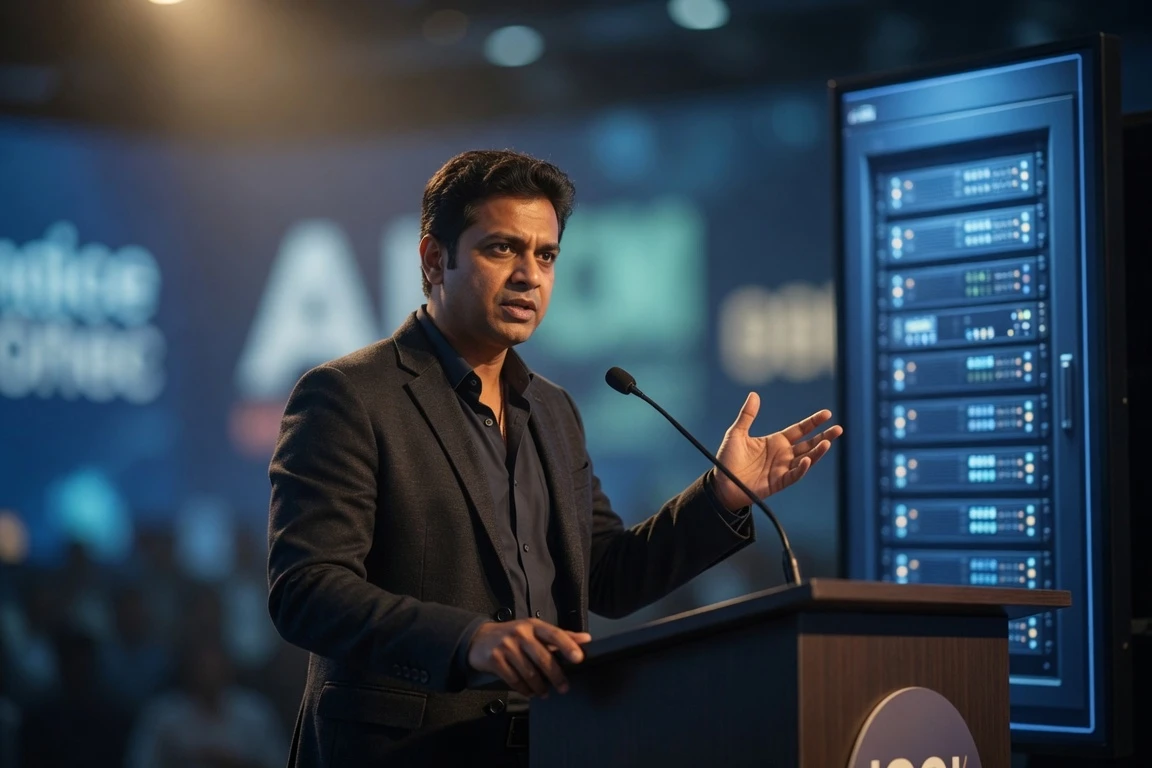
Three Bengaluru Founders, One Inference Thesis
Sanchayan Sinha is the CEO; Parag Jain is co-founder and CPO; Praveen Jain is the third co-founder. The trio’s bet is that inference workloads will keep growing regardless of how cheap tokens get, and that an inference-only chip with the right software layer underneath can deliver lower total cost of ownership than a general-purpose GPU doing inference as a side job, according to Turiyam’s pre-seed funding details.
Most chips on the market were built for training and inherited to handle inference. Turiyam is designing for the inference workload from the start, which means a hybrid memory design, a compiler-led optimisation layer, and a full-stack approach where the chip and the software are co-designed. The thesis is that inference hardware built from scratch can hit throughput and performance-per-watt numbers a general-purpose GPU cannot, because the GPU is doing two jobs and the inference accelerator is doing one.
Per-developer consumption rising sharply while unit costs fell is the same data point from the other direction. If inference is the layer where every dollar is actually spent, the structural cost problem sits there, and the chip underneath is the lever that has to move. Turiyam is one of a handful of vendors globally building specifically for that lever.
The funding round is small by AI hardware standards. It will buy the compiler stack, the first silicon tape-outs, the early pilots, and the engineering hires needed to prove the architecture on real workloads.
- Founded: 2024, in Bengaluru, by Sanchayan Sinha (CEO), Parag Jain (CPO) and Praveen Jain
- Pre-seed round: $4 million (about ₹36 crore) in March 2026, led by Ankur Capital and Micelio Fund (Axilor Ventures)
- Status: Currently in pilot phase with select enterprises, per Sinha
What a Full-Stack Inference Platform Means
Turiyam is building the chip and the software together. Its architecture pairs a custom accelerator with a compiler-led optimisation layer, both aimed at maximising throughput for inference-heavy workloads while improving performance-per-watt and lowering total cost of ownership. The hardware-software co-design framing is the company’s central technical pitch.
Ritu Verma, managing partner at Ankur Capital, said the software-first framing is what sets Turiyam apart. “Putting the software stack in place from day one, rather than as an afterthought, is what makes the approach differentiated and relevant for where the market is headed,” she told Inc42. The argument is that the inference gap is not a hardware problem alone. It is a hardware-and-software problem, and vendors that treat it as one will outcompete vendors that hand customers a chip and expect them to write the compiler themselves.
That architectural framing places Turiyam in the same camp as SambaNova, Groq, Cerebras and Fractile, the inference-focused silicon vendors that have spent the last three years building alternatives to general-purpose GPUs. Turiyam’s geographic base and capital profile are different: an Indian operation building on indigenous compute infrastructure, starting from a much smaller capital base than its global peers.
| Approach | Primary workload | Hardware design | Software model | Cost positioning |
|---|---|---|---|---|
| Turiyam.ai | Inference | Custom accelerator, hybrid memory | Compiler-led, software-first from day one | Pitch: lower TCO for inference workloads |
| General-purpose GPU cluster | Training + inference | General-purpose GPU | Mature CUDA stack, broad software base | Higher unit cost, deepest tooling |
| Other inference-focused silicon (Groq, SambaNova, Cerebras, Fractile) | Inference | Custom accelerator | Vendor-specific compiler or runtime | Targeted at inference economics |
The First Real-World Tests
Two deployments so far test the thesis outside the lab. The first is a partnership with Tokyo-headquartered NTT Global Data Centers to host and scale Turiyam’s next-generation inference servers inside NTT’s data centre facilities, per the partnership with Tokyo-headquartered NTT. NTT GDC operates a global portfolio of data centres and offers enterprise-grade physical and cybersecurity standards along with renewable energy integration.
Alok Bajpai, managing director for India at NTT Global Data Centers, said the collaboration would help enterprises deploy advanced AI workloads with greater efficiency. Sinha said it would let Turiyam deliver lower latency and high availability for mission-critical AI deployments. The deal gives Turiyam a global carrier-grade data-centre footprint without the capex of building one.
The second is a domestic validation. Turiyam deployed its inference engine on the Rudra 1 and Rudra 2 servers built by the Centre for Development of Advanced Computing (C-DAC), under India’s Ministry of Electronics and Information Technology. During validation, a large language model for Hindi covering 37 dialects was executed inside C-DAC’s high-performance computing environment, according to the C-DAC inference engine validation. E Magesh, Director General of C-DAC, called the validation “a reflection of the growing maturity of India’s research and innovation base.”
This milestone proves that India can build and execute across the full AI stack, from model to inference engine and advanced compute platforms.
Sinha’s framing of the deal positions it as a sovereign-compute proof point as much as a commercial deployment. Indian enterprises and government customers concerned about foreign silicon dependencies get a path that runs on domestically engineered servers and an inference engine developed inside India’s domestic compute base.
The deals do not yet prove production-scale cost economics. Turiyam is in a pilot phase with select enterprises, and the company has not disclosed customer numbers, revenue, or per-workload cost benchmarks. What they do prove is that the stack runs real workloads on real infrastructure, which is the precondition for any Indian full-stack inference play at all.
India’s AI Infrastructure Moment
The macro context is unusually large. India is home to a deep base of AI-native startups that have raised significant funding since 2020, per Inc42. At the India AI Impact Summit earlier this year, IT minister Ashwini Vaishnaw said India is set to attract $200 billion in AI investment over the next two years, with the Adani Group and Reliance among those announcing multi-billion-dollar AI commitments. The country is also building out one of the world’s largest data-centre pipelines at the same time, according to India’s expanding data-centre pipeline.
For an inference-first vendor, that pipeline is the addressable footprint. For an Indian inference-first vendor, sovereign-compute policies and data-residency requirements are the additional tailwind a non-Indian competitor does not get. Government and regulated-industry buyers in India face localisation rules that a US-based inference vendor cannot satisfy the same way.
- Indian AI startups: 150+ funded since 2020, per Inc42
- Funding raised by Indian AI startups since 2020: $1.5 Bn+
- India AI market by 2030: $17 Bn+ projected
- AI investment commitment (next two years): $200 Bn+, per IT minister Ashwini Vaishnaw
The Nvidia Moat That Isn’t Going Anywhere
The risk on the other side is real. Nvidia is not standing still on inference. The company agreed in December 2025 to buy assets from Groq for about $20 billion in cash, its largest acquisition on record, with Groq founder Jonathan Ross, president Sunny Madra and other senior leaders joining Nvidia to scale the licensed inference technology, per CNBC. A separate Groq press release confirms the deal as a non-exclusive licensing agreement for Groq’s inference IP, with Groq continuing to operate as an independent company. Nvidia also said in September 2025 it intended to invest up to $100 billion in OpenAI, though the companies have yet to announce a formal deal. The inference market is opening. Nvidia remains the incumbent every buyer knows how to procure, deploy, and operate.
For five years, hyperscalers and enterprises have built procurement, monitoring, and operational muscle around Nvidia’s CUDA stack. Replacing that muscle is not a chip decision. It is a data-centre decision, a talent decision, and a software decision. Turiyam’s software-first pitch addresses one of those, and only one. The other two depend on whether Turiyam can hire compiler engineers fast enough, ship a stable enough runtime, and sign enough enterprise reference customers to convince the next buyer that the migration cost is worth the inference savings.
Inference-cost economics can keep moving against buyers as long as usage scales faster than unit prices fall. That works in Turiyam’s favour. It also works in favour of every other inference-focused vendor, from the global players above to a half-dozen well-funded Chinese entrants. The Indian stack is novel; the inference-cost thesis is not unique.
The Tokenomics Foundation’s formal launch in July will put a standardised vocabulary around the problem. Until then, vendors and buyers are negotiating cost in incompatible units. Turiyam’s first-mover position inside the Indian full-stack category gives it a window. The window narrows the moment a global inference-silicon vendor sets up an Indian data-centre partnership of its own, or one of the existing CUDA-stack alternatives opens a Bangalore office.
The bet lands if enterprise AI buyers keep trading capability for cost, and if India’s sovereign-compute push keeps opening data-centre doors for vendors that can run on indigenous servers. Neither is settled. The pilots at NTT and C-DAC buy time. If inference economics at production scale match the pitch, Turiyam is one of the few vendors positioned for both the sovereign-compute track and the commercial data-centre track in India.
Frequently Asked Questions
What is Turiyam.ai?
Turiyam.ai is a Bengaluru-based deeptech startup founded in 2024 by Sanchayan Sinha, Parag Jain and Praveen Jain. The company builds full-stack AI inference hardware and software, with its own accelerator design and compiler-led software layer, aimed at lowering the cost of running trained AI models in production.
How is Turiyam different from Nvidia?
Turiyam focuses only on inference, not training, and is building both the chip and the software stack together. Its architecture uses a hybrid memory design and a compiler-led optimisation layer tuned for inference workloads. Nvidia’s general-purpose GPUs were originally optimised for training and now handle inference as well, but are not specialised for it.
Who funded Turiyam and how much?
Turiyam raised $4 million (about ₹36 crore) in a pre-seed round in March 2026, led by Ankur Capital and Micelio Fund, the early-stage vehicle of Axilor Ventures. The capital is earmarked for product development, team expansion, and early enterprise and data-centre deployments in India and overseas.
Where does Turiyam fit in India’s AI infrastructure push?
Turiyam has validated its inference engine on C-DAC’s Rudra 1 and Rudra 2 servers, including running a Hindi large language model covering 37 dialects inside C-DAC’s high-performance computing environment. The company has also partnered with NTT Global Data Centers to host its inference servers inside NTT’s data-centre facilities. The combination positions Turiyam inside both the sovereign-compute track and the commercial data-centre track in India.
What is the “inference cost crisis” Turiyam is targeting?
Per-token AI prices have dropped sharply, but enterprise AI bills keep climbing because usage volume is rising even faster. The average enterprise AI budget grew from $1.2 million per year in 2024 to $7 million per year in 2026, and per-developer token consumption rose about 18.6 times in nine months. Turiyam is betting that inference-layer compute, not training, is where the structural cost problem now lives.


South Korea Retail Investors Face Reckoning After KOSPI AI Rally Collapses

Surrey AI Maps Three Heart Attack Paths and Their Molecular Roots

Germany Locks Neutral Apple ATT Prompts Across Most of Europe

Apple’s 5% EU Fee Quietly Rewrites Alternative App Store Math

Apple’s EU Fee Truce Cuts Complexity but Leaves Rivals Fuming

Pixel 11 Pro Fold Trades Thinness for Durability and Seven-Year Stay

Mayo AI Flags HCM Obstruction From Everyday Ultrasound Videos

Indian Brands Quietly Scale Landmark Screens and Home Tech

Navin Vatsa Turns Grief Into a Lifetime of Quiet Seeing

Google Bets Pixel 11 Agentic AI Will Redefine Phones

Oracle Cuts 21,000 Jobs in a Year, Cites AI in 10-K Filing

Fable 5 and Mythos 5 Return as US Lifts Anthropic Export Controls

SpaceX’s Google Deal Turns a Rocket Company Into a Cloud Landlord

CD Projekt Red Co-CEO: Redemption Arc Isn’t Done, Witcher 4 in 2027

XPL Rallies 30% Ahead of Plasma One Card Tier Launch

Google Search Profiles Build a Follow Graph Inside Discover

DGO App Brings Rs 549 Mobile Pass for FIFA World Cup 2026 in Nepal

Moonshot AI Targets $30 Billion in China’s Fastest AI Funding Sprint

Oppo’s ColorOS 17 Eligibility List Leaves A-Series Buyers Behind

Microsoft Xbox Layoffs Start in July as Sharma Slams 3% Margin
-
 AI2 months ago
Oracle Cuts 21,000 Jobs in a Year, Cites AI in 10-K Filing
-
 AI2 months ago
Fable 5 and Mythos 5 Return as US Lifts Anthropic Export Controls
-
 AI3 months ago
SpaceX’s Google Deal Turns a Rocket Company Into a Cloud Landlord
-
 GAMING2 months ago
CD Projekt Red Co-CEO: Redemption Arc Isn’t Done, Witcher 4 in 2027
-
 CRYPTO3 months ago
XPL Rallies 30% Ahead of Plasma One Card Tier Launch
-
 NEWS3 months ago
Google Search Profiles Build a Follow Graph Inside Discover
-
 APPS3 months ago
DGO App Brings Rs 549 Mobile Pass for FIFA World Cup 2026 in Nepal
-
 AI3 months ago
Moonshot AI Targets $30 Billion in China’s Fastest AI Funding Sprint