
GADGETS
Meta Puts Its Own Name on $299 AI Glasses
Meta Glasses start at $299 with Muse Spark and no Ray-Ban logo, $80 under Wayfarer, while opticians and a bystander suit shape what the cheap frames actually change.

Meta Glasses start at $299 and are the first AI frames Meta sells under its own name, $80 below Ray-Ban Meta Gen 2. Three styles went on sale on June 23, 2026, at Meta.com, LensCrafters, Sunglass Hut, Best Buy, and Amazon.
The camera, battery story, and Meta AI stack match the dearer Wayfarer. The change is the temple: Meta’s name, a lower ticket, and lenses an ordinary optician can fit, so Muse Spark can ride on faces that never bought a Ray-Ban.
Meta Sells Its Own Glasses for $299
EssilorLuxottica still makes the hardware, as it has since Ray-Ban Stories in 2021. The new line does not wear Ray-Ban or Oakley on the arm. Adventurer and Fury open at $299. Meta Glasses by Kylie, also sold as Starfire, opens at $399.
That $80 gap is against the current Ray-Ban Meta Wayfarer (Gen 2) at $379, not against the 2023 debut that also used a $299 floor. Meta’s store lists the new pair with a 12-megapixel camera, a 100-degree field of view, stills at 3,024 x 4,032, video up to 3K at 30 fps, 1080p at 60 fps, and 720p at 120 fps. Open-ear speakers and a six-microphone array sit in the frame. Meta rates the glasses at over 8 hours, with up to 40 more hours from a foldable case. A USB-C cable is not in the box.
Alex Himel, Meta’s vice president of wearables, said the company wanted a lower price and could not hang it on a little-known EssilorLuxottica badge.
We just feel like we need to have a pair of glasses at a lower price point, and we were trying to figure out what could work there. They do have glasses at brands that are at lower price points, but they’re not really that well known, so there wasn’t an obvious fit there.
Alex Himel, vice president of wearables, Meta
Mark Zuckerberg, Meta’s chief executive, put the same push in plainer words at launch: “I believe glasses are going to be a main way people access personal superintelligence.” He added that Meta Glasses would make that accessible to a lot more people. EssilorLuxottica had already told investors it sold more than 7 million Ray-Ban and Oakley smart glasses in 2025, after about 2 million Ray-Ban Meta pairs by February 2025. A house brand at $299 is how Meta tries to grow past that fashion channel without abandoning the factory that built it.
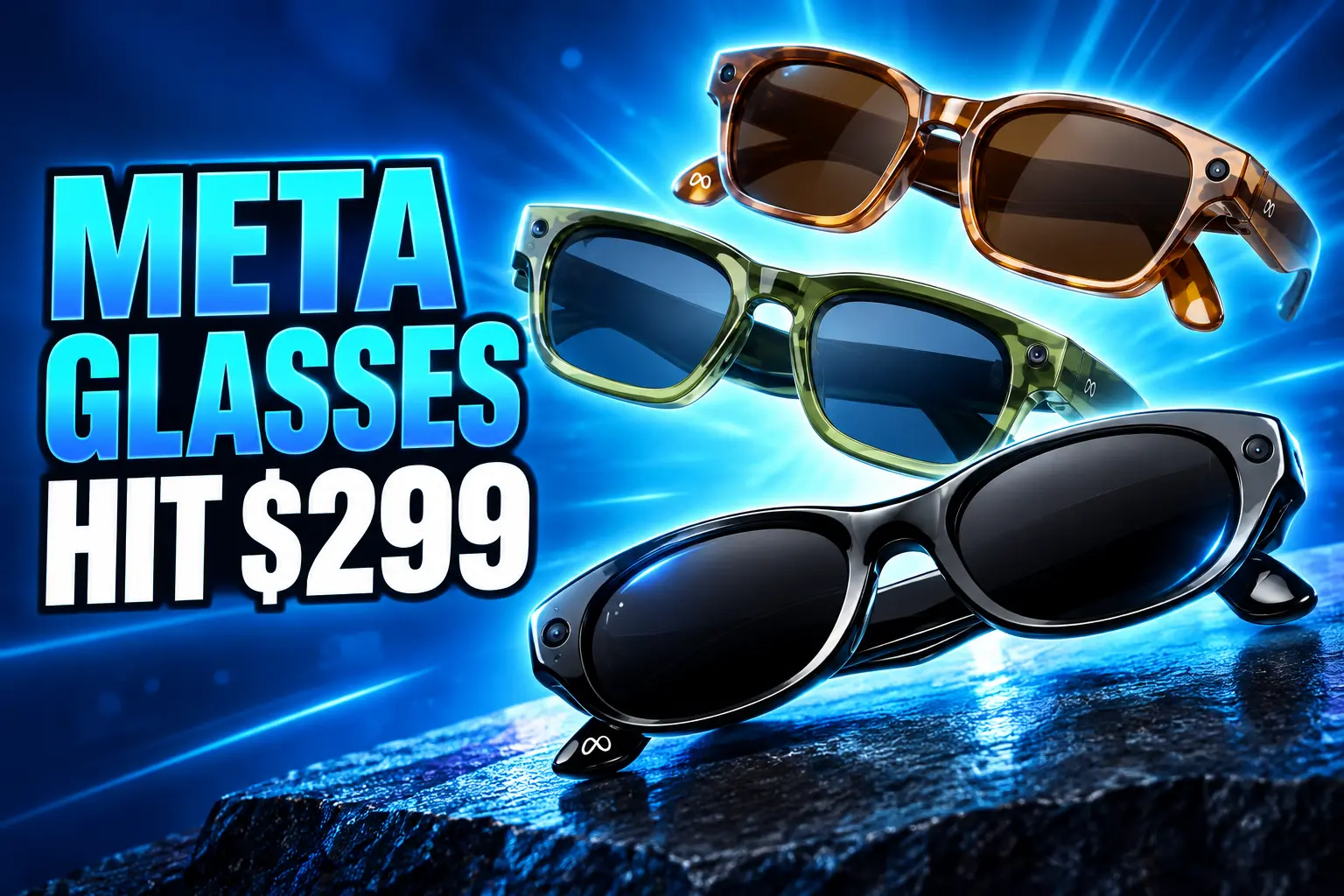
Adventurer, Fury, and Kylie’s $399 Oval
Meta lists 26 style mixes across colors, lenses, and three silhouettes. Colors include Classic Black, Classic Tortoise, Racing Green, Linen, Merlot, Mahogany, and Sandstone. Lenses run clear, sun, Transitions, and polarized. All three frames take prescription glass.
THE THREE LAUNCH FRAMES
- Adventurer: A clean rectangle in Standard and Large, built as the everyday $299 pair, with three-way nose pads, adjustable temple tips, and over-extension hinges.
- Fury: A thicker, bolder square at the same $299; Meta’s store lists the frame at 59.9 grams, so it wears heavier than a slim optical pair.
- Starfire by Kylie: A slim oval at $399, with a gem on the lens, and the only AI glasses Meta sells with Kylie Jenner’s voice on the assistant.
David Woodland, who posts for Meta’s glasses team, put the lineup on sale the same morning and followed with fit notes, including prescription down to -12.0.
Today we’ve expanded our AI glasses portfolio with 26 more styles and colors.
Meta Glasses available today, starting at $299. pic.twitter.com/wByxkxlR3Z
— David Woodland (@davidsven) June 23, 2026
Hands-on testers at Meta’s New York press event used the glasses to guess calories in a bowl of strawberries, turn an Arabic sign into English, and pull nearby museum tips. The demo is the product in one scene: a camera that looks with you, then talks. There is still no in-lens display. Turn-by-turn walking cues were promised as audio, not as arrows in glass.
Why Meta Dropped the Ray-Ban Name
Ray-Ban Meta remains on sale. Oakley Meta remains on sale. The Display model, the one with a screen in the lens, remains the expensive sibling. Meta Glasses sit under that stack as the pair you can buy without paying for a fashion house on the temple.
The internals are not a new chip generation. Reviewers who wore Fury and Adventurer found the same capture stack as Ray-Ban Meta Gen 2, then noticed the extras Meta did put in the cheap frames: a customizable action button, a six-microphone array against five mics on Wayfarer, tri-band Wi-Fi 6, Bluetooth 5.4, and those adjustable pads. You give up Wayfarer, Headliner, and Skyler shapes. You also give up Ray-Ban’s +6.00 prescription ceiling. Meta Glasses stop at +2.25 total power, with a floor of -12.00.
That trade is the point of the SKU. Meta gets a product it can advertise as its own. EssilorLuxottica still runs LensCrafters and Sunglass Hut, so the optical aisle does not disappear. Shoppers who want the Wayfarer can still pay $379. Shoppers who want a rectangle that does not say Ray-Ban can pay $299 and live inside the same app, the same assistant, and the same charging-case habit.
Putting Muse Spark on Ordinary Faces
Meta Superintelligence Labs introduced Muse Spark on April 8, 2026, as a natively multimodal reasoning model built for Meta’s own products rather than as a general chatbot. The June glasses post called Meta Glasses the first AI glasses to launch with Muse Spark from day one in the United States and Canada, with other markets later. A July 23, 2026, note on that same post tightened the availability language. Existing Ray-Ban Meta and Oakley Meta pairs were already in line for the same model by software.
On the glasses, Muse Spark is the rebuilt Meta AI: ask what you are looking at, get a restaurant pick, move a calendar block, keep a conversation going without staring at a phone. A dedicated action button wakes it, or you can map that button to another trick. Live translation was set to gain 14 languages after launch, including Japanese, Mandarin Chinese, Hindi, and Korean. Woodland’s summer software note listed the full 14 as Arabic, Dutch, Finnish, Greek, Hindi, Indonesian, Japanese, Korean, Mandarin, Russian, Swedish, Thai, Turkish, and Vietnamese.
FROM JUNE LAUNCH TO CONNECT
- April 8, 2026: Meta Superintelligence Labs ships Muse Spark as its first model and says it will reach AI glasses.
- June 23, 2026: Meta Glasses go on sale from $299 as the first frames to carry Muse Spark from day one in the US and Canada.
- June 26, 2026: Summer software (V126) starts rolling Muse Spark, Dynamic Photo, Photo Ultra HDR, Conversation Focus, Battery Saver, and the 14 translation languages across the glasses lineup.
- September 8, 2026: Meta introduces Muse, a personal agent it says is coming soon to AI glasses.
- September 23 and 24, 2026: Meta Connect in Menlo Park, where Zuckerberg said the company would share more on its glasses lineup.
Dynamic Photo, which grabs several frames and suggests a keeper, was a launch-month camera feature. Pedestrian navigation for display-free frames was “coming soon” in June; a September software pass added walking directions, with longer driving trips handed to the phone. Battery Saver trims heavy features when the over-8-hour claim meets a loud day. Testers who left music running have seen closer to four and a half hours, which is a different load than Meta’s mixed-use rating.
The agent layer is the next weight on those temples. Muse, separate from the Spark model name, is Meta’s personal agent on iOS, Android, and muse.ai in the United States, with a secure VM, a Sentinel that gates what leaves the machine, and checkout through Link. Meta says it is coming to AI glasses. That is the same agent thread as the Muse agent that can check out in apps. A $299 pair that already sees the room is the obvious place to park it, if the battery and the privacy fight allow it.
The Rx Swap That Leaves Warranty Intact
Smart glasses die in the optical shop when a local lens swap voids the electronics warranty. Meta’s reply is Rx Lens Swap. You buy the frames, then take them to a licensed optician, optometrist, ophthalmologist, or optical lab. Coverage lasts 1 year from purchase or delivery, whichever is later, and it is automatic on eligible pairs.
If a professional install cracks the front, temples, or hinges, warps the frame, or kills the electronics through physical stress, Meta’s terms promise a free frame replacement if install damages the pair. Cosmetic scuffs, amateur installs, and later drops are out. The lenses themselves are not covered by that program. Meta still wants people to order a complete Rx pair from its own site when they can, and it publishes install notes for outside shops. Vision benefits and FSA or HSA paperwork can apply to the frame, which matters more at $299 than it does at Display money.
The prescription window is the catch for strong plus corrections. Meta Glasses take -12.00 to +2.25 total power. Wayfarer Gen 2 goes to +6.00. Anyone above +2.25 is still in the Ray-Ban line, not on the house-brand pair. That split keeps EssilorLuxottica’s optical stores in the expensive SKU while the $299 frames chase people who already wear mild glass and would never walk into a Wayfarer shop for a computer.
How Meta Glasses Compare With Ray-Ban Meta
Meta’s own compare page is the cleanest way to see what $80 buys and what it does not. Fury matches Adventurer on price and core specs, so the table uses Adventurer as the $299 stand-in against Starfire and Wayfarer Gen 2.
META GLASSES VERSUS RAY-BAN META GEN 2
| Spec | Adventurer | Starfire by Kylie | Wayfarer (Gen 2) |
|---|---|---|---|
| Starting price | $299 | $399 | $379 |
| Battery on the glasses | Over 8 hours | Over 8 hours | Up to 8 hours |
| Charging case | 40 hours more | 40 hours more | 48 hours more |
| Microphones | 6-mic array | 6-mic array | 5-mic array |
| Prescription window | -12.00 to +2.25 | -12.00 to +2.25 | -12.00 to +6.00 |
| Action button | Customizable | Customizable | None listed |
| Display | No display | No display | No display |
| Name on the temple | Meta | Meta, Kylie voice, lens gem | Ray-Ban |
Camera duties match across that row: wide-angle 12 MP, 100-degree field of view, Dynamic Photo, Ultra HDR, hyperlapse, slow motion, 3K at 30 fps, 1080p at 60 fps. Meta’s compare sheet for Adventurer and Wayfarer side by side is the source for those cells. The $100 step to Starfire buys the oval, the gem, the voice, and a special case with a mirror, not a better sensor.
Launch countries were Australia, Austria, Belgium, Canada, Denmark, Finland, France, Germany, Ireland, Italy, the Netherlands, Norway, Spain, Sweden, Switzerland, the United Kingdom, and the United States, 17 in all. India was not on that list. Ray-Ban Meta has already been sold there; this house-brand line has not been dated for that market.
California Suit Adds a Bystander Class
A cheaper camera that looks like ordinary eyewear is easier to miss across a table. That is the objection that has followed these frames since June, and it got louder as the price fell and the Ray-Ban logo came off. Meta says the glasses include a recording LED, privacy settings, and firmware that can shut the camera if someone tampers with that light. Those controls sit on the wearer. They do nothing for a stranger who never agreed to be in the shot.
In the Northern District of California, the consolidated case In re Meta AI Glasses Litigation, No. 3:26-cv-01897, now includes a nationwide bystander class. An amended complaint filed August 31, 2026, alleges that footage from the glasses was sent to human reviewers, including at contractor Sama, and used to train Meta’s models without consent. The pleading describes accidental “Hey Meta” wakes, bathroom scenes, and a two-year-old on a changing table. Those are allegations in a live case, not findings. They are also the exact fear people keep repeating when the glasses show up in public: you do not know you are in the clip until it is already gone.
Federal bystander privacy rules for AI glasses still lag the hardware. Meta can cut $80, add 26 colorways, and hand Muse Spark to a $299 frame. It cannot legislate a consent regime for the sidewalk. Connect on September 23 and 24 is where Zuckerberg said more glasses news will land. Muse is already promised for the same faces that bought the cheap pair. The $299 Meta Glasses are the volume layer for that plan, camera, mics, and all.

Instagram Plus Tests a Read-Only Mode That Cuts Stories

Altman Asks the Public to Accept Some AI Harm

Google Freezes OSS VRP Product Reports After AI Flood

AI Agents Make Payment Rails the Scarce Prize

Turkey’s Crypto Boom Now Runs Through Three Banks

Fable 5 Came Back Under a Commerce On-Off Switch

Google’s SpaceX GPU Lease Has a Sept. 30 Deadline

Plasma One’s XPL Locks Face a 1.81 Billion Cliff

DGO’s Rs 549 World Cup Pass Cost Fans Sleep and Data

Moonshot AI’s $30 Billion Ask Became a $35 Billion Close
-
 AI4 months ago
Fable 5 Came Back Under a Commerce On-Off Switch
-
 AI4 months ago
Google’s SpaceX GPU Lease Has a Sept. 30 Deadline
-
 CRYPTO4 months ago
Plasma One’s XPL Locks Face a 1.81 Billion Cliff
-
 APPS4 months ago
DGO’s Rs 549 World Cup Pass Cost Fans Sleep and Data
-
 AI4 months ago
Moonshot AI’s $30 Billion Ask Became a $35 Billion Close
-

 NEWS4 months ago
ColorOS 17 Device List Spans Oppo, OnePlus and Realme
-

 GAMING4 months ago
Xbox Cuts 3,200 Jobs After Five Years of Thin Returns
-

 GAMING4 months ago
The RTX 4050 Under Rs 70,000 Hides a Wattage Gap