
AI
Vertiv’s $15 Billion AI Backlog Comes With a Concentration Catch
Vertiv’s AI infrastructure rally rests on a $15 billion backlog, but valuation, hyperscaler concentration and rivals like Fermi and AEIS complicate the trade.

Vertiv Holdings has ridden the AI data center boom to an 80% stock rally in 2026, backed by a backlog that topped $15 billion at year end. Retail investors chasing that same trade are increasingly funneling money into two very different names alongside it: semiconductor equipment supplier Advanced Energy Industries and a pre-revenue power grid developer called Fermi.
All three get filed under the same pick and shovel thesis for artificial intelligence. The actual risk on offer ranges from a premium priced cash generator with a concentrated customer list to a company still pouring concrete for the power plants it plans to sell electricity from.
The Power Bottleneck Behind Every AI Stock Rally
Electricity, not chips, is the constraint now shaping this trade. Goldman Sachs research released in May 2026 projects U.S. data center demand could reach 74 gigawatts by 2028, with roughly 49 gigawatts of that demand facing no available power access at all, according to Morgan Stanley Research.
The numbers keep compounding the further out analysts look.
- 31 to 41 gigawatts: U.S. data center electricity demand climbs from 31 gigawatts in 2025 to 41 gigawatts in 2026, per Goldman Sachs.
- 66 gigawatts by 2027: that same demand more than doubles again the following year on Goldman’s projections.
- 132 gigawatts worldwide: Gartner forecasts global data center power demand rising 27% in 2026 alone, up from 104 gigawatts in 2025.
Real estate services firm JLL puts a dollar figure on the buildout, expecting nearly 100 gigawatts of new data centers by 2030, doubling global capacity and requiring up to $3 trillion in investment. Companies across the supply chain are reorganizing around that demand. Manufacturing giant Flex spun off its AI data center power unit this year to chase the same buildout Vertiv, AEIS and Fermi are all trying to monetize.
Vertiv Turns Hyperscaler Orders Into a $15 Billion Backlog
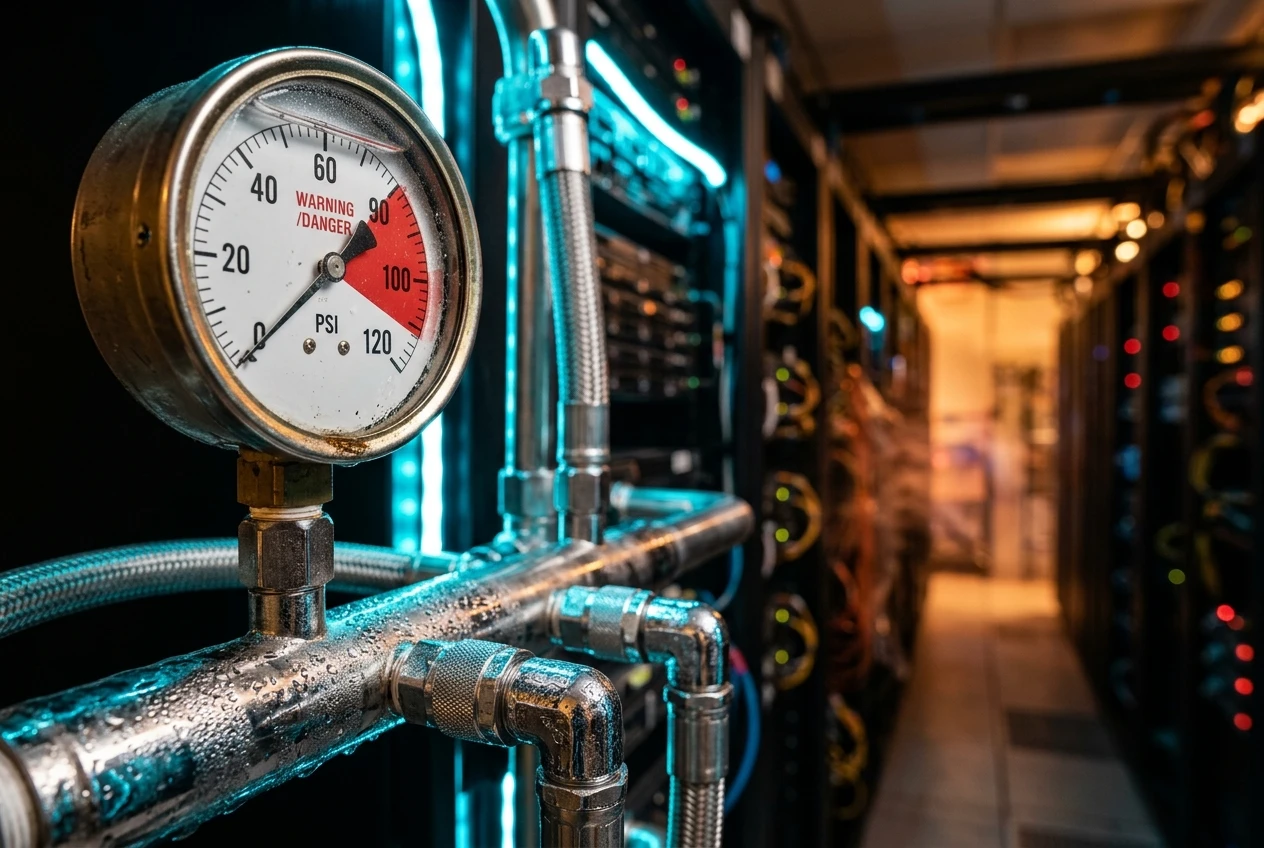
Vertiv makes the power systems, cooling equipment and racks that keep AI data centers running in more than 100 countries. Its backlog hit $15 billion at the end of 2025, up 109% year over year, with a book to bill ratio near 2.9 times.
First quarter 2026 net sales came in around $2.65 billion, up roughly 30% year over year, with adjusted diluted earnings per share climbing 83% to $1.17 and net income of $390 million. Adjusted operating margin expanded 430 basis points to 20.8%. Management raised full year guidance to between $13.5 billion and $14.0 billion in net sales, with adjusted EPS guidance now at $6.35, a 51% increase from 2025.
We’re still in the early stage of the infrastructure build out for AI.
Dave Cote, Vertiv’s chairman, made that comment as the stock traded near its highs earlier this year. Chief executive Giordano Albertazzi has described the company’s relationship with Nvidia in similar terms, telling Forbes the partnership lets Vertiv be the installer before the launch of new GPU generations. Vertiv has since outlined its role in Nvidia’s Vera Rubin DSX AI factory reference design, supplying standardized 12.5 megawatt infrastructure blocks and opening a new manufacturing plant in Johor, Malaysia to keep up with orders.
Is Vertiv Stock Too Expensive After an 80% Rally?
Shares have gained more than 80% in 2026 and traded near $318 in recent sessions, up from a 52 week low of $109.96 but well off the 52 week high of $379.94. The stock now trades at roughly 45 to 80 times forward earnings depending on the metric used, a premium that leaves little room for disappointment if order growth slows.
Wall Street has kept raising the bar to match the rally. In late April, the average target among 17 analysts sat at $309.75, implying only modest upside at the time, according to Forbes contributor Peter Cohan. Bernstein has since set a target as high as $416, while other models put fair value closer to $360.
Where analysts disagree:
- Seeking Alpha’s bull case argues the 46 times forward P/E is justified by 43% EPS growth, putting the stock roughly 11% below its $310 fair value estimate.
- Peter Cohan at Forbes counters that Vertiv’s reduced backlog disclosure and vagueness on customer concentration are less than bullish signals, putting the stock closer to fully valued.
- TIKR’s valuation model lands in between, calling Vertiv fairly valued near $318 with about 14% upside to a $360 target tied to order momentum rather than multiple expansion.
History adds another layer of caution. Vertiv’s average peak to trough drop during major market shocks since 2018 has run about 32%, according to Trefis, nearly double the S&P 500’s average 17% decline over the same stretches, with a beta of 2.04 magnifying every macro wobble.
Hyperscalers Are Starting to Build Their Own Cooling
Vertiv’s own annual report warns of unpredictable customer order patterns and the risk of failing to realize sales expected from its backlog. Two developments make that warning concrete.
Amazon Web Services is now building its own server liquid cooling systems, a direct challenge to Vertiv’s high margin cooling business, according to a July 10 analysis from TradingKey. Eaton, meanwhile, added liquid cooling capability through its Boyd Thermal acquisition in March 2026, giving hyperscalers another external option even if they do not build in house.
The concentration math is stark. A handful of hyperscale customers drive the bulk of Vertiv’s order book, so a single capital expenditure pause could ripple through results fast, especially if the broader industry enters the kind of spending discipline already playing out in the fight over AI token budgets and bills among model providers.
Advanced Energy Industries Is the Quieter, Cheaper Bet
Advanced Energy Industries supplies precision power systems for semiconductor manufacturing, AI data centers, industrial production and medical devices, backed by a global calibration and repair network. Its market cap sits near $11.8 billion against roughly $1.9 billion in revenue, spread across the United States, Mexico and other international markets, according to Simply Wall St data.
Earnings grew 154.9% over the past year with margins improving to 10.1%, and analysts have kept lifting price targets as order books and backlog strengthen. The trade off is real: customer concentration in hyperscalers, exposure to cyclical semiconductor and industrial demand, and tariff pressure on margins that could bite before the AI story fully offsets them.
Fermi Is Pricing Power Plants That Don’t Exist Yet
Fermi is the riskiest of the three by a wide margin. The company is building gigawatt scale private power grids that combine natural gas, nuclear, solar, battery storage and utility power behind the meter, anchored by its flagship Project Matador in Texas, according to Simply Wall St.
Its market cap runs about $4.7 billion despite being pre-revenue today. Analysts model multibillion dollar revenue and high profit margins once leases are signed, and Simply Wall St’s discounted cash flow estimate sits far above the current share price, implying considerable upside if projects execute on schedule.
That is a large if. Fermi carries construction and funding risk, has faced governance disputes, and has seen insider selling, all while trying to convince utilities and chipmakers to sign long term power contracts for infrastructure that has not been built.
Three Very Different Bets on One AI Trade
| Company | Market Cap | Core Business | Biggest Risk |
|---|---|---|---|
| Fermi (FRMI) | $4.7 billion | Gigawatt scale private power grids for AI campuses, led by Project Matador in Texas | Pre-revenue, construction and funding risk, governance disputes, insider selling |
| Advanced Energy Industries (AEIS) | $11.8 billion | Precision power systems for semiconductor tools and AI data centers, about $1.9 billion in revenue | Cyclical semiconductor demand, tariff exposure, customer concentration |
| Vertiv Holdings (VRT) | $124.4 billion | Liquid cooling and power systems for hyperscale data centers, $15 billion backlog | Premium valuation, hyperscaler concentration, funding built on external debt |
The dispersion in that table is the whole story. Vertiv offers real cash flow at a rich price, AEIS offers cheaper growth tied to a more cyclical business, and Fermi offers a lottery ticket on power infrastructure that may or may not get built on schedule. Investors treating all three as interchangeable exposure to the same theme are underpricing how differently each one could end up, a pattern that has already reshuffled which AI stocks actually deliver market-beating returns this year.
Vertiv reports second quarter results on July 29. That print, and whether the backlog keeps growing or simply keeps getting spent down, is the next real test of the thesis.


South Korea Retail Investors Face Reckoning After KOSPI AI Rally Collapses

Surrey AI Maps Three Heart Attack Paths and Their Molecular Roots

Germany Locks Neutral Apple ATT Prompts Across Most of Europe

Apple’s 5% EU Fee Quietly Rewrites Alternative App Store Math

Apple’s EU Fee Truce Cuts Complexity but Leaves Rivals Fuming

Pixel 11 Pro Fold Trades Thinness for Durability and Seven-Year Stay

Mayo AI Flags HCM Obstruction From Everyday Ultrasound Videos

Indian Brands Quietly Scale Landmark Screens and Home Tech

Navin Vatsa Turns Grief Into a Lifetime of Quiet Seeing

Google Bets Pixel 11 Agentic AI Will Redefine Phones

Oracle Cuts 21,000 Jobs in a Year, Cites AI in 10-K Filing

Fable 5 and Mythos 5 Return as US Lifts Anthropic Export Controls

SpaceX’s Google Deal Turns a Rocket Company Into a Cloud Landlord

CD Projekt Red Co-CEO: Redemption Arc Isn’t Done, Witcher 4 in 2027

XPL Rallies 30% Ahead of Plasma One Card Tier Launch

Google Search Profiles Build a Follow Graph Inside Discover

DGO App Brings Rs 549 Mobile Pass for FIFA World Cup 2026 in Nepal

Moonshot AI Targets $30 Billion in China’s Fastest AI Funding Sprint

Oppo’s ColorOS 17 Eligibility List Leaves A-Series Buyers Behind

Microsoft Xbox Layoffs Start in July as Sharma Slams 3% Margin
-
 AI2 months ago
Oracle Cuts 21,000 Jobs in a Year, Cites AI in 10-K Filing
-
 AI2 months ago
Fable 5 and Mythos 5 Return as US Lifts Anthropic Export Controls
-
 AI3 months ago
SpaceX’s Google Deal Turns a Rocket Company Into a Cloud Landlord
-
 GAMING2 months ago
CD Projekt Red Co-CEO: Redemption Arc Isn’t Done, Witcher 4 in 2027
-
 CRYPTO2 months ago
XPL Rallies 30% Ahead of Plasma One Card Tier Launch
-
 NEWS3 months ago
Google Search Profiles Build a Follow Graph Inside Discover
-
 APPS2 months ago
DGO App Brings Rs 549 Mobile Pass for FIFA World Cup 2026 in Nepal
-
 AI3 months ago
Moonshot AI Targets $30 Billion in China’s Fastest AI Funding Sprint