
AI
Viet Nam’s FSC and AI Tools Reshape ASEAN Timber Trade
Vietnam’s ASEAN furniture council chairmanship lands alongside an AI wood-ID app, an expanding FSC-certified forest base, and a US$9 billion US export book.

On 4 March 2026, Viet Nam took over the chairmanship of the ASEAN Furniture Industries Council in Ho Chi Minh City, with HAWA’s Nguyen Quoc Khanh leading the body for the 2026-2027 term. Customs officers in the country are now using an AI wood-identification app that returns species matches in under a second with 98.6% accuracy. The combined FSC and PEFC-certified commercial forest base has grown to roughly 700,000 hectares. The Department of Forestry and Forest Protection is preparing new traceability regulations covering business classification and geographical zoning.
Vietnamese wood and wood-product exports to the United States reached $9 billion in 2024, up 24% year-on-year, and the US now accounts for 55% of Viet Nam’s total wood exports. Viet Nam imported $316.36 million of timber from the US in the same year, up 32.9% year-on-year.
Vietnam Takes the AFIC Chair
The 4 March ceremony took place in Ho Chi Minh City and brought together furniture industry leaders from across ASEAN. Mr. Dhanakorn Kasetrsuwan, who chaired AFIC for the 2024-2025 term under the Thai Furniture Industry Club, formally handed over the AFIC Cup to Mr. Nguyen Quoc Khanh of HAWA. The handover came on the same day AFIC convened its 44th Working Committee Meeting, also in Ho Chi Minh City.
HAWA, the Handicraft and Wood Industry Association of Ho Chi Minh City, takes the seat with an explicit focus on sustainable forestry and regional cooperation. The Programme for the Endorsement of Forest Certification, or PEFC, used the same week to reaffirm a four-year partnership with AFIC. At HAWA Expo 2026, PEFC’s Southeast Asia Market Engagement Manager Wikkie Netten reviewed opportunities to deepen that work, while Jamila Akhundova, PEFC Furniture Programme Lead, framed Viet Nam’s role in global furniture supply chains. “Vietnam’s furniture sector is a global leader, and sustainability is becoming an increasingly important part of that leadership,” Akhundova said at the exhibition. Several PEFC Chain-of-Custody-certified companies, including suppliers Timberlink and Canadian Wood, displayed certified materials at the same show.
The chairmanship runs through 2027 and will end with a handover to the next ASEAN member. AFIC’s leadership cycle rotates every two years among the group’s national furniture associations.
Vietnam’s furniture sector is a global leader, and sustainability is becoming an increasingly important part of that leadership.
Jamila Akhundova, PEFC Furniture Programme Lead, at HAWA Expo 2026 in Ho Chi Minh City.
AI Now Reads the Wood at Customs
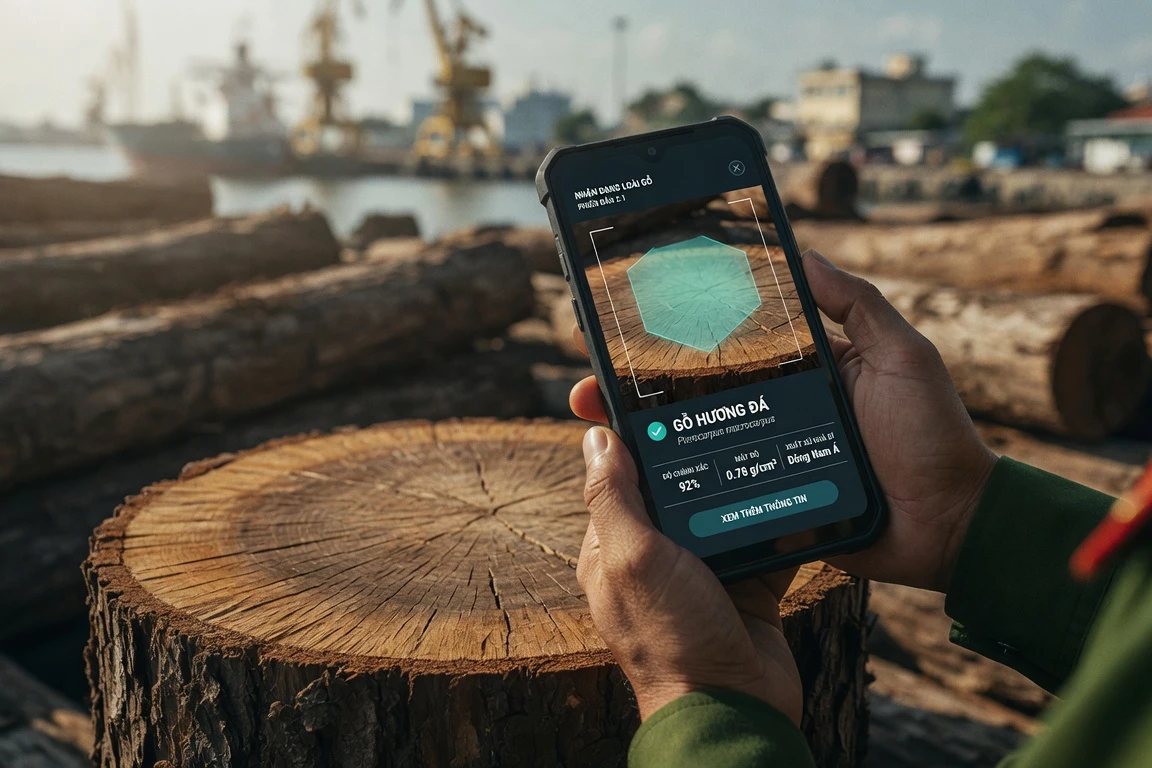
Customs officers in Viet Nam are now identifying timber species with a smartphone. Vn-WoodID, an AI-driven wood-identification application, was officially launched on 12 September 2025 inside the “Ensuring Timber Legality for Sustainable Forestry Development in Vietnam” forum. The app analyses images of wood cross-sections and returns a species match with 98.6% accuracy in less than one second. That speed matters in a country that imports more than 800 wood species from over 120 countries.
The tool works without an internet connection, so officers can use it at the port, in a warehouse, or in the field. Its current database holds 260 wood species, including 181 that are commonly imported into Viet Nam, seven that are listed under CITES, and many others that are frequently illegally exploited. The model itself was trained on nearly 3,000 wood samples collected from high-risk origin regions across Africa, South America, and Asia.
Vn-WoodID was built under the Supporting the Implementation of the VPA/FLEGT Agreement in Viet Nam project, funded by Germany’s Federal Ministry for Economic Cooperation and Development. The Department of Forestry and Forest Protection led implementation, with technical support from the German Agency for International Cooperation, the Forest Industry Research Institute, and Artificial Intelligence Technology Consulting and Development. The German-built tool is now part of a broader push to implement Viet Nam’s commitments under the 2019 Voluntary Partnership Agreement with the EU on Forest Law Enforcement, Governance and Trade. “Vietnam’s import of over 800 wood species from more than 120 countries makes management very complex, especially in the declaration and verification of wood names,” said Le Thi Loc, a GIZ Viet Nam project officer. Within a year of launch the app had recorded over 8,000 downloads and 371 officials and researchers had joined the pilot phase.
Vietnam Customs representative Nguyen Thi Quynh Chi described the previous process as time-consuming and costly. “With WoodID, results are available in just a few seconds, significantly saving effort and cost for both management agencies and businesses,” she said.
Vn-WoodID at a Glance
- 98.6% accuracy on wood cross-section identification in under a second
- 260 wood species in the current database, 181 commonly imported into Viet Nam, 7 listed under CITES
- Operates offline on a standard smartphone, no internet required
- Trained on nearly 3,000 wood samples from high-risk origins across Africa, South America, and Asia
- Over 8,000 downloads and 371 officials and researchers in the pilot phase within a year of launch
FSC Certification Becomes the Market Pass
Certification has become the practical price of admission to Viet Nam’s export markets. The country holds roughly 310,000 hectares of FSC-certified forests, including more than 20,000 hectares of natural and planted forest, according to Vu Thi Que Anh, the FSC representative in Viet Nam. The number of FSC Chain-of-Custody certifications in the country has climbed to 1,730. An additional 9,000 hectares of bamboo and 6,000 hectares of rubber are also certified under FSC, giving processors a wider raw-material base.
FSC-certified wood sells at a premium. “FSC-certified raw materials command a higher price, ranging from 10 to 15 per cent compared to non-certified wood,” Anh told Nông Nghiệp newspaper. At a 24 June workshop in Hanoi, VIFOREST Vice Chairman and Secretary General Ngo Sy Hoai put the combined FSC and PEFC base at 700,000 hectares of commercial forest.
The biggest pull on that certified supply is the United States. Vietnamese exporters shipped wood and wood products worth $9 billion in 2024 to the US, up 24% year-on-year, according to Hoai. The US accounts for 55% of Viet Nam’s total wood exports, with wooden furniture, plywood, doors, and handicrafts as the main categories. Viet Nam imported $316.36 million of timber from the US in the same year, up 32.9% year-on-year, with the top items being sawn timber, logs, and veneer. That made the US Viet Nam’s fourth-largest wood source, supplying 11.2% of total wood imports.
Both sides are tightening the legal net. The US Lacey Act requires wood imports to be legal and traceable, while the EU Deforestation Regulation took effect in June 2023 and became applicable in December 2024.
Viet Nam banned natural forest logging in 2014, according to the Department of Forestry and Forest Protection, and now relies mainly on 3 million hectares of planted forests, principally acacia and eucalyptus, plus 1 million hectares of rubber plantations. Imports of tropical timber into Viet Nam have fallen sharply, from over 2 million cubic metres in 2015 to 700,000 cubic metres in 2024. Director of the department Tran Quang Bao said at the 24 June workshop that Viet Nam “does not use wood materials from natural forests for export and is completely transparent in the supply chain and legal system.” That licensing step, once complete, will let the Viet Nam Timber Legality Assurance System, or VNTLAS, issue FLEGT export licences for shipments bound for the EU.
Viet Nam’s Certification and Trade Footprint
| Metric | Figure |
|---|---|
| FSC-certified forest area | ~310,000 ha |
| FSC Chain-of-Custody certifications | 1,730 |
| FSC-certified bamboo | 9,000 ha |
| FSC-certified rubber | 6,000 ha |
| FSC + PEFC commercial forest base | 700,000 ha |
| Premium for FSC-certified wood | 10-15% over non-certified |
| Certified plantation coverage target | 70% by 2030 |
| Wood exports to US, 2024 | $9 billion (up 24% YoY) |
| US share of Viet Nam’s wood exports | 55% |
| US timber imports into Viet Nam, 2024 | $316.36 million (up 32.9% YoY) |
A Cross-Border Wood Platform Forms
A regional timber platform is taking shape from Ho Chi Minh City outward. On 4 June 2025, the Tropical Asia Forest Fund 2, or TAFF2, managed by Australia’s New Forests, announced its first investment in Viet Nam: a stake in the Tavico Group. Tavico, founded in 2005 as a log trader and sawn-timber mill, now operates at an annual production capacity of about 250,000 cubic metres, enough to supply roughly 16,500 medium-sized houses a year.
The investment is meant to expand an integrated timber processing and plantation business across Laos, Cambodia, and Viet Nam, using Viet Nam as a focal point. Tavico already runs a 3,200-hectare FSC-certified community forestry programme with smallholder farmers, and the new capital will help grow that programme. “This collaboration reflects a shared vision for creating long-term value through innovation, sustainability, and positive impact on local communities,” said Geoffrey Seeto, Senior Managing Director for Emerging Markets at New Forests. Tavico CEO Vo Quang Ha framed the deal as a step toward “a traceable, high-value supply chain that benefits both local communities and the environment.” Viet Nam recorded close to $4 billion in wood-product exports in the first quarter of 2025 alone, with wooden furniture, pellets, woodchips, plywood, and engineered wood products as the main categories.
TAFF2 closed at $130 million in 2024 and had already deployed into forestry plantations and infrastructure in Thailand and Laos before the Tavico deal. The investment marks the fund’s fourth acquisition since launch.
From Forests to Low-Carbon Buildings
The same wood is now being pushed into Viet Nam’s building stock. On 29 January 2026, the Association of Structure Wood Architecture, or SAWA, and the Viet Nam Institute for Building Materials, or VIBM, signed a memorandum of understanding in Ho Chi Minh City. VIBM sits inside the Ministry of Construction. The MoU creates a technical cooperation framework for research, testing, and standard-setting on structural wood.
Signatories Vo Quang Ha, SAWA’s chairman and the same executive who leads Tavico, and Nguyen Quang Hiep, VIBM’s president, agreed to focus on LVL, glulam, and CLT, engineered-wood products for which Viet Nam still lacks a harmonised standard system. The two organisations will jointly run a pilot testing project in Hanoi to build a base of physical, mechanical, and durability data. The cooperation is meant to feed directly into new national technical standards that classify wood as a renewable, low-carbon building material.
Field testing will follow at the “Mass Timber House in Forest” exhibition, also called GOTO Exhibition, planned for Khanh Hoa Province. Five structural-wood house prototypes will be built on site using CLT, glulam, and LVL, with VIBM serving as SAWA’s technical partner. The goal is to validate design and construction methods under actual Vietnamese operating conditions. The push dovetails with Viet Nam’s broader net-zero commitments and the government’s plans to expand green-building codes. Forestry and forest products industry leaders in Viet Nam have argued that treating wood as a low-carbon construction input can pull certified supply into higher-value domestic use.
VIBM’s involvement gives the standard-setting work direct line-of-sight into the Ministry of Construction. A successful pilot could move sustainable wood from a niche construction material into mainstream low-carbon building practice.
What’s Pending: Licensing and New Rules
The next test for Viet Nam’s timber regime will be licensing. VNTLAS was launched in 2020 and updated in 2024, and is now preparing for the licensing step that will let it issue FLEGT (Forest Law Enforcement, Governance and Trade) licences for shipments bound for the European Union. At the 24 June workshop, Tran Quang Bao, Director of the Department of Forestry and Forest Protection, said new regulations covering business classification, traceability of forest products, and geographical zoning were expected to be issued this month.
Capacity on the ground is being built in parallel. TRAFFIC, the wildlife-trade monitoring network, ran timber-legality training courses with the Department of Forestry and the Ministry of Agriculture and Rural Development in Quang Tri, Ba Ria-Vung Tau, Dong Nai, and Gia Lai. The series reached 123 officials from Viet Nam Customs, the Forest Protection Department, and Environmental Police across 21 provinces. The training came as Viet Nam works to implement its 2019 Voluntary Partnership Agreement with the EU on Forest Law Enforcement, Governance and Trade.
Key Milestones on the Path to FLEGT Licensing
- 2019: Viet Nam signs the Voluntary Partnership Agreement with the EU on Forest Law Enforcement, Governance and Trade
- 2020: VNTLAS, the Viet Nam Timber Legality Assurance System, is launched
- September 2025: Vn-WoodID AI identification app launches at the Ensuring Timber Legality for Sustainable Forestry Development in Vietnam forum
- 2024: VNTLAS is updated; the country records 8,000+ Vn-WoodID downloads and 371 pilot users
- June 2025: New Forests’ TAFF2 fund invests in Tavico Group to anchor a Laos-Cambodia-Viet Nam timber platform
- March 2026: HAWA’s Nguyen Quoc Khanh takes over the AFIC chairmanship in Ho Chi Minh City
- June 2026: Department of Forestry and Forest Protection signals new traceability, business classification, and geographical zoning regulations are due this month
Frequently Asked Questions
Who chairs the ASEAN Furniture Industries Council in 2026-2027?
Mr. Nguyen Quoc Khanh, the former chairman of the Handicraft and Wood Industry Association of Ho Chi Minh City, chairs AFIC for the 2026-2027 term after the 4 March handover from Thailand.
How accurate is Viet Nam’s Vn-WoodID app?
Trained on nearly 3,000 wood samples from Africa, South America, and Asia, the app identifies species with 98.6% accuracy in less than one second and works offline. Over 8,000 downloads and 371 officials have used it in the first year.
How much of Viet Nam’s forests are FSC-certified?
FSC covers roughly 310,000 hectares of forest and 1,730 Chain-of-Custody certifications in Viet Nam, with another 9,000 hectares of bamboo and 6,000 hectares of rubber also certified. Combined FSC and PEFC commercial forest is 700,000 hectares, against a 70% plantation certification target by 2030.
What is VNTLAS?
The Viet Nam Timber Legality Assurance System is the national framework verifying that all timber in the supply chain is legal. Launched in 2020 and updated in 2024, VNTLAS is now preparing for the licensing step that will let it issue FLEGT licences for shipments to the EU.
What is Viet Nam’s wood export book with the US?
Vietnamese exporters shipped $9 billion of wood and wood products to the United States in 2024, up 24% on the year. Furniture, plywood, doors, and handicrafts dominate the basket, with $316.36 million of US timber imported back for re-processing.


Lunit Turns Routine H&E Slides Into a Lung Pre-Screen

Meta’s Muse Agent Wants Your Inbox and Your Card

Police Chase Mules as AI Chatbots Run Romance Scams

Ticketmaster’s Personalized App Is Built to Move Empty Seats

Software Deals Now Hinge on Filing Accuracy, Not Beats

Iowa Counties Warn Workers That ChatGPT Keeps Their Files

Shaalan Beg’s Oncology AI Hits an Enrollment Wall

Exowatt Warns Gas-Fired AI Campuses May Not Last a Decade

Philips Splits Innovation and Hands AI to Partovi

Chrome 153 Puts the Whole Web on a Two-Week Clock

Oracle Cuts 21,000 Jobs in a Year, Cites AI in 10-K Filing

Fable 5 and Mythos 5 Return as US Lifts Anthropic Export Controls

SpaceX’s Google Deal Turns a Rocket Company Into a Cloud Landlord

CD Projekt Red Co-CEO: Redemption Arc Isn’t Done, Witcher 4 in 2027

XPL Rallies 30% Ahead of Plasma One Card Tier Launch

Google Search Profiles Build a Follow Graph Inside Discover

DGO App Brings Rs 549 Mobile Pass for FIFA World Cup 2026 in Nepal

Moonshot AI Targets $30 Billion in China’s Fastest AI Funding Sprint

Oppo’s ColorOS 17 Eligibility List Leaves A-Series Buyers Behind

Microsoft Xbox Layoffs Start in July as Sharma Slams 3% Margin
-
 AI3 months ago
Oracle Cuts 21,000 Jobs in a Year, Cites AI in 10-K Filing
-
 AI2 months ago
Fable 5 and Mythos 5 Return as US Lifts Anthropic Export Controls
-
 AI3 months ago
SpaceX’s Google Deal Turns a Rocket Company Into a Cloud Landlord
-
 GAMING3 months ago
CD Projekt Red Co-CEO: Redemption Arc Isn’t Done, Witcher 4 in 2027
-
 CRYPTO3 months ago
XPL Rallies 30% Ahead of Plasma One Card Tier Launch
-
 NEWS3 months ago
Google Search Profiles Build a Follow Graph Inside Discover
-
 APPS3 months ago
DGO App Brings Rs 549 Mobile Pass for FIFA World Cup 2026 in Nepal
-
 AI3 months ago
Moonshot AI Targets $30 Billion in China’s Fastest AI Funding Sprint