
AI
Ineffable Intelligence Taps Google Cloud for Its $1.1bn Vera Rubin Bet
Ineffable Intelligence’s exclusive Google Cloud deal puts Nvidia Vera Rubin NVL72 GPUs behind its $1.1bn superlearner bet on reinforcement learning.

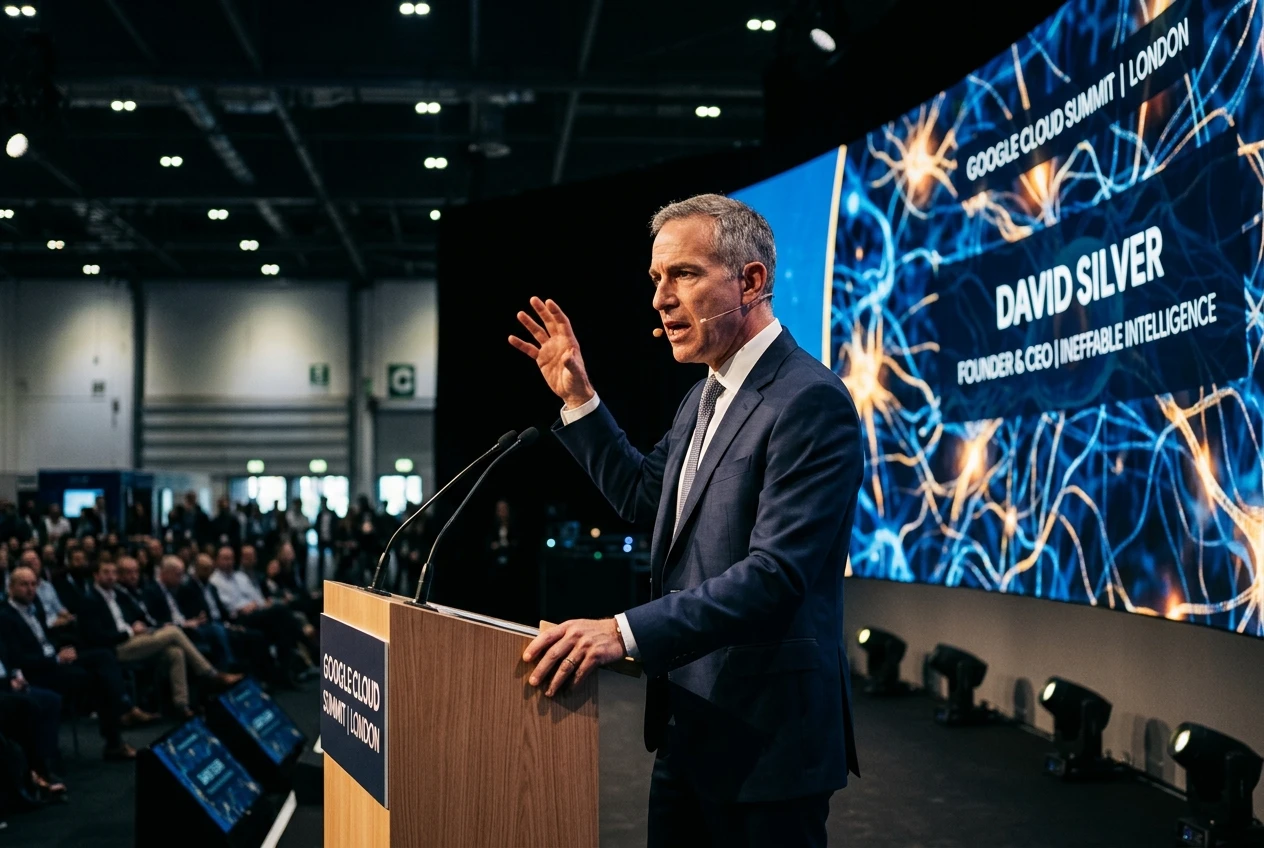
Ineffable Intelligence has selected Google Cloud as its exclusive infrastructure partner to build what it calls the world’s first “superlearner,” deploying one of the world’s largest clusters of Nvidia Vera Rubin NVL72 GPUs (A5X) on Google’s AI Hypercomputer architecture. The deal was announced at the Google Cloud Summit in London this week, weeks after the London-based AI lab closed a $1.1bn seed round at a $5.1bn valuation, the largest in European history. The startup is led by David Silver, the UCL professor and former Google DeepMind scientist who led the AlphaGo and AlphaZero projects.
The choice of cloud partner is the first sign of how seriously Ineffable is taking the compute side of its bet. Where most frontier AI labs treat infrastructure as a question of raw chip count, Silver’s team is framing it as a systems-engineering problem tied to reinforcement learning at scale.
The Compute Behind the Wager
The Google Cloud deployment will use Google’s full-stack AI Hypercomputer, incorporating Jupiter networking and optimised storage, to handle the computational scale required for reinforcement learning. The architecture moves away from standard “box of chips” provisioning to systems-level optimisation that lets researchers focus on autonomous learning rather than infrastructure bottlenecks.
Silver framed the choice in systems terms rather than raw-compute terms. “We evaluated the space and chose Google Cloud as the best fit for our reinforcement learning infrastructure,” he said. “We aren’t just looking for processors; we are building a resilient and scalable environment to make ‘first contact’ with superintelligence.” The Vera Rubin NVL72 cluster is the same platform Nvidia detailed at its GTC 2026 conference, where the company declared AI the essential infrastructure of the modern enterprise and outlined its roadmap for agentic AI built on Rubin GPUs. The two-partner structure of this deal mirrors that roadmap. Google Cloud hosts the cluster, Nvidia builds the silicon, and Ineffable supplies the research agenda.
- $1.1bn (£860m) seed round announced in April
- $5.1bn post-money valuation, largest seed round in European history
- One of the world’s largest Vera Rubin NVL72 GPU clusters
- Google Cloud AI Hypercomputer with Jupiter networking and optimised storage
the Vera Rubin platform’s agentic focus at Nvidia’s GTC event underscored how seriously the chip maker is treating agentic and reinforcement-learning workloads as the next scaling axis, an orientation Ineffable’s superlearner research inherits directly. The processor tier of the platform pairs Vera Rubin GPUs with a custom Olympus-core CPU, and that CPU is now beginning to reach first customers through a separate NVIDIA Vera CPU rollout to first customers.
An ‘Anti-LLM’ Built to Learn From Its Own Actions
The superlearner is designed for experience-based learning, where the model generates, evaluates and learns from its own actions in real time. Where LLMs are trained on static, human-produced datasets, Ineffable’s system produces its own training signal by acting, observing outcomes, and reinforcing the actions that worked. The startup is aiming to bypass the human data ceiling it says currently limits systems such as ChatGPT and Claude.
That is the wager, and the framing is deliberate. Ineffable has positioned the project as a direct response to the limits of the dominant LLM paradigm, building a system that does not need human-written text or human-labelled examples to keep improving.
Silver has been explicit about the ambition. “We aren’t just looking for processors; we are building a resilient and scalable environment to make ‘first contact’ with superintelligence, AI that transcends human limitations in science, mathematics and technology,” he said. Reinforcement learning’s prior wins in Go and StarCraft gave Silver’s lab a template. Applying the same trial-and-error approach to the open-ended complexity of human knowledge is a different and unproven step.
Industry observers have called the anti-LLM strategy a high-stakes scientific bet. The thesis is that the next leap in AI capability will not come from larger language models trained on more human data, but from systems that discover new knowledge themselves.
| Dimension | LLM training | Ineffable superlearner |
|---|---|---|
| Training data | Human-generated text and data | Self-generated actions and outcomes |
| Learning method | Pattern matching on static datasets | Trial-and-error reinforcement learning |
| Output | Mimics human knowledge | Discovers new knowledge |
| Proven track record | Powers ChatGPT, Claude and similar products | Won at Go and StarCraft; unproven at scientific discovery |
David Silver’s Two Decades of Reinforcement Learning Wins
Silver is a UCL professor and the former lead of Google DeepMind’s reinforcement learning team, where he spent more than a decade before leaving to found Ineffable Intelligence. He is one of the few researchers in the world with a public track record of taking reinforcement learning from research papers to systems that beat the best human players at their own games.
That track record is the bet’s scientific foundation. Silver led the AlphaGo project, the first program to defeat a top professional player at Go. He then led AlphaZero, which learned by itself to defeat the world’s strongest chess, shogi and Go programs. He co-led AlphaStar, the first grandmaster-level StarCraft player. He contributed to AlphaFold, the program that solved the protein folding problem, and to AlphaProof, which achieved a medal in the international mathematics olympiad in 2024. The full arc, from board games to proteins to mathematics, is detailed in a profile of Silver’s full track record from DeepMind.
Silver has been explicit that the superlearner is the natural next step in that arc, an extension of the same RL philosophy into open-ended scientific discovery. In his own framing, captured in the Silver’s ‘harder problem of AI’ framing interview tied to the Nvidia code-sign deal, “Researchers have largely solved the easier problem of AI: how to build systems that know all the things humans already know. But now we need to solve the harder problem of AI: how to build systems that discover new knowledge for themselves. That requires a very different approach, systems that learn from experience.” The AlphaGo and AlphaZero results showed that RL could master closed domains. The superlearner is the test of whether that method scales to open-ended human knowledge.
The May Nvidia Code-Sign Deal That Set Up the Cluster
The Google Cloud deployment did not arrive in a vacuum. In May, Ineffable Intelligence announced a collaboration with Nvidia on the engineering requirements for its massive GPU cluster, an effort to ensure the environment can scale to support the next generation of reinforcement learning algorithms. The partnership, reported on 13 May 2026, has engineers from both companies working on a pipeline that can feed reinforcement learning systems at scale. The work uses Nvidia’s Grace Blackwell chips alongside its Vera Rubin platform.
Nvidia CEO Jensen Huang tied the project to his own framing of the next AI frontier. “The next frontier of AI is superlearners, systems that learn continuously from experience,” Huang said. “We are thrilled to partner with Ineffable Intelligence to codesign the infrastructure for large-scale reinforcement learning as they push the frontier of AI and pioneer a new generation of intelligent systems.” The May code-sign deal was the engineering prerequisite for the Google Cloud announcement; the September-tier cluster is the production instantiation of that work.
The $1.1bn Seed Bankroll and Its Backers
April’s seed round was, by size, the largest in European history. The $1.1bn (£860m) raise, closed weeks before the Google Cloud announcement, valued the London-based company at $5.1bn and gives Ineffable several years of runway to operate without a product, a revenue line, or a public roadmap. The April seed round details were reported the day the round closed, and the size alone made Ineffable one of the most heavily funded seed-stage AI labs ever.
The investor mix is unusual. The round was co-led by Sequoia Capital and Lightspeed Venture Partners, with participation from Nvidia, Google, Index Ventures, DST Global, EQT, Evantic, Flying Fish, BOND, the British Business Bank (£15m), and the UK government’s Sovereign AI Fund. Strategic investors include both the chip partner (Nvidia) and the cloud partner (Google), an alignment that has direct implications for the Vera Rubin deployment.
The structure of the round matters. Two of Ineffable’s three operational counterparties (Nvidia on chips, Google on cloud) are also equity backers. The British Business Bank and the UK Sovereign AI Fund, both of which are directly tied to UK industrial strategy, anchor the sovereign side of the cap table.
- Sequoia Capital (co-lead)
- Lightspeed Venture Partners (co-lead)
- Nvidia (chip partner and investor)
- Google (cloud partner and investor)
- Index Ventures
- DST Global
- EQT
- Evantic
- Flying Fish
- BOND
- British Business Bank (£15m)
- UK Sovereign AI Fund
Where the Reinforcement Learning Thesis Stands on Shaky Ground
Industry observers have been blunt. “While reinforcement learning proved successful in closed-system game environments like Go and StarCraft, applying trial-and-error algorithms to the vast complexity of human knowledge and scientific discovery remains an unproven frontier.” The lab has no shipped product, no published benchmark, no public timeline, and no working paper on the superlearner’s architecture.
The practical risks stack up. The superlearner path “may lack the immediate utility and predictability of current generative AI systems.” The technical challenge of ensuring safety and ethical guardrails in a system that discovers knowledge independently of human input will be a big hurdle as the lab attempts to rediscover and then transcend human inventions.
The valuation pressure is real. The $5.1bn post-money places Ineffable in the “pentacorn” tier of seed-stage companies whose valuations are so large they are nicknamed “coconut rounds.” Investor patience for a research-stage bet with no product, no revenue, and no public roadmap will be tested on a long horizon.
The lab is also young. Founded in late 2025 and less than a year old as of the Google Cloud announcement, Ineffable is carrying a $1.1bn seed and a $5.1bn valuation on top of roughly six months of operating history.
We aren’t just looking for processors; we are building a resilient and scalable environment to make first contact with superintelligence, AI that transcends human limitations in science, mathematics and technology.
Why the UK Government Is Putting Money Behind the Bet
The UK government’s involvement is a direct industrial-strategy decision. Backing from the Department for Science, Innovation and Technology and the Sovereign AI Fund reflects a strategic move by the UK government to scale British-built technology that can generate new knowledge in medicine, engineering and science. The British Business Bank’s £15m cheque, part of the same seed round, ties the sovereign stake directly to the company’s cap table.
The London base is part of the strategy. The project is expected to “further consolidate London as a critical global centre for frontier AI research, with the startup’s mission expected to attract premier engineering talent to the UK.” The competitive context is crowded: Recursive Superintelligence, also UK-based, raised $650m in the same period; AMI Labs (Yann LeCun) raised $1bn in March; Jeff Bezos’s Project Prometheus is reportedly scouting London office space. Ineffable sits at the centre of a wave of frontier-AI labs choosing the UK as their anchor, a positioning the government is paying to keep. The UK’s broader posture on frontier AI infrastructure has been to back it with long-term cloud commitments, including the kind of large-scale deal seen in Anthropic’s $200bn Google Cloud commitment.
Frequently Asked Questions
What is Ineffable Intelligence?
Ineffable Intelligence is a London-based AI lab founded in late 2025 by David Silver. The company’s stated mission is to build a “superlearner” that can discover knowledge and skills from its own experience rather than from human-generated training data.
Who is David Silver?
David Silver is a UCL professor and the former lead of Google DeepMind’s reinforcement learning team. He led the AlphaGo, AlphaZero, and AlphaStar projects and contributed to AlphaFold and AlphaProof before leaving DeepMind in 2026 to found Ineffable Intelligence.
What is a “superlearner”?
Ineffable’s term for an AI system that generates, evaluates, and learns from its own actions in real time using reinforcement learning. Unlike an LLM, which is trained on human-produced text, a superlearner is trained on experience, producing its own training signal through trial and error.
How is this different from ChatGPT or Claude?
ChatGPT and Claude are large language models trained on human-generated text. Ineffable’s superlearner is trained on experience rather than human data, with the system producing its own training signal through trial and error instead of pattern matching on static human datasets.
Why is the UK government backing this?
The Department for Science, Innovation and Technology and the Sovereign AI Fund are investing to keep a frontier AI lab anchored in London. The British Business Bank invested £15m directly into Ineffable’s seed round as part of the same industrial strategy.


South Korea Retail Investors Face Reckoning After KOSPI AI Rally Collapses

Surrey AI Maps Three Heart Attack Paths and Their Molecular Roots

Germany Locks Neutral Apple ATT Prompts Across Most of Europe

Apple’s 5% EU Fee Quietly Rewrites Alternative App Store Math

Apple’s EU Fee Truce Cuts Complexity but Leaves Rivals Fuming

Pixel 11 Pro Fold Trades Thinness for Durability and Seven-Year Stay

Mayo AI Flags HCM Obstruction From Everyday Ultrasound Videos

Indian Brands Quietly Scale Landmark Screens and Home Tech

Navin Vatsa Turns Grief Into a Lifetime of Quiet Seeing

Google Bets Pixel 11 Agentic AI Will Redefine Phones

Oracle Cuts 21,000 Jobs in a Year, Cites AI in 10-K Filing

Fable 5 and Mythos 5 Return as US Lifts Anthropic Export Controls

SpaceX’s Google Deal Turns a Rocket Company Into a Cloud Landlord

CD Projekt Red Co-CEO: Redemption Arc Isn’t Done, Witcher 4 in 2027

XPL Rallies 30% Ahead of Plasma One Card Tier Launch

Google Search Profiles Build a Follow Graph Inside Discover

DGO App Brings Rs 549 Mobile Pass for FIFA World Cup 2026 in Nepal

Moonshot AI Targets $30 Billion in China’s Fastest AI Funding Sprint

Oppo’s ColorOS 17 Eligibility List Leaves A-Series Buyers Behind

Microsoft Xbox Layoffs Start in July as Sharma Slams 3% Margin
-
 AI2 months ago
Oracle Cuts 21,000 Jobs in a Year, Cites AI in 10-K Filing
-
 AI2 months ago
Fable 5 and Mythos 5 Return as US Lifts Anthropic Export Controls
-
 AI3 months ago
SpaceX’s Google Deal Turns a Rocket Company Into a Cloud Landlord
-
 GAMING2 months ago
CD Projekt Red Co-CEO: Redemption Arc Isn’t Done, Witcher 4 in 2027
-
 CRYPTO3 months ago
XPL Rallies 30% Ahead of Plasma One Card Tier Launch
-
 NEWS3 months ago
Google Search Profiles Build a Follow Graph Inside Discover
-
 APPS3 months ago
DGO App Brings Rs 549 Mobile Pass for FIFA World Cup 2026 in Nepal
-
 AI3 months ago
Moonshot AI Targets $30 Billion in China’s Fastest AI Funding Sprint