
AI
Arm’s $14 Billion AI CPU Bet Has Wall Street at $475
UBS raised its Arm price target to $470 from $260, citing a $14B AI CPU opportunity by 2030 and 70% head-node share. TD Cowen moved to $475 the same week.

UBS lifted its Arm Holdings price target to $470 from $260 on June 24, and TD Cowen moved to $475 from $265 the same week. Both analyst notes pointed at the same shift: agentic AI is moving work off GPUs and onto CPUs, and Arm’s AI CPU architecture is sitting at the receiving end of that move.
Arm’s AI CPU opportunity has gone from a footnote in research notes to the central bet on the company in three months. A first-party silicon product launched in late March, more than $2 billion in customer demand booked before the chip ships in volume, and a UBS forecast of roughly 70% share of the 20 million-unit head-node server market by 2030 now stack on top of one another. Each is its own story. Together they push the smartphone-era Arm into a supporting role.
The Targets Just Moved, and the Story Moved With Them
Wall Street’s reset on Arm began with UBS analyst Timothy Arcuri, who raised his price target to $470 from $260 and kept a Buy rating. Arcuri told clients he is “incrementally more constructive” on the stock as CPU standalone racks scale up alongside agentic AI deployments, per a UBS and TD Cowen research note lifting their ARM targets on agentic AI demand.
TD Cowen’s Krish Sankar moved his target to $475 from $265 the same week and held a Buy. Sankar pointed to the same shift: some workloads are migrating from GPUs to CPUs as AI agents multiply, and CPUs are the quieter beneficiary. He said Arm’s $15 billion AGI CPU revenue target for FY31 is achievable, even as he hedged that GPU-to-CPU usage rates and per-core pricing remain swing factors.
The two notes land at the same number for different reasons. Arcuri’s math is the head-node TAM: a 20 million-unit market by 2030, with Arm architectures taking roughly 70% of it. Sankar’s math is the standalone CPU TAM. He argues some investors are applying a flat 15% share assumption to Nvidia’s estimated $200 billion CPU TAM and overstating Arm’s chip revenue potential, while the IP licensing story runs hotter than the Street models. Both firms agree on direction. Both raised targets to nearly $475. Both left the smartphone royalty story in the rearview.
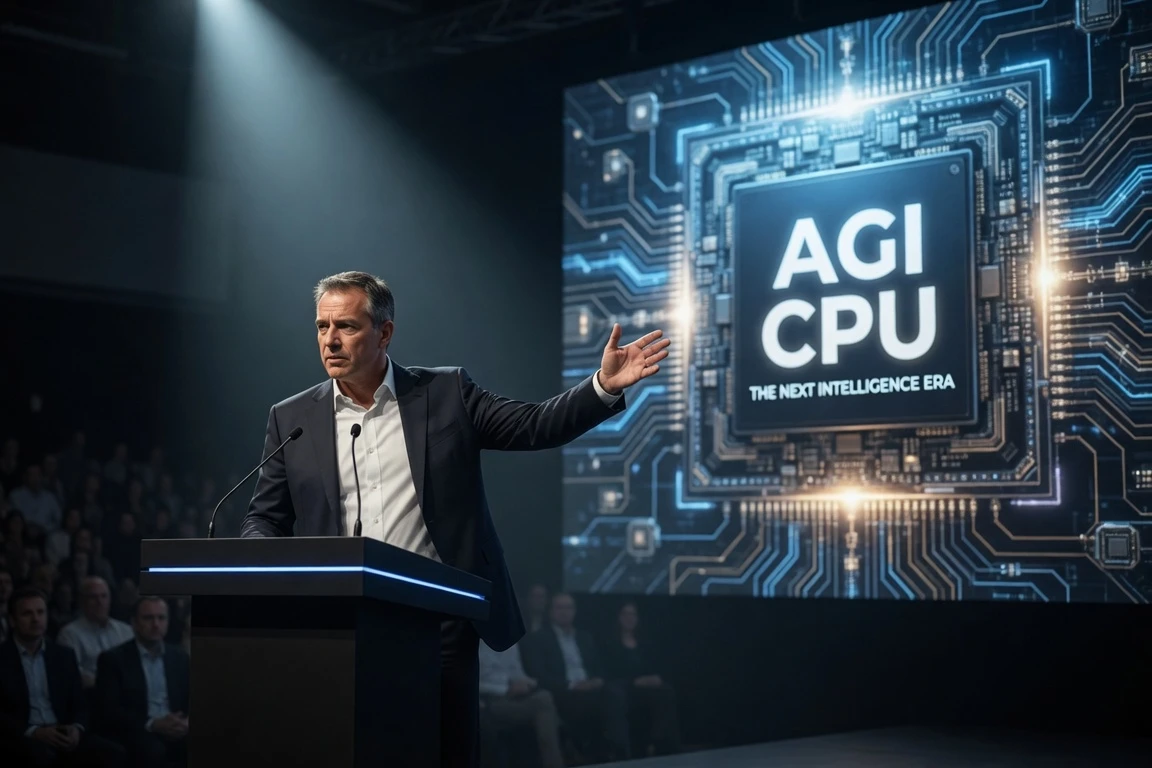
What 70% of the Head-Node Market Actually Means
Head-node servers are the orchestration layer of an AI factory, the CPUs that schedule accelerators, move data between GPU clusters, and handle the prompt-and-response traffic that fills inference clusters. UBS sizes that market at 20 million units by 2030, and Arcuri expects Arm-based architectures to take roughly 70% of those shipments. The implied Arm share is about nearly 90% of the AI ASIC server CPU market by 2029, per a separate Counterpoint forecast tracking Arm’s data center expansion. The two numbers are not contradictory. ASIC server CPUs are purpose-built accelerator hosts, where Arm’s per-watt pitch wins by default. The head-node TAM is broader and includes general-purpose servers where x86 still holds the installed base.
The math is what separates a footnote from a thesis. UBS’s 20 million-unit head-node TAM at 70% Arm share is roughly 14 million Arm head-node CPUs annually by 2030, a volume larger than today’s entire merchant Arm-based server CPU market. Counterpoint’s 90% ASIC share by 2029 applies to the narrower purpose-built AI accelerator host category. Arcuri also nudged his 2030 estimate for Arm’s standalone AGI CPU business up to nearly $14 billion from about $13 billion, a modest revision rather than a step change.
- 20 million – UBS’s 2030 head-node server TAM, in units
- ~70% – UBS’s projected Arm share of head-node servers by 2030
- ~90% – Counterpoint’s projected Arm share of AI ASIC server CPUs by 2029
- $14 billion – UBS’s 2030 estimate for Arm’s AGI CPU business
The AGI CPU Made Arm a Silicon Vendor
On March 24, 2026, Arm did something it had never done before. The company shipped its own silicon product, not a license. The Arm AGI CPU is an Arm-designed data center CPU built for agentic AI workloads, with up to 136 Neoverse V3 cores per CPU at a 300-watt TDP, per the Arm newsroom release introducing the AGI CPU and Meta partnership. The chip is positioned as the CPU architecture for the next layer of AI infrastructure, the one that sits next to every GPU rack and runs the orchestration that keeps token throughput high.
Meta is the lead partner and co-developer, working with Arm across multiple generations of the roadmap. Santosh Janardhan, head of infrastructure at Meta, said in the launch release that the AGI CPU was built to “deliver an efficient compute platform that significantly improves our data center performance density and supports a multi-generation roadmap for our evolving AI systems.” Arm says the AGI CPU delivers more than 2x performance per rack versus x86 CPUs, enough to enable up to $10 billion in CAPEX savings per gigawatt of AI data center capacity.
The customer roster reads like a who’s-who of the agentic AI buildout. Arm confirmed commercial commitments with Cerebras, Cloudflare, F5, OpenAI, Positron, Rebellions, SAP, and SK Telecom at launch, with each planning deployments for accelerator management, control plane processing, and enterprise API hosting. The ODMs and OEMs lined up to build systems around the chip: ASRock Rack, Lenovo, Quanta Computer, and Supermicro, with early systems available at launch and broader availability expected in the second half of the year.
The ecosystem of supporters ran wider than paying customers. AWS, Broadcom, Google, Marvell, Micron, Microsoft Azure, NVIDIA, Samsung, SK hynix, and TSMC all endorsed the platform at launch, a list that spans every layer of the AI hardware stack. Arm framed the move as a platform expansion: customers can still license Arm IP, adopt Arm Compute Subsystems (CSS), or deploy the new Arm-designed silicon. For the first time, one company offers all three paths from the same architecture.
AI has fundamentally redefined how computing is built and deployed. Agentic computing is accelerating that change. Today marks the next phase of the Arm compute platform and a defining moment for our company.
The quote came from Rene Haas, chief executive officer of Arm, in the company’s March 24, 2026 launch release for the AGI CPU. The platform supports up to 8,160 cores per rack in air-cooled 1U chassis and exceeds 45,000 cores per rack in liquid-cooled deployments, with 6 GB/s memory bandwidth per core at sub-100ns latency.
| Spec | Arm AGI CPU |
|---|---|
| Cores per CPU | Up to 136 Neoverse V3 |
| TDP | 300W |
| Memory bandwidth per core | 6 GB/s at sub-100ns latency |
| Cores per rack (air-cooled 1U) | Up to 8,160 |
| Cores per rack (liquid-cooled) | 45,000+ |
| Performance per rack vs x86 | More than 2x |
| CAPEX savings per GW | Up to $10 billion |
The Hyperscaler Flywheel Is Spinning
Hyperscalers don’t move on architecture bets overnight. AWS launched its fifth-generation Graviton processor built on the higher-performance Arm Neoverse CSS V3, doubling the core count to 192 cores from Graviton4. Microsoft followed with Cobalt 200, also on Neoverse CSS V3, at 132 cores, up from 128 in Cobalt 100.
NVIDIA moved on a different axis. The next-generation Vera CPU carries 88 Arm-based cores, up from 72 in the Grace generation, and pairs with Arm-based Bluefield DPUs for a sixfold increase in DPU compute capability over the prior generation. Google, separately, highlighted Axion’s up to 65% better price-performance and 60% lower energy usage, a profile that lines up directly with power-constrained AI data center buildouts, per Arm’s Q3 FY2026 results detailing the hyperscaler core-count ramp.
The trajectory runs through volume. Arm Neoverse CPUs have now surpassed one billion cores deployed, and Arm’s share among top hyperscalers is expected to reach nearly 50%. The Stargate AI infrastructure sites that Arm flagged in its Q2 earnings added five locations in a single quarter, expanding visibility into future capacity where Arm platforms participate across compute and infrastructure layers. Each new hyperscaler generation adds more cores, and Arm’s per-chip royalty rises with the count.
| Hyperscaler | CPU | Cores | Architecture | Generation |
|---|---|---|---|---|
| AWS | Graviton5 | 192 | Neoverse CSS V3 | 5th |
| Microsoft | Cobalt 200 | 132 | Neoverse CSS V3 | 2nd |
| NVIDIA | Vera | 88 | Arm-based | Replaces Grace |
| Axion | Not specified in source | Arm-based | Current |
AI PCs Are the Second Front Opening
The server story gets the headlines, but the PC story is doing the same thing at a different scale. Counterpoint Research’s latest AI PC Tracker and Forecast expects AI-Advanced PC shipments to climb 52% year-on-year in 2026 to roughly 59% of global shipments, up from about 39% in 2025, as next-generation Windows laptops clear the 40-plus TOPS NPU bar required for Microsoft’s Copilot+ designation.
The refresh catalyst arrived on October 14, 2025, when Windows 10 reached end of support and fed a multi-quarter enterprise upgrade cycle into 2026. Major OEMs are already seeing the mix shift; AI PCs surpassed 25% of one leading vendor’s shipments in Q3 FY2025, per Counterpoint. The architecture battle on the PC side lines up the same way as the server side: Arm-based designs from Qualcomm and Apple against Intel Lunar Lake and AMD Strix Point on x86.
Arm’s CSS roadmap is the structural reason the PC side scales. Five customers are now shipping Arm CSS-based chips, including two on the second-generation platform, and the top four Android smartphone vendors are all shipping Arm CSS-powered devices. The royalty rate per chip rises with the architecture generation. As Armv9 penetrates the AI PC base, every unit shipped carries more margin back to Cambridge. The agentic AI workloads running on-device need the same Neoverse-class performance-per-watt that hyperscalers pay a premium for, and the company that built the server contract is now collecting on the same architecture in every laptop that ships.
The Revenue Mix Is Quietly Inverting
Arm’s most recent quarter tells the rebalancing story. Q3 FY2026, the quarter ended December 31, 2025, delivered revenue of $1.24 billion, up 26% year-on-year and the company’s fourth consecutive billion-dollar quarter. Royalty revenue hit a record $737 million, up 27% year-on-year, with strong contributions from AI and general-purpose data centers, smartphones, physical AI, and edge AI.
The data center line is the one that grew fastest. Counterpoint’s analysis of Arm’s Q4 FY2026 results noted that data center royalty revenue more than doubled year-on-year, driven by hyperscaler adoption of Arm-based CPUs for AI and cloud workloads. Licensing revenue rose 29% year-on-year to $819 million in the same quarter, a higher mix than the royalty line, reflecting the upfront payments for next-generation architectures and the AGI CPU itself.
The developer footprint is the underlying asset. Arm’s ecosystem now counts 22 million developers, representing more than 80% of the global total, a base that compounds software availability and platform relevance. CSS adoption is the practical lever: 21 CSS licenses now span 12 companies, with the top four Android smartphone vendors all shipping CSS-powered devices. The next constraint is no longer silicon. It is the Wyoming-style race for power to feed AI data centers, and Arm’s per-watt pitch is the angle hyperscalers will lean into as the grid tightens.
- $1.24 billion – Arm’s Q3 FY2026 revenue, up 26% YoY
- $737 million – record royalty revenue in Q3 FY2026, up 27% YoY
- More than 2x – YoY growth in Arm data center royalty revenue in Q4 FY2026
- 22 million – developers in Arm’s ecosystem (>80% of global total)
- 21 – CSS licenses across 12 companies
The Risk Hidden in the $2 Billion Headlines
The customer demand number is the headline most analysts lead with. Arm said AGI CPU customer demand exceeded $2 billion across FY27 and FY28, more than double what the company stated at the launch event in late March. Mercury Research’s Dean McCarron walked through the size of that number for Tom’s Hardware: even if Arm ships $2 billion worth of AGI CPUs over two years, the company’s overall server CPU market share would still land in the low single digits, under 5%, per Mercury Research’s market share math on AGI CPU shipments. The bet is real. The head start against x86 is shorter than the launch numbers suggest.
The bullish numbers also leave room for execution slippage. UBS raised its 2030 AGI CPU revenue estimate to about $14 billion, up from roughly $13 billion, a modest revision rather than a step change. TD Cowen’s $15 billion FY31 target depends on GPU-to-CPU usage rates and per-core pricing that Sankar flagged as swing factors in his note.
The x86 incumbents are not standing still. UBS expects the standalone CPU segment to split 60% x86 and 40% Arm, with AMD positioned to gain share against Intel as the Clearwater Forest 288 e-core platform lands. AMD’s CPU server revenue is now modeled at $16 billion in 2026, $23 billion in 2027, and $29 billion in 2028, up from prior estimates of $21 billion and $27 billion. The market Arm is going after is large enough for two architectures to grow inside it, and Counterpoint’s 90% ASIC share by 2029 sits alongside UBS’s 70% head-node share by 2030 as two different bets on two different layers. TD Cowen’s Sankar said Arm’s $15 billion FY31 AGI CPU revenue target is achievable, with GPU-to-CPU usage rates and per-core pricing the variables to watch.
Frequently Asked Questions
What is the Arm AGI CPU?
The AGI CPU is the first Arm-designed data center CPU, launched on March 24, 2026. It is built around Neoverse V3 cores, with up to 136 cores per CPU at a 300-watt TDP, and is positioned for agentic AI workloads that orchestrate accelerators and run continuous inference traffic inside AI data centers. Arm says the chip delivers more than 2x performance per rack versus x86 CPUs and enables up to $10 billion in CAPEX savings per gigawatt of AI data center capacity.
Who is the lead customer for the Arm AGI CPU?
Meta is the lead partner and co-developer for the Arm AGI CPU, working with Arm across multiple generations of the roadmap. Other confirmed commercial customers announced at launch include Cerebras, Cloudflare, F5, OpenAI, Positron, Rebellions, SAP, and SK Telecom. Lead OEM and ODM partners building systems around the chip include ASRock Rack, Lenovo, Quanta Computer, and Supermicro.
How much did UBS raise its Arm price target?
UBS analyst Timothy Arcuri raised his Arm price target to $470 from $260 on June 24, 2026, and kept a Buy rating. TD Cowen’s Krish Sankar raised his target to $475 from $265 the same week, also with a Buy rating. Both firms cited agentic AI driving CPU demand as the trigger for the reset.
What share of the AI server CPU market does Arm expect?
UBS expects Arm-based architectures to capture roughly 70% of the 20 million-unit head-node server market by 2030. Counterpoint Research expects Arm-based CPUs to capture nearly 90% of the AI ASIC server CPU market by 2029. Arm’s share among top hyperscalers is expected to reach nearly 50%, and Arm Neoverse CPUs have now surpassed one billion cores deployed.
Is Arm competing with Intel and AMD?
Arm licenses its architecture to firms including NVIDIA, AWS, Microsoft, and Google, which build their own custom Arm-based server CPUs. The competition with Intel and AMD runs through these licensees rather than through direct sales of an Arm-branded chip, with one exception: the AGI CPU is the first Arm-branded silicon product in the company’s history. UBS expects the standalone CPU segment to split 60% x86 and 40% Arm over the forecast period.
What are the AGI CPU’s main specs?
The AGI CPU supports up to 136 Neoverse V3 cores per CPU at a 300-watt TDP, with 6 GB/s memory bandwidth per core at sub-100ns latency. Air-cooled 1U chassis support up to 8,160 cores per rack; liquid-cooled deployments exceed 45,000 cores per rack. Arm positions the chip for accelerator management, control plane processing, and cloud and enterprise API hosting inside agentic AI infrastructure.


Google Opens Gmail to Voice and Gates Docs Live

Lenovo Prices the IdeaPad Vibe Against Apple’s $699 Neo

Xbox Caps Game Pass Cloud Gaming at 15 Hours

GTA 6 DualSense Controllers Follow Sony’s Usual $84.99 Script

South Korea Retail Investors Face Reckoning After KOSPI AI Rally Collapses

Surrey AI Maps Three Heart Attack Paths and Their Molecular Roots

Germany Locks Neutral Apple ATT Prompts Across Most of Europe

Apple’s 5% EU Fee Quietly Rewrites Alternative App Store Math

Apple’s EU Fee Truce Cuts Complexity but Leaves Rivals Fuming

Pixel 11 Pro Fold Trades Thinness for Durability and Seven-Year Stay

Oracle Cuts 21,000 Jobs in a Year, Cites AI in 10-K Filing

Fable 5 and Mythos 5 Return as US Lifts Anthropic Export Controls

SpaceX’s Google Deal Turns a Rocket Company Into a Cloud Landlord

CD Projekt Red Co-CEO: Redemption Arc Isn’t Done, Witcher 4 in 2027

XPL Rallies 30% Ahead of Plasma One Card Tier Launch

Google Search Profiles Build a Follow Graph Inside Discover

DGO App Brings Rs 549 Mobile Pass for FIFA World Cup 2026 in Nepal

Moonshot AI Targets $30 Billion in China’s Fastest AI Funding Sprint

Oppo’s ColorOS 17 Eligibility List Leaves A-Series Buyers Behind

Microsoft Xbox Layoffs Start in July as Sharma Slams 3% Margin
-
 AI2 months ago
Oracle Cuts 21,000 Jobs in a Year, Cites AI in 10-K Filing
-
 AI2 months ago
Fable 5 and Mythos 5 Return as US Lifts Anthropic Export Controls
-
 AI3 months ago
SpaceX’s Google Deal Turns a Rocket Company Into a Cloud Landlord
-
 GAMING2 months ago
CD Projekt Red Co-CEO: Redemption Arc Isn’t Done, Witcher 4 in 2027
-
 CRYPTO3 months ago
XPL Rallies 30% Ahead of Plasma One Card Tier Launch
-
 NEWS3 months ago
Google Search Profiles Build a Follow Graph Inside Discover
-
 APPS3 months ago
DGO App Brings Rs 549 Mobile Pass for FIFA World Cup 2026 in Nepal
-
 AI3 months ago
Moonshot AI Targets $30 Billion in China’s Fastest AI Funding Sprint