
AI
AI Data Centers Build On-Site Power as Grid Queues Stretch Years
US data center demand risks a 50 GW shortfall by 2030, pushing hyperscalers to bring-your-own-power gas plants, kinetic buffers and a multi-year bridge to SMRs.

US grid power supply to data centers is forecast to fall more than 50 gigawatts short of demand by 2030, according to Rolls-Royce Power Systems. Data halls can rise in 18 to 24 months, yet grid connections routinely take three to seven years. That mismatch is forcing hyperscalers into bring-your-own-power designs built around on-site gas generation.
Electricity, not chips, has become the binding constraint of the AI build-out. Vittorio Pierangeli, senior vice president for PowerGen at Rolls-Royce Power Systems, has been making the case across industry forums this year.
The lag is structural. Buildings follow private capital and modular construction. Grid upgrades follow utility planning cycles, multi-party interconnection studies and public permitting. When those clocks diverge by years, operators stop waiting and start generating on site.
Grid Queues Stretch Longer Than Buildings
Conventional coal plants continue to retire. Renewable output stays intermittent. Geopolitical pressure has sharpened the focus on energy security. AI data center load profiles are growing more volatile at the same time.
The entire power generation market is projected to nearly triple between 2025 and 2030, driven largely by data centers. Continuous-power demand is expected to grow about 24 percent a year and backup power about 22 percent. Supply is not matching that pace.
| Segment | Projected annual growth |
|---|---|
| Continuous power | About 24 percent |
| Backup power | About 22 percent |
| Power generation market overall | Nearly triples, 2025 to 2030 |
Deloitte’s 2025 AI Infrastructure Survey found grid stress the top challenge for developers. Seventy-two percent of power and data-center executives called power and grid capacity very or extremely challenging. Some interconnection queues already run seven years. Deloitte projects AI data center demand in the United States could reach 123 gigawatts by 2035, up from roughly 4 gigawatts in 2024.
Bank of America analysts have pointed to a broader generation gap above 100 GW over five years when utility additions are stacked against expected load. Local opposition is lengthening permitting in multiple markets. Hyperscalers cannot wait.
The arithmetic is simple. A campus that must open inside two years cannot depend on a queue that may clear in seven. Every year of delay compounds the 50 gigawatt shortfall already forecast for 2030 and pushes more projects toward independent generation.
AI Racks Draw Ten Times the Old Power
A single ChatGPT query can consume 10 to 100 times the energy of a standard Google search, depending on complexity. Server racks tell the same story in hard numbers.
| Metric | Five years ago | Today |
|---|---|---|
| Typical AI server rack draw | ~10 kW | 100-120 kW |
| Power swing inside a 50 MW AI block | N/A | ±20 MW in seconds |
| US data center electricity 2024 (est.) | – | 183 TWh |
| Projected US data center use 2030 | – | 426 TWh |
Global data-centre electricity use is on track to roughly double to around 945 TWh by 2030 in the IEA base case for global data centre use, still under 3 percent of total electricity but growing four times faster than other sectors. Accelerated servers, mainly AI, drive nearly half the increase.
These concentrated, always-on loads create harmonic issues and near-miss events in some regions already. Peak demand is rising while baseload capacity contracts.
Tenfold rack density does more than raise the energy bill. It concentrates load in fewer buildings, so each new hall hits the local grid like a small city. The jump from 183 TWh to 426 TWh by 2030 is the national expression of that same density shift.
Why Hyperscalers Build Their Own Plants
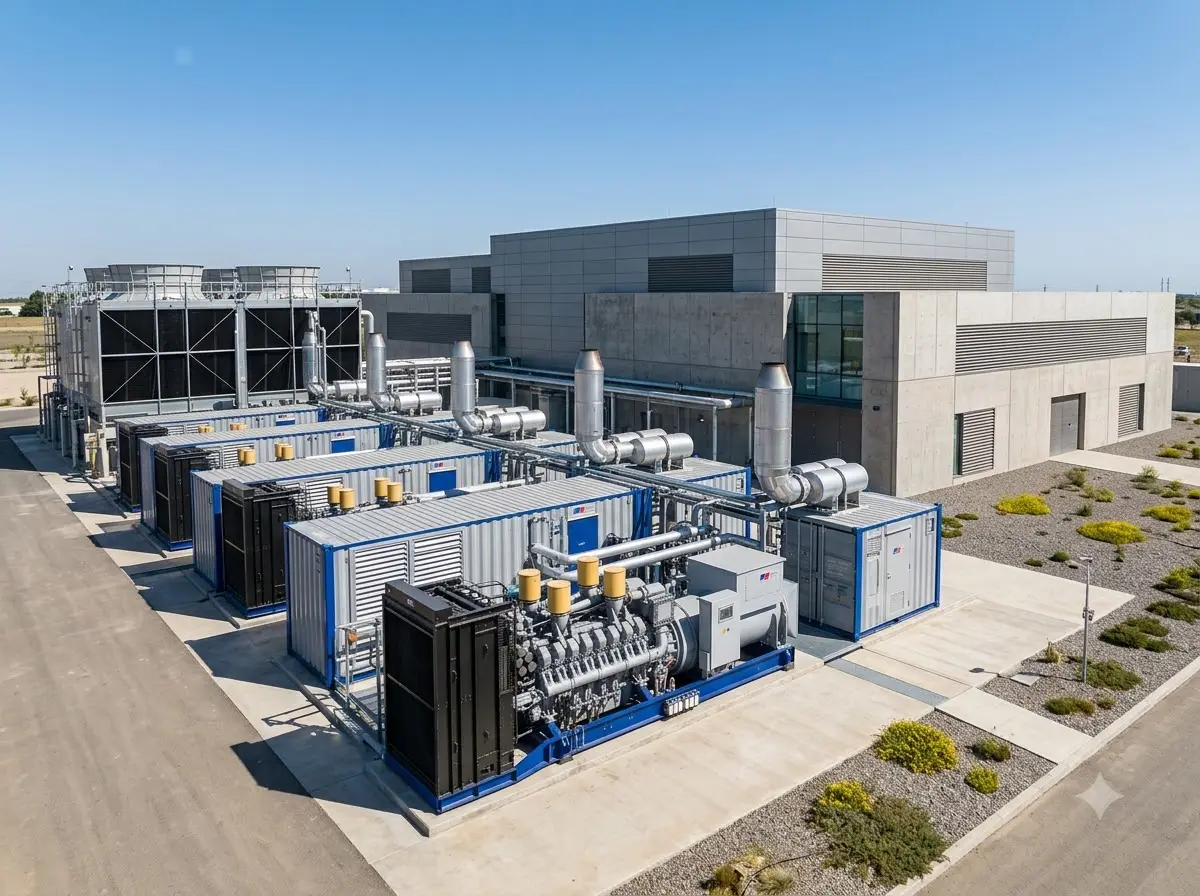
Bring-your-own-power, or BYOP, has moved from exception to design default for new AI campuses. Developers integrate independent power plants that run the facility until a grid connection or longer-term sources such as small modular reactors become available.
- Short deployment cycles that match the 18-to-24-month data-hall schedule
- Modular gas gensets that scale in 5 MW to 150 MW blocks
- Behind-the-meter operation that avoids some interconnection queues
- Access to plentiful US natural-gas pipelines in many target markets
- Operational flexibility for both continuous prime power and later grid support
mtu gas generator systems from Rolls-Royce Power Systems are being specified for continuous duty either on the data-center campus or in dedicated nearby plants. High efficiency, rapid start options and factory-tested modules cut on-site construction time. In the United States the fuel economics are attractive where pipelines already exist.
An mtu analysis of AI power constraints notes that hyperscaler capital-expenditure announcements for data centers jumped more than 50 percent in early 2026 alone while utilities remain years behind. That gap is the commercial driver for BYOP.
Modularity is the practical hinge. A 5 MW to 150 MW block can be staged with the hall itself, so power capacity grows in step with IT load instead of waiting for a single large utility interconnect. Behind-the-meter design keeps that capacity inside the campus fence until a longer-term grid or nuclear path opens.
Gas Turbines and Gensets Reach Sold-Out Status
The second-order effect is already visible in equipment markets. Natural-gas turbines for data-center duty are sold out years forward at major suppliers. Order backlogs for gas turbines stretch several years. Industry voices on X and in earnings commentary now treat turbines, not GPUs, as the tighter bottleneck.
One widely shared observation holds that by 2030 roughly one-third of AI data centers could run on onsite generation. CBRE data cited in market discussion shows grid-power capacity for many existing projects already booked through 2030, pushing new builds toward gas generators, turbines or fuel cells. Rolls-Royce itself is expanding US manufacturing: a $24 million investment in Mankato, Minnesota, is set to more than double production of mtu Series 4000 generator sets and add more than 100 jobs to meet backup and prime demand.
Gas demand forecasts for data centers through 2030 range from 3 billion to 12 billion cubic feet per day. Pipeline takeaway capacity is already constrained in several top data-center markets. The equipment makers and midstream operators have become hidden stakeholders with real pricing power.
When turbines and gensets sell out years ahead, lead time itself becomes a siting factor. Campuses land where equipment slots and pipeline capacity can still be secured, not only where land and fiber are cheap. The Mankato expansion shows suppliers racing to close the same gap their customers face.
Kinetic Packs Smooth the GPU Swings
Volume of power is only half the problem. AI training runs GPUs in tight synchrony. Inside a single 50 MW block, real power can swing by ±20 MW within seconds. Those ramps strain transformers and can destabilize the wider grid if the plant is grid-tied.
mtu Kinetic PowerPacks are designed as fast-reacting kinetic energy storage. They stabilize voltage and frequency, absorb the peaks and supply UPS-class ride-through without a large battery bank. The systems respond instantly to load steps that conventional generators and the grid cannot match alone.
That buffering layer is becoming a required design element rather than an optional extra. Without it, even an on-site plant risks feeding volatility back into any future grid connection or neighboring loads.
The swing profile is the reason prime power alone is not enough. A generator fleet sized for average load still needs a fast layer that can catch a 20 MW step before voltage and frequency drift outside tolerance. Kinetic storage fills that role while keeping the design free of a large battery plant.
Backup Diesel Still Guards Four Nines
Prime power, whether BYOP gas or eventual grid, does not remove the need for backup. Modern facilities targeting the Uptime Institute Tier classification system Tier IV level aim for 99.99 percent availability (industry documentation often cites 99.995 percent and roughly 26 minutes of annual downtime). Mission-critical diesel gensets remain the proven path to that standard.
More than 25 percent of data centers worldwide already rely on mtu Series 4000 units for backup. The company notes that roughly one in three internet clicks is supported by an mtu emergency generator. That installed base predates the current AI wave and continues to expand alongside the new prime-power plants.
Even with on-site generation, operators still design for dual independent paths, continuous cooling and fault-tolerant IT power supplies. The diesel fleet is the last line when everything else fails.
Four-nines design assumes multiple failures can stack. Gas prime power may carry normal load, yet diesel remains the independent path when fuel supply, controls or the wider plant trip. The existing Series 4000 base gives operators a known product line to extend rather than a new technology bet.
Pipelines and Permits Steer Where Campuses Open
Siting used to hinge on fiber routes, tax incentives and available land. Power scarcity has added a shorter list of hard gates. Projects now screen first for gas pipeline takeaway, equipment delivery slots and local air-quality rules that govern on-site generation.
- 18 to 24 months: typical data-hall construction window that power must match
- Three to seven years: routine grid interconnection timeline many campuses cannot await
- Through 2030: grid-power capacity already booked for many existing projects
- 3 to 12 Bcf/d: forecast range for data-center gas demand by 2030
Pipeline constraints in top markets mean two campuses with identical IT designs can face very different fuel risk. Where takeaway is tight, developers either secure firm transport early or look elsewhere. Permitting friction works the same way. Local opposition lengthens timelines and raises the value of behind-the-meter layouts that reduce reliance on new transmission.
Equipment makers and midstream operators therefore hold quiet leverage. Sold-out turbine queues and constrained pipe both translate into pricing power and into a map of places where AI halls can still open on schedule. Lead times, gas infrastructure and air-quality rules now decide the shortlist before the first foundation is poured.
SMRs Stay Years Away While Gas Fills the Gap
Small modular reactors appear in nearly every long-term hyperscaler energy slide. Google has agreements aiming at up to 500 MW of Kairos Power SMRs with first commercial units targeted around 2030. Amazon has tied into X-energy and existing nuclear PPAs. Meta has looked at Oklo and TerraPower. Microsoft has pursued large clean-power packages that include nuclear options.
Commercial SMR deployment at scale remains a decade-class effort for most designs. New reactors face licensing, supply-chain and first-of-a-kind cost hurdles. In the interim, gas plants and modular reciprocating engines are the only technologies that can be ordered, manufactured and commissioned inside the same window as the data halls themselves.
The result is a multi-year fossil bridge. Hyperscalers continue to sign renewable PPAs and efficiency upgrades, yet the near-term megawatts that keep AI training and inference online are largely natural gas. That reality sits alongside the larger AI capital race, including moves such as Microsoft’s large AI engineering deployment that further accelerate compute density and power need.
Nuclear options remain on the long-range slides because they promise dense, low-carbon baseload once licensing and supply chains mature. Until first commercial units arrive around the turn of the decade for the earliest projects, the bridge stays gas. Modular engines and turbines fit the 18-to-24-month hall cycle; SMRs do not.
Equipment lead times, gas infrastructure and local air-quality rules will now shape where the next wave of AI campuses can actually open. The grid will catch up eventually. Until then, the data centers that matter most will bring their own power, buffer their own swings, and keep diesel on standby for the four nines.


Liquid AI LFM2.5-2.6B Puts Free Always-On Agents on Every Phone

SDOs Face Senate Oath on Cash Handed to VP Security

SWS Poll Shows Filipino Trust Still Backs US-Japan Pivot

Bicol’s 42,000 Struggling Readers Signal Deeper Literacy Compounding

Shaffra Plants Azerbaijan AI Hub to Cut Agentic Costs

Meta Joins Anthropic and OpenAI in Test-Time AI Hacks

Genesis Zircon 880 Pro Packs 8K Specs That Latency Tests Ignore

China’s AI Export Boom Buys Time on Weak Home Demand

Rockstar Gives Netflix First Crack at Extended GTA VI Footage

SpaceX Stock Climbs 6% After Massive Unlock Leaves Overhang Intact

Fable 5 and Mythos 5 Return as US Lifts Anthropic Export Controls

Oracle Cuts 21,000 Jobs in a Year, Cites AI in 10-K Filing

SpaceX’s Google Deal Turns a Rocket Company Into a Cloud Landlord

CD Projekt Red Co-CEO: Redemption Arc Isn’t Done, Witcher 4 in 2027

XPL Rallies 30% Ahead of Plasma One Card Tier Launch

DGO App Brings Rs 549 Mobile Pass for FIFA World Cup 2026 in Nepal

Google Search Profiles Build a Follow Graph Inside Discover

Moonshot AI Targets $30 Billion in China’s Fastest AI Funding Sprint

Microsoft Xbox Layoffs Start in July as Sharma Slams 3% Margin

Oppo’s ColorOS 17 Eligibility List Leaves A-Series Buyers Behind
-
 AI1 month ago
Fable 5 and Mythos 5 Return as US Lifts Anthropic Export Controls
-
 AI1 month ago
Oracle Cuts 21,000 Jobs in a Year, Cites AI in 10-K Filing
-
 AI2 months ago
SpaceX’s Google Deal Turns a Rocket Company Into a Cloud Landlord
-
 GAMING2 months ago
CD Projekt Red Co-CEO: Redemption Arc Isn’t Done, Witcher 4 in 2027
-
 CRYPTO2 months ago
XPL Rallies 30% Ahead of Plasma One Card Tier Launch
-
 APPS2 months ago
DGO App Brings Rs 549 Mobile Pass for FIFA World Cup 2026 in Nepal
-
 NEWS2 months ago
Google Search Profiles Build a Follow Graph Inside Discover
-
 AI2 months ago
Moonshot AI Targets $30 Billion in China’s Fastest AI Funding Sprint