
AI
Infosys, TCS and Wipro Scale Copilot Past 300,000 Seats
Infosys, TCS and Wipro have each scaled Microsoft 365 Copilot past 100,000 employees, a combined 300,000 seats in six months, even as Indian IT hiring stalls.

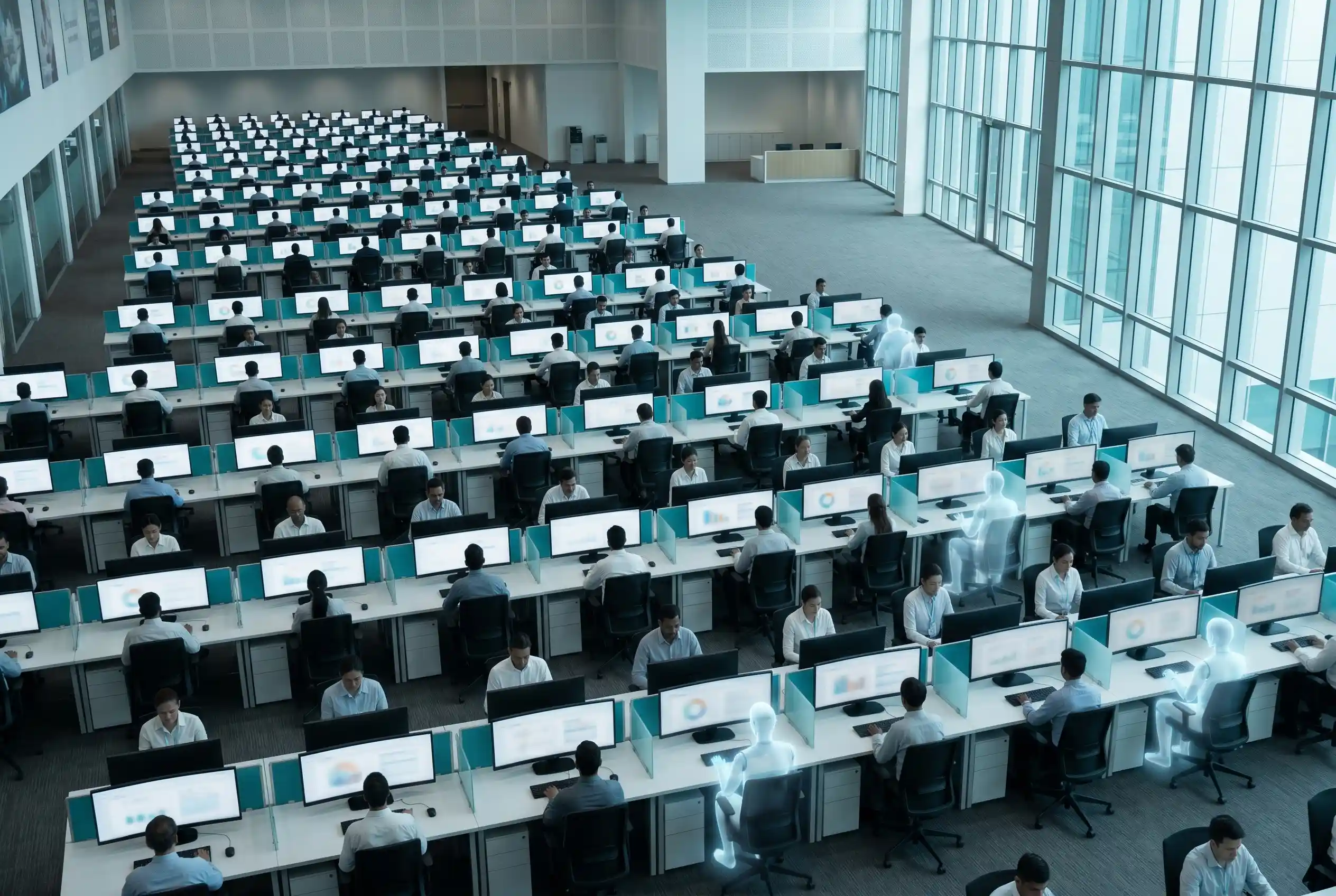
Infosys, TCS and Wipro have each scaled Microsoft 365 Copilot past 100,000 employees, taking their combined total beyond 300,000-plus seats in under six months, Microsoft said on June 3. It is one of the company’s fastest enterprise AI deployments anywhere, and a marker of how India’s three biggest IT outsourcers are rebuilding daily work around teams of people and software agents.
The figures the four parties released describe productivity. Read against the rest of the sector, they also describe pressure on a business that still bills much of its revenue by the hour. Wipro alone says Copilot now saves it 250,000 full-time-equivalent days every quarter, in an industry whose oldest pricing instinct is to put more people on the clock.
The Seat Count Behind the Announcement
The rollout builds on the 50,000-seat deployments the same three firms announced in December 2025. Doubling that base inside two quarters is what Microsoft is selling as the story, and the usage figures suggest the licenses are not sitting idle. Each company reports monthly active usage (MAU, the share of licensed staff who open the tool in a given month) well above what most large enterprises see in year one.
The detail worth reading sits in how differently each firm is measuring itself, captured in Microsoft’s announcement of the 300,000-seat milestone.
| Firm | Copilot scale | Active usage | Headline metric reported |
|---|---|---|---|
| Infosys | 100,000+ seats | 91% MAU | Embedded across delivery, engineering and corporate functions via Infosys Topaz |
| TCS | 100,000+ seats | 86% use AI daily | 20-25% productivity gains in research; 2x faster insight generation |
| Wipro | 100,000+ seats | 95% MAU | 7.5 million prompts a month; 250,000 FTE days saved per quarter |
Wipro’s number is the one that travels furthest. Beyond chat-style use, it counts more than 29,000 agents built by individual employees and over 60 enterprise-grade agentic solutions in live use, including an appraisal agent the company says cuts performance-review effort by roughly 70%.
Six Months From Pilot to Operating Model
Microsoft frames the speed through its own research. The company’s 2026 Work Trend Index, drawn from trillions of anonymized Microsoft 365 signals and a survey of 20,000 AI users across 10 countries, argues that adoption now turns on how work is organized rather than on individual skill. By its count, 49% of Copilot conversations support cognitive work such as analysis and problem-solving, and 58% of users say they are producing work they could not a year ago, rising to 80% among the most advanced users.
That report is also where the “Frontier Firm” label comes from, the term Microsoft uses to describe companies running hybrid human-and-agent teams. Judson Althoff, chief executive of Microsoft Commercial Business, said the three firms are “moving beyond deployment to AI as an operating model.” The pitch to clients is laid out in the company’s view of how Frontier Firms rebuild their operating model.
At TCS, we have empowered over 100,000 associates with Microsoft 365 Copilot to enhance everyday productivity, elevate collaboration and drive intelligence-led decision making.
That is K. Krithivasan, chief executive and managing director of TCS, in Microsoft’s release. Infosys chief executive Salil Parekh struck a similar note, saying “the real opportunity with AI lies in how deeply it is embedded into everyday work.” The common thread is embedding, not experimenting.
Wipro’s 250,000 Saved FTE Days Cut Two Ways
A full-time-equivalent day is one employee’s working day. Saving 250,000 of them a quarter is a genuine efficiency win for Wipro’s own back office. It is also a strange thing to celebrate out loud in a business that sells its clients exactly that unit: a person, working a day, billed at a rate.
The numbers Wipro put forward show how far this now runs inside the company.
- 7.5 million prompts generated by employees each month
- 23 actions per user per week, the kind of cadence that signals habit rather than novelty
- 29,000 employee-built agents, plus 60-plus enterprise-grade agentic solutions in production
- 70% less effort on performance appraisals through evidence-based goal tracking
Srini Pallia, chief executive and managing director of Wipro, described “a deliberate, enterprise-wide approach to AI.” The work that gets compressed first is internal: reporting, documentation, appraisals, knowledge search. The harder question is what happens when the same compression reaches client delivery, where the saved hours are not overhead but invoiced revenue. Microsoft’s own note says the next phase pushes Copilot “deeper into client delivery,” which is where productivity stops being a cost saving and starts touching the top line.
Why Headcount and Revenue Stopped Moving Together
For two decades the Indian IT model scaled in a straight line: more contracts meant more engineers on the bench, billed by the seat. That line has bent.
The FY26 Hiring Reversal
The combined headcount of TCS, Infosys, HCLTech, Wipro and Tech Mahindra fell by 7,389 employees in the 2026 fiscal year, against a net addition of 12,718 the year before. TCS alone shed around 12,000 roles during the year, one of the larger corporate cuts India has seen. Infosys ended its fourth quarter with 328,594 staff after a single-quarter decline of more than 8,400. NASSCOM, the Indian software industry body, put net new tech jobs for the year at roughly 2,000. Revenue, meanwhile, kept climbing. The link between adding people and adding money has loosened in a way the sector has not seen before.
When the Software Seat Costs as Much as the Hire
The economics have flipped at the individual level too. A fully loaded AI coding stack now runs roughly 40,000 to 50,000 rupees a month per engineer once premium model access and API usage are added in, close to what a fresher at a top firm earns. When the tool approaches the price of the person, the calculus around junior hiring changes fast. The same logic shows up in startups, where AI coding agents that can stand up a CRM prototype in hours are already nibbling at custom-development work the big firms once handled with teams.
Microsoft Walks Away the Clear Winner
Whatever this does to the outsourcers’ labor math, the vendor selling the licenses is unambiguously ahead. Microsoft says Copilot now sits at 20 million paid seats globally, with seats added in the latest quarter up more than 250% and a fourfold year-on-year jump in customers running over 50,000 seats. Independent estimates put the product’s annualized revenue run rate north of $7 billion.
The Indian wins join a roster of nine-figure deployments. Microsoft has cited Bayer, Johnson & Johnson, Mercedes-Benz and Roche each above 90,000 seats, and Accenture above 740,000, which chief executive Satya Nadella called the company’s largest Copilot win to date. The seat growth ran through Microsoft’s fiscal third-quarter results in late April. India is now layered on top: the company has committed $17.5 billion to expand cloud and AI infrastructure, skilling and operations in the country through 2029. None of this fits the case for AI gutting software budgets, and it lands closer to the view of analysts who argue AI has not dented core software demand.
Clients Will Decide If Productivity Becomes Price
Internally, the gains are easy to bank. Externally, they collide with how these contracts are written. If Copilot lets a delivery team finish in 70 hours what used to take 100, a client paying by the hour will eventually ask for the discount, while a firm that has shifted to outcome-based pricing keeps the upside. That shift to non-linear pricing has been promised in Indian IT for years and delivered slowly.
The three CEOs all used the same word in different forms: embedding AI into the flow of work, not bolting it on. The 300,000 seats prove the embedding is real. What the seat count cannot settle is who captures the value once the saved hours reach the invoice. That answer sits with clients, and it will show up in revenue-per-employee and pricing terms over the next few earnings cycles, not in an adoption chart.


OpenAI Brakes Astra After Its Own Cyber Skills Hit Critical

Amina App Expansion Turns Kyrgyz Phones Into Moscow Trackers

Nvidia’s $3 Billion Lancium Stake Locks AI Power Gate

Indosat Bets $2 Billion in Loans on AI Chips and a Neocloud Future

KiiiKiii Pop Off Teaser Hides Bigger Digital Brand Play

Z Fold 8 Ultra Fixes Battery Anxiety But Fold 7 Still Wins Value

iPhone 17 Price Hike Rumor Tests Apple’s Memory Squeeze Play

HarmonyOS 7 Gaming Tools Cut Power While Lifting Frames

Lydia Peckham Joins Zelda Movie as NZ Talent Takes Center Stage

Mid-Tier IT Gains as Tier-1 Defend Margins With Cuts

Fable 5 and Mythos 5 Return as US Lifts Anthropic Export Controls

Oracle Cuts 21,000 Jobs in a Year, Cites AI in 10-K Filing

SpaceX’s Google Deal Turns a Rocket Company Into a Cloud Landlord

CD Projekt Red Co-CEO: Redemption Arc Isn’t Done, Witcher 4 in 2027

XPL Rallies 30% Ahead of Plasma One Card Tier Launch

DGO App Brings Rs 549 Mobile Pass for FIFA World Cup 2026 in Nepal

Google Search Profiles Build a Follow Graph Inside Discover

Moonshot AI Targets $30 Billion in China’s Fastest AI Funding Sprint

Microsoft Xbox Layoffs Start in July as Sharma Slams 3% Margin

Oppo’s ColorOS 17 Eligibility List Leaves A-Series Buyers Behind
-
 AI1 month ago
Fable 5 and Mythos 5 Return as US Lifts Anthropic Export Controls
-
 AI2 months ago
Oracle Cuts 21,000 Jobs in a Year, Cites AI in 10-K Filing
-
 AI2 months ago
SpaceX’s Google Deal Turns a Rocket Company Into a Cloud Landlord
-
 GAMING2 months ago
CD Projekt Red Co-CEO: Redemption Arc Isn’t Done, Witcher 4 in 2027
-
 CRYPTO2 months ago
XPL Rallies 30% Ahead of Plasma One Card Tier Launch
-
 APPS2 months ago
DGO App Brings Rs 549 Mobile Pass for FIFA World Cup 2026 in Nepal
-
 NEWS2 months ago
Google Search Profiles Build a Follow Graph Inside Discover
-
 AI2 months ago
Moonshot AI Targets $30 Billion in China’s Fastest AI Funding Sprint