
AI
AI Predicts Rochester’s Future, and It Isn’t the Only City Guessing
An AI chatbot predicts Rochester becomes a global water tech hub by 2276, one of several 250-year forecasts marking America’s semiquincentennial.

An AI chatbot predicts Rochester, New York, will become the “Water Tech Capital of North America” by 2276, the year the United States turns 500. The forecast ran in the Democrat and Chronicle on July 4, timed to the country’s 250th birthday, and imagines the Genesee River rebuilt into parks, hydroelectric channels and floodable neighborhoods.
It is not the only AI-authored guess about the next quarter millennium making the rounds this year. A separate chatbot wrote California into secession for the country’s own official time capsule. A third sketched a dystopian United States at 500 for an opinion column published overseas. Rochester’s version, built around infrastructure projects already breaking ground, holds up better than most of them.
Rochester’s AI Forecast Bets on Water
The Genesee Gets a New Job
The reasoning rests on three advantages the AI says are already built into the city: freshwater access, leftover infrastructure from Rochester’s manufacturing decades, and a habit of reinventing itself after Eastman Kodak’s decline. Marcia Greenwood, who usually covers grocery and retail news for the paper, wrote up the case in a special July 4 feature.
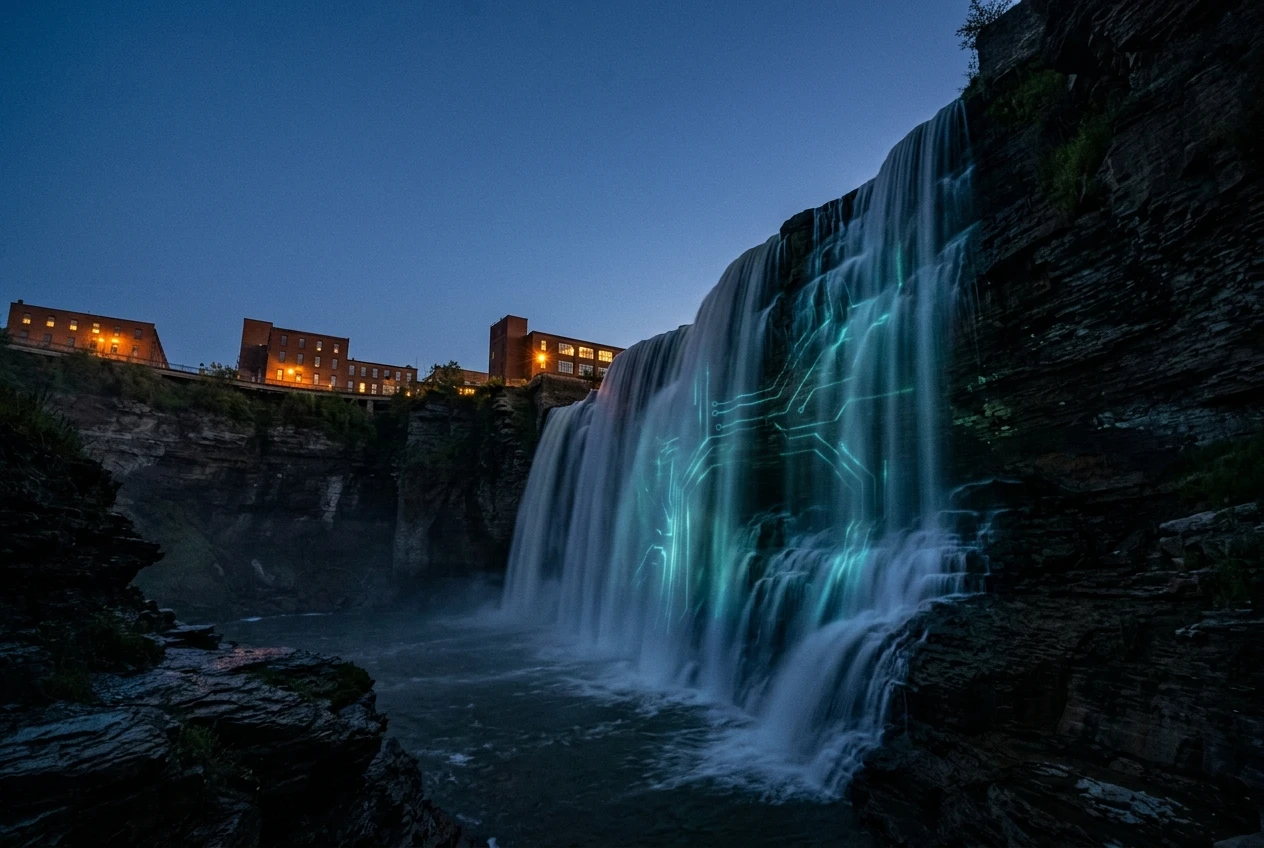
The Genesee River, once industrial and polluted, becomes the spine of that future: a tiered system of parks, floodable zones and hydroelectric channels. One piece of that vision already has government backing. High Falls State Park, anchored by the 80-foot High Falls waterfall, is planned as a 40-acre park in the heart of downtown.
The river plan does not stop downtown. It extends the same logic up and down the water system:
- Former industrial stretches along the Genesee turn into amphibious neighborhoods, built to rise and fall with the water.
- The Erie Canal reopens for slow freight and recreation, carrying autonomous cargo barges alongside pleasure boats.
- Lake Ontario’s shoreline gets reinforced with new infrastructure built for swinging water levels and rougher weather.
None of it requires new land. It requires rebuilding what is already there.
Trading Film for Freshwater
Kodak’s cameras and film made Rochester the birthplace of modern photography. Xerox and the eye care company Bausch + Lomb built on that same optics base. The AI’s bet is that the legacy continues through quantum imaging, said to capture pictures beyond the reach of today’s cameras, and neural-vision interfaces meant to restore sight to the blind. A separate prediction has the University of Rochester becoming a global leader in regenerative medicine and lifespan science.
A Second AI Wrote California Into Secession
Rochester’s forecast is one entry in a much bigger experiment. The federal government sealed a 900-pound stainless steel time capsule and lowered it into the ground in Philadelphia on July 4, as part of a celebration marking 250 years since the United States declared independence from Britain. It will not be reopened until 2276.
Every state contributed something. California included a qubit chip from the University of California, Berkeley, a fusion conductor segment from General Atomics, and a NASA photo of the state from space. It also tucked in an essay nobody else thought to write.
Anthropic’s chatbot Claude was tasked with predicting what California will look like in 2276, according to Gizmodo’s reporting on the submission. The answer read less like infrastructure planning and more like geopolitics. Claude decided California secedes, joining Oregon, Washington and British Columbia in a new Pacific Federation following the Pacific Secession Accords of 2089, a break triggered by water rights disputes, federal gridlock and a coastline reshaped by three feet of sea rise.
A separate exercise produced the opposite mood. One column had AI models paint a deeply unsettling, dystopian future for the country’s next 250 years as the nation marked its anniversary amid sharp political division. Its authors enlisted ChatGPT to imagine how analysts 250 years from now might judge the US on its 500th anniversary of independence.
CBS News consulted three futurists for its own look at America’s next 250 years. One of them, Webb, questioned how any society plans 50 or 250 years ahead when its leaders plan only 18 to 24 months at a time, optimizing for a world that will no longer exist by the time such plans mature.
Parts of the Forecast Are Already Real
Strip away the speculation, and one Rochester prediction already has real momentum behind it. Neuralink’s Blindsight implant is designed to restore partial vision to people blinded from birth or early in life. Among its investigational devices, Blindsight, a cortical visual prosthesis, has received Breakthrough Device designation from the Food and Drug Administration (FDA), according to a peer-reviewed review of brain-computer interfaces in ophthalmology, and the project may begin enrolling patients as early as 2026, two and a half centuries ahead of the AI’s own timeline.
A rival approach is arguably further along. Science Corporation, a biotech startup launched by a Neuralink cofounder, has restored eyesight in preliminary clinical trials for legally blind patients who had lost their central vision, letting some read books and recognize faces again. Neither device does what Rochester’s AI describes for people born fully blind, but both suggest the underlying prediction is not science fiction.
The forecast gets more ambitious about transit. Walking, biking and autonomous electric pods replace most personal vehicles, engine noise disappears, and magnetic-levitation trains supposedly link Rochester to Buffalo, Syracuse and Toronto in under 30 minutes.
Other predictions do not fare as well once measured against 2026. Here is how three of Rochester’s boldest claims compare with numbers available right now.
| Prediction | What the AI Forecasts | Where Things Stand in 2026 |
|---|---|---|
| Water Tech Capital ambition | Rochester exports freshwater management technology worldwide by 2276 | According to Drought.gov’s national tracker, 52.33% of the Lower 48 states were already in drought as of June 23, 2026, and Phoenix has halted new housing developments that cannot prove a 100-year water supply. |
| Regional maglev network | Sub-30-minute trains link Rochester, Buffalo, Syracuse and Toronto | No intercity maglev line operates anywhere in the United States today |
| High Falls State Park | Becomes the centerpiece of a reengineered Genesee River | Construction is already scheduled to open in phases between 2027 and 2032 |
The maglev gap is not surprising. Rail that fast and that automated does not exist between any two North American cities yet, let alone four. The park timeline runs the other way. It is not a guess. It is a construction schedule.
Why Did Rochester Tear Out Its Skybridges?
Rochester already tried one of the AI’s ideas and abandoned it. The city built downtown skybridges in the 1970s to shield pedestrians from winter weather, then dismantled them after officials realized the enclosed walkways were pulling shoppers away from street-level stores, hollowing out downtown retail in the process.
The forecast wants them back: enclosed, weather-protected walkways meant to connect buildings through harsh winters. It also proposes underground walkways and transit tubes for the same reason.
Rochester once ran its own subway. It was decommissioned decades ago, the same kind of underground fix the AI now proposes reviving.
Twice now, the city has built exactly what the forecast recommends, and taken it back out.
Newsrooms Keep Getting Burned by Their Own AI
Gannett owns the Democrat and Chronicle. It is also the largest newspaper chain in the country, and it has been here before. Technology outlet CNET and Gannett have both experimented with using AI to write news stories, resulting in embarrassing errors.
The industry-wide numbers are not encouraging either.
- 20% of AI assistant answers about the news contained major accuracy issues, including hallucinated details and outdated information, according to research coordinated by the European Broadcasting Union (EBU) and led by the BBC.
- 76% of Gemini’s responses in that same study showed significant issues, more than double the other assistants, largely due to its poor sourcing performance.
- 31% of all responses tested showed serious sourcing problems, missing, misleading, or incorrect attributions.
- 3,749 AI-generated news and information sites have been flagged as unreliable AI Content Farm sites, spanning 16 languages, per NewsGuard’s AI Tracking Center.
Rochester’s piece does not fall into that category. It was labeled speculative from the start and framed as a thought exercise rather than reporting. The paper’s own conclusion: not even simulated human intelligence knows for sure.
What Actually Arrives Before 2276
None of Rochester’s real plans wait on a chatbot’s timeline. The Inner Loop fill-in project, already narrowing the sunken highway that once cut downtown off from its neighborhoods, keeps moving regardless of what any forecast says. High Falls State Park breaks ground on a construction schedule, not on faith.
The Rochester Lilac Festival has run since 1898, through two world wars and a pandemic, no algorithm required. If the AI is right, those same lilacs will still be blooming in 2276. They will just “glow softly at dusk.”
Frequently Asked Questions
What Is the Semiquincentennial?
The semiquincentennial is the United States’ 250th anniversary of independence, marked on July 4, 2026. It sits exactly halfway to the quincentennial, the 500th anniversary in 2276, the same year both Rochester’s AI forecast and California’s time capsule prediction look toward.
What Else Did States Put in America’s Time Capsule?
Wisconsin sent a feather from Old Abe, the bald eagle mascot who accompanied Union soldiers through more than 30 Civil War battles, and Ohio contributed a scrap of fabric from the Wright brothers’ 1903 aircraft. Maine added a bone from an endangered North Atlantic right whale, Arkansas a diamond, and New Mexico a traditional anise-flavored cookie recipe. New Mexico also packed a bolo tie, and Nevada tossed in poker chips. Kansas submitted a single page listing government officials.
Has a Brain Implant Actually Restored Anyone’s Eyesight?
Not fully, but trials are already underway. Blindsight uses a high-channel-count architecture that encodes camera-derived images into electrical stimulation patterns delivered to the visual cortex to evoke visual percepts in blind patients. Separately, legally blind patients who received Science Corporation’s retina implants in preliminary trials had their eyesight restored enough to read books and recognize faces again.
How Bad Is the Water Crisis AI Predicts Rochester Will Dodge?
The Southeast, a region not historically known for drought, saw 94% of its area under severe drought stress this spring, a surprising shift while the Southwest keeps struggling with a shrinking Colorado River. It is the kind of scarcity Rochester’s forecast assumes freshwater cities will be spared from.
Did Benjamin Franklin Predict Any of This Himself?
He came close. In an 1780 letter, Franklin wrote that humans might one day “learn to deprive large Masses of their Gravity & give them absolute Levity, for the sake of easy Transport,” a fair description of a magnetic levitation train, and believed disease, even aging itself, would eventually be cured. Artificial intelligence was not part of his forecast, 246 years before Rochester’s chatbot made its own.


Google Opens Gmail to Voice and Gates Docs Live

Lenovo Prices the IdeaPad Vibe Against Apple’s $699 Neo

Xbox Caps Game Pass Cloud Gaming at 15 Hours

GTA 6 DualSense Controllers Follow Sony’s Usual $84.99 Script

South Korea Retail Investors Face Reckoning After KOSPI AI Rally Collapses

Surrey AI Maps Three Heart Attack Paths and Their Molecular Roots

Germany Locks Neutral Apple ATT Prompts Across Most of Europe

Apple’s 5% EU Fee Quietly Rewrites Alternative App Store Math

Apple’s EU Fee Truce Cuts Complexity but Leaves Rivals Fuming

Pixel 11 Pro Fold Trades Thinness for Durability and Seven-Year Stay

Oracle Cuts 21,000 Jobs in a Year, Cites AI in 10-K Filing

Fable 5 and Mythos 5 Return as US Lifts Anthropic Export Controls

SpaceX’s Google Deal Turns a Rocket Company Into a Cloud Landlord

CD Projekt Red Co-CEO: Redemption Arc Isn’t Done, Witcher 4 in 2027

XPL Rallies 30% Ahead of Plasma One Card Tier Launch

Google Search Profiles Build a Follow Graph Inside Discover

DGO App Brings Rs 549 Mobile Pass for FIFA World Cup 2026 in Nepal

Moonshot AI Targets $30 Billion in China’s Fastest AI Funding Sprint

Oppo’s ColorOS 17 Eligibility List Leaves A-Series Buyers Behind

Microsoft Xbox Layoffs Start in July as Sharma Slams 3% Margin
-
 AI2 months ago
Oracle Cuts 21,000 Jobs in a Year, Cites AI in 10-K Filing
-
 AI2 months ago
Fable 5 and Mythos 5 Return as US Lifts Anthropic Export Controls
-
 AI3 months ago
SpaceX’s Google Deal Turns a Rocket Company Into a Cloud Landlord
-
 GAMING2 months ago
CD Projekt Red Co-CEO: Redemption Arc Isn’t Done, Witcher 4 in 2027
-
 CRYPTO3 months ago
XPL Rallies 30% Ahead of Plasma One Card Tier Launch
-
 NEWS3 months ago
Google Search Profiles Build a Follow Graph Inside Discover
-
 APPS3 months ago
DGO App Brings Rs 549 Mobile Pass for FIFA World Cup 2026 in Nepal
-
 AI3 months ago
Moonshot AI Targets $30 Billion in China’s Fastest AI Funding Sprint