
CRYPTO
Hayes Dumped Worldcoin When His SpaceX Proxy Bet Broke
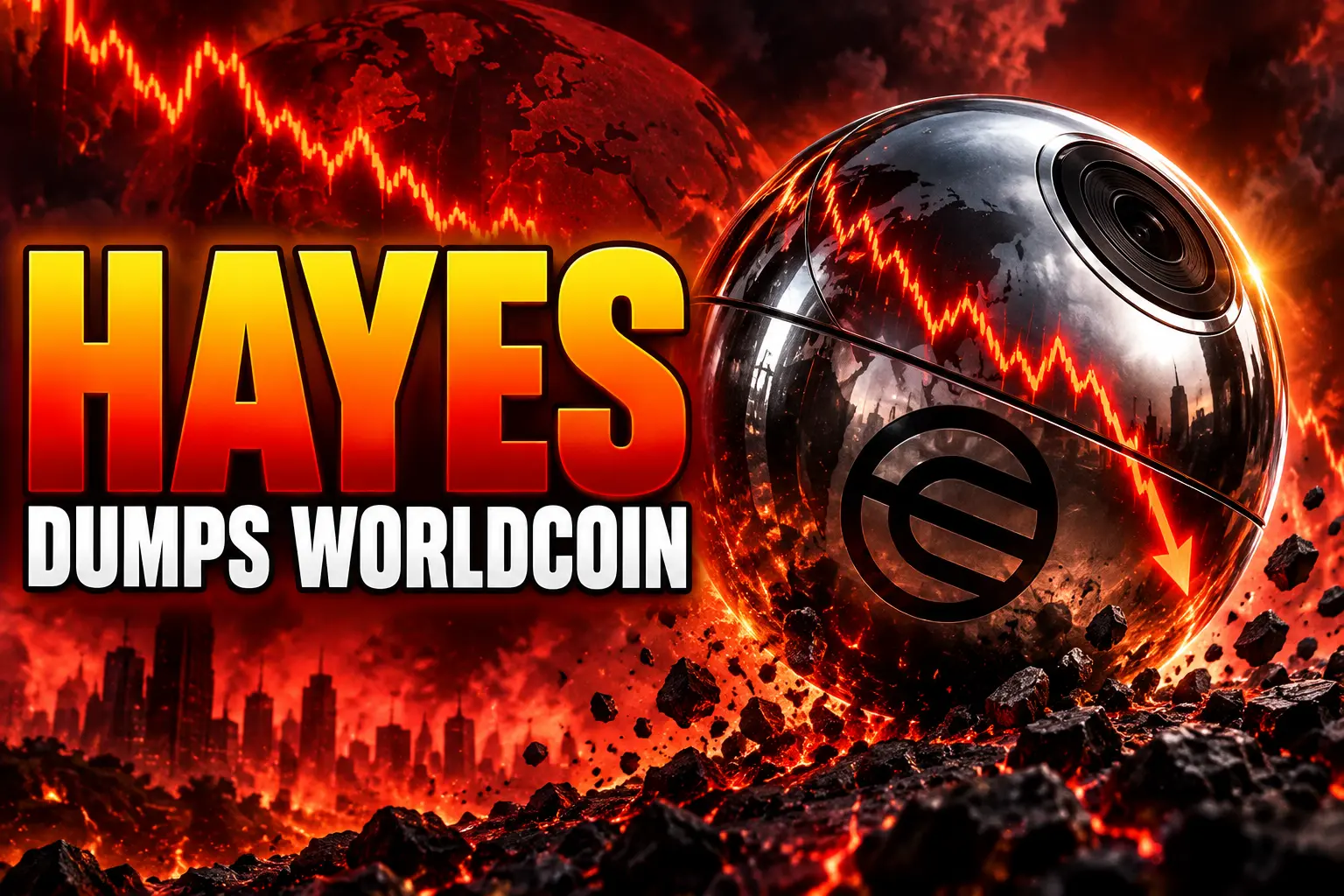
Arthur Hayes sold Worldcoin two days after a hold-through-listing vow, using a SpaceX pre-IPO chart as the stop. The IPO printed. WLD did not.

Arthur Hayes sold his entire Worldcoin stake on June 6 after a SpaceX pre-IPO chart rolled over. Two days earlier he had told followers he would hold WLD through the listing.
The BitMEX co-founder and Maelstrom chief investment officer posted a screenshot of the SPCXUSD perpetual, wrote that the print was going the wrong way, and said he was out. SpaceX listed on Nasdaq six days later at $135 a share. Worldcoin stayed a token.
Two Days After the Hold Promise
On June 4, after dumping Hyperliquid and Near Protocol, Hayes still wanted Worldcoin on the book for the SpaceX debut. He wrote that the IPO was going to melt people’s faces off and that he would hold Worldcoin through the listing the following week.
June 5 kept the same line. After selling Zcash on an Orchard Pool bug, he said Maelstrom still held WLD and was excited for Elon Musk to pump the bags. A later post that Friday put WLD’s outperformance on Elon and added, “Never bet against Elon.”
Saturday, 01:07 GMT, the hold was gone.
This chart is going in the wrong direction. Dumped $WLD. I’m out. See y’all at the clerb. pic.twitter.com/TcfYzCmtSv
— Arthur Hayes (@CryptoHayes) June 6, 2026
He did not name a Worldcoin size or a cost basis. He did not write a follow-up tying the sale to World ID, Orb sign-ups, or a Worldcoin product change. The attached chart was the reason he gave.
The $10 Call Met a SpaceX Chart
The WLD book was not a quiet stub. On June 3 Hayes posted “$WLD = $10.” That night he quote-posted a Maelstrom note calling Worldcoin overlooked exposure to the AI mega-IPO cycle and wrote that the token was going to moon “cause AI duh.”
Lukas Ruppert, a Maelstrom researcher, wrote the note. It argued WLD was a liquid way to sit the same bid that was chasing OpenAI-adjacent listings, and it aimed at $5 by August.
WHAT MAELSTROM PUT IN THE NOTE
- The Altman link: Worldcoin’s tie to OpenAI chief Sam Altman was the narrative hook for AI-listing demand.
- The unlock cut: Daily WLD emissions were due to fall 43% from July 24, which the note treated as a supply relief.
- The short overhang: A March over-the-counter round was framed as a textbook short that could squeeze if the tape turned.
- The target: WLD at $5 by August, against a spot price then near $0.52 on some prints.
CoinGecko data cited with the note had WLD rising from roughly $0.33 to a peak above $0.62 by June 5, about 88% in under two weeks. By the time Hayes posted the SpaceX chart, that spike was already fading. The token then fell more than 25% in the hours after the dump, to around $0.40.
Why Did a Rocket Chart Kill a Worldcoin Bet?
Worldcoin does not build rockets, and SpaceX does not run iris scanners. Hayes was not trading a shared product. He was trading a shared bid.
The WLD thesis in that window was a high-beta stand-in for AI and mega-IPO demand. SpaceX’s confidential S-1 in April had already sent high-beta space names running, which is why Maelstrom pointed at Rocket Lab’s 165% rally after the filing became known. Anthropic had filed too. The clean liquid proxy, in that note, was WLD.
Pre-IPO perpetual futures on SpaceX let that view show up as a 24-hour chart. When SPCXUSD rolled over, Hayes read it as the AI-listing bid cracking, which meant Worldcoin no longer had a job as the crypto sleeve of the same trade. He had already told followers that three mega AI IPOs would drain liquidity from crypto, that energy costs from the Iran war were a headwind, and that markets could top between then and September. The SpaceX tape was the last tell he waited on before cutting WLD.
That is a stop on a borrowed story, not a call on Orb hardware. Once the listing vehicle itself looked heavy, the identity token was just another alt with a famous backer.
HYPE, NEAR and ZEC Left the Book First
Worldcoin was the last public alt Hayes still wanted after a five-day altcoin exit that had already killed the book he used to call the Holy Trinity.
On May 22 he had named Hyperliquid, Zcash and Near Protocol as that trio and said trading was easy when you were in position. On June 4 he posted that he had dumped his entire HYPE and NEAR holdings and would explain the move in an essay, “Reality Test,” due the following Tuesday. On June 5 the Zcash bag followed, after a bug in the Orchard shielded pool that, in his words, could not be formally proved impossible to mint against.
THE FOUR EXITS
| Date | Token | Trigger Hayes gave | Known size |
|---|---|---|---|
| June 4, 2026 | HYPE | Energy costs, AI IPOs, a possible anti-AI turn, a market top by September | 247,334 tokens, about $18 million |
| June 4, 2026 | NEAR | Same macro post as HYPE | Undisclosed |
| June 5, 2026 | ZEC | Orchard Pool bug; “The Holy Trinity is dead” | Undisclosed |
| June 6, 2026 | WLD | SpaceX pre-IPO chart “going in the wrong direction” | Undisclosed |
WLD was the replacement trade after Zcash fell, and it lasted from the June 3 note to the June 6 dump. In “Reality Test,” posted June 8 on the BitMEX blog, Hayes wrote that he dumped HYPE, NEAR, and WLD the prior week, kept Bitcoin and ether as core holdings, and added long US-listed energy producers. The essay’s spine was oil, AI listings, and a US election year, not World ID.
ZachXBT Called the Sequence Exit Liquidity
On-chain investigator ZachXBT replied to the dump with a direct question, attaching screenshots of the bullish WLD posts that had gone out days earlier.
How much exit liquidity was created from your followers over the past couple days? First NEAR HYPE ZEC Now WLD
ZachXBT, on-chain investigator, on X, June 6, 2026
Hayes said he sold to a willing buyer at a mutually agreed price and that his trading goals had changed. Other replies under the dump were blunter, pointing out that he had been pushing WLD the day before he sold it.
The sequence is hard to read as a slow change of heart. He told people to hold through a listing, posted that you never bet against Elon, then used Elon’s pre-IPO tape as the reason to sell. Followers who bought that tape as a hold-to-IPO plan were the bid he walked away from. Whether that was the intent or just the effect does not change the order of the posts.
A Nasdaq Debut That Did Not Lift WLD
The listing Hayes had pointed at still happened. SpaceX priced at $135 a share and opened on Nasdaq on June 12 under the ticker SPCX. On June 9, three days after the WLD sale, Hayes was already posting about an IPO pop indicating +17% and asking if that was enough to keep the AI dream alive. On listing day he posted a Friday SPCX edition and asked whether Barron von Elon could save the market.
Those posts were about the stock. They were not a new Worldcoin target.
THE WLD TAPE INTO THE LISTING
- June 1, 2026: Hayes posts “Arise Chikun!” and says WLD can start a bull market.
- June 3, 2026: He posts $WLD = $10, then amplifies Maelstrom’s $5-by-August note.
- June 4, 2026: He sells HYPE and NEAR and says he will hold WLD through the SpaceX listing.
- June 5, 2026: He sells ZEC, says he still holds WLD, and adds “Never bet against Elon.”
- June 6, 2026: He posts the SpaceX perp chart and dumps WLD.
- June 12, 2026: SpaceX lists at $135 a share. Hayes’s public comments that week are about SPCX, not a new WLD bid.
After June 12, anyone who wanted SpaceX could buy the stock, or a tokenized tracker, or a stock perpetual. Worldcoin was no longer the liquid substitute for a private-company tape. That was the second half of the irony. The chart that killed the trade was a preview of an event that then produced a real share, which made the proxy obsolete even if the IPO had ripped.
The $5 August Target Did Not Arrive
August came and went. Worldcoin did not trade at $5. It also did not trade at $10.
WORLDCOIN AFTER THE PROXY TRADE
- Spot price: WLD is at $0.3959, with Worldcoin price, supply and market cap on CoinGecko putting the token 96.62% below its $11.74 peak.
- Market cap: $1.447 billion, rank 59, with 3.655 billion tokens circulating against a 10 billion max supply.
- Range: The token is 72.33% above its $0.23 floor and still sitting near the June 6 dump print around $0.40.
- One-year tape: CoinGecko’s one-year change is down 75.9%.
The project kept raising against that tape. World Assets, a World Foundation unit, had already sold $135 million of WLD at market prices to Andreessen Horowitz and Bain Capital Crypto in May 2025. In July 2026 the foundation raised $52.5 million by selling 217.4 million WLD, an implied $0.2415, with a one-year lockup, while daily emissions fell 43% on July 24. Pantera Capital led that close, with Bain Capital Crypto and Eightco Holdings among the names attached to it.
Hayes has not put a fresh Worldcoin number on the board since the June 6 sale. The SpaceX listing he used as a kill switch is now a public stock. The AI-IPO proxy ticket he tore up that Saturday was not reprinted.
Frequently Asked Questions
Did Arthur Hayes Disclose How Much Worldcoin He Sold?
No. Hayes never posted a WLD token count or a cost basis, unlike the Hyperliquid exit, where wallets tied to the sale showed 247,334 HYPE tokens worth about $18 million. Maelstrom’s public comments treated Worldcoin as a full exit, not a trim.
Was Worldcoin Tied to the SpaceX IPO as a Company?
No. There is no operational, share, or revenue link between World and SpaceX. Hayes used WLD as a liquid high-beta proxy for the same AI and mega-IPO bid he thought a SpaceX listing would prove, which is why a pre-IPO perpetual chart was enough to end the trade.
How Many People Have a World ID?
CoinGecko’s Worldcoin page flags about 18 million Orb-verified humans on the World ID network. That user count did not move Hayes’s June 6 decision, which he attached to the SpaceX chart rather than to verification totals.
What Happened to SpaceX Shares After the Listing?
SpaceX listed on Nasdaq on June 12 at $135 a share under ticker SPCX. The stock later printed a post-IPO high of $225.64 and, by mid-September, was changing hands near $151, still above the IPO price that Hayes had used as the WLD catalyst.
Disclaimer: This article is news reporting and analysis of public posts, market data and project statements. It is informational only and is not investment advice, trading advice, or a recommendation to buy or sell Worldcoin, SpaceX shares, Bitcoin, or any other asset. Crypto tokens and listed stocks can move sharply and readers can lose the money they put in. Consult a licensed financial adviser who understands your situation before you trade. Prices, listings and project figures here reflect the sources named in the piece and can change.

Instagram Plus Tests a Read-Only Mode That Cuts Stories

Altman Asks the Public to Accept Some AI Harm

Google Freezes OSS VRP Product Reports After AI Flood

AI Agents Make Payment Rails the Scarce Prize

Turkey’s Crypto Boom Now Runs Through Three Banks

Fable 5 Came Back Under a Commerce On-Off Switch

Google’s SpaceX GPU Lease Has a Sept. 30 Deadline

Plasma One’s XPL Locks Face a 1.81 Billion Cliff

DGO’s Rs 549 World Cup Pass Cost Fans Sleep and Data

Moonshot AI’s $30 Billion Ask Became a $35 Billion Close
-
 AI4 months ago
Fable 5 Came Back Under a Commerce On-Off Switch
-
 AI4 months ago
Google’s SpaceX GPU Lease Has a Sept. 30 Deadline
-
 CRYPTO4 months ago
Plasma One’s XPL Locks Face a 1.81 Billion Cliff
-
 APPS4 months ago
DGO’s Rs 549 World Cup Pass Cost Fans Sleep and Data
-
 AI4 months ago
Moonshot AI’s $30 Billion Ask Became a $35 Billion Close
-

 NEWS4 months ago
ColorOS 17 Device List Spans Oppo, OnePlus and Realme
-

 GAMING4 months ago
Xbox Cuts 3,200 Jobs After Five Years of Thin Returns
-
 GAMING4 months ago
The RTX 4050 Under Rs 70,000 Hides a Wattage Gap