
AI
Dow Hits a Record, But AI Chip Stocks Crater Behind It
The Dow hit a record 52,900.07 on July 2, but AI chip stocks cratered behind it. SanDisk fell 14.25%, Lam Research 10.16%. The AI trade is splitting in two.

The Dow Jones Industrial Average closed at a record 52,900.07 on Thursday, July 2, 2026, capping a four-week winning streak. The S&P 500 finished the day virtually unchanged at 7,483.24, and the Nasdaq composite dropped 0.8% to 25,382.67. The gap between the blue-chip index and the chip-heavy Nasdaq hid a sharp split inside AI chip stocks.
SanDisk fell 14.25%, Teradyne 13.67%, KLA 11.61%, and Lam Research 10.16% in a single session, according to a Money Morning analysis. Micron Technology erased an early gain to finish down 5.5%, a day after plunging 10.6%. By Friday morning in Asia, the Kospi had bounced 5.8% to 8,088.34, with Samsung Electronics up 8.2% and SK Hynix up 10.9%. The bounce reached Tokyo, where memory maker Kioxia jumped 9.2%.
Dow 52,900 as Chip Equipment Names Drop Up to 14%
The Dow’s 52,900.07 close beat the prior record by 594.83 points, or 1.14%, according to the trading-day breakdown of the Dow’s record close.
The blue-chip index gained 2% for the holiday-shortened week and is now up 10.1% since the start of 2026. The S&P 500 and Nasdaq composite added 1.8% and 2.1%, respectively, for the week, bouncing back from losses the prior week.
Apple led the Dow’s winners with a 5% gain, and McDonald’s and Walt Disney each added 4%. Tesla slipped more than 7% even after reporting more than 480,000 deliveries in the second quarter, well above the roughly 400,000 analysts had expected. Twenty-four of the Dow’s 30 components rose.
Below the surface, the chip rout was severe. The iShares Semiconductor ETF dropped nearly 6%, and the Roundhill Memory ETF fell 9%. The damage sat squarely on the names exposed to the broader chip equipment cycle, while AI accelerator designers largely held their ground, per Investopedia. Here is the breakdown of Thursday’s worst-hit chip names:
| Stock (Ticker) | Thursday’s Move | Segment |
|---|---|---|
| SanDisk (SNDK) | -14.25% | Memory and storage |
| Teradyne (TER) | -13.67% | Semiconductor test equipment |
| KLA Corporation (KLAC) | -11.61% | Process control and yield |
| Lam Research (LRCX) | -10.16% | Deposition and etch equipment |
| Marvell Technology (MRVL) | -10% | Custom silicon |
| Micron Technology (MU) | -5.5% | Memory chips |
| Intel (INTC) | -5% | Logic and foundry |
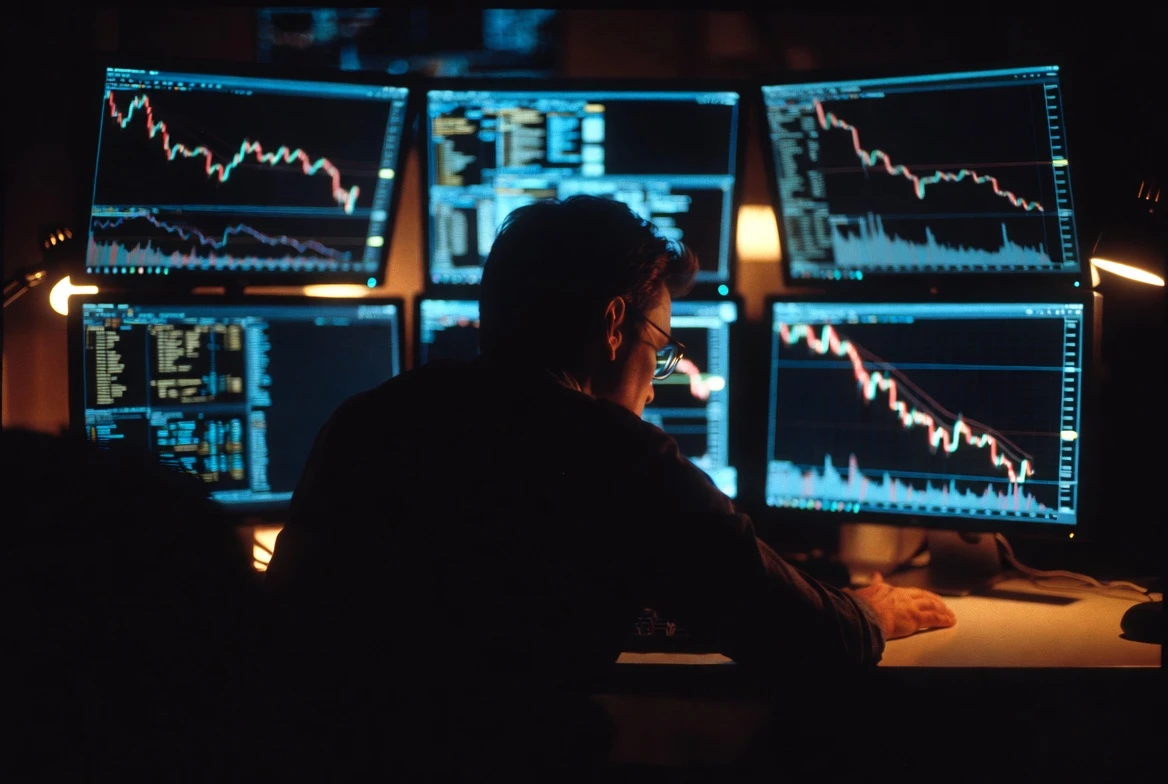
Why Are Memory and Equipment Moving in Opposite Directions?
The chip sector did not sell off as a block. AI-adjacent names like Nvidia, TSMC, and Broadcom largely held their ground on July 2, and the divergence in year-to-date returns between AI-linked chip stocks and broader equipment makers has now reached roughly 35 percentage points in 2026, according to the chip-equipment divide exposed on July 2.
The catalyst was a wave of signals from memory manufacturers, including a major memory maker’s preliminary guidance showing NAND oversupply extending through at least the third quarter of 2026. SanDisk, spun off from Western Digital and heavily exposed to NAND, took the brunt with a 14.25% drop. Teradyne and KLA fell because they sell testing and process-control gear into mature-node logic production, where capex has been declining as chipmakers defer upgrades. Twelve analyst downgrades hit equipment names over the past 30 days, leaving positioning crowded on the long side.
The concern, per the AP wire, is that all the spending on chips and data centers may not yield as much profit and productivity growth as hoped. Lam Research, the most exposed to memory capex, saw its year-to-date return slip into negative territory for 2026.
Lam Research reports earnings in roughly three weeks, and Applied Materials is scheduled to report on August 14, per Money Morning. Those calls will determine whether July 2 was a buying opportunity or the opening act of a deeper reset.
Asia Bounced Back Friday, Led by Seoul
South Korea’s Kospi climbed 5.8% to 8,088.34 on Friday, a day after sinking nearly 8%, per Thursday’s global trading recap. Samsung Electronics gained 8.2% and SK Hynix jumped 10.9%. Memory makers led the rebound.
Japan’s Nikkei 225 advanced 1.5% to 69,744.07. Chipmaker Tokyo Electron rose 0.4%, and memory maker Kioxia jumped 9.2%. Markets elsewhere in Asia also firmed, with the day’s regional moves including:
- Kospi (South Korea): +5.8% to 8,088.34
- Samsung Electronics: +8.2%
- SK Hynix: +10.9%
- Nikkei 225 (Japan): +1.5% to 69,744.07
- Tokyo Electron: +0.4%
- Kioxia: +9.2%
- Hang Seng (Hong Kong): +1.3% to 23,350.03
- Shanghai Composite: +0.4% to 4,043.64
- Sensex (India): +0.4%
- S&P/ASX 200 (Australia): +1.4% to 8,844.40
In European trading, Germany’s DAX rose 0.4% to 25,667.73, the CAC 40 in Paris edged 0.1% lower to 8,471.19, and Britain’s FTSE 100 shed 0.4% to 10,613.55. Hong Kong’s Hang Seng climbed 1.3% to 23,350.03, and the Shanghai Composite added 0.4% to 4,043.64. Taiwan’s Taiex edged up 0.1%, the Sensex in India rose 0.4%, and the S&P/ASX 200 in Australia picked up 1.4% to 8,844.40. Stephen Innes of SPI Asset Management summed up the day in a Friday written commentary:
Asian stocks found some footing after two bruising tech-led sessions, with the Korean market once again showing how quickly a stretched rubber band can snap back when everyone leans the same way.
Innes, of SPI Asset Management, made the remark in the Friday commentary. Memory names, including Samsung and SK Hynix, led the regional gains, with Korean chip stocks climbing more than 10%.
A Soft Jobs Report Takes Pressure Off the Fed
The U.S. economy added 57,000 jobs in June, well below the 100,000 economists had forecast, according to the Bureau of Labor Statistics. The unemployment rate ticked lower to 4.2%, the first change in four months. The data landed the morning of the trading session and gave markets a reason to relax.
CME FedWatch showed the implied probability of a Federal Reserve rate hike at the late-July meeting fell from 29% to 18% after the report. For September, the implied odds fell from 64% to 54%.
Chris Zaccarelli, chief investment officer at Northlight Asset Management, said in a written commentary that slowing job growth could force more hawkish Fed governors to “reconsider quickly raising rates to fight inflation.” The AP wire noted that oil prices had already retreated below their pre-war levels, taking one source of inflation pressure off the table. Lower rates tend to lift stock prices by making borrowing cheaper for households and businesses.
The Bitcoin and Oil Tailwind
Bitcoin rose 0.9% early Friday, on top of a roughly 2% gain the day before, according to the AP wire. Crypto stocks followed. Robinhood Markets rose 3.8% and Coinbase Global gained 3.9% on Thursday, riding the broader risk-on tone. Crypto had come within a whisker of its lowest level since 2024 just a day earlier.
The cross-asset picture:
- Bitcoin: +0.9% early Friday (after +2% on Thursday)
- Robinhood Markets: +3.8% on Thursday
- Coinbase Global: +3.9% on Thursday
- Brent crude: $71.76 a barrel (less than 0.1% lower)
- West Texas Intermediate: $68.48 a barrel (down 0.2%)
Earnings Season Will Test the AI Chip Story
Lam Research reports earnings in roughly three weeks, and Applied Materials on August 14, according to Money Morning. If either management team cuts forward guidance or cites order deferrals, the July 2 selloff will look like the opening act. Per the same analysis, both reporting order book strength would frame July 2 as a buying opportunity.
The Fed’s late-July meeting sits in the same window. With oil below pre-war levels and hiring softening, traders have largely priced out a July hike. A surprise inflation print could still force the Fed’s hand. Nvidia, with a market cap of nearly $4.7 trillion, now carries more weight on the S&P 500 than any other stock, so a single chip name can move the index more than the rest of the market combined.
The capex question, whether all the spending on AI chips and data centers yields the profit and productivity growth the market has been pricing in, remains open. Investors are pricing two different cycles: a tight, narrow AI accelerator cycle for the hyperscaler customers, and a broader, lagging cycle for everyone else who sells into chip fabs. The same divide showed up in Thursday’s Dow record and chip selloff.
Frequently Asked Questions
What happened to the Dow on July 2, 2026?
The Dow Jones Industrial Average closed at a record 52,900.07 on July 2, 2026, gaining 1.1% or nearly 600 points. The S&P 500 finished virtually unchanged at 7,483.24, while the Nasdaq composite dropped 0.8% to 25,382.67. U.S. markets were closed on Friday, July 3, for Independence Day.
Why did AI chip stocks fall so hard on Thursday?
Concerns about chip capex spread beyond the AI accelerator names into the broader equipment and memory complex. SanDisk fell 14.25%, Teradyne 13.67%, KLA 11.61%, and Lam Research 10.16%, according to Money Morning. The damage reflected warnings of NAND oversupply, declining mature-node capex, and doubts that AI infrastructure spending would lift the rest of the chip cycle.
Will the Federal Reserve cut interest rates?
The Fed has not signaled a cut. After the June jobs report, CME FedWatch put the odds of a July rate hike at 18%, down from 29%, and the odds of a September hike at 54%, down from 64%. With oil below pre-war levels and inflation easing, traders expect the Fed to hold rates through summer and reassess in the fall.
Is the AI bubble bursting?
Not across the board. AI accelerator designers and data-center suppliers largely held their ground on July 2. The damage hit chip equipment makers and memory names exposed to broader cycles. The year-to-date return gap between AI-adjacent chip stocks and equipment names reached roughly 35 percentage points, according to Money Morning.
Why did Korean markets bounce back Friday?
After sinking nearly 8% on Thursday, the Kospi gained 5.8% to 8,088.34 on Friday. Samsung Electronics rose 8.2% and SK Hynix jumped 10.9%. Stephen Innes of SPI Asset Management called the rebound a rubber-band snap-back after two tech-led sessions, with memory makers leading the bounce.
Disclaimer: This article is for informational purposes only and does not constitute investment advice. Investing in stocks involves risk, including the potential loss of principal. Readers should consult a qualified financial professional before making investment decisions. Market figures are accurate as of publication.


Pixel 11 Trails Galaxy Phones That Last as Long

OpenAI’s Research Intern Arrives With a Warning Attached

Robinhood Prices XRP Into a Two-Cent 9 a.m. Bet

Sony’s 10 Percent Disc Drop Leaves the 2028 Cutoff Intact

Chip Allocation Sidelines the Base iPhone 18 This Fall

Miami-Dade Fights the Vice City Brand It Already Wears

IFA 2026 Awards Put Tecno Ahead of Flagship Phones

USB-C Gadgets Made the Junk Drawer Rechargeable

Pixel 11 Pro Asks $1,099 for a Light Google Locked

The iPhone Ultra Sells Two Retired Minis as One Foldable

Oracle Cuts 21,000 Jobs in a Year, Cites AI in 10-K Filing

Fable 5 and Mythos 5 Return as US Lifts Anthropic Export Controls

SpaceX’s Google Deal Turns a Rocket Company Into a Cloud Landlord

CD Projekt Red Co-CEO: Redemption Arc Isn’t Done, Witcher 4 in 2027

XPL Rallies 30% Ahead of Plasma One Card Tier Launch

Google Search Profiles Build a Follow Graph Inside Discover

DGO App Brings Rs 549 Mobile Pass for FIFA World Cup 2026 in Nepal

Moonshot AI Targets $30 Billion in China’s Fastest AI Funding Sprint

Oppo’s ColorOS 17 Eligibility List Leaves A-Series Buyers Behind

Microsoft Xbox Layoffs Start in July as Sharma Slams 3% Margin
-
 AI3 months ago
Oracle Cuts 21,000 Jobs in a Year, Cites AI in 10-K Filing
-
 AI2 months ago
Fable 5 and Mythos 5 Return as US Lifts Anthropic Export Controls
-
 AI3 months ago
SpaceX’s Google Deal Turns a Rocket Company Into a Cloud Landlord
-
 GAMING3 months ago
CD Projekt Red Co-CEO: Redemption Arc Isn’t Done, Witcher 4 in 2027
-
 CRYPTO3 months ago
XPL Rallies 30% Ahead of Plasma One Card Tier Launch
-
 NEWS3 months ago
Google Search Profiles Build a Follow Graph Inside Discover
-
 APPS3 months ago
DGO App Brings Rs 549 Mobile Pass for FIFA World Cup 2026 in Nepal
-
 AI3 months ago
Moonshot AI Targets $30 Billion in China’s Fastest AI Funding Sprint