
AI
India-France Year of Innovation Sets 13 Outcomes in Nice
The India-France Year of Innovation summit in Nice produced 13 bilateral outcomes, a joint AI working group, an Innovation Roadmap 2030, and a five-year trade-doubling plan.

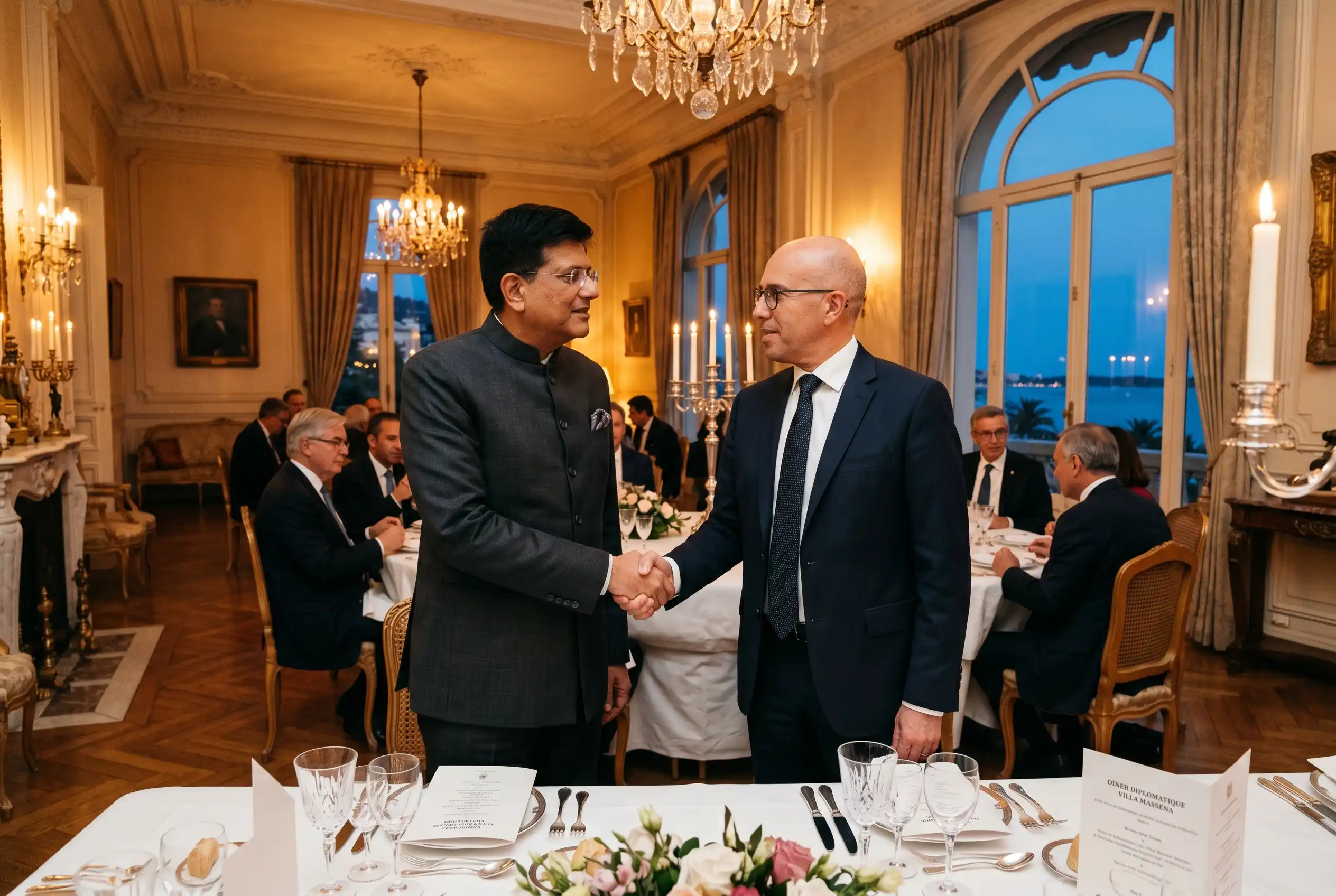
The India-France Year of Innovation arrived in Nice this week, with Bharat Innovates 2026 at the Palais des Expositions converting diplomatic language into project commitments and partnerships. Union Commerce and Industry Minister Piyush Goyal hosted a dinner at the Villa Masséna on Sunday alongside Nice Mayor Eric Ciotti, the same day Prime Minister Narendra Modi and President Emmanuel Macron jointly inaugurated Bharat Innovates 2026. New Delhi and Paris left the Riviera with 13 outcomes, a new bilateral AI working group, and a specific commitment to double their trade within five years.
For all the national-level language around the Year of Innovation, the city of Nice is the venue the national-level announcements actually need to land. The Goyal-Ciotti dinner, Macron’s walk through the Indian startup pavilion, and a separate Modi-Macron sit-down at Villa Kerylos put the Riviera’s innovation corridor, anchored by the Sophia Antipolis tech park, at the centre of a deal the Sunday list is still translating into projects.
Nice Becomes the Stage for India-France Tech Ties
Bharat Innovates 2026 runs from 14 to 16 June at the Palais des Expositions in Nice. The local convention bureau describes the three days as an inauguration and strategic vision day, a second day of startup pitches and roundtables with investors, and a third day of agreement signings and targeted networking sessions.
Wrapped up a productive day in Nice by hosting a dinner in the presence of the Mayor of Nice, Mr. Eric Ciotti, alongside distinguished leaders from government, business, innovation and investment ecosystems.
Piyush Goyal, Union Minister of Commerce and Industry, posted the line on X on 15 June. He framed the evening as a chance to exchange ideas and explore new avenues for collaboration across trade, technology, and emerging sectors, and tied the partnership to India’s Viksit Bharat vision. The Goyal-Ciotti dinner ran in parallel with the Modi-Macron bilateral at Villa Kerylos, and the city-to-country complement is the underreported layer of the trip.
The first leg of Modi’s Europe visit is the framing the dinner sits inside. The Nice stop is a bridge to the Vivatech conference in Paris and the G7 Summit in Évian-les-Bains that follows. Bharat Innovates 2026 is the runway between the Riviera and the Paris investor room.
The 13 Outcomes That Came Out of Sunday
Foreign Secretary Vikram Misri briefed reporters in Nice on Sunday and ran through 13 key outcomes spanning innovation, AI, trade, education, space, and strategic cooperation, the Tribune India reported. The catalogue couples national-level political wins to operational projects, and the 19 signed agreements between innovation-network institutions give it commercial weight. The 19 sit across the same six sectors the 13 outcomes cover, and they are the line items the rhetoric converts into project work.
The Sunday list, as Misri read it out:
- A high-level mechanism to double bilateral trade within five years, building on the existing Economic and Financial Dialogue
- A new Economic Security Dialogue
- Adoption of the India-France Innovation Roadmap 2030
- Signing of 19 agreements between institutions in the two countries’ innovation networks
- Creation of a Joint India-France AI Working Group on AI governance
- Expanded use of India’s Unified Payments Interface (UPI) in France
- A National Centre of Excellence for Skilling in Aeronautics and Allied Sectors at NSTI Kanpur
- Incubation of 10 additional Indian startups at Station F in Paris
- A Centre of Digital Sciences between India’s DST and France’s INRIA
- An ICCR India Chair on “AI, Innovation and Culture” at Université Paris-Saclay
- A Letter of Intent between India’s ICMR and France’s Health Data Hub
- A Declaration of Intent on Railway and High-speed Railway Development in India
- ISRO-CNES cooperation on microgravity research and human space exploration, paired with a General Security Agreement on classified-information exchange
The City-Level Story the National Headlines Skip
The Sunday outcome list frames the partnership as a state-to-state arrangement. The detail work is being done at the city level, and Nice is where the rhetoric has to land if it converts into contracts.
Ciotti, in Eric Ciotti’s post on the Goyal meeting, hosted the Indian minister at the Villa Masséna and used the post to flag Nice’s place in the partnership. Nice is pitching itself as open to the world, with a focus on investment, innovation, and international partnerships, and the city is putting its assets on the table as the operational answer to the national-level pledges.
The centre of that pitch is Sophia Antipolis, the French Riviera’s largest technology park and the corridor the Mayor cited in his bilateral write-up. Ciotti wrote that “with Sophia Antipolis, our university, our innovation network, and our businesses, our territory has a full role to play in this forward-looking partnership,” a line aimed at the Indian investors and founders the Bharat Innovates 2026 programme is courting, per the Nice event listing for Bharat Innovates 2026.
The other city-level pieces are operational, not rhetorical. The pieces include:
- Ten additional Indian startups incubating at Station F in Paris, one of the world’s largest startup campuses
- The NSTI Kanpur National Centre of Excellence for Skilling in Aeronautics and Allied Sectors
- French university campuses invited to open in India under the National Education Policy
- Swift implementation of visa-free airport transit for Indian nationals travelling through France
The Sophia Antipolis pitch is the underreported move. National-level deals need a landing site, and the Riviera corridor is making its case to be the landing site for the 120 Indian deep-tech startups in town for the showcase.
What 120 Indian Deep-Tech Startups Bring to the Table
Bharat Innovates 2026 is a national programme of India’s Ministry of Education, designed as a global accelerator for innovations from Indian higher education institutions. The Nice edition, announced by Modi on 17 February 2026 at the inauguration of the India-France Year of Innovation, takes the top 120 Indian deep-tech startups to the Riviera, with 15 premier Indian HEIs including the IITs and IISc, plus 5+ scientific and strategic institutions, per the Bharat Innovates 2026 programme page.
The showcase is the meeting point between French capital and Indian engineering depth. The numbers the local convention bureau is starting from are a specific stat block:
- 120 DeepTech startups at the Palais des Expositions
- 13 frontier technology themes (semiconductors, biotechnology, space and defence, healthcare and medtech, advanced computing, communications, advanced materials, manufacturing, energy, sustainability, smart cities, the blue economy, and agri-food)
- 350+ prominent investors and venture capitalists from around the world
- 200,000 recognised Indian startups
- 120+ Indian unicorns
The AI Working Group and the Innovation Network Behind It
The Joint India-France AI Working Group is the institutional peg. The group’s stated remit is cooperation on AI and its global governance, and it sits inside the India-France Innovation Roadmap 2030, the long-term umbrella document for bilateral technology collaboration.
The working group is paired with a project pipeline. The 19 signed agreements between innovation-network institutions are the operational layer, the Centre of Digital Sciences between India’s DST and France’s INRIA is the research side, and the ICCR India Chair on AI, Innovation and Culture at Université Paris-Saclay is the academic side. The Bharat Innovates 2026 platform, per the cooperative AI push at Bharat Innovates 2026, is the public showcase where the rhetoric is being put on display.
UPI’s expansion in France is the consumer-tech line. India’s real-time payment system is already a domestic fixture, and the Nice deal extends the same rails to French merchant networks. The project pipeline the 19 signed agreements are meant to seed is the work that follows the speeches.
Trade, Talent Mobility, and the Test Ahead
The trade target is doubling bilateral trade within five years.
The high-level mechanism to deliver that target sits on top of the existing Economic and Financial Dialogue, and the two sides also called for early implementation of the India-EU Free Trade Agreement signed in February 2026.
Talent mobility is the human-capital line. Modi invited French universities to open campuses in India under the National Education Policy, Macron committed to facilitating Indian students pursuing higher education in France, and the two leaders discussed expanding mutual recognition of educational qualifications. The visa-free airport transit for Indian travellers that Modi thanked Macron for is the friction-cut, and the SHANTI Act that opened new avenues for cooperation in small and advanced modular reactors is the civil-nuclear add-on.
The Economic Security Dialogue is the third leg. Critical minerals, semiconductors, and pharmaceuticals are the three categories both sides agreed to track, and the dialogue is designed to sit alongside the trade target rather than under it. NSTI Kanpur’s aeronautics centre is the operational seed for the supply-chain strand.
The 19 signed agreements from this leg are the project pipeline the rhetoric is meant to convert into deals. Nice’s pitch is the city-level test that follows.
Frequently Asked Questions
What is Bharat Innovates 2026?
Bharat Innovates 2026 is a national programme of India’s Ministry of Education, designed as a global accelerator for innovations from Indian higher education institutions. The maiden edition is being held at the Palais des Expositions in Nice from 14 to 16 June 2026, with 120 deep-tech startups and 15 Indian HEIs including the IITs and IISc.
When was the India-France Year of Innovation launched?
The India-France Year of Innovation was jointly inaugurated by President Emmanuel Macron and Prime Minister Narendra Modi on 17 February 2026 in Mumbai, the same event at which the relationship was elevated to a Special Global Strategic Partnership.
How many deep-tech startups are in Nice for Bharat Innovates 2026?
The showcase features 120 Indian deep-tech startups across 13 frontier technology themes, ranging from semiconductors and biotechnology to space, defence, advanced computing, energy, smart cities, and the blue economy. The Nice event has drawn participation from more than 350 prominent investors and venture capitalists from around the world.
What is the Joint India-France AI Working Group?
The Joint India-France AI Working Group is one of the 13 outcomes from Modi’s first-leg visit to France, with a stated focus on AI and its global governance. It sits inside the India-France Innovation Roadmap 2030 and is paired with 19 signed agreements between innovation-network institutions in the two countries.
What is the trade target between India and France?
India and France agreed at Nice to set up a high-level mechanism aimed at doubling bilateral trade within five years, building on the existing Economic and Financial Dialogue. The two sides also instituted a separate Economic Security Dialogue to track critical minerals, semiconductors, and pharmaceuticals.


South Korea Retail Investors Face Reckoning After KOSPI AI Rally Collapses

Surrey AI Maps Three Heart Attack Paths and Their Molecular Roots

Germany Locks Neutral Apple ATT Prompts Across Most of Europe

Apple’s 5% EU Fee Quietly Rewrites Alternative App Store Math

Apple’s EU Fee Truce Cuts Complexity but Leaves Rivals Fuming

Pixel 11 Pro Fold Trades Thinness for Durability and Seven-Year Stay

Mayo AI Flags HCM Obstruction From Everyday Ultrasound Videos

Indian Brands Quietly Scale Landmark Screens and Home Tech

Navin Vatsa Turns Grief Into a Lifetime of Quiet Seeing

Google Bets Pixel 11 Agentic AI Will Redefine Phones

Oracle Cuts 21,000 Jobs in a Year, Cites AI in 10-K Filing

Fable 5 and Mythos 5 Return as US Lifts Anthropic Export Controls

SpaceX’s Google Deal Turns a Rocket Company Into a Cloud Landlord

CD Projekt Red Co-CEO: Redemption Arc Isn’t Done, Witcher 4 in 2027

XPL Rallies 30% Ahead of Plasma One Card Tier Launch

Google Search Profiles Build a Follow Graph Inside Discover

DGO App Brings Rs 549 Mobile Pass for FIFA World Cup 2026 in Nepal

Moonshot AI Targets $30 Billion in China’s Fastest AI Funding Sprint

Oppo’s ColorOS 17 Eligibility List Leaves A-Series Buyers Behind

Microsoft Xbox Layoffs Start in July as Sharma Slams 3% Margin
-
 AI2 months ago
Oracle Cuts 21,000 Jobs in a Year, Cites AI in 10-K Filing
-
 AI2 months ago
Fable 5 and Mythos 5 Return as US Lifts Anthropic Export Controls
-
 AI3 months ago
SpaceX’s Google Deal Turns a Rocket Company Into a Cloud Landlord
-
 GAMING2 months ago
CD Projekt Red Co-CEO: Redemption Arc Isn’t Done, Witcher 4 in 2027
-
 CRYPTO3 months ago
XPL Rallies 30% Ahead of Plasma One Card Tier Launch
-
 NEWS3 months ago
Google Search Profiles Build a Follow Graph Inside Discover
-
 APPS3 months ago
DGO App Brings Rs 549 Mobile Pass for FIFA World Cup 2026 in Nepal
-
 AI3 months ago
Moonshot AI Targets $30 Billion in China’s Fastest AI Funding Sprint