
NEWS
Instagram for TV Hits Samsung as Phone Casting Lags
Instagram for TV reaches US Samsung 2020 sets, while phone casting stays on Fire TV and Google TV and longer series remain unshipped tests.

Instagram for TV is on Samsung Smart TVs in the United States, covering 2020 models and newer, after a June 22, 2026 rollout. The app already ran on Amazon Fire TV and Google TV. Meta said that mix now covers the majority of connected TV devices in the country.
The shared-room pitch still has a hole. Phone-to-TV casting of Reels, including videos from the Saved tab, was listed for Google TV and Fire TV, not for Samsung.
Samsung Gets the App, Not the Phone Handoff
Meta framed the Samsung build as a way to expanding Instagram for TV to Samsung TVs so more people can watch on the biggest screen at home. The same post said friends and family already pass the remote and swap clips in real time, and that the new tests are meant to make that easier.
Today, we’re expanding Instagram for TV to Samsung TVs across the US and testing new features, like casting Reels and channels organized by interest, that help people connect around what they’re watching.https://t.co/VyNOh1bdMh
— Meta Newsroom (@MetaNewsroom) June 22, 2026
Casting is the test that matches that pitch. A person finds a Reel on a phone, sends it to the set in a few taps, and the room watches the same clip. Meta said that path is available on Google TV and Fire TV, and that it includes Saved videos, so a stash built on a phone can play on the couch.
Samsung is the brand that makes the rollout look national, and it is the one left off that sentence. On a 2020 or newer Samsung set, the living-room app is a signed-in player with channels, Stories, and a remote. It is not, on Meta’s own wording, the place you beam a saved Reel from the phone in your hand.
That split will nag anyone who treats the TV as a second phone. The clip you want to show the room often lives in Saved, in DMs, or in a profile you opened on glass that is six inches wide. Without a cast path, someone still has to search the same creator on the TV app, or huddle around the phone Meta said it wanted to retire for group watching.
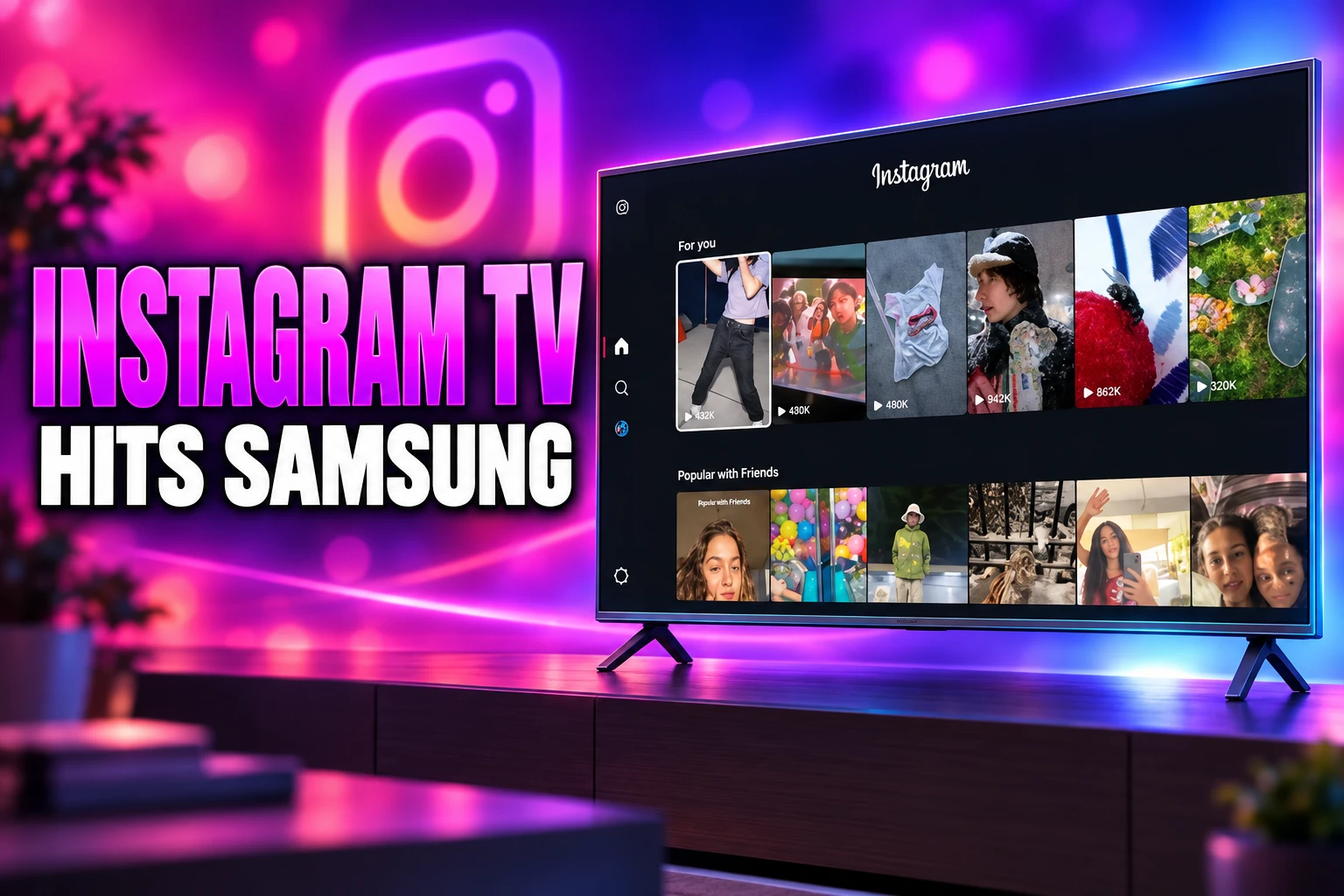
What Instagram for TV Shows on a Samsung Set
The TV app is not the full phone client stretched onto a 4K panel. It is a lean-back Reels player with a few social tools, built so videos start on their own with sound, and so a household can switch profiles without sharing a password out loud.
THE LIVING-ROOM TOOLKIT
- Interest channels: Reels are grouped so a room can pick a lane such as comedy, sports, music, travel, or a favorite creator instead of fighting over the next clip.
- Stories on the set: Friends and creators can be watched on the TV, so a daily stack does not require a cluster of heads over one phone.
- Horizontal home: A dedicated area for widescreen video is in test, aimed at clips that were shot for a TV or a computer rather than a vertical feed.
- Phone casting: Reels, including Saved videos, can be sent to Google TV and Fire TV; Samsung was not named in that list.
- Five household logins: Up to five Instagram accounts can sit on one set, and a separate account can be created just for TV.
On the TV you can browse topic rows (including a personalized For you line), like and repost, read and like comments, open profiles, follow or unfollow, view saved items, and lock the login so the next person on the couch cannot wander into your DMs. Instagram’s help pages also say you can view story highlights on a profile.
Plenty of phone habits stay off the set. You cannot edit or delete Stories from the TV, share a Story in a message, or view public comments on Stories there. Those jobs still belong to the mobile app or instagram.com. The remote is for watching, not for running an account.
We’ve heard from our community that Instagram for TV is often a shared experience. Friends and family watch together, pass the remote, and swap recommendations in real time.
Instagram, Meta newsroom, June 22, 2026
That quote is the product thesis. Channels, Stories, and casting are the tools Meta put against it. Only some of them are on every set that can install the app.
Fire TV and Google TV Still Hold the Cast Button
The hardware map is narrower than a Samsung press photo suggests, and it is still a United States map. Instagram’s current US device list for the app names three families and then stops.
WHERE THE TV APP RUNS
| Platform | Opened in the US | Hardware gate | Phone casting of Reels |
|---|---|---|---|
| Amazon Fire TV | December 16, 2025 | Fire TVs and Fire TV sticks, except the Fire TV Stick 4K Select | Yes, including the Saved tab |
| Google TV | February 24, 2026 | Android 10 and above, with a later pass to Android 7.1.2 and higher | Yes, including the Saved tab |
| Samsung Smart TV | June 22, 2026 | Models released in 2020 or later | Not listed in the June 22 note |
Roku, LG, and Apple TV are not on that list. Neither are older Samsung sets from 2019 and earlier. A Fire TV Stick 4K Select in the same living room as a supported Cube still cannot load the store tile. Google TV’s Android 10 floor leaves some cheaper boxes waiting for the 7.1.2 expansion Instagram said would follow over the next few months from the date of that help page.
Samsung Sets From 2020 Onward
The Samsung cut is simple: model year 2020 or later, United States only. That pulls in a large share of Tizen sets still on walls, and it leaves out the long tail of 2018 and 2019 screens that still stream Netflix just fine. There is no sideload promise in the official copy. If the set is older than 2020, the app is not the next icon in the Samsung hub.
Roku, LG, and Apple TV Stay Off the List
Meta’s “majority of connected TV devices” line is a US claim about Fire TV, Google TV, and Samsung together. It is not a listing for every stick in a Best Buy aisle. A Roku-heavy household, an LG webOS living room, or an Apple TV under the soundbar still has no official Instagram for TV client. Those rooms keep watching Reels the old way, which is a phone, a Chromecast-style workaround, or nothing.
A Widescreen Tab for a Vertical App
The horizontal test is the tell that this is not only a bigger Reels feed. Instagram said people asked for a home for horizontal video, and that it is testing one so creators can reach a TV-shaped audience. Vertical clips on a 16:9 Samsung panel still sit in a tall window with empty bars on both sides. That is a fine way to glance at a joke. It is a poor way to hold a couch for twenty minutes.
Instagram has been here before, under a different name. IGTV launched in June 2018 as a long-video bet, with its own app and a TV-style badge on profiles. The IGTV brand came off in October 2021. The standalone app was pulled after a February 28, 2022 announcement, and stores dropped it in mid-March 2022 as the company piled investment into Reels. Long video did not vanish; it lost its door.
The TV app now asks for the shapes IGTV never got to show on an actual television: widescreen clips, longer creator films, and stories that run in episodes. On phones, that work already has a cousin in the Series rebuild on Reels after IGTV, which groups serialized clips so a viewer can move through episodes. The June TV note said episodic series on the set would build on viewing habits already seen in the mobile app.
Tessa Lyons, Instagram’s vice president of product, called television “the next frontier.” She also argued that short-form makers can step into longer, episodic work without waiting for a studio.
We also think there’s an incredibly compelling opportunity for creators themselves to create in this format. And for a lot of the shortform content creators who are Instagram-native, it’s a very accessible way to get into telling longer and more episodic stories.
Tessa Lyons, Instagram vice president of product
That is a creative brief, not a ship date. The widescreen tab is a test. Longer-form, series, and Live on TV are listed as formats Meta is exploring and aims to roll out soon. They were not on the Samsung download as finished rows.
Households Can Load Five Accounts on One Set
The social graph on the TV is a household graph. The first Instagram for TV test on Fire TV let a home add up to five accounts, and it let someone spin up a separate account used only on the set. Login is a QR code on the TV, scanned by a phone that is already signed in. Switch account sits in the nav, so a teenager, a parent, and a guest profile can take turns without mixing For you rows.
Each logged-in account keeps its own recommendations, settings, and activity. Instagram says data from the account you use personalizes the TV app, including interests and other accounts in the same Accounts Center. When several people have linked the same set, the experience follows whoever is signed in at that moment. The company also says it may share some data with TV partners, such as Amazon Fire TV, to run the app and keep it safe.
Stories on the big screen are the other household feature that is easy to underestimate. A Story is still a 24-hour stack, but it is no longer a phone passed around the sofa. That is closer to a shared status board than to YouTube. It is also a reason the 13+ content bar matters. Instagram said Reels on the TV test generally follow the 13+ ratings system used on mobile, because the set is built for a room, not a single pair of headphones.
December 2025 copy also floated a phone-as-remote, richer channel surfing, and shared feeds with friends. Those were exploration items on day one. The June 2026 Samsung post did not mark them as done. The remote in most homes is still the Samsung clicker, and the feed is still the signed-in account’s Reels, not a merged family playlist.
Series and Live on TV Remain a Test
Adam Mosseri, Instagram’s head, said in October 2025 that if people were going to consume these apps on TV, the company had to show up there too. The device tour since then has been slow and public.
THE PATH TO THE LIVING ROOM
- December 16, 2025: Instagram opens a US test of Instagram for TV on Amazon Fire TV, with Reels in interest channels, autoplay with sound, search, and up to five accounts.
- February 24, 2026: The same app lands on Google TV devices in the US, with an update posted on the original launch note.
- June 22, 2026: Samsung Smart TVs from the 2020 model year onward get the app in the US, with Stories, interest channels, a horizontal-video test, and a casting test limited to Google TV and Fire TV.
- Formats still listed as upcoming: Longer-form creator video, episodic series, and Live on TV, which Meta said it aims to roll out soon and is shaping with creators.
Six months after the Fire TV test, the Samsung tile is the distribution win. The formats that would make the app look like a streaming row, not a Reels scroller, are still in the “exploring” column. Live on TV would be the first time a creator broadcast is designed for a room that can talk back together. Series would give those broadcasts a next episode. Neither had a public launch date attached in the June note, and no later official post in this research put them on a store.
Lyons said in December 2025 that 2026 would focus on more people and more devices, with monetization later. Ads on the TV app were not part of the Samsung announcement. For creators, that leaves a familiar gap: a new surface that can add watch time without a clear pay path, and without a proven tap-through from a ten-foot UI. A view on a Samsung set may never become a profile visit, a shop click, or a follow the way a phone Reel does.
The other friction is trust, and it showed up in the dumbest place. Meta’s own announcement replies filled with people asking to get banned accounts back, not with notes about comedy channels. A living-room app still signs in with the same account that can vanish on a phone. If that login dies, the TV tile dies with it.
Teen Time Counts, and the App Stays in the US
The TV is not a side door around the clock. Instagram said time on the TV app counts toward a Teen Account’s overall usage limits, and that teens can get the same reminders about those limits or sleep mode. Help copy on how Teen Accounts work on the TV app repeats that the same age gates, content limits, and time rules apply as on mobile.
Parents still cannot do the admin work from the Samsung remote. Changes to supervision, and any settings edits for a Teen Account, have to be made in the iPhone or Android app, or on instagram.com. The set can burn the minutes. It cannot raise the cap.
Content rules are the other living-room control. Reels on the TV test generally follow 13+ ratings, and the product is described as a shared-viewing app with limits on content, comments, and profiles that may not fit people under 18. That is a PG-13 living room, not an unfiltered For you dumped onto a 65-inch screen. It is also why a dedicated horizontal and long-form path matters. A two-hour creator film and a 20-second joke do not belong in the same unsupervised scroll, and Meta has not said how a future Live on TV row will be rated for a mixed-age couch.
Country expansion is the last unfinished line from day one. The December 2025 test said more devices and countries would follow as Instagram learned. The June 2026 help pages still said the United States only. Samsung did not punch a ticket to the UK, India, or Brazil. Until that changes, Instagram for TV is a US living-room experiment that now happens to include the country’s largest TV brand, with the phone-to-TV share still sitting on Amazon and Google hardware, and with series and live video still in the lab.

Instagram Plus Tests a Read-Only Mode That Cuts Stories

Altman Asks the Public to Accept Some AI Harm

Google Freezes OSS VRP Product Reports After AI Flood

AI Agents Make Payment Rails the Scarce Prize

Turkey’s Crypto Boom Now Runs Through Three Banks

Fable 5 Came Back Under a Commerce On-Off Switch

Google’s SpaceX GPU Lease Has a Sept. 30 Deadline

Plasma One’s XPL Locks Face a 1.81 Billion Cliff

DGO’s Rs 549 World Cup Pass Cost Fans Sleep and Data

Moonshot AI’s $30 Billion Ask Became a $35 Billion Close
-
 AI4 months ago
Fable 5 Came Back Under a Commerce On-Off Switch
-
 AI4 months ago
Google’s SpaceX GPU Lease Has a Sept. 30 Deadline
-
 CRYPTO4 months ago
Plasma One’s XPL Locks Face a 1.81 Billion Cliff
-
 APPS4 months ago
DGO’s Rs 549 World Cup Pass Cost Fans Sleep and Data
-
 AI4 months ago
Moonshot AI’s $30 Billion Ask Became a $35 Billion Close
-

 NEWS4 months ago
ColorOS 17 Device List Spans Oppo, OnePlus and Realme
-

 GAMING4 months ago
Xbox Cuts 3,200 Jobs After Five Years of Thin Returns
-

 GAMING4 months ago
The RTX 4050 Under Rs 70,000 Hides a Wattage Gap