
GAMING
Valve’s Steam Machine Ships With One Stick of DDR5, Not Two
Valve’s Steam Machine ships with a single 16GB DDR5 stick: 8GB SODIMMs were ‘literally impossible’ to source amid the AI memory crunch, leaving games slower.

Valve’s Steam Machine goes on sale June 30 starting at $1,049, and every unit rolling off the production line ships with a single 16GB DDR5 stick in single-channel mode. The setup is not what Valve designed for the device. The company told Valve’s single-channel memory explanation and Gamers Nexus that it planned two 8GB SODIMM modules in dual-channel configuration. The 8GB DDR5 sticks were “literally impossible” to buy in the volumes the project needed.
The compromise is the second-order cost of an AI-driven memory shortage that has rewritten consumer hardware roadmaps for two years. Single-channel memory leaves Valve’s compact gaming system paying a performance penalty in CPU-heavy titles. That gap is one owners can close themselves, by adding a second stick to the empty SODIMM slot.
The Configuration Valve Did Not Ship
Valve engineer Yazan Aldehayyat, who worked on the Steam Machine’s motherboard, told Valve’s engineering interview on the new Steam Machine that the device was built around two 8GB DDR5 sticks. By the time Valve came to buy the quantities it needed, those modules had effectively disappeared from the SODIMM market, so the single 16GB DDR5-5600 stick that ships in every box was the practical fallback.
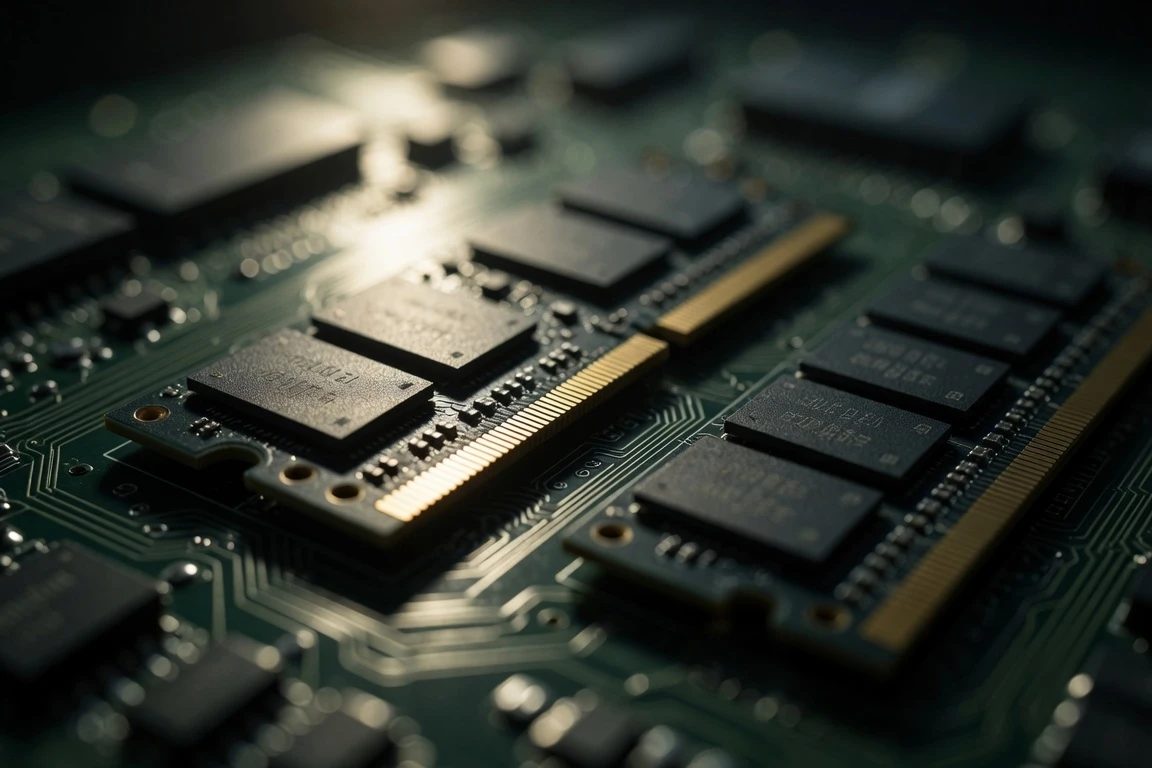
In a statement to Overclock3D, Valve laid out the constraint plainly: “All Steam Machines produced to date come with 2 SODIMM slots but only one is populated with a 16GB stick and we currently have no plans to change that configuration.” Valve added that “given the challenges with supply it may be possible that we change the configuration to 2 8 GB sticks,” a hedge that leaves the door open to a future batch of dual-channel units. The empty slot in every shipping unit is the visible scar of that decision. For now, the single-channel configuration is the only one Valve is producing.
Where the Shortage Actually Bit
Digital Foundry’s reporting puts the cause in plain terms: 8GB SODIMMs disappeared from the market because higher-capacity modules are more profitable, and all the production capacity shifted to those. Valve, like most PC makers, buys 8GB SODIMMs at the bottom of a market that no longer wants to make them.
It was quite literally impossible to buy 8GB [sticks], at least at the quantities we’re looking to buy mostly because everybody wants higher storage, and that’s more profitable, so all the capacity shifted to that.
Aldehayyat said that to Digital Foundry. The capacity shift is the same one reshaping the broader DRAM market. Major memory makers Samsung, SK Hynix, and Micron have been reallocating wafer production toward High Bandwidth Memory for AI accelerators, leaving conventional DDR4 and DDR5 lines for consumer PCs and smartphones with less supply than they need. 8GB DDR5 SODIMMs ran into that reallocation head-on, which is why Valve’s compact gaming system shipped with one populated slot.
Valve entered that squeeze without the kind of long-term supply contracts the largest buyers typically reserve. Gamers Nexus noted that Gabe Newell’s company was ill-prepared for the component shortage, and lacking long-term contracts with DRAM giants, it was in the same position as smaller vendors or consumers. The result was straightforward: it could not lock in 8GB SODIMMs at scale, so it built the Steam Machine around the parts it could actually get. The same shortage delayed the Steam Frame headset and the new Steam Controller, both of which were originally set to launch earlier in 2026. Single-channel memory is the most visible consequence of that timing shift, not the only one.
What Single-Channel Memory Costs in Real Games
Valve argues the difference is small in real games. Aldehayyat told Digital Foundry the performance of a single 16GB stick versus a dual-channel 2x8GB configuration is “pretty comparable” in actual games, and less so only in CPU-specific or memory-specific benchmarks. Digital Foundry’s own testing elsewhere backs that up for GPU-limited titles, which is most of what runs at 4K on a 28-CU RDNA 3 chip.
The penalty shows up in CPU-bound workloads, not GPU-bound ones. Titles where the system spends time simulating large worlds, managing many agents, or processing a deep simulation stack expose the bandwidth gap that dual-channel memory would otherwise close.
For Steam Machine owners, the practical rule is simple. If a game runs hot on the GPU at the resolution you are targeting, the memory channel will not change the result. If a game leans on the CPU for pathfinding, AI, or world simulation, the second stick gives that CPU something to do. Digital Foundry flagged a handful of CPU-heavy titles where the gap is most likely to show up.
That list is not exhaustive, and CPU cost in games moves with each new engine release. Still, it gives a sense of the workload class the single-channel setup most directly affects.
- Crimson Desert
- Baldur’s Gate 3
- Dragon’s Dogma 2
- Factorio
- Cities: Skylines
The User Fix Valve Built In
Valve has made the upgrade straightforward, at least on paper. The Steam Machine has two SODIMM slots, and the second one is empty. Drop in another 16GB DDR5-5600 module and the system moves to 32GB of dual-channel memory. The only catch is that replacing the RAM takes significant disassembly of the machine, more involved than swapping the user-replaceable M.2 SSD. Owners who plan to do the upgrade on day one should budget for the second stick on top of the Steam Machine’s launch price.
Valve is producing its own guides for opening up the Steam Machine, as it did for the Steam Deck, and is also working with iFixit to publish repair manuals and offer replacement parts. The empty slot is a small mercy, but it is the only one the supply chain left the company. For buyers who never open the case, the single-channel setup is what they will run.
The Price Tag Tells the Same Story
Valve confirmed the Steam Machine’s launch pricing on June 23, and the numbers tell the same story as the memory configuration. The 512GB model costs $1,049, the 2TB model $1,349, and both prices are higher than the under-$750 estimates that circulated when Valve first announced the hardware in November 2025. Valve has openly acknowledged that the original target is no longer achievable. The reservation queue runs from June 22 to June 25, with the launch set for June 30.
The company’s own statement frames the shift: “Our initial goal for the price of the Steam Machine is no longer viable. The prices we’re sharing today reflect the current state of manufacturing, or more precisely, the cost of the components we’ve secured over the past six months.” The pricing admission and the single-channel memory compromise share the same component-cost cause.
For context, the Steam Machine now sits above both current-generation consoles. The PlayStation 5 Pro costs $699 and the base Xbox Series X is available for $499, while a comparable self-built PC typically ranges from $700 to $900 depending on current component prices. The Steam Machine is not competing on dollar-for-dollar hardware value. It is selling the SteamOS experience in a living-room box, and Valve has said it is selling at cost, not subsidising the hardware.
| Device | Price | Note |
|---|---|---|
| Steam Machine (512GB) | $1,049 | Launches June 30, 2026 |
| Steam Machine (2TB) | $1,349 | Launches June 30, 2026 |
| PlayStation 5 Pro | $699 | Sony current-gen console |
| Xbox Series X | $499 | Microsoft current-gen console |
| Comparable self-built PC | $700 to $900 | Range depends on current component prices |
A Shortage That Started in Datacenters
The Steam Machine’s single-channel memory is one visible scar from a supply crunch that started in 2025 and shows no sign of easing. The shortage, sometimes labelled “RAMmageddon” in tech media, has a clear structural cause: the rapid expansion of generative AI services triggered unprecedented demand for High Bandwidth Memory used in AI accelerators and data center GPUs. The major memory makers reallocated wafer capacity to chase those contracts.
SK Hynix’s CEO has said the shortage will last until 2030, and a 2026 Kearney analysis projects at least that far before the market rebalances. 200 to 400 percent price increases in DRAM and NAND flash have flowed through to consumer hardware. PC OEMs have absorbed 15 to 20 percent cost increases on the components, and HP has warned that memory now accounts for 35 percent of PC build materials. The 2027 U.S. games market slowdown is one downstream effect of the same cost pressure. Valve is one of many companies caught in that reallocation.
The same shortage has delayed Valve’s Steam Frame and Steam Controller launches, originally set for early 2026. Gartner and IDC forecast a 10 to 11 percent decline in worldwide PC shipments for 2026, citing the same cost pressure. OpenAI’s Stargate AI infrastructure initiative is the most concentrated expression of that demand, with the 2025 to present global memory supply shortage estimating it consumes roughly 40 percent of global DRAM output. The empty SODIMM slot in every Steam Machine is a small piece of the same story.
For buyers weighing the Steam Machine this week, the practical question is which games they play and whether they are willing to open the case. The single-channel setup is the one Valve shipped; the dual-channel version is one screw and a second stick away.
Frequently Asked Questions
Why does the Steam Machine ship with one RAM stick?
Valve told Digital Foundry that 8GB DDR5 SODIMM modules became “literally impossible” to buy in the volumes the Steam Machine needed. The company designed the system around two 8GB sticks in dual-channel mode, but by the time it came to source parts, higher-capacity modules had absorbed the SODIMM production capacity.
Can users add a second stick of RAM to the Steam Machine?
Yes. The Steam Machine has two SODIMM slots, and only one is populated. Adding a second 16GB DDR5-5600 module moves the system to 32GB of dual-channel memory. Valve is producing its own guides and is working with iFixit to publish repair manuals and offer replacement parts, though replacing the RAM takes more disassembly than swapping the M.2 SSD.
Will single-channel RAM slow down most Steam Machine games?
For GPU-limited titles at 4K, no. Valve engineer Yazan Aldehayyat told Digital Foundry the configurations are “pretty comparable” in actual games. For CPU-heavy RPG and simulation titles like Baldur’s Gate 3, Crimson Desert, Dragon’s Dogma 2, Factorio, and Cities: Skylines, the second stick closes a real bandwidth gap.
How much does the Steam Machine cost at launch?
The 512GB model costs $1,049 and the 2TB model costs $1,349. Both are higher than the sub-$750 estimates from November 2025. Valve has said it is selling the hardware at cost and that the original pricing target is no longer viable given current component costs.
When does the Steam Machine go on sale?
The Steam Machine launches June 30, 2026, with a randomized reservation queue open from June 22 to June 25. Reservations require a Steam account in good standing and at least one Steam purchase made before April 27, 2026.


South Korea Retail Investors Face Reckoning After KOSPI AI Rally Collapses

Surrey AI Maps Three Heart Attack Paths and Their Molecular Roots

Germany Locks Neutral Apple ATT Prompts Across Most of Europe

Apple’s 5% EU Fee Quietly Rewrites Alternative App Store Math

Apple’s EU Fee Truce Cuts Complexity but Leaves Rivals Fuming

Pixel 11 Pro Fold Trades Thinness for Durability and Seven-Year Stay

Mayo AI Flags HCM Obstruction From Everyday Ultrasound Videos

Indian Brands Quietly Scale Landmark Screens and Home Tech

Navin Vatsa Turns Grief Into a Lifetime of Quiet Seeing

Google Bets Pixel 11 Agentic AI Will Redefine Phones

Oracle Cuts 21,000 Jobs in a Year, Cites AI in 10-K Filing

Fable 5 and Mythos 5 Return as US Lifts Anthropic Export Controls

SpaceX’s Google Deal Turns a Rocket Company Into a Cloud Landlord

CD Projekt Red Co-CEO: Redemption Arc Isn’t Done, Witcher 4 in 2027

XPL Rallies 30% Ahead of Plasma One Card Tier Launch

Google Search Profiles Build a Follow Graph Inside Discover

DGO App Brings Rs 549 Mobile Pass for FIFA World Cup 2026 in Nepal

Moonshot AI Targets $30 Billion in China’s Fastest AI Funding Sprint

Oppo’s ColorOS 17 Eligibility List Leaves A-Series Buyers Behind

Microsoft Xbox Layoffs Start in July as Sharma Slams 3% Margin
-
 AI2 months ago
Oracle Cuts 21,000 Jobs in a Year, Cites AI in 10-K Filing
-
 AI2 months ago
Fable 5 and Mythos 5 Return as US Lifts Anthropic Export Controls
-
 AI3 months ago
SpaceX’s Google Deal Turns a Rocket Company Into a Cloud Landlord
-
 GAMING2 months ago
CD Projekt Red Co-CEO: Redemption Arc Isn’t Done, Witcher 4 in 2027
-
 CRYPTO3 months ago
XPL Rallies 30% Ahead of Plasma One Card Tier Launch
-
 NEWS3 months ago
Google Search Profiles Build a Follow Graph Inside Discover
-
 APPS3 months ago
DGO App Brings Rs 549 Mobile Pass for FIFA World Cup 2026 in Nepal
-
 AI3 months ago
Moonshot AI Targets $30 Billion in China’s Fastest AI Funding Sprint