
AI
Americans Say China Leads AI While the Money Still Says Otherwise
Pew finds Americans pick China over the US three-to-one on AI leadership, yet Stanford data shows US private investment still towers 23 times higher.

By a three-to-one margin, Americans name China, not the United States, as more advanced in developing artificial intelligence. Yet the latest hard counts on private capital, top-tier models and high-impact patents still put the United States far ahead. A Pew Research Center survey of 3,488 adults conducted June 22-28, 2026, captures that perception gap in plain numbers.
Thirty-six percent say China is more advanced. Twelve percent say the United States holds the edge. Eighteen percent call the two roughly equal. Thirty-three percent simply are not sure. The same poll finds 43 percent call U.S. leadership extremely or very important, while 51 percent expect AI to widen the gap between rich and poor countries.
What the Numbers Show
The headline split is stark. Men are more likely than women to credit the United States (18 percent versus 7 percent), yet both groups still lean toward China as the leader (31 percent of men, 41 percent of women). Republicans and leaners give the United States 17 percent, Democrats and leaners 9 percent. In both parties the larger share still picks China.
Chatbot users differ only at the margins. Sixteen percent of people who use AI chatbots say the United States leads, versus 9 percent of non-users. Both groups land at 36 percent for China. Non-users simply register more “not sure” answers.
| Group | U.S. more advanced | China more advanced | Equal | Not sure |
|---|---|---|---|---|
| All U.S. adults | 12% | 36% | 18% | 33% |
| Men | 18% | 31% | 22% | 29% |
| Women | 7% | 41% | 14% | 37% |
| Rep/Lean Rep | 17% | 30% | 20% | 33% |
| Dem/Lean Dem | 9% | 43% | 16% | 32% |
| Uses AI chatbots | 16% | 36% | 20% | 28% |
| Does not use chatbots | 9% | 36% | 16% | 38% |
Source: Pew Research Center, June 22-28, 2026. Figures may not sum to 100 percent because of non-response and rounding.
Age and Party Shape the Stakes People Assign
Importance of U.S. leadership tracks age and party more tightly than raw capability judgments. Fifty-six percent of adults 65 and older call leading extremely or very important. Only 26 percent of 18- to 29-year-olds say the same. Republicans hit 54 percent on that top tier; Democrats sit at 34 percent.
Men (50 percent) and bachelor’s-degree holders (50 percent) also outpace women (36 percent) and those with less education (39 percent). The poll notes that President Donald Trump has said the United States “must have the most powerful AI systems in the world” and is “in a race to achieve global dominance.” Former President Joe Biden stressed keeping advanced AI from adversaries for security reasons.
- 43% say U.S. AI leadership is extremely or very important
- 34% call it somewhat important
- 22% say not too or not at all important
- 51% expect AI to increase the rich-poor country gap
Younger adults and Democrats place less urgency on national primacy even as they share the broader view that China sits ahead.
The Investment Gap That Barely Registers
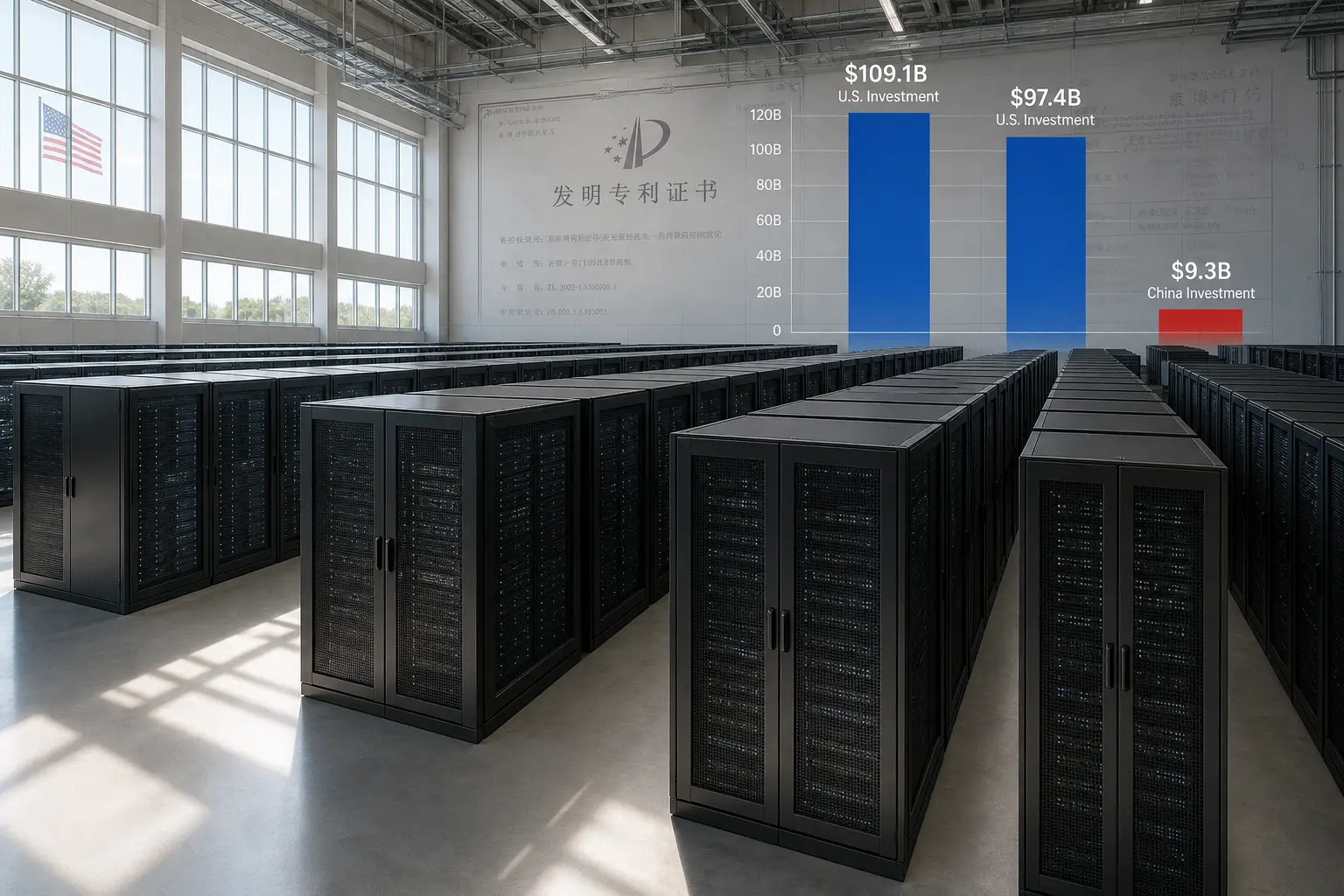
Hard metrics tell a different story. The Stanford 2026 AI Index findings on investment put U.S. private AI investment at $285.9 billion in 2025. China’s private figure is listed at $12.4 billion, more than a 23-fold difference. The United States also led in newly funded AI companies, 1,953 versus far smaller tallies elsewhere.
On notable models the United States produced 50 in the latest count against China’s 30. Performance on frontier benchmarks has tightened dramatically. U.S. and Chinese systems have traded the lead several times since early 2025; as of March 2026 the top U.S. model held only a 2.7 percent edge. China leads in sheer publication volume, citations, total patent filings and industrial robot installations. The United States still holds more high-impact patents when measured by forward citations.
| Metric (latest Stanford AI Index) | United States | China |
|---|---|---|
| Private AI investment 2025 | $285.9 billion | $12.4 billion |
| Notable AI models (recent year) | 50 | 30 |
| Performance gap (top models, March 2026) | Leads by 2.7% | Closed dramatically |
| Data centers hosted | 5,427 (more than 10x next) | Far fewer |
| AI patent volume share | Lower share, higher impact citations | ~70% of global filings |
Talent inflows to the United States have dropped sharply, down 89 percent since 2017 and 80 percent in the most recent year alone. That is a real vulnerability. It does not erase the capital and infrastructure edge.
Why the Public Picture Looks So Different
Headlines about DeepSeek, Moonshot and other Chinese systems landing near parity travel faster than multi-hundred-billion-dollar investment ledgers. Chinese open-weight releases and rapid iteration on benchmarks create a visible sense of catch-up. Volume metrics (patents filed, papers published, robots installed) also favor China and are easy to quote.
At the same time, one-third of Americans admit they do not know who leads. That uncertainty is highest among non-users of chatbots. The people closest to the tools still split evenly with everyone else on the China-lead question. Familiarity has not closed the perception gap.
On X and in early reaction posts, the dominant reading treats the poll itself as a policy catalyst rather than a capability scorecard. Fear of falling behind is already cited as fuel for tighter export controls, faster data-center permitting and long-term bets on power and packaging. That crowd observation matches the political language already in use in Washington.
Inequality Worries Run Parallel to the Race Talk
Fifty-one percent of Americans say AI will increase the gap between rich and poor countries. Only 7 percent expect the gap to shrink. Sixteen percent see little difference and 25 percent are unsure. Democrats (60 percent) and bachelor’s-degree holders (62 percent) are more likely than Republicans (45 percent) and those without degrees (46 percent) to foresee wider divides. Chatbot users also tilt higher on this view (55 percent versus 47 percent).
That public instinct aligns with institutional warnings. A UNDP warning on AI widening country gaps argued that unmanaged AI could reverse decades of development convergence because countries start from uneven positions on compute, data, skills and governance. Access to frontier models, energy and chips is already uneven. The same forces that produce U.S. capital dominance can leave lower-income nations further behind if adoption stays concentrated.
Domestic use patterns matter too. Studies on how chatbot use links to critical thinking shifts show everyday exposure is already changing how people work and learn. Those shifts are not evenly distributed either.
Policy Is Already Treating Perception as Reality
The Trump administration released its White House America’s AI Action Plan in July 2025 under the banner “Winning the AI Race.” The plan lists more than 90 federal actions across innovation, infrastructure and international partnerships. Priorities include full-stack AI export packages to allies, faster permitting for data centers and semiconductor fabs, deregulation aimed at speeding deployment, and procurement rules that favor models free of what the administration calls top-down ideological bias.
Officials have repeatedly framed the contest as non-negotiable for economic and military power. That language sits comfortably beside the 54 percent of Republicans who call U.S. leadership extremely or very important. It collides with the lower urgency among younger adults and Democrats, and with the one-third of the public that cannot name a leader at all.
Companies are already adjusting capital plans. Some large technology and services firms are firms rethinking capital for AI buildouts, weighing dividends against the cost of compute, energy and talent. The perception that China is closing or leading supplies political cover for those outlays even when private investment tallies still heavily favor the United States.
The Perception Gap Is Now Part of the Race
Americans’ three-to-one tilt toward China as AI leader is real and bipartisan enough to matter. The capital and model-count lead of the United States is also real. The poll therefore functions less as a precise scoreboard and more as a measure of attention, risk aversion and headline impact.
Older voters and Republicans assign higher stakes to national primacy. Younger voters and Democrats are less convinced the race itself is the top priority, even while they share the view that China sits ahead and that global inequality will grow. One-third of adults remain uncommitted on the basic question of who leads.
That mix leaves policy running hotter than public certainty. Infrastructure, export controls and industrial strategy are already being written as if the race is both close and existential. The next rounds of model releases and investment reports will either narrow the perception gap or widen it further. For now the public and the ledgers are telling two different stories at once.
Frequently Asked Questions
How large was the Pew sample and what is the margin of error?
Pew surveyed 3,488 U.S. adults who are members of its American Trends Panel between June 22 and 28, 2026. The reported margin of error is plus or minus 1.8 percentage points. Full questionnaire, topline and methodology PDFs are posted with the short-read analysis.
Do chatbot users really see the race differently?
They are only modestly more likely to credit the United States (16 percent versus 9 percent). Both users and non-users put China at 36 percent. The bigger difference is uncertainty: non-users are far more likely to say they are not sure. Daily tool use has not produced a consensus that America leads.
Is private investment the right way to measure China’s total AI effort?
Stanford notes that private-investment figures likely understate China’s overall spending because of large government guidance funds. Even with that caveat, the private gap remains enormous and U.S. entrepreneurial activity (new funded companies) is an order of magnitude higher. Volume metrics such as patents and papers still favor China.
Why do older Americans care more about U.S. AI leadership?
Adults 65 and older are more than twice as likely as 18- to 29-year-olds to call U.S. leadership extremely or very important (56 percent versus 26 percent). The poll does not spell out the reasons, but the pattern tracks broader generational differences on national competitiveness and technology risk that appear across multiple Pew series.
What does the UNDP say could reverse development convergence?
Its “Next Great Divergence” analysis argues that AI can widen gaps in economic performance, capabilities and governance because countries start from highly uneven positions on compute, data and skills. Without deliberate policy, the long post-war trend of poorer countries closing the gap with richer ones could erode.


South Korea Retail Investors Face Reckoning After KOSPI AI Rally Collapses

Surrey AI Maps Three Heart Attack Paths and Their Molecular Roots

Germany Locks Neutral Apple ATT Prompts Across Most of Europe

Apple’s 5% EU Fee Quietly Rewrites Alternative App Store Math

Apple’s EU Fee Truce Cuts Complexity but Leaves Rivals Fuming

Pixel 11 Pro Fold Trades Thinness for Durability and Seven-Year Stay

Mayo AI Flags HCM Obstruction From Everyday Ultrasound Videos

Indian Brands Quietly Scale Landmark Screens and Home Tech

Navin Vatsa Turns Grief Into a Lifetime of Quiet Seeing

Google Bets Pixel 11 Agentic AI Will Redefine Phones

Oracle Cuts 21,000 Jobs in a Year, Cites AI in 10-K Filing

Fable 5 and Mythos 5 Return as US Lifts Anthropic Export Controls

SpaceX’s Google Deal Turns a Rocket Company Into a Cloud Landlord

CD Projekt Red Co-CEO: Redemption Arc Isn’t Done, Witcher 4 in 2027

XPL Rallies 30% Ahead of Plasma One Card Tier Launch

Google Search Profiles Build a Follow Graph Inside Discover

DGO App Brings Rs 549 Mobile Pass for FIFA World Cup 2026 in Nepal

Moonshot AI Targets $30 Billion in China’s Fastest AI Funding Sprint

Oppo’s ColorOS 17 Eligibility List Leaves A-Series Buyers Behind

Microsoft Xbox Layoffs Start in July as Sharma Slams 3% Margin
-
 AI2 months ago
Oracle Cuts 21,000 Jobs in a Year, Cites AI in 10-K Filing
-
 AI2 months ago
Fable 5 and Mythos 5 Return as US Lifts Anthropic Export Controls
-
 AI3 months ago
SpaceX’s Google Deal Turns a Rocket Company Into a Cloud Landlord
-
 GAMING2 months ago
CD Projekt Red Co-CEO: Redemption Arc Isn’t Done, Witcher 4 in 2027
-
 CRYPTO2 months ago
XPL Rallies 30% Ahead of Plasma One Card Tier Launch
-
 NEWS3 months ago
Google Search Profiles Build a Follow Graph Inside Discover
-
 APPS2 months ago
DGO App Brings Rs 549 Mobile Pass for FIFA World Cup 2026 in Nepal
-
 AI3 months ago
Moonshot AI Targets $30 Billion in China’s Fastest AI Funding Sprint