
APPS
Apple’s 15% External Fee Bid Admits Its Own Zero Floor
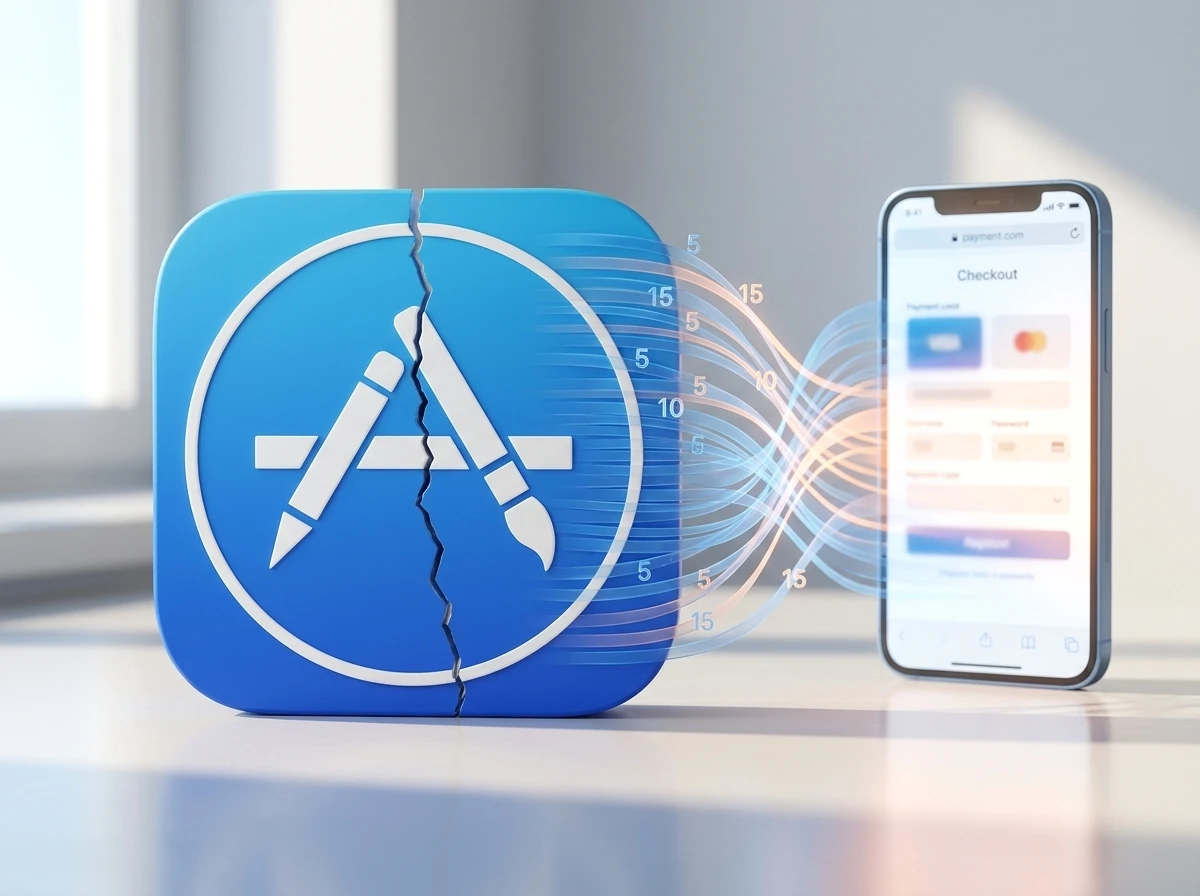
Apple asked a federal judge for 5-15% on external App Store purchases after the Supreme Court cleared the path.

Apple asked a federal judge on August 13, 2026, for commissions of up to 15% on purchases made through external payment links inside U.S. iOS apps. The same filing states that under the Ninth Circuit’s definition of “necessary costs,” the recoverable rate is essentially zero.
That tension now sits at the center of the latest round in Epic Games v. Apple. Judge Yvonne Gonzalez Rogers must set a rate that is not prohibitive, after the Supreme Court refused to pause the lower-court proceeding.
The filing therefore lands as both a request and a concession. Apple wants a tiered percentage. Its own papers also show why a strict reading of the remand order points the other way.
The Rates Apple Put on Paper
In its remand proffer, Apple proposed a tiered structure for linked-out purchases in the United States:
- 15% for standard apps that currently pay 30% on in-app purchases
- 10% for apps in the Video Partner Program, News Partner Program, or Mini Apps Partner Program, and for subscription renewals
- 5% for apps in the Small Business Program
Apple argued these rates would let large numbers of efficient developers link out profitably and still create competitive pressure on its own in-app purchase system. The company submitted expert reports, including from economist Dennis Carlton, claiming the vast majority of the roughly 2,700 largest apps could do so under the proposal. It also asked the court to refer the parties to a settlement conference.
The tier design tracks existing Apple program lines rather than inventing a single flat fee. Standard apps would move from a 30% in-app take to a 15% link-out take. Partner-program apps and subscription renewals would sit one step lower. Small Business Program apps would see the lightest cut.
That structure is meant to answer the non-prohibitive test while still collecting a percentage on transactions the App Store does not process. Carlton’s reports are the economic backbone of that claim. Apple presents them as proof that efficient large developers would still find link-out rational under the proposed cuts.
Readers can examine Apple’s full remand proffer filing for the complete legal and economic arguments.
How the Zero Floor Became the Centerpiece
The Ninth Circuit’s December 2025 decision upheld the contempt finding against Apple but reversed a permanent ban on any linked-out commission. It instructed the district court to allow recovery only of costs “genuinely and reasonably necessary” for coordinating external links, excluding security and privacy features already tied to in-app purchases, and to ensure any fee stays below the prohibitive threshold.
Apple’s own papers concede the point. Under that narrow definition the incremental costs are de minimis relative to transaction revenue. A percentage commission sized only to those costs would be essentially zero.
Apple’s filing is in, and Apple admitted that under the Ninth Circuit’s definition of “necessary costs” they would charge 0% for purchases made via linkouts to the web. Apple proposed linkout fees of 15% for standard apps and 5% for Small Business Program apps. Epic believes these fees are far outside of the bounds of the Ninth Circuit’s guidance on permissible fees, and we have roughly 60 days to file our opposition supported by expert witnesses.
That statement came from the Epic Games Newsroom account on X the same day the filing landed. The post drew tens of thousands of views within hours. Epic plans a formal opposition and has long maintained that Apple should receive nothing beyond direct, incremental costs for links it does not process.
The circuit’s cost test is narrow on purpose. Security and privacy work already bound to in-app purchases cannot be re-billed as link coordination. What remains, on Apple’s own description, is incremental and small beside transaction revenue. That is how the recoverable rate collapses toward zero when the definition is applied as written.
Apple counters that a pure cost-based cap would ignore the intellectual property, tools, and platform value developers still use, and that the Ninth Circuit itself spoke of non-prohibitive commissions rather than pure cost recovery as the only path. The filing therefore offers both the 0% concession under the strict test and a separate value-based justification for 5-15%.
An earlier reading of the zero-floor admission already flagged how this language would shape the fight.
Why the Clock Forced the Filing Now
The sequence that produced Thursday’s proffer was compressed and public.
- September 2021: Judge Gonzalez Rogers issues a permanent injunction barring Apple’s anti-steering rules that blocked external payment links.
- April 2025: The same judge finds Apple in civil contempt for imposing a 27% commission and restrictive link rules that had a prohibitive effect, temporarily barring commissions.
- December 2025: Ninth Circuit upholds contempt but reverses the permanent zero-commission sanction and remands for a properly tailored non-prohibitive rate or cost-based remedy.
- June 30, 2026: Supreme Court grants certiorari on the contempt issues.
- August 11-13, 2026: District court denies Apple’s stay request; a brief Supreme Court temporary stay expires; full stay denied; Apple files the rate proffer by the evening deadline.
Apple had argued the Supreme Court review could moot or reshape the rate proceeding. Both the district court and the high court let the lower-court work continue. The company now faces a live schedule while its Supreme Court brief is due by mid-September.
The August window left little room to wait. Once the stay path closed, the remand proffer deadline controlled the calendar. Apple filed into an active district-court track even as the contempt questions moved upward.
Google’s Parallel Menu and Epic’s Earlier Deal
Apple repeatedly compared its proposal to Google Play’s external arrangements. Google’s documented U.S. external content links program charges service fees that reach 20% on many in-app item purchases from existing installs, 15% for certain program participants, and 10% on recurring subscriptions (with a 10% first-$1M tier in several cells). Fixed per-install fees also apply for some external app downloads.
| Tier / Category | Apple Proposal (link-out) | Google Play External (selected) |
|---|---|---|
| Standard / most offers | 15% | Up to 20% (existing installs) |
| Special programs | 10% (Video, News, Mini Apps) | 15% (Level Up / Apps Experience) |
| Small business / first $1M | 5% | 10% first $1M in several cells |
| Subscription renewals | 10% | 10% |
Apple noted that Epic had agreed to Google’s rates in resolving its separate dispute with Google. Full details appear in the Google Play external content links fees documentation. The comparison is imperfect: Google’s program includes install fees, new-versus-existing distinctions, and different technical requirements, while Apple’s proposal is pure percentage commissions on completed linked-out purchases. Still, it supplies the only major-store benchmark currently in front of the court.
On the face of the selected cells, Apple’s percentages land at or below the Google figures shown. Subscription renewals match at 10%. The standard and small-business rows favor Apple’s proposal on a simple side-by-side read. The gaps in program design still limit how far that comparison can travel.
Developers Facing the Tiered Cut
If the court adopts anything close to Apple’s numbers, the practical impact splits by developer size and category.
- Large games and apps that already pay 30% on IAP would see the external option cut the platform take roughly in half, but still face a double-digit cut plus their own payment-processor costs.
- Small Business Program participants would face only 5%, a figure closer to pure payment-processing economics.
- Video, news, and mini-app partners plus subscription renewals land at 10%.
- Developers who already built robust web checkout and account systems stand to gain the most; those who never invested outside IAP face new engineering and support costs even if the commission itself looks attractive.
Carlton’s analysis, as summarized by Apple, claims most efficient large developers could still improve margins by linking out. Epic and many independent developers counter that any ongoing percentage on transactions Apple does not process functions as a barrier that protects IAP rather than a recovery of true incremental cost. The current temporary regime is zero commission; any approved rate will reverse that baseline.
The fight also sits inside a wider pattern of store-policy pressure. Epic’s broader mobile store push and continued free-game promotions on its own storefront keep the competitive alternative visible even while iOS remains closed to sideloading in the United States.
The Record Holds Two Competing Floors
The remand papers now place two different floors before the court at once. One is the cost floor Apple concedes under the Ninth Circuit’s narrow definition. The other is the value-based tier schedule Apple asks the judge to adopt.
| Measure | Rate on linked-out purchases |
|---|---|
| Temporary regime now in force | 0% |
| Ninth Circuit “necessary costs” floor (Apple’s concession) | Essentially 0% |
| Apple proposed tiers | 5%, 10%, or 15% by category |
Epic has already treated the concession as the controlling number. Its public response framed the 5% and 15% asks as outside the circuit’s guidance and promised expert-backed opposition inside roughly 60 days.
Apple’s answer is structural. It separates the strict cost test from what it calls a non-prohibitive commission that still reflects intellectual property, tools, and platform value. The filing keeps both paths open so the district court can choose the frame.
That choice matters because the temporary baseline is already zero. Moving from zero to any standing percentage changes developer math overnight, even when the new number is half the old in-app rate.
Settlement Remains on the Table Beside Trial
Apple’s proffer did more than list percentages. It asked the court to refer the parties to a settlement conference. That request sits beside the expert reports and the tier schedule as part of the same filing package.
A conference would not erase the Ninth Circuit’s instructions. It could still narrow the distance between a near-zero cost formula and the 5-15% menu before the judge has to pick a line. Epic’s opposition clock, set at roughly 60 days from the filing, continues either way.
Parallel pressure comes from the Supreme Court track. Apple’s brief there is due by mid-September. A later ruling that Apple never violated the injunction could unwind parts of the remand framework, which is one reason Apple sought a stay. The stay failed. Both tracks now run at once.
What the Judge Must Still Decide
Judge Gonzalez Rogers now has Apple’s evidence package and will receive Epic’s opposition, expected within roughly 60 days, plus any reply. She must craft a rate or structure that satisfies the Ninth Circuit’s dual instructions: no prohibitive commission that chills linking, and a remedy tailored to the original unfair-competition informational harm.
Possible outcomes range from adopting Apple’s tiers, trimming them, imposing a pure cost-recovery formula that lands near zero, or crafting a hybrid. A settlement conference could narrow the issues. In parallel, the Supreme Court will hear the contempt questions; a ruling that Apple never violated the injunction could unwind parts of the remand framework.
European developments supply additional context. After Apple’s failed EU gatekeeper challenges, the company already operates under different external-link and alternative-store rules in the European Union. The U.S. rate proceeding remains a distinct, California-centered fight over the 2021 injunction’s residual effect.
For now the record contains both Apple’s request for 5-15% and its own concession that the court-defined cost floor is zero. Epic has already seized on the second number. The judge will decide which number, if either, becomes the new U.S. baseline for external purchases on iOS.
Epic’s full statement and the surrounding thread remain available as Epic’s official response on X.


Korea AI Job Shift Erases Youth Roles While Seniors Gain

Meta Faces States Over Child Safety Claims in Oakland Trial

Nuke tests leave asteroid fragments fate still open

Apple must strip ATT warning prompts after German ruling

Facebook crypto lure turns into ₹7 lakh street robbery in Hyderabad

Round Hill Sues Anthropic and Suno Over 500 Songs

HYPERDROP Drops Perth Studio Into Pachinko Roguelite Wave

Apple must neutralise ATT prompts after German cartel probe

FiiO FG3 cracks open budget gaming headsets at seventy dollars

Glodon QuantifAI launch pushes Malaysian quantity takeoff into AI judgment work

Fable 5 and Mythos 5 Return as US Lifts Anthropic Export Controls

Oracle Cuts 21,000 Jobs in a Year, Cites AI in 10-K Filing

SpaceX’s Google Deal Turns a Rocket Company Into a Cloud Landlord

CD Projekt Red Co-CEO: Redemption Arc Isn’t Done, Witcher 4 in 2027

XPL Rallies 30% Ahead of Plasma One Card Tier Launch

Google Search Profiles Build a Follow Graph Inside Discover

DGO App Brings Rs 549 Mobile Pass for FIFA World Cup 2026 in Nepal

Moonshot AI Targets $30 Billion in China’s Fastest AI Funding Sprint

Microsoft Xbox Layoffs Start in July as Sharma Slams 3% Margin

Oppo’s ColorOS 17 Eligibility List Leaves A-Series Buyers Behind
-
 AI2 months ago
Fable 5 and Mythos 5 Return as US Lifts Anthropic Export Controls
-
 AI2 months ago
Oracle Cuts 21,000 Jobs in a Year, Cites AI in 10-K Filing
-
 AI2 months ago
SpaceX’s Google Deal Turns a Rocket Company Into a Cloud Landlord
-
 GAMING2 months ago
CD Projekt Red Co-CEO: Redemption Arc Isn’t Done, Witcher 4 in 2027
-
 CRYPTO2 months ago
XPL Rallies 30% Ahead of Plasma One Card Tier Launch
-
 NEWS2 months ago
Google Search Profiles Build a Follow Graph Inside Discover
-
 APPS2 months ago
DGO App Brings Rs 549 Mobile Pass for FIFA World Cup 2026 in Nepal
-
 AI2 months ago
Moonshot AI Targets $30 Billion in China’s Fastest AI Funding Sprint