
AI
The AI Drug Discovery Bill Is Due at Phase II
AI drug discovery still has zero FDA approvals, but the empty column is the 12-year clock. Phase II rates look like old chemistry.

No AI-discovered drug has full FDA approval as of August 2026, despite $8.9 billion raised in 2024 and $11 billion more in 2025.
Drug development still takes 10 to 15 years from idea to label, and the first wave of AI candidates only entered people in the early 2020s.
Zero Approvals Match the 12-Year Clock
The scoreboard everyone recites is simple: AI-ML discovery firms took in $8.9 billion across 264 venture rounds in 2024, biotechnology AI accounted for $5.6 billion of that, and the FDA still has not put a fully AI-discovered medicine on a label. Projections for a first approval have sat on 2026 or 2027 for three years. That empty column is being treated as a verdict on the science. It is mostly a function of how long human trials take.
Nature Medicine, in the rentosertib paper, put the ordinary path at $2 billion to $3 billion and 10 to 15 years. Insilico Medicine has said its own preclinical run for the idiopathic pulmonary fibrosis candidate took 18 months and about $150,000, then reached phase 0 and 1 testing in under 30 months from the start of target work. Compressing the chemistry does not compress a year of dosing, a second year of follow-up, or a review division’s questions. A molecule that first reached healthy volunteers around 2022 was never on a 2024 approval calendar.
Industry tallies circulating in 2026 put more than 173 AI-originated programs in the clinic, up from roughly two dozen in late 2023, with 15 to 20 expected to hit pivotal trials this year. That is a pipeline, not a product. Pipeline reviews also keep stretching the “AI-discovered” sticker onto physics-based design against known targets, which is a different claim from generating both a new target and a new molecule.
THE RENTOSERTIB CLOCK
- Target to candidate, about 18 months: Insilico’s Pharma.AI stack (PandaOmics for biology, Chemistry42 for generative chemistry) nominated TNIK and a small-molecule inhibitor later named rentosertib, formerly ISM001-055.
- February 2023: The FDA grants Orphan Drug Designation for idiopathic pulmonary fibrosis.
- June 3, 2025: Nature Medicine publishes the 12-week Phase IIa study in 71 patients at 22 sites in China.
- May 2025: China’s CDE grants Breakthrough Therapy Designation.
- July 7, 2026: Insilico starts Phase III (NCT07687459, CTR20262475) in 320 patients over 52 weeks.
That sequence is fast by discovery standards and ordinary by late-stage standards. The bill, if there is one, is not that 2024’s checks failed to buy a 2025 stamp from CDER.
The Phase II Rate Matches Old Chemistry
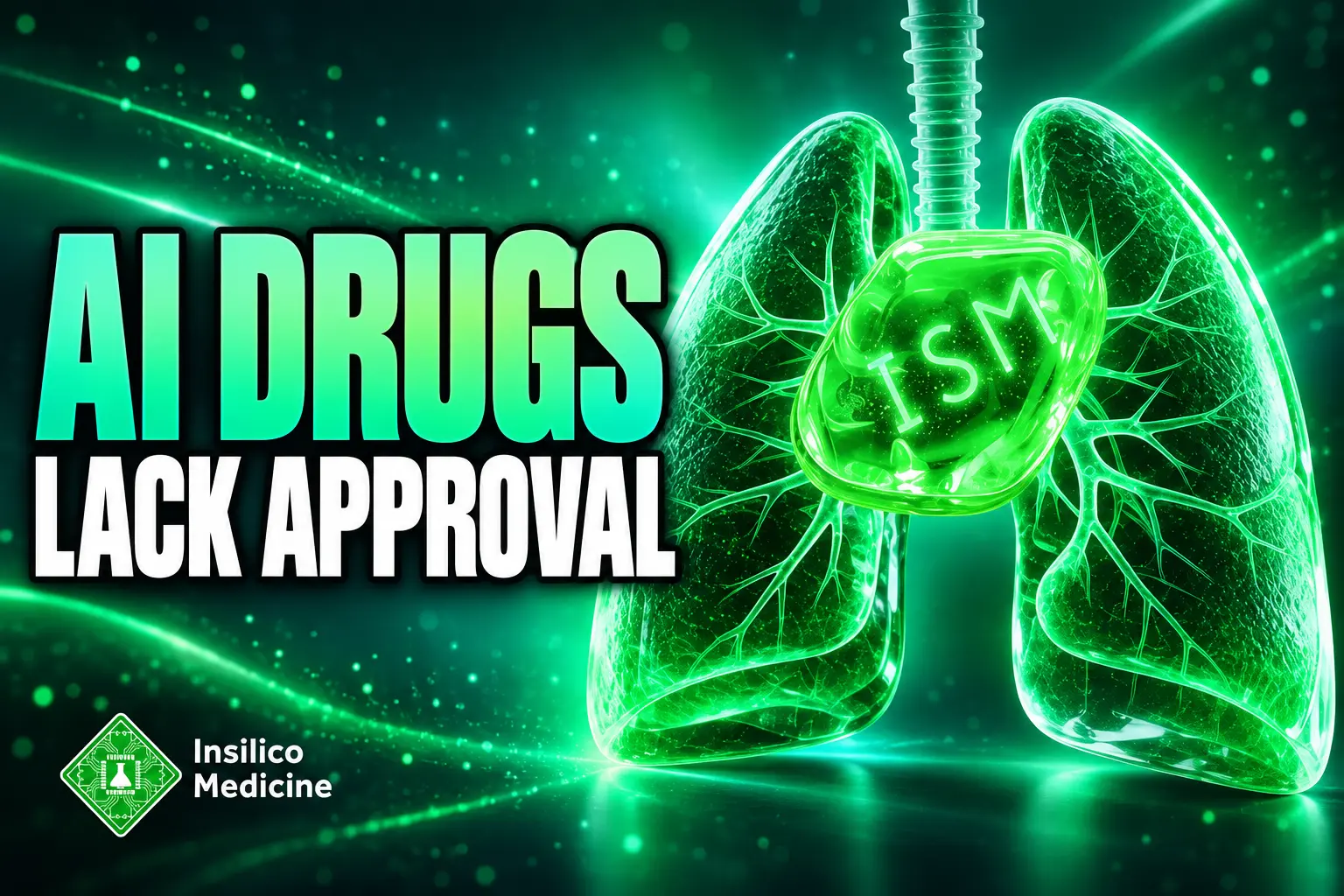
Where the algorithms do look different is the first time a compound meets a human liver and a human gut. Analyses in Drug Discovery Today, repeated through 2026 pipeline reviews, put AI-discovered molecules at an 80 to 90 percent Phase I pass rate against a historical average near 52 percent. That is a real preclinical win: fewer toxic surprises, cleaner pharmacokinetics, less waste before anyone asks whether the drug works.
Phase II is where efficacy lives, and that is where the advantage fades. The same reviews put AI Phase II success around 40%, in line with traditional small molecules. The Nature Medicine authors said it in plain language: AI-discovered drugs have seen similar levels of Phase 2 failure as the rest of the industry, and as of that paper none had gone through Phase 3. Tools for literature, docking, and lab notes keep getting better, including Anthropic’s Claude science workbench for drug discovery, and they still stop at the clinic door.
| Stage | Traditional benchmark | AI-discovered (early samples) |
|---|---|---|
| Phase I | About 40 to 65 percent, ~52 percent in one widely cited average | 80 to 90 percent |
| Phase II | About 29 to 40 percent | About 40 percent |
| Full FDA approval, August 2026 | CDER’s ordinary novel-drug flow | Zero end-to-end AI-discovered labels |
The translation problem showed up early at BenevolentAI. BEN-2293, a Pan-Trk inhibitor for atopic dermatitis that the company advanced with AI-assisted targeting and chemistry, missed both EASI and NRS primary endpoints in Phase IIa on April 5, 2023. One failed cream does not indict a field. It does show where the $8.9 billion was not spent: on the messy work of patient mix, endpoint choice, and human biology that no model fully owns.
What Rentosertib’s Phase IIa Measured
The candidate carrying the sector’s hopes is a TNIK inhibitor for IPF, a scarring lung disease with median survival often put at two to four years after diagnosis. Insilico says current antifibrotics slow decline and do not reverse it. The randomized phase 2a trial in Nature Medicine is the first peer-reviewed efficacy look at a drug whose target and structure were both generated with AI, and the details matter more than the press-release FVC headline.
GENESIS-IPF, 12 WEEKS
- Who enrolled: 71 of 128 screened patients, randomized to 30 mg once daily, 30 mg twice daily, 60 mg once daily, or placebo (n = 18, 18, 18, 17).
- Primary endpoint: Share of patients with at least one treatment-emergent adverse event, not lung function. Rates were 72.2, 83.3, 83.3, and 70.6 percent, similar across arms.
- The FVC number: At 60 mg once daily, mean forced vital capacity rose +98.4 mL (95 percent CI 10.9 to 185.9) versus -20.3 mL (CI -116.1 to 75.6) on placebo. That interval barely clears zero.
- Dropouts: 16 patients (22.5 percent) stopped early; six of 18 left the high-dose arm. The paper tied the most common discontinuations to liver toxicity or diarrhea.
- Geography: 22 sites, all in China. An earlier Insilico topline had put the placebo FVC change at -62.3 mL; the journal number is -20.3 mL.
Safety was the question the trial was built to answer, and it answered it well enough to go on. The lung-function signal is a secondary finding in a small, short, single-country study. IPF trials that change practice run longer and larger than 12 weeks and 18 people on the top dose. Anyone treating Phase IIa as proof that generative chemistry solved fibrosis is reading a safety study as a launch.
Insilico’s 320-Patient Trial Is the Sector’s Exam
On July 7, 2026, the company said it had opened a 320-patient, 52-week Phase III study of once-daily rentosertib versus placebo. Leading PI is Professor Zuojun Xu of Peking Union Medical College Hospital; co-leads include Academician Nanshan Zhong and President Chang Chen of Shanghai Pulmonary Hospital. Insilico, listed in Hong Kong as 3696, issued the note from Cambridge, Massachusetts. The pivotal work is China-led.
Feng Ren, Insilico’s co-CEO and chief scientific officer, has been careful to separate this program from “screen more compounds against a known kinase” work. Carol Satler, who runs non-oncology clinical development, described the next hurdle without decoration.
The Phase III study is designed to determine whether the safety profile and lung-function signal observed in Phase IIa can translate into clinically meaningful benefit for patients with IPF.
Carol Satler, MD, PhD, Senior Vice President for Clinical Development, Non-Oncology, Insilico Medicine, July 7, 2026 announcement
Alex Zhavoronkov, Insilico’s founder and CEO, called the start the first time an AI shop had taken a novel target and a novel generative molecule into Phase III, and he listed 13 INDs, eight Phase I trials, three Phase II trials, and this one Phase III. He also said luck is the most important superpower in the work, which is a more honest sentence than most investor decks.
Hello, my dear friends, we have some breaking news today! Our rentosertib (novel target that has never been in clinical trials before we picked it using AI, novel molecule designed using true generative AI with the published broadly used AI platform, targeting fibrosis and… pic.twitter.com/STwFPy4h6j
— Alex Zhavoronkov, PhD (aka Aleksandrs Zavoronkovs) (@biogerontology) July 7, 2026
A 52-week trial that began in July 2026 does not produce a 2026 FDA decision, orphan designation or not. Chemistry cut the front of the calendar. The back of the calendar still runs in clinic years.
Investors Sent Another $11 Billion in 2025
If the empty FDA column were already a reckoning, 2025’s ledgers would show it. They do not. DealForma, the biopharma deal database, counted 348 rounds that raised $11 billion for AI-ML discovery and licensing last year, up from 264 rounds and $8.9 billion in 2024. Across the two years that is 612 rounds and about $19.9 billion. Partnership headlines grew faster than the venture line: 114 discovery and licensing deals with $43.4 billion in potential value in 2025, against 84 deals and $11.8 billion in 2024, almost all of that value sitting in milestones rather than cash on signing.
| Year | Venture rounds | Venture total | R&D partnership deals | Potential partnership value |
|---|---|---|---|---|
| 2024 | 264 | $8.9 billion | 84 | $11.8 billion |
| 2025 | 348 | $11.0 billion | 114 | $43.4 billion |
Isomorphic Labs, the Alphabet-backed shop built around AlphaFold-style design, took a $600 million Series A in March 2025. Pathos AI raised $365 million at about a $1.6 billion post-money valuation. Recursion closed its purchase of Exscientia in late 2024 and folded two platform stories into one ticker. Large pharma is still buying optionality, the right to watch a platform work without rebuilding clinical development around it, and that includes Bayer’s Iambic AI discovery partnership. The checks keep clearing because discovery speed is visible and approval is not yet the metric the term sheets use.
Jascayd Reached IPF Patients First
While AI-IPF decks circulated, CDER kept approving ordinary novel drugs. The agency’s own list shows 46 novel drugs CDER approved in 2025. On October 7, 2025, number 33 on that list was Jascayd, nerandomilast, for idiopathic pulmonary fibrosis. A non-AI fibrosis pill reached U.S. patients while rentosertib was still a 12-week China study in a journal.
That is the comparison the hype cycle skips. IPF already had nintedanib and pirfenidone; it now has another approved small molecule. Insilico’s own note says IPF affects about 5 million people worldwide and that approved antifibrotics slow the disease without stopping it. A faster discovery engine has to beat that standard in a year-long trial, not in a slide about 18-month candidate nomination. Orphan designation from February 2023 lowers some U.S. burdens. It does not replace a second region, a larger N, or a 52-week FVC curve that holds up.
One Orphan Path Cannot Carry a Sector
The first AI-discovered approval, when it comes, will be treated as a sector event. Bankers will put it in every deck. It will prove that one platform, in one indication, assembled a package one review team would accept. Rentosertib is the closest fully generative case, and it is an orphan fibrosis program whose only randomized human data so far are 71 people and a safety primary. That is a narrow exam for a commercial story that needs large chronic diseases, standard evidence, and more than one geography.
Combinatorial chemistry and high-throughput screening went through a similar stretch in the 1990s: millions of compounds, loud promises to shrink the 10-to-14-year path, then a decade of thin pipelines. The FDA and EMA’s ten guiding principles on good AI practice, issued jointly on January 14, 2026, are still principles, not a form you file. Documentation, data provenance, and model versioning will matter when a sponsor actually sits in front of a review division. They are not why the approval count is still zero this month.
The count is zero because the molecules are young. The harder figure is already on the table: Phase II still looks like everyone else’s Phase II. Rentosertib’s 320 patients will take 52 weeks of drug before anyone can read the curve.
Disclaimer: This article is news reporting and analysis of public trial results, company statements, and deal data. It is informational only and is not medical advice, investment advice, or a recommendation to start, stop, or change any therapy or to buy or sell any security. Readers making health decisions should consult a qualified physician; readers making capital decisions should consult a licensed financial adviser. Figures, trial statuses, and financing totals reflect the cited sources as of August 24, 2026, and will change as trials read out and as DealForma, FDA, and company filings are updated.

Instagram Plus Tests a Read-Only Mode That Cuts Stories

Altman Asks the Public to Accept Some AI Harm

Google Freezes OSS VRP Product Reports After AI Flood

AI Agents Make Payment Rails the Scarce Prize

Turkey’s Crypto Boom Now Runs Through Three Banks

Fable 5 Came Back Under a Commerce On-Off Switch

Google’s SpaceX GPU Lease Has a Sept. 30 Deadline

Plasma One’s XPL Locks Face a 1.81 Billion Cliff

DGO’s Rs 549 World Cup Pass Cost Fans Sleep and Data

Moonshot AI’s $30 Billion Ask Became a $35 Billion Close
-
 AI4 months ago
Fable 5 Came Back Under a Commerce On-Off Switch
-
 AI4 months ago
Google’s SpaceX GPU Lease Has a Sept. 30 Deadline
-
 CRYPTO4 months ago
Plasma One’s XPL Locks Face a 1.81 Billion Cliff
-
 APPS4 months ago
DGO’s Rs 549 World Cup Pass Cost Fans Sleep and Data
-
 AI4 months ago
Moonshot AI’s $30 Billion Ask Became a $35 Billion Close
-

 NEWS4 months ago
ColorOS 17 Device List Spans Oppo, OnePlus and Realme
-

 GAMING4 months ago
Xbox Cuts 3,200 Jobs After Five Years of Thin Returns
-

 GAMING4 months ago
The RTX 4050 Under Rs 70,000 Hides a Wattage Gap