
AI
Google’s AI Opt-Out Cracks Its Web Data Edge
UK rules and Cloudflare defaults force Google to let sites block AI use of content without losing search rank, but bots already dominate traffic.

Google is testing a setting that lets websites block their content from AI answers while staying in regular search results, and it plans a worldwide rollout after UK trials. The move follows a hard order from the UK’s Competition and Markets Authority and a looming Cloudflare default that will treat mixed search-and-AI crawlers as blockable on ad-supported pages.
The dual-use Googlebot that feeds both the search index and Gemini-class products has long given the company wider web access than rivals. That edge is now under direct pressure just as automated traffic has overtaken human visitors for the first time.
How Googlebot Bundled Search and AI Access
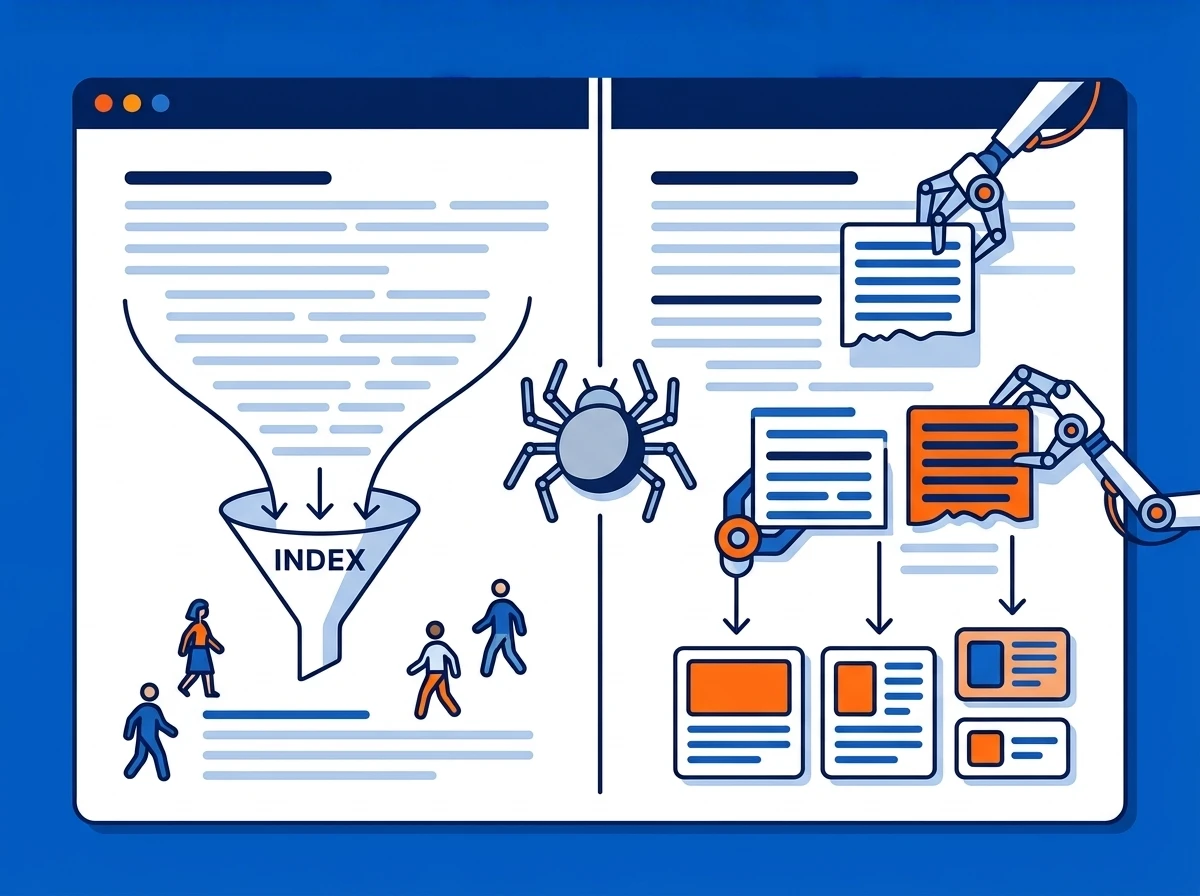
For years the bargain was simple. Sites let Googlebot crawl freely. Google sent readers back. AI changed the math. The same crawler now supplies training data and live grounding for AI Overviews and AI Mode. Publishers who want to stay visible in search have struggled to keep their pages out of the AI path.
Cloudflare CEO Matthew Prince has quantified the resulting advantage. Googlebot sees 3.2 times more of the web than OpenAI’s crawler and 4.8 times more than Microsoft’s. That gap exists because many sites cannot block the AI side without risking the search side.
| Crawler operator | Relative web visibility (Cloudflare data) | Primary noted purpose mix |
|---|---|---|
| 3.2× OpenAI / 4.8× Microsoft | Search + AI features + training | |
| OpenAI | 1× baseline | Mostly training / agent |
| Microsoft | ~0.2× Google | Search + some AI |
The visibility gap is structural rather than accidental. A publisher that needs classic rankings has had little choice but to accept the full Googlebot package, training data and live AI grounding included. Rivals that run narrower crawlers simply never see those pages.
Internal Google slides from the 2024 antitrust record, cited in the original reporting, showed the company considered a clean opt-out before launching AI Overviews and then set it aside because the space was “evolving into a space for monetization.”
That internal choice locked in the bundled model for the launch window. The CMA order and the Cloudflare defaults now force the question back onto the table under external deadlines rather than internal product calendars.
The UK Order That Forced a Choice
On 3 June 2026 the CMA imposed a conduct requirement after designating Google with strategic market status in general search. The rules require world-first publisher AI opt-out tools. Sites must be able to keep their pages out of AI features such as AI Overviews while remaining fully ranked in classic results. Google cannot punish the choice by demoting them.
Today, we have introduced a world-first requirement on Google’s search services in the UK, enabling fair treatment, greater transparency and meaningful choice for businesses and consumers.
Sarah Cardell, CMA chief executive, said the measures also demand clear links and attribution inside AI-generated answers and an opt-out from fine-tuning of models. Google has nine months to finish the full package, though key controls were expected earlier.
The same day Google published its response. It is testing a new Search Console toggle for generative AI features (AI Overviews, AI Mode, Discover). Opting out means the site stops appearing in those experiences and loses the associated impressions and clicks. The toggle “will not be used as a ranking signal for search results outside of these generative AI Search features.” UK sites go first; global availability follows the test.
The nine-month clock and the same-day product response show how tightly the regulatory order and the engineering schedule are now linked. Publishers gain a dashboard control, yet they still depend on Google’s assurance that the setting stays invisible to the classic ranking systems.
Cloudflare’s September Defaults Raise the Stakes
Cloudflare, which sits in front of roughly one-fifth of the web, moved next. On 1 July it announced that from 15 September 2026 its defaults will change for new domains, free customers and many existing ones. Training and Agent crawlers will be blocked by default on pages that carry ads. Search remains allowed.
Mixed-purpose crawlers that combine search with training or agents will be judged by their most restrictive behavior. That puts Googlebot, Applebot and Bingbot squarely in the firing line for any customer who enables the training block. Site owners can override the defaults, but the new baseline flips the old honor system.
- 1 July 2026, Cloudflare publishes new taxonomy and announces September defaults plus Pay Per Use evolution.
- 15 September 2026, Defaults activate: Training and Agent blocked on ad pages; multi-purpose bots inherit the strictest rule.
- Ongoing, BotBase visibility tools roll to enterprise; content-use signals expand in robots.txt.
The company frames the change as enforcement of transparency. A bot that does search, agent work and training should run as three separate crawlers so owners can choose. The September 15 defaults on mixed-purpose crawlers are designed to make that separation the path of least resistance.
Because the rule fires at the network edge, the block happens before the request reaches the origin. That mechanical difference matters for any publisher that no longer wants to rely solely on a crawler operator’s dashboard promise.
Bots Already Outnumber People Online
The pressure arrives after a historic crossover. Cloudflare Radar data showed bots generating 57 percent or more of web requests against roughly 43 percent human. Prince posted the milestone on 3 June with more than two million views: agentic traffic grew faster than he had predicted for late 2027 or early 2027.
- 57%+ of measured requests now automated
- 52% of crawler requests aimed at AI training as of June 2026 (up from 22% a year earlier)
- 36%+ of crawler activity still mixed-use
- Pure search crawling a shrinking share
In the companion report Cloudflare notes that for every hour people spend searching, only about 15 minutes is spent on the open web itself. AI answers and agents collapse the visit. The old referral model is breaking across news, retail, software and finance. Some categories have seen human traffic drop 40 percent in under a year.
That is the second-order reality. Even if every publisher gains a clean opt-out tomorrow, the machines are already the majority audience. Original work still gets scraped, summarized and reused; the human who might have clicked through and paid the bills appears less often.
The mix inside the crawler share sharpens the point. Training already accounts for more than half of crawler requests, and mixed-use traffic still exceeds a third. Pure search is the residual category, not the dominant one.
What the New Controls Deliver
Publishers now have more levers than a year ago. The practical toolkit looks like this:
- Google Search Console generative-AI toggle (UK test, then global), keep classic rankings, leave AI experiences
- Cloudflare per-use classification (Search / Agent / Training) with ad-page defaults
- Managed robots.txt and content-use signals (immediate / reference / full)
- Pay Per Crawl marketplace evolving into Pay Per Use so value created, not just fetches, can be charged
- Attribution and impression reporting inside AI answers (CMA-mandated clarity)
These tools create scarcity and negotiating leverage. Cloudflare reports more than 50 publisher-AI licensing deals since 2023 and a growing market for paid access. Yet the core Google problem remains trust. The same bot still fetches the page; the company simply promises to honor the setting. Full technical separation into distinct crawlers would let owners block at the door without relying on that promise.
Crowd reaction on X and in publisher circles has been wary. The opt-out is real on paper, but many note the missing performance data that would let them judge traffic impact before flipping the switch. Some see the Cloudflare defaults as the sharper instrument because they operate at the network edge rather than inside Google’s dashboard.
The Original Bargain No Longer Holds
Google still holds roughly 90 percent of search. That gateway status made the bundled crawler almost irresistible. Sites needed the readers; Google needed the corpus. AI Overviews and AI Mode turned the corpus into answers that often satisfy the query without the click. Google says the features drive more overall searches and include prominent links and Preferred Sources. Publishers counter that referral volumes have collapsed in key verticals.
The company’s AI leadership has tightened under Sundar Pichai even as research and product lines shifted. Recent moves including Pichai’s consolidation of Google AI leadership and the DeepMind split from day-to-day AI ops show how central the models have become to the core search business. The crawler that feeds them sits at the foundation of that strategy.
Prince and others argue humans risk becoming “a rounding error” next to their agents. Meta’s planned consumer agents for Messenger, WhatsApp and Instagram will only accelerate the shift. Useful bots are not the problem. An internet that no longer rewards the people who write the original pages is.
Two Paths Create Uneven Publisher Leverage
The Google toggle and the Cloudflare defaults address the same complaint from opposite directions. One lives inside the search company’s own console. The other lives on the network in front of the origin server.
| Control | Where it runs | Search treatment | AI treatment | Enforcement style |
|---|---|---|---|---|
| Search Console generative-AI toggle | Google dashboard | Classic rankings preserved by promise | Removed from AI Overviews, AI Mode, Discover | Operator honor system |
| Cloudflare September defaults | Network edge (about one-fifth of the web) | Search crawlers still allowed | Training and Agent blocked on ad pages; mixed bots take the strictest rule | Technical block before origin |
Publishers that enable both tools still confront a residual gap. Googlebot remains a single dual-use agent until the company splits it. Cloudflare can refuse the mixed crawler at the edge, yet any site outside that network still depends on the dashboard setting alone.
The missing performance data noted by publishers compounds the unevenness. Without clear before-and-after numbers on impressions and clicks, the decision to flip either switch stays partly blind.
Licensing Markets Begin to Fill the Gap
Scarcity is already producing contracts. Cloudflare’s count of more than 50 publisher-AI licensing deals since 2023 shows that paid access is no longer theoretical. The shift from Pay Per Crawl toward Pay Per Use tries to price the value extracted, not merely the raw fetch.
Those deals sit alongside the new technical levers rather than replacing them. A site that can block training by default or opt out of AI Overviews holds a stronger hand when the next licensing conversation opens. The reverse is also true: a site that remains fully open to every mixed crawler has less reason to be paid.
- Blocking tools create the scarcity that makes a license worth buying
- Attribution rules from the CMA raise the visibility of unpaid reuse
- Pay Per Use schemes attempt to meter value after the fetch
None of these pieces scales overnight. They do, however, move the conversation from pure honor-system access toward measurable exchange.
Why a Clean Crawler Split Still Matters Most
The opt-out toggle and the Cloudflare defaults are genuine progress. They give sites a choice the 2024 slides denied them and they raise the cost of opaque mixed crawling. Google’s confirmation that the UK test will expand globally is a direct result of the CMA order and the infrastructure ultimatum.
Yet the second-order effect is already visible in the traffic numbers. When machines generate the majority of requests and AI training dominates crawler purpose, the economic engine of the open web needs new fuel. Licensing markets and pay-per-use schemes are early answers. They will not scale overnight.
A fully separated Googlebot pair, one for indexing that respects classic discovery, one for AI that can be blocked or charged at the edge, would restore the clearest signal. Until then, publishers must trust Google’s dashboard settings and Cloudflare’s network rules while watching referral lines continue to thin. The September deadline will show how many sites choose the new defaults and how quickly the largest search company responds with true technical separation.
The web’s original deal is being rewritten in real time. Choice has arrived. Whether human creators still get paid for the work that trains the machines remains the open question the numbers are already answering.


South Korea Retail Investors Face Reckoning After KOSPI AI Rally Collapses

Surrey AI Maps Three Heart Attack Paths and Their Molecular Roots

Germany Locks Neutral Apple ATT Prompts Across Most of Europe

Apple’s 5% EU Fee Quietly Rewrites Alternative App Store Math

Apple’s EU Fee Truce Cuts Complexity but Leaves Rivals Fuming

Pixel 11 Pro Fold Trades Thinness for Durability and Seven-Year Stay

Mayo AI Flags HCM Obstruction From Everyday Ultrasound Videos

Indian Brands Quietly Scale Landmark Screens and Home Tech

Navin Vatsa Turns Grief Into a Lifetime of Quiet Seeing

Google Bets Pixel 11 Agentic AI Will Redefine Phones

Oracle Cuts 21,000 Jobs in a Year, Cites AI in 10-K Filing

Fable 5 and Mythos 5 Return as US Lifts Anthropic Export Controls

SpaceX’s Google Deal Turns a Rocket Company Into a Cloud Landlord

CD Projekt Red Co-CEO: Redemption Arc Isn’t Done, Witcher 4 in 2027

XPL Rallies 30% Ahead of Plasma One Card Tier Launch

Google Search Profiles Build a Follow Graph Inside Discover

DGO App Brings Rs 549 Mobile Pass for FIFA World Cup 2026 in Nepal

Moonshot AI Targets $30 Billion in China’s Fastest AI Funding Sprint

Oppo’s ColorOS 17 Eligibility List Leaves A-Series Buyers Behind

Microsoft Xbox Layoffs Start in July as Sharma Slams 3% Margin
-
 AI2 months ago
Oracle Cuts 21,000 Jobs in a Year, Cites AI in 10-K Filing
-
 AI2 months ago
Fable 5 and Mythos 5 Return as US Lifts Anthropic Export Controls
-
 AI3 months ago
SpaceX’s Google Deal Turns a Rocket Company Into a Cloud Landlord
-
 GAMING2 months ago
CD Projekt Red Co-CEO: Redemption Arc Isn’t Done, Witcher 4 in 2027
-
 CRYPTO3 months ago
XPL Rallies 30% Ahead of Plasma One Card Tier Launch
-
 NEWS3 months ago
Google Search Profiles Build a Follow Graph Inside Discover
-
 APPS3 months ago
DGO App Brings Rs 549 Mobile Pass for FIFA World Cup 2026 in Nepal
-
 AI3 months ago
Moonshot AI Targets $30 Billion in China’s Fastest AI Funding Sprint