
AI
Dr Gunilla Burrowes Wins 2026 Ada Lovelace Medal, Calls for AI Ethics
Dr Gunilla Burrowes wins the 2026 UNSW Ada Lovelace Medal and calls on engineers to ask what AI should do for humanity, beyond what it can already do.

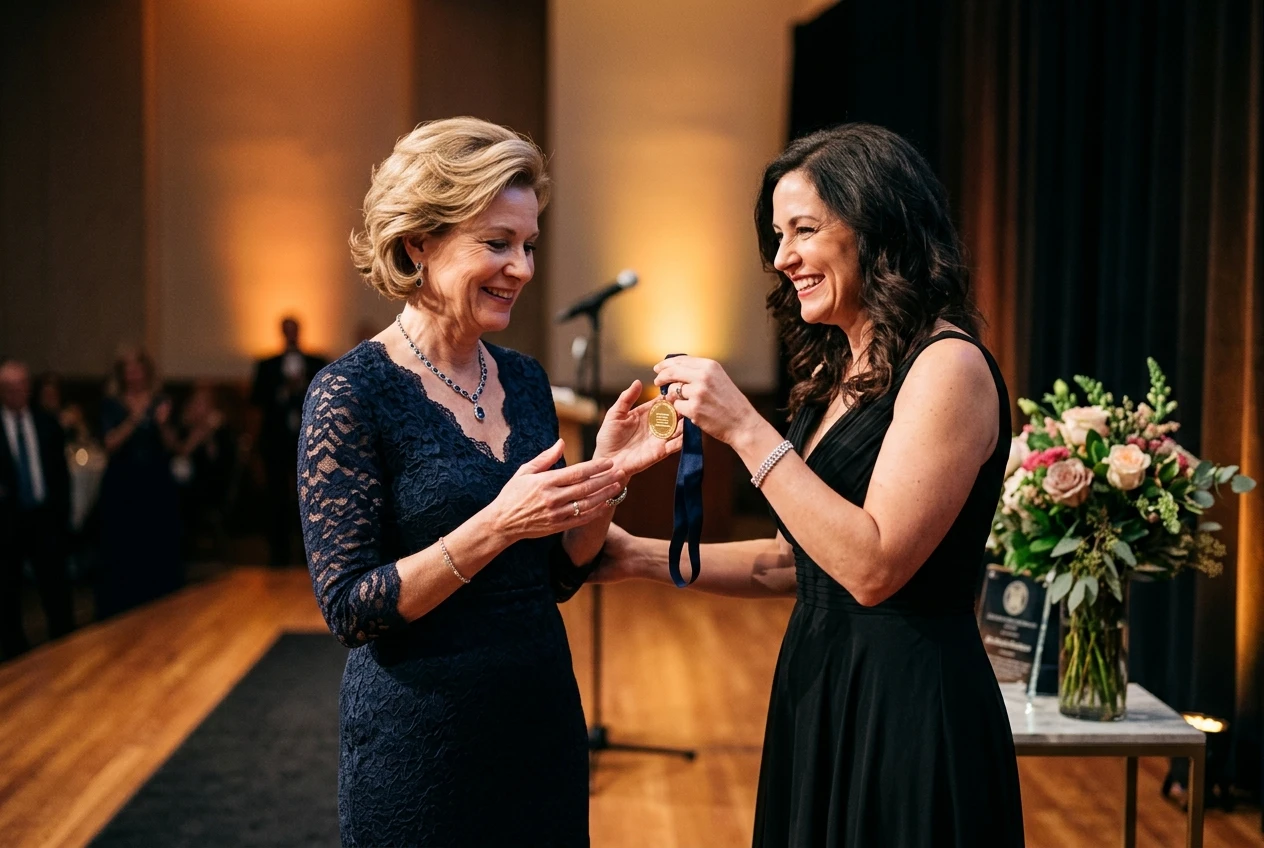
The 2026 Ada Lovelace Medal for Outstanding Engineer has been awarded to Dr Gunilla Burrowes, Chair of the NSW Division of the Australian Academy of Technological Sciences and Engineering. UNSW Engineering presented the medal at its annual Women in Engineering Alumni Awards, where Burrowes used her acceptance speech to draw a line from Ada Lovelace’s 19th-century leap from numbers to symbols to a present-day question she says engineers can no longer avoid: what AI should be doing for humanity. Rebecca Cook, the 2025 winner, presented the medal to Burrowes on stage at this year’s ceremony.
Burrowes is an electrical engineer with a doctorate in underwater swarm sensor networks, and her 40-year career has spanned renewable energy, deep-technology innovation, and gender equity in STEM. She co-founded BlueZone Group, an engineering firm specialising in autonomous underwater systems and marine innovation, and later established Eighteen04 Inc., described in the UNSW release as the nation’s first CleanTech and Smart City incubator. Through investment, mentorship, and governance, she has supported more than 50 technology ventures. The medal, created by UNSW Engineering in 2016, sits alongside the Judy Raper Award for Leadership, the Maria Skyllas-Kazacos Young Professional Award for Outstanding Achievement, and the Inspiring Student Award.
Forty Years in Three Parallel Careers
The UNSW press release on the 2026 medal opens with a single line that compresses an unusually wide career into a list of four fields: renewable energy, deep-technology innovation, entrepreneurship, and diversity in STEM. Read closely, those four fields are not parallel so much as three careers running alongside each other inside the same professional life. The Australian Academy of Technological Sciences and Engineering, where Burrowes now chairs the NSW Division, names the same three strands: underwater communication technology, industry innovation, and gender equity, per the NSW Division chair profile.
The first career starts at BP Solar, where Burrowes contributed to the deployment of some of Australia’s earliest photovoltaic systems. The second is built around autonomous machines underwater: she co-founded BlueZone Group, an engineering firm specialising in autonomous underwater systems, sensing technologies, and marine innovation, and her doctoral research in autonomous underwater vehicle swarming advanced Australia’s capability in marine autonomous systems engineering. The third is the work of standing up infrastructure around the people who build those things: after the Hunter region’s industrial transition, she co-founded one of Australia’s first regional angel investment networks and established Eighteen04 Inc., described in the UNSW release as the nation’s first CleanTech and Smart City incubator. Eighteen04’s own committee biography for the medal winner adds a fourth venture to the list, Gender Matters, a consultancy addressing unconscious bias in decision-making.
Engineers Australia’s Year of Women in Engineering is the umbrella under which much of her diversity work has run. The Eighteen04 committee page also lists her directorships with SmartCrete CRC and the Blue Economy CRC.
- 40 years in engineering, per the UNSW release
- Doctorate in Underwater Swarm Sensor Networks
- Co-founder of BlueZone Group, an autonomous underwater systems firm
- Co-founded one of Australia’s first regional angel investment networks
- Established Eighteen04 Inc., described as the nation’s first CleanTech and Smart City incubator
- More than 50 technology ventures supported through investment, mentorship, and governance
- Led Engineers Australia’s Year of Women in Engineering
- Co-founder of Gender Matters, a consultancy addressing unconscious bias in decision-making
- Current Chair (NSW Division), Australian Academy of Technological Sciences and Engineering
Burrowes has held directorships with SmartCrete CRC and the Blue Economy CRC, the Eighteen04 committee page notes. The release adds that she has continued to mentor and support future generations of engineers and innovators. ATSE, where she now chairs the NSW Division, brings the parallel strands back together under three labels: underwater communication technology, industry innovation, and gender equity.
She now chairs the NSW Division of ATSE. Burrowes’s 40-year arc has run through utility-scale solar, autonomous underwater vehicles, and clean-tech venture infrastructure in roughly equal measure. The 2026 medal cites that combination of work as the reason for the award. The UNSW release credits her with supporting more than 50 technology ventures through investment, mentorship, and governance.
What Lovelace Saw, and What Burrowes Says Engineers Must Now Ask
The medal is named for Augusta Ada Byron, later Countess Ada Lovelace, the English mathematician widely regarded as the first computer programmer for her work on Charles Babbage’s Analytical Engine. UNSW Engineering created the award in 2016 to honour women engineers whose work creates impact and serves as a role model for the next generation.
Burrowes opened her acceptance speech at the place where Lovelace started, on the moment when Lovelace looked at Babbage’s mechanical general-purpose computer and refused to see it as only a faster calculator. Lovelace “thought about what if we could replace the numbers they were using at the time with symbols, and how we could actually solve problems far beyond just mathematical problems,” Burrowes said. “So she saw possibilities.”
I am deeply honoured to receive this award, and I especially love the fact that it is the Ada Lovelace Award, because she was somebody who inspired me from the very first day I entered engineering. Ada not only recognised what the analytical engine that Charles Babbage had invented, and became the first computer programmer, but she actually documented the idea that it could be a lot more than that. She thought about what if we could replace the numbers they were using at the time with symbols, and how we could actually solve problems far beyond just mathematical problems. So she saw possibilities. It seems fitting to reflect on the fact that today we are seeing the beginning of the AI era. We have this extraordinary technology before us, and it’s kind of scary to think that we really no longer can simply ask the question about what AI can do, but maybe consider what AI should be doing. And I think that it is the responsibility of engineers to have that wisdom, that courage to ask the questions of what AI really needs and should do for humanity now.
Dr Gunilla Burrowes, accepting the 2026 UNSW Ada Lovelace Medal for Outstanding Engineer at the Faculty of Engineering’s Women in Engineering Alumni Awards, per the UNSW press release. The speech places Lovelace’s 19th-century leap from numbers to symbols alongside what Burrowes calls the start of the AI era. Burrowes’s framing hands the harder half of the question to engineers, calling on the profession to have the wisdom and the courage to ask what AI should be doing for humanity now. Studies of daily AI use in the same period have tracked what daily AI use does to memory and critical thinking, a related line of concern raised from a different angle.
The Other Three Honours, and the Cohort That Filled Them
The Ada Lovelace Medal was one of four honours presented at the 2026 Women in Engineering Alumni Awards. UNSW describes its Faculty of Engineering as by far the nation’s largest, and frames the awards as part of an ongoing commitment to attract more women to the profession and support a more inclusive engineering community. The 2025 medal winner, Rebecca Cook, presented the award on stage at this year’s ceremony, per the full 2026 awards press release.
The 2026 cohort spans the widest possible arc of an engineering life, from current UNSW students to a member of the European Space Agency astronaut reserve. The Judy Raper Award honouree could not attend in person, sending a video message that cited UNSW’s Engineering Ambassadors and Revues, the Co-Op program, and Yellow Shirts as the formative activities of her degree. That speaker was one of 17 selected for the European Space Agency’s 2022 astronaut class from more than 22,500 European applicants and has undertaken two missions, including a winter-over, to Concordia Station in Antarctica, where she served as a research scientist in charge of atmospheric physics and meteorology. Dr Marlene Kanga AO delivered the keynote address at the ceremony, per the UNSW release.
| Award | 2026 Winner | Role |
|---|---|---|
| Ada Lovelace Medal for Outstanding Engineer | Dr Gunilla Burrowes | Chair (NSW Division), Australian Academy of Technological Sciences and Engineering |
| Judy Raper Award for Leadership | Dr Meganne Christian | Senior Exploration Manager (Commercial), UK Space Agency; ESA astronaut reserve |
| Maria Skyllas-Kazacos Young Professional Award for Outstanding Achievement | Aishwarya Jha | Senior Electrical Engineer, Jacobs |
| Inspiring Student Award | Hayley Jiang and Sarah Muller (joint) | UNSW Chemical Engineering student; UNSW Space Systems Engineering postgraduate |
Professor Julien Epps, Dean of UNSW Engineering, framed the year’s winners as a reminder “of the importance of continuing to build an engineering profession where everyone can thrive.” Burrowes’s award is the centrepiece of the 2026 cycle, with the other three honours going to a current UK Space Agency senior manager, a Jacobs senior electrical engineer, and two UNSW students.
Special recognition in the Judy Raper Award category went to Jo-Anne Dudley, principal consultant at Miner Ventures Pty Ltd, and Turia Pitt, founder of Turia Pitt International. The Maria Skyllas-Kazacos Young Professional Award winner was unable to attend and recorded a video message, per the release. The two Inspiring Student Award winners received their prizes from The Hon. Jodie Harrison MP, NSW Government Minister for Women, Minister for Seniors, and Minister for the Prevention of Domestic Violence and Sexual Assault.
Why Engineers, Not Their Systems, Get the AI Question
The AI question Burrowes placed at the centre of her acceptance speech lands at a moment when the engineering workforce is being reshaped around the technology. The same period has seen the layoffs, petition, and risks from a $145B AI build-out at one major tech employer. Professor Rita Henderson, Deputy Dean (Societal Impact and Translation) at UNSW’s Faculty of Engineering and a member of the 2026 selection committee, took the same line into a different register from the podium. Henderson framed the awards as more than recognition, calling them “a way of making excellence visible and showing what becomes possible when talent is supported, included and celebrated.”
Equity, diversity and inclusion are essential to the future of engineering because the challenges our profession is asked to solve affect every part of society. We need teams that bring different experiences, perspectives and ways of thinking to that work.
Professor Rita Henderson, Deputy Dean (Societal Impact and Translation) at UNSW’s Faculty of Engineering and a member of the 2026 selection committee, per the UNSW press release. Henderson’s full statement also said that “UNSW Engineering has an important role to play in championing that change.” Burrowes’s own diversity work, including her leadership of Engineers Australia’s Year of Women in Engineering, is the engineer-side of the same argument Henderson made from the podium.
The Medal’s Predecessors, From 2016 Onwards
UNSW Engineering created the medal in 2016. The UNSW press release names four previous winners: Dr Mary O’Kane, then NSW Chief Scientist and Engineer; Kathryn Fagg, a board member of the Reserve Bank and Boral; Dr Judy Raper, a chemical engineer and former senior official at the U.S. National Science Foundation; and Rebecca Cook, Ground Terminal and Infrastructure Manager at Northrop Grumman Space Systems. The 2025 ceremony saw Cook receiving the medal from the year before’s winner, Joanna Groves, with Cook herself passing the medal to Burrowes at the 2026 event. The full list now spans Chief Scientists, Reserve Bank directors, a former senior U.S. NSF official, and a Northrop Grumman Space Systems manager.
Burrowes adds her own strand to that lineage. The UNSW release notes that she led Engineers Australia’s Year of Women in Engineering and continues to mentor and support future generations of engineers and innovators. ATSE, where she now chairs the NSW Division, lists her three recognitions as underwater communication technology, industry innovation, and gender equity.
The medal that arrived at this 2026 ceremony is named for a 19th-century mathematician who insisted on asking what a machine could become, beyond what it could calculate. Burrowes used her acceptance speech to put the same question to the engineering profession at the start of the AI era.
Frequently Asked Questions
Who won the 2026 Ada Lovelace Medal?
Dr Gunilla Burrowes, Chair of the NSW Division of the Australian Academy of Technological Sciences and Engineering, was named the 2026 winner. She received the medal at the 2026 ceremony from the 2025 winner, Rebecca Cook, the Ground Terminal and Infrastructure Manager at Northrop Grumman Space Systems.
What did Dr Gunilla Burrowes say about AI in her acceptance speech?
Burrowes told the audience that engineers can no longer ask only what AI can do, and must consider what AI should be doing for humanity. Her full statement: “It seems fitting to reflect on the fact that today we are seeing the beginning of the AI era. We have this extraordinary technology before us, and it’s kind of scary to think that we really no longer can simply ask the question about what AI can do, but maybe consider what AI should be doing.”
Who was Ada Lovelace?
She was Augusta Ada Byron, later Countess Ada Lovelace, a 19th-century English mathematician whose notes on Charles Babbage’s Analytical Engine contained what is generally considered the first algorithm intended for a machine. UNSW Engineering named its medal for Outstanding Engineer after her in 2016.
What is the UNSW Women in Engineering Alumni Awards?
It is the annual awards programme of UNSW’s Faculty of Engineering, held each year to recognise women engineers whose work creates impact and serves as a role model for the next generation. The 2026 ceremony gave out four honours: the Ada Lovelace Medal for Outstanding Engineer, the Judy Raper Award for Leadership, the Maria Skyllas-Kazacos Young Professional Award for Outstanding Achievement, and the Inspiring Student Award.
Who won the other 2026 UNSW Women in Engineering Awards?
The Judy Raper Award went to a UNSW alumna who now serves as Senior Exploration Manager (Commercial) at the UK Space Agency and sits on the European Space Agency astronaut reserve, having been selected from a pool of more than 22,500 European applicants in 2022. The Maria Skyllas-Kazacos Young Professional Award went to a Senior Electrical Engineer at Jacobs specialising in high-voltage systems and utility connections. The Inspiring Student Award was jointly presented to two UNSW students.


South Korea Retail Investors Face Reckoning After KOSPI AI Rally Collapses

Surrey AI Maps Three Heart Attack Paths and Their Molecular Roots

Germany Locks Neutral Apple ATT Prompts Across Most of Europe

Apple’s 5% EU Fee Quietly Rewrites Alternative App Store Math

Apple’s EU Fee Truce Cuts Complexity but Leaves Rivals Fuming

Pixel 11 Pro Fold Trades Thinness for Durability and Seven-Year Stay

Mayo AI Flags HCM Obstruction From Everyday Ultrasound Videos

Indian Brands Quietly Scale Landmark Screens and Home Tech

Navin Vatsa Turns Grief Into a Lifetime of Quiet Seeing

Google Bets Pixel 11 Agentic AI Will Redefine Phones

Oracle Cuts 21,000 Jobs in a Year, Cites AI in 10-K Filing

Fable 5 and Mythos 5 Return as US Lifts Anthropic Export Controls

SpaceX’s Google Deal Turns a Rocket Company Into a Cloud Landlord

CD Projekt Red Co-CEO: Redemption Arc Isn’t Done, Witcher 4 in 2027

XPL Rallies 30% Ahead of Plasma One Card Tier Launch

Google Search Profiles Build a Follow Graph Inside Discover

DGO App Brings Rs 549 Mobile Pass for FIFA World Cup 2026 in Nepal

Moonshot AI Targets $30 Billion in China’s Fastest AI Funding Sprint

Oppo’s ColorOS 17 Eligibility List Leaves A-Series Buyers Behind

Microsoft Xbox Layoffs Start in July as Sharma Slams 3% Margin
-
 AI2 months ago
Oracle Cuts 21,000 Jobs in a Year, Cites AI in 10-K Filing
-
 AI2 months ago
Fable 5 and Mythos 5 Return as US Lifts Anthropic Export Controls
-
 AI3 months ago
SpaceX’s Google Deal Turns a Rocket Company Into a Cloud Landlord
-
 GAMING2 months ago
CD Projekt Red Co-CEO: Redemption Arc Isn’t Done, Witcher 4 in 2027
-
 CRYPTO2 months ago
XPL Rallies 30% Ahead of Plasma One Card Tier Launch
-
 NEWS3 months ago
Google Search Profiles Build a Follow Graph Inside Discover
-
 APPS2 months ago
DGO App Brings Rs 549 Mobile Pass for FIFA World Cup 2026 in Nepal
-
 AI3 months ago
Moonshot AI Targets $30 Billion in China’s Fastest AI Funding Sprint