
NEWS
Tiny Solar Vortices Supply the Missing Twist for Magnetic Energy
DKIST images and simulations confirm ubiquitous Kelvin-Helmholtz swirls that mix plasma and braid fields.

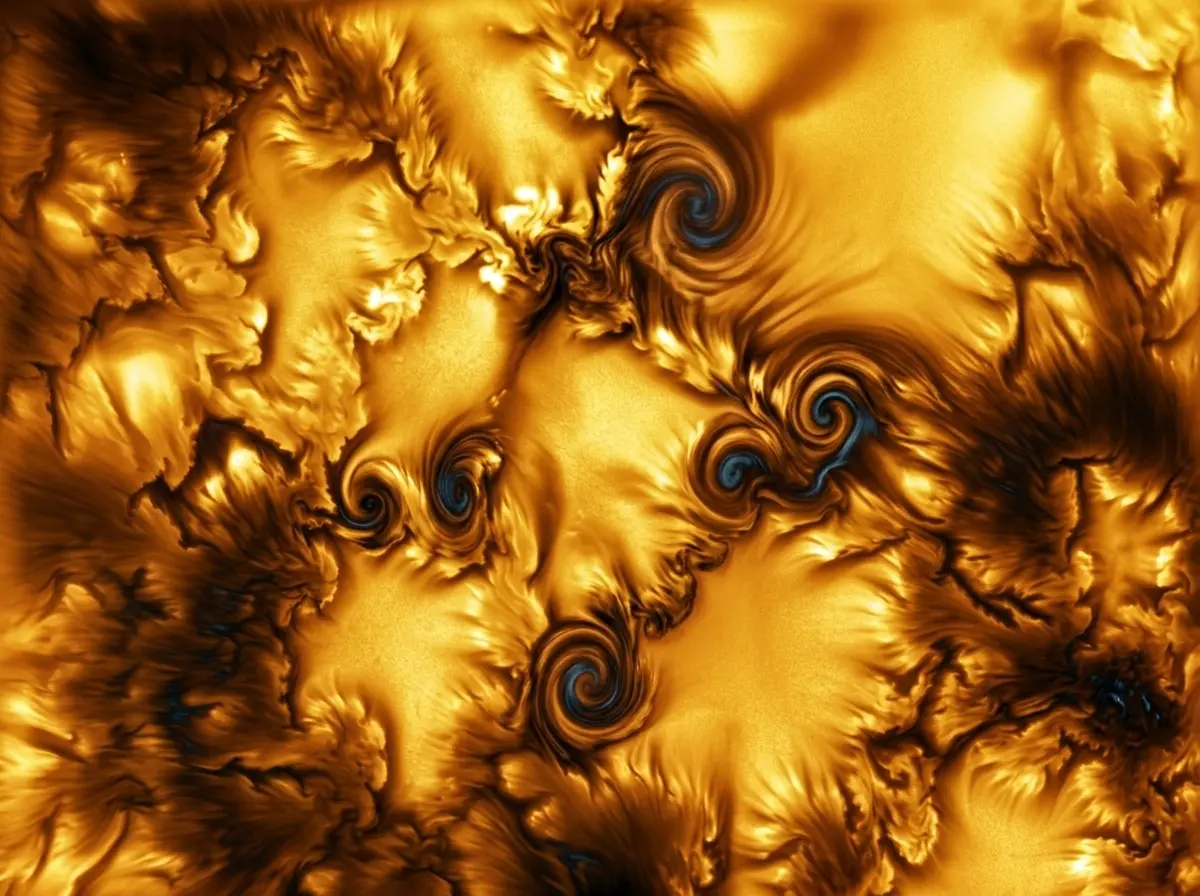
Scientists using the world’s largest solar telescope have resolved plasma vortices as small as 20 kilometers across on the Sun’s visible surface, the first direct view of a process long predicted by theory. The swirling features line the edges of granules and match high-resolution simulations of Kelvin-Helmholtz instability, offering a continuous mechanism that twists magnetic fields and mixes plasma.
The finding, published 5 August 2026 in Nature, comes from the NSF Daniel K. Inouye Solar Telescope in Hawaii paired with MURaM radiation-magnetohydrodynamic runs. It reframes how energy and magnetic flux move from the photosphere into the atmosphere.
The Sharpest Solar Surface View Ever Recorded
The observations targeted a magnetically active region near a sunspot (NOAA 14060) on 14 April 2025. At 416 nm the 4-meter aperture and adaptive optics system reached a spatial resolution of roughly 19 kilometers, near the telescope’s diffraction limit.
Previous instruments with apertures under 2 m left the interfaces between granules and magnetic flux concentrations looking smooth and blurry. DKIST images show those edges packed with vortex-like structures and fine striations.
- ~19 km diffraction-limited resolution at 416 nm
- 25-170 km measured vortex sizes, characteristic wavelength 65 km
- 0.014-0.054 s⁻¹ growth rates for prominent examples
- 0.67-3.0 km s⁻¹ apparent propagation speeds
Researchers from the NSF National Solar Observatory, Max Planck Institute for Solar System Research and High Altitude Observatory restored the data with advanced techniques that remove atmospheric distortion. The result is the highest-resolution photospheric sequence yet released.
That leap in clarity turns a once-smooth boundary into a busy zone of shear. The same edges that looked featureless under smaller apertures now reveal the rolling structures theory had long expected. The 4-meter aperture simply reaches the scale where the instability becomes visible, and the adaptive optics keep those frames sharp enough to measure growth and motion.
Waves That Curl Like Breaking Ocean Surf
Granules themselves span 500 to 2,000 kilometers. Hot plasma rises, cools and sinks, creating cellular convection that covers the photosphere. At their borders, neighboring plasma streams move at different speeds and create shear.
That shear triggers Kelvin-Helmholtz instability. Small disturbances amplify into rolling waves and vortices, exactly as wind over water produces curling breakers. On the Sun the fluid is charged plasma, so magnetic forces join the dynamics.
| Feature | Typical Scale | Role |
|---|---|---|
| Solar granule | 500-2,000 km | Convective cell |
| KHI vortex | 20-170 km | Shear-driven swirl |
| Characteristic wavelength | ~65 km (obs) / 49 km (sim) | Spacing of instabilities |
| Sunspot / pore | thousands of km | Strong vertical field |
The same instability appears in Earth’s oceans and clouds, the atmospheres of Jupiter and Saturn, and the solar-wind interaction with planetary magnetospheres. Until now the photospheric version stayed below the resolution of earlier telescopes.
Granule borders therefore act as natural shear layers. Wherever neighboring flows differ in speed, the interface can roll up. The vortices sit an order of magnitude smaller than the granules that host them, which is why they remained hidden until the Inouye telescope opened the 20-kilometer regime.
How the Vortices Grab Magnetic Fields
Magnetic flux concentrations sit nearly vertical at the surface. Horizontal shear flows run parallel to their boundaries. Because the field is mostly perpendicular to the flow, it offers little stabilization. Linear theory predicts maximum growth when the wavevector aligns with the flow, matching both the images and the simulations.
MURaM runs at 3.2 km grid spacing, started with a net vertical flux matching the observed plage, spontaneously produce identical fringed edges and vortices. Synthetic intensities filtered to DKIST resolution line up with the real time sequences, including growth rates of 0.027-0.059 s⁻¹ and speeds of 1.6-2.8 km s⁻¹.
We believe that the discovery of Kelvin-Helmholtz instability in the solar photosphere, backed up by analysis of numerical simulations, is a major step forward in our understanding of the dynamics and evolution of solar and stellar plasma.
Dr. David Boboltz, deputy director at the National Solar Observatory, made the statement in the NSF Inouye Solar Telescope discovery announcement.
The swirling plasma bends and deforms the magnetic boundaries. That mechanical action twists field lines, converting kinetic energy of convection into stored magnetic energy-the classic “flux braiding” picture made concrete at the smallest scales.
Alignment of the wavevector with the flow maximizes the growth, so the rolls develop preferentially along the shear. Once formed, each vortex continues to stretch and fold the field. The result is a continuous, local conversion of convective kinetic energy into magnetic twist rather than a rare or intermittent event.
A Steady Engine for Nanoflares and Coronal Heat
Once magnetic fields are twisted enough they become unstable. Reconnection rearranges the lines and dumps energy as heat, particle acceleration and radiation. Individually tiny nanoflares have long been proposed as a contributor to the corona’s million-degree temperatures, yet the supply mechanism stayed unclear.
Because the vortices appear ubiquitous wherever the magnetic field is strong enough, they supply a persistent, widespread loading process. Energy cascades upward from tens of kilometers to the larger events that drive space weather. The Nature study on ubiquitous Kelvin-Helmholtz instabilities frames the swirls as efficient transporters of mass, energy, momentum and magnetic flux.
Dr. Friedrich Wöger of NSO noted that scientists are only beginning to grasp the wide-reaching impact on energy transport into the upper atmosphere.
The loading is steady rather than episodic. Each vortex contributes a small increment of twist; many vortices acting across an active region accumulate the free energy that later flares and jets release. That picture links the newly resolved surface scales directly to the energy budget of the overlying atmosphere.
Mixing That Lets Magnetic Flux Race Across the Surface
The observations and simulations also show the mini-whirlpools efficiently stir magnetized and non-magnetized plasma together. Existing models struggle to explain how the Sun redistributes magnetic flux fast enough to complete an 11-year activity cycle. The new mixing channel offers a route for fields to spread upward more rapidly than previously calculated.
Resolving structures comparable to spotting a one-euro coin from 180 kilometers made the mixing visible for the first time. Sami K. Solanki of MPS emphasized that processes at the limit of current techniques significantly determine the nature of the star.
- 14 April 2025, DKIST/VBI FastCam records the active-region sequence at 416 nm.
- Simulation campaign, MURaM plage runs at 3.2 km resolution reproduce the vortices and shear layers.
- 5 August 2026, Nature publishes the combined observational and numerical analysis.
Crowd discussion on X quickly linked the resolution leap to long-standing theory confirmation and the practical hope of better storm prediction. The chain from 20 km swirls to large-scale eruptions is the detail that stood out beyond the striking images.
Classical diffusion alone cannot move flux on the observed cycle timescale. The vortices add an advective mixing term at the boundaries of magnetic concentrations, letting polarity spread and cancel more quickly. That extra transport channel helps close the gap between measured surface motions and the 11-year reversal of the global field.
Telescope Numbers and Simulation Numbers Align
Side-by-side comparison of the measured and modeled quantities shows how closely the two approaches converge. The agreement is not limited to appearance; growth rates, speeds and characteristic wavelengths all fall in overlapping ranges.
| Quantity | DKIST Observation | MURaM Simulation |
|---|---|---|
| Vortex size range | 25-170 km | Structures at grid scale and above |
| Characteristic wavelength | ~65 km | 49 km |
| Growth rates | 0.014-0.054 s⁻¹ | 0.027-0.059 s⁻¹ |
| Propagation speeds | 0.67-3.0 km s⁻¹ | 1.6-2.8 km s⁻¹ |
| Grid / resolution | ~19 km at 416 nm | 3.2 km spacing |
Synthetic images from the simulations were filtered to the same effective resolution as the telescope. The fringed edges and rolling vortices then line up with the restored DKIST frames in both morphology and evolution. That match gives confidence that the instability, not an instrumental artifact, produces the observed swirls.
Because the MURaM runs begin with only a net vertical flux matching the plage and still develop the vortices spontaneously, the process appears to be a natural outcome of photospheric shear. No special initial perturbation is required.
What Solar Models and Forecasts Gain Next
The result forces models of photospheric magneto-convection to include ubiquitous shear-driven vortices rather than smooth interfaces. Energy budgets for coronal heating and the efficiency of flux transport both need recalibration. Space-weather forecasts that depend on how magnetic energy builds and releases stand to improve once the small-scale engine is quantified.
Researchers caution that the present data cover only a narrow window. Frequency, magnetic shaping and total energy throughput remain open. Still, the apparent ubiquity suggests the process is fundamental, not exotic.
- How often the vortices form across quiet and active Sun
- Exact energy per vortex delivered to the chromosphere and corona
- Coupling strength to overlying atmospheric layers
- Contribution relative to other braiding or wave-heating channels
Further DKIST sequences and refined simulations will answer those points. For now the Sun’s surface looks far more dynamic at the smallest scales, and that turbulence feeds the larger magnetic drama that reaches Earth.
Forecast models that treat the photosphere as a smooth lower boundary will under-represent the rate at which free energy accumulates. Inserting a statistically realistic population of Kelvin-Helmholtz vortices changes both the timing and the spatial pattern of energy injection into the corona. Quantifying that population is the next practical step for operational space-weather codes.
Why the Smallest Scales Shape the Whole Star
The newly resolved vortices sit at the limit of what current instruments can see, yet they influence processes that span the entire solar atmosphere. Energy and flux that begin as 20-kilometer rolls can cascade into events that disturb Earth’s magnetosphere.
Sami K. Solanki of MPS stressed that processes at the limit of current techniques significantly determine the nature of the star. The same point emerges from the Nature analysis: the swirls act as efficient transporters of mass, energy, momentum and magnetic flux. Ignoring them leaves a gap between surface convection and atmospheric heating.
Because the instability appears wherever shear and vertical field coexist, it is likely present across both quiet and active regions. The single active-region sequence already shows the mechanism at work; wider surveys will test how universal the loading and mixing really are. Until those surveys arrive, models must at least allow for a continuous small-scale engine rather than assuming smooth interfaces.
Frequently Asked Questions
What is Kelvin-Helmholtz instability on the Sun?
It is the growth of waves and vortices at the interface where two plasma streams slide past each other at different speeds, producing shear. On the photosphere the streams are granular flows meeting magnetic concentrations; the resulting rolls twist field lines and mix plasma. The same fluid process shapes ocean waves and cloud bands on gas giants.
How small are the newly observed solar vortices?
The smallest resolved features sit near 20 kilometers across, with a typical spacing of 65 kilometers between vortices. That scale sits at the diffraction limit of the 4-meter Inouye telescope at 416 nm and matches the structures that appear spontaneously in 3.2-kilometer-grid MURaM simulations.
Why does the Sun’s corona stay so hot?
One leading idea is that countless nanoflares continually release magnetic energy. The new vortices provide a persistent surface mechanism that twists field lines and loads that energy, offering a concrete path from photospheric convection to coronal heating that earlier unresolved images could not confirm.
How do the vortices help the solar magnetic cycle?
They mix magnetized and non-magnetized plasma efficiently at the surface. That mixing allows magnetic flux to spread into the atmosphere faster than classical diffusion models predict, helping explain how the Sun can reverse and rebuild its large-scale field on the comparatively short 11-year timescale.


South Korea Retail Investors Face Reckoning After KOSPI AI Rally Collapses

Surrey AI Maps Three Heart Attack Paths and Their Molecular Roots

Germany Locks Neutral Apple ATT Prompts Across Most of Europe

Apple’s 5% EU Fee Quietly Rewrites Alternative App Store Math

Apple’s EU Fee Truce Cuts Complexity but Leaves Rivals Fuming

Pixel 11 Pro Fold Trades Thinness for Durability and Seven-Year Stay

Mayo AI Flags HCM Obstruction From Everyday Ultrasound Videos

Indian Brands Quietly Scale Landmark Screens and Home Tech

Navin Vatsa Turns Grief Into a Lifetime of Quiet Seeing

Google Bets Pixel 11 Agentic AI Will Redefine Phones

Oracle Cuts 21,000 Jobs in a Year, Cites AI in 10-K Filing

Fable 5 and Mythos 5 Return as US Lifts Anthropic Export Controls

SpaceX’s Google Deal Turns a Rocket Company Into a Cloud Landlord

CD Projekt Red Co-CEO: Redemption Arc Isn’t Done, Witcher 4 in 2027

XPL Rallies 30% Ahead of Plasma One Card Tier Launch

Google Search Profiles Build a Follow Graph Inside Discover

DGO App Brings Rs 549 Mobile Pass for FIFA World Cup 2026 in Nepal

Moonshot AI Targets $30 Billion in China’s Fastest AI Funding Sprint

Oppo’s ColorOS 17 Eligibility List Leaves A-Series Buyers Behind

Microsoft Xbox Layoffs Start in July as Sharma Slams 3% Margin
-
 AI2 months ago
Oracle Cuts 21,000 Jobs in a Year, Cites AI in 10-K Filing
-
 AI2 months ago
Fable 5 and Mythos 5 Return as US Lifts Anthropic Export Controls
-
 AI3 months ago
SpaceX’s Google Deal Turns a Rocket Company Into a Cloud Landlord
-
 GAMING2 months ago
CD Projekt Red Co-CEO: Redemption Arc Isn’t Done, Witcher 4 in 2027
-
 CRYPTO3 months ago
XPL Rallies 30% Ahead of Plasma One Card Tier Launch
-
 NEWS3 months ago
Google Search Profiles Build a Follow Graph Inside Discover
-
 APPS3 months ago
DGO App Brings Rs 549 Mobile Pass for FIFA World Cup 2026 in Nepal
-
 AI3 months ago
Moonshot AI Targets $30 Billion in China’s Fastest AI Funding Sprint