
AI
Micron Posts Record Quarter as AI Memory Demand Resets Pricing
Micron posted $41.46B in revenue, an 84.9% gross margin, and $100B in AI memory contracts. Apple raised prices as IDC sees smartphones falling 13.9% in 2026.

Micron Technology posted its strongest quarter on record on June 24, 2026, delivering $41.46 billion in revenue, $25.11 in adjusted earnings per share, and an 84.9% gross margin. The fiscal third-quarter results beat the LSEG consensus of $35.84 billion in revenue and $20.78 in adjusted EPS by wide margins. The market cap crossed $1 trillion on the news, and management’s $50 billion revenue guide for the current quarter pointed to continued pricing power into the fiscal fourth quarter.
The same supply reallocation that more than doubled Micron’s gross margin year-over-year is now showing up on every iPhone, MacBook, and PC sold in 2026. Apple raised prices across its Mac and iPad lineup on June 25, one day after Micron’s report. IDC forecasts global smartphone shipments will fall 13.9% in 2026, the steepest annual contraction in the industry’s history.
The Quarter That Reset the Memory Cycle
Three numbers defined Micron’s fiscal third quarter. Revenue of $41.46 billion was a record, against the $35.84 billion consensus, with adjusted EPS of $25.11 versus the $20.78 LSEG estimate. The company turned a 39% gross margin a year ago into 84.9% in the latest period. Operating cash flow climbed to $25.39 billion from $4.61 billion in the same quarter a year earlier.
Net income on a GAAP basis reached $28.24 billion, or $24.67 per diluted share, against $1.88 billion, or $1.68 per share, a year earlier. The beat extended through every reported business segment. Cloud Memory revenue rose to $13.77 billion from $3.39 billion. Core Data Center generated $11.52 billion, up from $1.53 billion. Mobile and Client posted $11.52 billion, and Automotive and Embedded reached $4.63 billion.
The print, paired with the $50 billion Q4 guide, pushed the stock up 15% in extended trading. Micron’s shares touched $1,255 in post-earnings trade, lifting the market cap toward $1.3 trillion. CEO Sanjay Mehrotra called the results evidence of the strategic value of memory in the AI era. The trailing-year stock gain of more than 700% captured how sharply the AI memory story has reset expectations. Micron’s full Q3 2026 earnings release includes the segment-by-segment detail and the product roadmap notes.
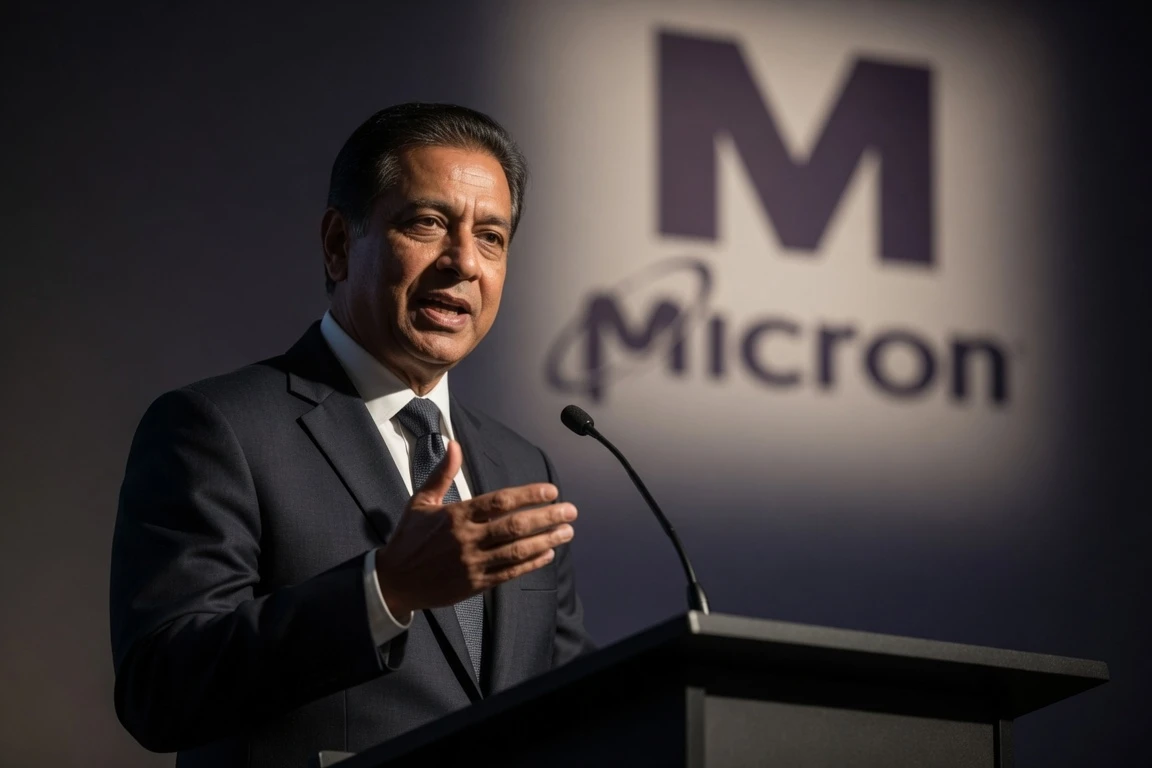
$100 Billion in Locked-In Orders That Rewrote Memory’s Risk Profile
The most consequential disclosure sat below the headline numbers. Micron revealed 16 strategic customer agreements, or SCAs, that lock in roughly half or more of company revenue across three-to-five-year terms. The agreements carry a cumulative contracted value of $100 billion in minimum revenue and $22 billion in firm financial commitments. The structure is the first time a major memory company has sold forward this aggressively on take-or-pay terms.
The contracts address the central criticism of memory stocks: cyclicality. CFO Mark Murphy framed the SCAs as committed volume that the company can rely on for capacity investment.
This is good for Micron. We get visibility on our demand, it’s committed volume that we can be confident about making our investments.
The arrangements bind customers to take allocated HBM and DRAM volumes at agreed pricing floors, with take-or-pay penalties for non-fulfillment on the customer side. Micron disclosed in its prepared remarks that the SCAs cover 20% of its DRAM volume and one-third of NAND volume through 2030.
Wall Street reacted with a stampede of price-target raises. JPMorgan lifted its target to $1,540 from $550. RBC moved to $1,500, Deutsche Bank to $1,550, and Morgan Stanley to $1,200. Melius Research’s Ben Reitzes set the Street high at $2,200, double his prior target. Among 43 analysts covering Micron, the rating now sits at Strong Buy with an average target near $1,338, and the range spans from $249 to $2,200. The latest Micron price target raises ahead of earnings included Cantor Fitzgerald lifting to $1,500 from $700, Wells Fargo more than doubling to $1,220, and Susquehanna holding the Street high at $1,750.
Business Unit Revenue, Micron Fiscal Q3 2026
| Segment | FQ3-26 | FQ3-25 |
|---|---|---|
| Cloud Memory | $13.77 billion | $3.39 billion |
| Core Data Center | $11.52 billion | $1.53 billion |
| Mobile and Client | $11.52 billion | $3.26 billion |
| Automotive and Embedded | $4.63 billion | $1.13 billion |
HBM4 in Volume, and the Three-Horse Race for AI’s Bottleneck
Micron’s product roadmap turned a corner in the same quarter. The company confirmed that HBM4, built on its 1-beta DRAM technology, is in high-volume shipments for a lead customer’s platform, with qualification samples shipped to multiple additional end-customers. Development of HBM4E, built on 1-gamma DRAM, is well underway, with volume production targeted for calendar 2027. The 256GB DDR5 RDIMMs, G9-based PCIe Gen6 high-performance SSD, and 245TB QLC SSD are all in volume production.
HBM sits at the center of the AI accelerator buildout, and the market is consolidating around three suppliers. By Q4 2025, SK Hynix led the HBM market with nearly 57% share and Micron had reached 21%, per Counterpoint Research data, with Samsung trailing after delays in qualifying its HBM3 products with Nvidia. All three are now scaling into HBM4 production, and Nvidia’s go-ahead for Samsung, SK Hynix, and Micron on HBM4 came in early June, per Bloomberg reporting on June 5.
SK Hynix and Samsung are positioned as the lead HBM4 suppliers for Vera Rubin, with Micron as a significant third source. The competition between the three for HBM4 volume allocations will play out over yield, bin distribution, and packaging throughput across the next 18 months. Samsung has resumed construction of its Pyeongtaek P5 fab and is positioning its sixth-generation 10-nanometre-class DRAM process as a stepping stone to volume HBM4. Counterpoint expects Samsung’s share to strengthen above 30% as HBM3E qualifications close and HBM4 enters full-scale supply in 2026.
Why This Memory Cycle Looks Structurally Different
Memory has historically been a boom-bust commodity, with pricing resetting every six to nine months as supply caught up to demand. Micron’s results suggest a different shape is forming. The SCAs effectively convert a portion of the company’s revenue into long-duration infrastructure contracts with hyperscalers, automakers, and data center operators.
Micron’s record fiscal Q3 financial results and even stronger outlook for Q4 reflect the strategic value of memory in the AI era. Micron is investing at record levels in technology, products and supply to address our customers’ rapidly growing demand. We believe our multi-year Strategic Customer Agreements will significantly enhance the durability and predictability of Micron’s strong financial performance.
The structural argument rests on three pillars. HBM requires roughly three times the wafer capacity of standard DRAM, which pulls supply away from commodity memory and structurally tightens the broader market. Qualification cycles for HBM customers run 12 to 18 months, so the supply locked in today is set against demand two product generations away. The three HBM suppliers are now spending a combined $80 billion or more in capex per year, with new capacity only arriving in 2027 and 2028.
Micron itself is leaning into the shift. The company plans to ramp capital expenditures in fiscal 2027 to expand capacity, on top of the $7.1 billion in net capex in the most recent quarter, while pledging to return 100% of excess cash to shareholders. The dual commitment signals that management views the current pricing environment as durable. Mehrotra said on the call that supply shortages in memory and storage will take considerable time to improve, even as industry supply improves gradually in 2028. Bank of America described the results as evidence of a structural shift in the memory industry.
The Few Buyers With a Cushion
For most of the consumer electronics industry, the same memory reallocation is now a cost crisis. The brands that are absorbing it cleanly are the ones that locked in supply early or built inventory buffers that smaller rivals cannot match.
Apple held iPhone 17 prices flat through the worst of the squeeze by drawing on DRAM inventory it secured before the shortage tightened. Apple raised prices on MacBooks, iPads, the Apple TV 4K, and HomePods on June 25, 2026, one day after Micron’s report. CEO Tim Cook told The Wall Street Journal that price increases were “unavoidable,” noting Apple had been trying to shield customers from the increases but the situation had become unsustainable. Tim Cook explained why Apple is raising prices in the same interview, framing the move as a pass-through of memory costs Apple can no longer absorb.
Samsung Electronics, the world’s largest memory maker, has secured its own 2026 supply and is positioned to gain Android share on the strength of a stronger Galaxy S26 lineup. Huawei has expanded HarmonyOS into the entry-level segment in China, sustaining pricing on new models where most Android rivals are being forced to retrench. Lenovo’s chief financial officer told CNBC in January 2026 that memory inventories were running roughly 50% above normal levels. The cushion matters less for what it does for these companies and more for the vendors it leaves exposed.
The gap is widening between vendors with scale and those without. The structural underdogs of 2026 are the mid-range and entry-level Android brands concentrated in the sub-$200 price bands. Counterpoint Research found that more than 80 smartphone models in India were repriced higher in the first quarter, with an average hike of 15%. Successor models from Redmi, OPPO, iQOO, Realme, and Vivo launched at prices 13% to 24% above the phones they replaced.
The bill lands hardest where margins are thinnest. Apple’s price hike after memory chip costs surge covered the MacBook Neo, a budget laptop originally priced at $599, signaling that even the entry tier is no longer shielded.
The Bill Lands on Phones, PCs, and Emerging Markets
Apple’s June 25 price hikes covered most of its Mac and iPad lineup. The MacBook Neo moved from $599 to $699, a 17% increase. The 13-inch MacBook Air went from $1,099 to $1,299, and the 16-inch MacBook Pro climbed from $2,699 to $2,999. Apple said in a statement that it had never seen a component price increase “this much, this quickly.” AI data centers are driving up phone, laptop, and console prices across the broader market, and Apple’s adjustment is one of the more visible data points.
The smartphone market is taking the broader hit. IDC’s forecast of a record 13.9% smartphone decline in 2026 marks the steepest annual contraction in the industry’s history, with another 1.1% decline projected for 2027. The smartphone ASP is on track to rise to a record $550, up $100 from 2025. Apple’s iOS share is expected to hit 22%, its highest annual figure, with iPhone 17 demand holding up in developed markets and China.
The PC market is following the same curve. IDC’s outlook on the 11.3% PC shipment decline points to deteriorating conditions through Q4, when shipments are projected to fall 20% year-over-year. PC ASPs are expected to grow 17% in 2026. The pull-forward demand that masked the problem in Q1, with shipments up 3% year-over-year, has run out, and IDC does not expect any relief in the memory shortage before the end of 2027.
Emerging markets are absorbing the worst of the squeeze. IDC’s regional forecast shows Middle East and Africa smartphone shipments down 23% in 2026, Central and Eastern Europe down 19%, and Asia Pacific excluding Japan and China down 14%. The sub-$200 segment, which accounted for over 170 million devices in 2025, is becoming economically unviable as memory and NAND costs settle at a permanently higher level.
Apple Price Hikes, June 25, 2026
| Product | Old Price | New Price |
|---|---|---|
| MacBook Neo | $599 | $699 |
| MacBook Air (13″) | $1,099 | $1,299 |
| MacBook Air (15″) | $1,299 | $1,499 |
| MacBook Pro (14″) | $1,699 | $1,999 |
| MacBook Pro (16″) | $2,699 | $2,999 |
| Mac Studio (M3) | $3,999 | $5,299 |
| Mac Studio (M4) | $1,999 | $2,499 |
| iPad Pro | $999 | $1,199 |
| iPad Air | $599 | $749 |
| iPad Mini | $499 | $599 |
| Apple TV | $129 | $199 |
| HomePod | $299 | $349 |
What Could Break the Pricing Power
The structural risks sit on both sides of the trade. SK Hynix plans to invest roughly KRW 40 trillion, or $29 billion, in capex in 2026, with Samsung also scaling HBM4 production at its Pyeongtaek P5 fab. Micron itself is targeting higher capex in fiscal 2027 on top of the $7.1 billion spent in the most recent quarter. If new HBM and DRAM capacity arrives faster than the AI demand curve, the contracted pricing power that Micron has imported from the SCAs could face a slower erosion.
For now, the condition for the bull case to break is hyperscaler capital discipline, not consumer demand. Alphabet, Amazon, Microsoft, and Meta have committed to take all the supply the fabs can produce regardless of cost, per industry coverage of the quarter. The contract book insulates Micron from a near-term reset. The longer-term question is whether the contracted volume and pricing floor holds when SK Hynix and Samsung bring new HBM capacity online in late 2027 and 2028.
Frequently Asked Questions
What did Micron actually announce on June 24, 2026?
Micron reported fiscal Q3 2026 revenue of $41.46 billion against the $35.84 billion LSEG consensus, with adjusted EPS of $25.11 versus the $20.78 estimate. The company guided fiscal Q4 revenue to $50 billion plus or minus $1 billion and disclosed $100 billion in contracted customer commitments across 16 multi-year agreements.
Why does Micron’s quarter matter beyond the stock price?
The memory reallocation behind Micron’s numbers is now setting consumer electronics prices. Apple raised prices across its Mac and iPad lineup on June 25, 2026, the day after Micron’s report. IDC forecasts a 13.9% drop in smartphone shipments and an 11.3% drop in PC shipments in 2026, the steepest contractions in each industry’s history. The same chips that more than doubled Micron’s gross margin year-over-year are inflating the cost of every phone and laptop sold this year.
What are Micron’s Strategic Customer Agreements?
Micron disclosed 16 multi-year agreements with hyperscalers, data center operators, and automakers. The agreements run three to five years and are expected to cover roughly half or more of company revenue under take-or-pay structures with binding volume and minimum pricing commitments. Micron also disclosed $22 billion in firm financial commitments under the SCAs. The arrangements cover 20% of Micron’s DRAM volume and one-third of its NAND volume through 2030, per the company’s prepared remarks.
Will memory prices come back down?
Mehrotra said on the call that supply shortages will take considerable time to improve and that industry supply should improve gradually in 2028. Counterpoint Research data shows DRAM prices rose 80% to 90% within the first six weeks of 2026 alone. IDC does not expect smartphone or PC shipments to recover to 2025 levels within its forecast horizon, even after memory supply normalises in 2028.
What is HBM4 and why does it matter?
HBM4 is the fourth generation of High Bandwidth Memory, a stacked DRAM product that sits next to AI accelerators inside data center servers. Micron confirmed HBM4 is in high-volume shipment for a lead customer’s platform as of the latest quarter, with qualification samples shipped to additional end-customers. The product carries roughly three times the wafer content of standard DRAM and sells at a margin premium that lifted Micron’s gross margin from 39% a year ago to 84.9% in the most recent quarter.


Pixel 11 Trails Galaxy Phones That Last as Long

OpenAI’s Research Intern Arrives With a Warning Attached

Robinhood Prices XRP Into a Two-Cent 9 a.m. Bet

Sony’s 10 Percent Disc Drop Leaves the 2028 Cutoff Intact

Chip Allocation Sidelines the Base iPhone 18 This Fall

Miami-Dade Fights the Vice City Brand It Already Wears

IFA 2026 Awards Put Tecno Ahead of Flagship Phones

USB-C Gadgets Made the Junk Drawer Rechargeable

Pixel 11 Pro Asks $1,099 for a Light Google Locked

The iPhone Ultra Sells Two Retired Minis as One Foldable

Oracle Cuts 21,000 Jobs in a Year, Cites AI in 10-K Filing

Fable 5 and Mythos 5 Return as US Lifts Anthropic Export Controls

SpaceX’s Google Deal Turns a Rocket Company Into a Cloud Landlord

CD Projekt Red Co-CEO: Redemption Arc Isn’t Done, Witcher 4 in 2027

XPL Rallies 30% Ahead of Plasma One Card Tier Launch

Google Search Profiles Build a Follow Graph Inside Discover

DGO App Brings Rs 549 Mobile Pass for FIFA World Cup 2026 in Nepal

Moonshot AI Targets $30 Billion in China’s Fastest AI Funding Sprint

Oppo’s ColorOS 17 Eligibility List Leaves A-Series Buyers Behind

Microsoft Xbox Layoffs Start in July as Sharma Slams 3% Margin
-
 AI3 months ago
Oracle Cuts 21,000 Jobs in a Year, Cites AI in 10-K Filing
-
 AI2 months ago
Fable 5 and Mythos 5 Return as US Lifts Anthropic Export Controls
-
 AI3 months ago
SpaceX’s Google Deal Turns a Rocket Company Into a Cloud Landlord
-
 GAMING3 months ago
CD Projekt Red Co-CEO: Redemption Arc Isn’t Done, Witcher 4 in 2027
-
 CRYPTO3 months ago
XPL Rallies 30% Ahead of Plasma One Card Tier Launch
-
 NEWS3 months ago
Google Search Profiles Build a Follow Graph Inside Discover
-
 APPS3 months ago
DGO App Brings Rs 549 Mobile Pass for FIFA World Cup 2026 in Nepal
-
 AI3 months ago
Moonshot AI Targets $30 Billion in China’s Fastest AI Funding Sprint