
AI
Mistral’s Robostral Navigate Beats Sensor-Heavy Rivals at 76.6%
Mistral AI’s Robostral Navigate scored 76.6% on a top navigation benchmark using one camera and no LiDAR, though real-world testing remains unproven.

Mistral AI says a robot can now find its way through an office, a warehouse or a hotel corridor using nothing but one ordinary camera and a spoken instruction. The French AI lab’s new model, called Robostral Navigate, scored a 76.6% on R2R-CE (Room-to-Room in Continuous Environments) validation unseen, the benchmark for following instructions in environments held out of training. It beats the best single-camera approach by 9.7 points and the best system using depth or multiple cameras by 4.5 points, despite using neither.
Every one of those numbers comes from a simulator. There is no independent third-party evaluation yet, and no peer-reviewed paper cited at launch. And a 76.6% success rate means roughly one in four runs failed, a detail Mistral’s own announcement does not dwell on.
Robostral Navigate Turns Camera Pixels Into Directions
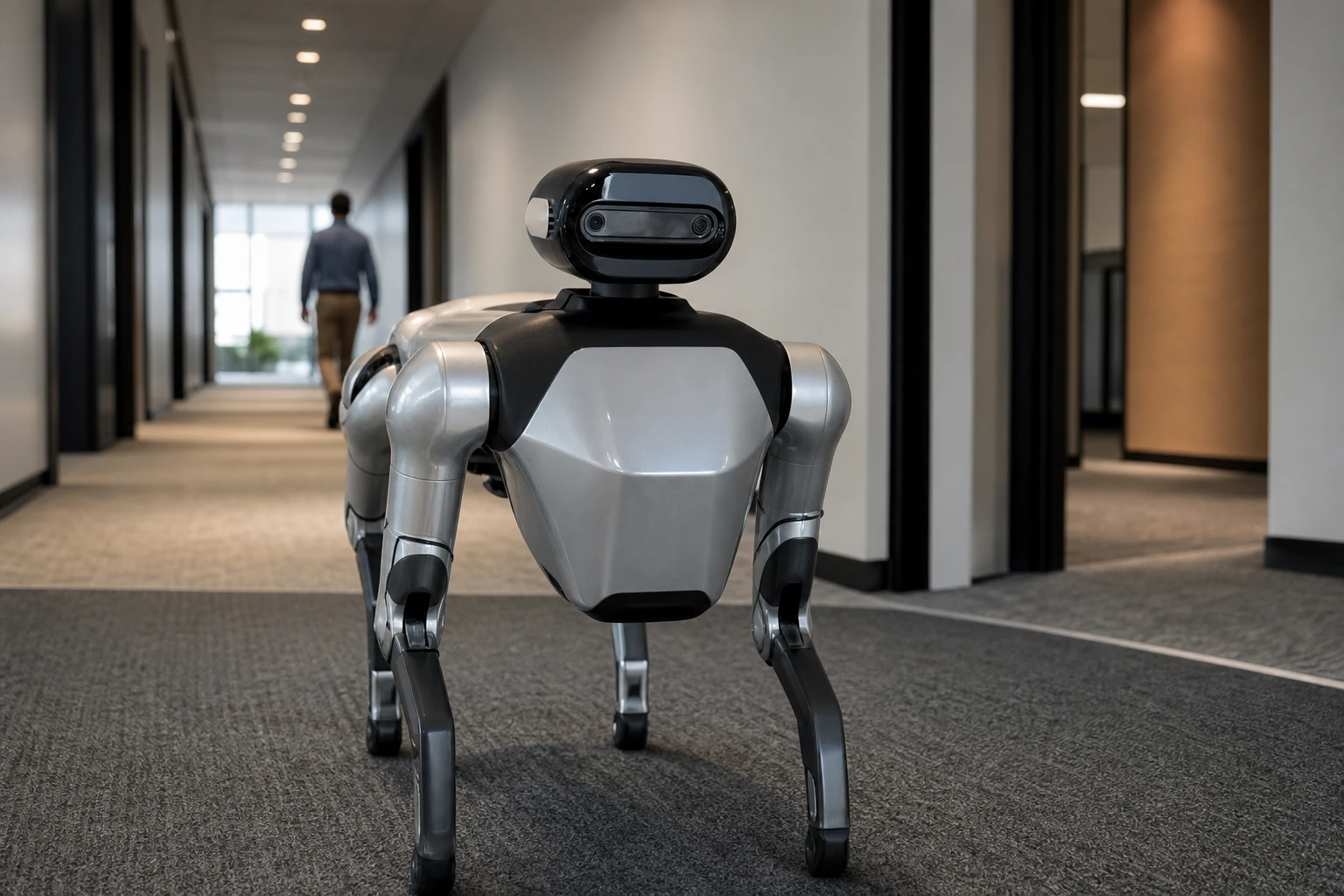
The model is compact by industry standards. Robostral Navigate is an 8B model that enables robots to autonomously navigate complex environments using only a single RGB camera. Mistral AI, the Paris-based company behind it, says the system was built entirely in-house and initialized from the company’s own vision-language model for grounding tasks such as pointing, counting and object localization, rather than adapted from an existing open-source model.
Feed it a camera frame and a line of English, and it moves. Mistral’s own example instruction reads: “Leave the lobby, walk through the corridor, enter the supply room, and stop to face the second shelf.”
Instead of calculating metric distances, the model works by pointing. Given a task and a history of observations, it infers the image coordinates of the target location in the robot’s current camera view along with the desired orientation on arrival, a method that keeps working even as camera angle, mounting height or the robot’s scale changes. When the destination sits outside the current frame, it falls back to plain movement commands: “Move 2 meters forward, 1.5 meters to the left, and turn 25 degrees left.”
Mistral packed several efficiency claims into the launch:
- 8 billion parameters, trained without touching any existing open-source vision-language model.
- Roughly 400,000 simulated trajectories collected across 6,000 scenes, with no real-world data collection.
- A prefix-caching training method that Mistral says cut training tokens twenty two fold, shrinking runs that once took months down to days.
- An online reinforcement learning stage using an algorithm called CISPO that helped the model learn through trial and error, recover from failures, and improve exploration, increasing success rates by 3.2%, with no plateau yet.
Mistral said it can run on wheeled, legged and flying robots and can generalize across robot sizes.
The Benchmark Numbers Behind Mistral’s Claim
R2R-CE is not a warehouse floor. It evaluates instruction-following agents inside photorealistic 3D reconstructions of actual buildings, run through the Habitat simulator, and it has become a standard yardstick for testing whether a robot can follow multi-step directions in a building it has never seen.
| System | Sensors Required | R2R-CE Validation Unseen |
|---|---|---|
| Robostral Navigate | 1 standard RGB camera | 76.6% |
| Robostral Navigate (seen environments) | 1 standard RGB camera | 79.4% |
| Best prior single-camera system | 1 standard RGB camera | 9.7 points lower |
| Best prior multi-sensor system | LiDAR, depth sensors or multiple cameras | 4.5 points lower |
Published navigation methods on the same unseen split had historically clustered in the 50s and 60s for years, as the field wrestled with the unseen-generalization problem. A jump into the mid-70s counts as real progress, not just a marketing figure, if it reproduces outside the launch post, in the range where practical deployments start to look possible rather than research demos.
Why Mistral Is Racing Into Warehouses Now
Mistral AI built its name on open-weight language models before this week. The company announced Robostral Navigate as it expands in the emerging field of physical artificial intelligence, after signing deals with major European industrial customers, according to Bloomberg.
The timing lines up with a busy year of dealmaking. Mistral’s May acquisition of Emmi AI, an Austria-based physics-AI specialist, brought more than 30 researchers into the company, according to Global Banking & Finance, strengthening the simulation work behind this launch, a move laid out in the companies’ acquisition announcement. The launch also comes months after Paris-based startup Genesis AI unveiled a broader robotics model with navigation and manipulation capabilities, a rival approach to the same physical-AI race.
Money is following the pivot. Mistral was valued at 11.7 billion euros (about $13.4 billion) in a September Series C round that raised 1.7 billion euros (about $1.9 billion). PYMNTS reported in June that the company was in talks to raise about 3 billion euros (about $3.42 billion) at a valuation of about 20 billion euros (about $23 billion). Industry newsletters tracking the launch pointed to existing commercial ties as evidence the bet does not start from zero: “Mistral’s Robostral Navigate turns a European AI lab into a direct industrial robotics competitor, backed by existing Airbus and BMW partnerships,” AI Weekly wrote.
Is 76.6% Good Enough to Deploy?
Not by the standard industrial robotics has used until now. A 76.6% score leaves roughly one attempt in four short of the goal, and the number is self-reported from a launch post with no outside testing yet. Warehouse operators have historically wanted reliability much closer to full marks before pulling a human chaperone off the floor.
It’s a self-reported number from a launch post. There’s no independent third-party evaluation yet, and no peer-reviewed paper cited at launch, The AI Dude pointed out in its breakdown of the release. Benchmark leaderboards, it added, will need weeks to settle whether the score holds up.
What the model does when it loses confidence, stopping safely or continuing into an obstacle, matters as much as the headline percentage, and that breakdown has not been published anywhere.
“In structured industrial automation, 95%+ reliability is often the bar before you remove the human escort,” one technical breakdown of the release noted. Navigation somewhere between the mid-70s and 80% reads as research-grade progress and an impressive demo, not something ready to replace a fleet of autonomous mobile robots without human oversight, by that same measure.
The Sim-to-Real Gap Nobody Has Measured
Every one of Mistral’s numbers was generated inside a simulator. The gap between a simulation-trained policy and an actual robot in an actual building is the single biggest unknown, and Mistral has not published results from a real robot deployment, The AI Dude wrote.
Other analysts flagged similar blind spots. “Deployment teams should expect edge cases around lighting, occlusion, camera intrinsics, and robot morphology,” AI Weekly wrote, while a separate review cautioned that “dynamic obstacles, sunlight glare, reflective surfaces, and narrow passageways remain concerns” once a camera-only system leaves the lab.
The debate is not new to robotics or to autonomy more broadly. “Camera-only perception is what Tesla bet its self-driving stack on,” The AI Dude observed, and whether vision alone is enough for safety-critical autonomy remains an open argument years into that wager.
Who Feels the Squeeze First
If the approach holds up, the businesses selling sensor-heavy navigation stacks stand to lose the most ground. “Whoever is selling LiDAR-heavy nav stacks to European industrial customers just got a new competitor,” AI Weekly wrote of the launch.
Robostral Navigate does not do everything, though. The model is currently focused solely on navigation; it does not perform object manipulation or handling. Warehouses that need a robot to pick, sort or assemble still need a separate system layered on top of it.
The launch also arrived to a crowded room online. It drew more than 400 points on Hacker News, splitting the thread between robotics veterans debating whether the score is deployable and hobbyists asking how to bolt the model onto their own machines.
What Mistral Still Won’t Say
Several practical questions were left open at launch.
What We Know
- Simulation only. The training dataset was built entirely from roughly 400,000 trajectories across 6,000 simulated scenes, with zero real-world data collection.
- Limited rollout. Robostral Navigate is currently available to select partners in manufacturing, logistics, delivery, and hospitality sectors, with broader access planned later.
What’s Unconfirmed
- Pricing and access. Details on API access and pricing for the new robotics model were not disclosed.
- Open weights. The launch announcement does not confirm a public checkpoint, so it remains unclear whether outside developers will ever get the model itself.
Mistral has said only that this is its first step and that it is expanding its robotics team, without a published timeline for a wider release.
Frequently Asked Questions
What Is the R2R-CE Benchmark Mistral Used to Test Robostral Navigate?
R2R-CE stands for Room-to-Room in Continuous Environments, and it is not run inside a live building. The benchmark works from scans of 90 indoor scenes captured through Matterport3D and run inside the Habitat platform, so a high score measures generalization to floor plans the model has never seen rather than performance on an actual factory floor.
Does Robostral Navigate Need a Powerful Onboard Computer?
Running the 8 billion parameter model well typically needs either an onboard GPU in the Jetson Orin class or a fast link to a remote server, since a navigation step that takes roughly 80 milliseconds locally can stretch toward 400 milliseconds over a weaker connection, according to one technical walkthrough of the release. That gap changes how a robot behaves step by step in the field.
Can Developers Access Robostral Navigate Right Now?
Not broadly. The launch announcement does not confirm a public checkpoint or open-weight release, and pricing has not been disclosed. Developers curious about a downloadable version have been advised to check Mistral’s page on Hugging Face directly rather than assume access is open.
Who at Mistral Built Robostral Navigate?
The model came out of Mistral’s AI Science Robotics team. The company credited nine researchers on the announcement: Théo Cachet, Arjun Majumdar, Srijan Mishra, Thomas Chabal, Chris Bamford, Elliot Chane-Sane, Benjamin Tibi, Ludovic Ho Fuh and Olivier Duchenne.


South Korea Retail Investors Face Reckoning After KOSPI AI Rally Collapses

Surrey AI Maps Three Heart Attack Paths and Their Molecular Roots

Germany Locks Neutral Apple ATT Prompts Across Most of Europe

Apple’s 5% EU Fee Quietly Rewrites Alternative App Store Math

Apple’s EU Fee Truce Cuts Complexity but Leaves Rivals Fuming

Pixel 11 Pro Fold Trades Thinness for Durability and Seven-Year Stay

Mayo AI Flags HCM Obstruction From Everyday Ultrasound Videos

Indian Brands Quietly Scale Landmark Screens and Home Tech

Navin Vatsa Turns Grief Into a Lifetime of Quiet Seeing

Google Bets Pixel 11 Agentic AI Will Redefine Phones

Oracle Cuts 21,000 Jobs in a Year, Cites AI in 10-K Filing

Fable 5 and Mythos 5 Return as US Lifts Anthropic Export Controls

SpaceX’s Google Deal Turns a Rocket Company Into a Cloud Landlord

CD Projekt Red Co-CEO: Redemption Arc Isn’t Done, Witcher 4 in 2027

XPL Rallies 30% Ahead of Plasma One Card Tier Launch

Google Search Profiles Build a Follow Graph Inside Discover

DGO App Brings Rs 549 Mobile Pass for FIFA World Cup 2026 in Nepal

Moonshot AI Targets $30 Billion in China’s Fastest AI Funding Sprint

Oppo’s ColorOS 17 Eligibility List Leaves A-Series Buyers Behind

Microsoft Xbox Layoffs Start in July as Sharma Slams 3% Margin
-
 AI2 months ago
Oracle Cuts 21,000 Jobs in a Year, Cites AI in 10-K Filing
-
 AI2 months ago
Fable 5 and Mythos 5 Return as US Lifts Anthropic Export Controls
-
 AI2 months ago
SpaceX’s Google Deal Turns a Rocket Company Into a Cloud Landlord
-
 GAMING2 months ago
CD Projekt Red Co-CEO: Redemption Arc Isn’t Done, Witcher 4 in 2027
-
 CRYPTO2 months ago
XPL Rallies 30% Ahead of Plasma One Card Tier Launch
-
 NEWS2 months ago
Google Search Profiles Build a Follow Graph Inside Discover
-
 APPS2 months ago
DGO App Brings Rs 549 Mobile Pass for FIFA World Cup 2026 in Nepal
-
 AI2 months ago
Moonshot AI Targets $30 Billion in China’s Fastest AI Funding Sprint