
AI
Qualcomm in Talks to Acquire Tenstorrent for Up to $10 Billion
Qualcomm is in talks to acquire AI chip startup Tenstorrent for between $8 billion and $10 billion as it pushes deeper into AI infrastructure.

Qualcomm is in talks to acquire AI chip startup Tenstorrent for a price the two companies have framed between $8 billion and $10 billion, according to a person with direct knowledge of the deal. The Information first reported the price range on Monday, June 15, 2026. The negotiations remain in the early stages, with the valuation and structure both still in motion and no agreement yet reached.
The reported price would be a steep premium to Tenstorrent’s last private valuation, a sign of how rapidly investor appetite for AI infrastructure companies has reset. A Tenstorrent deal would mark one of the largest AI hardware acquisitions in years and a sharp acceleration of Qualcomm’s push beyond its smartphone chip roots. Neither company has publicly confirmed the talks. Sources familiar with the matter told The Information that Tenstorrent has also been speaking with investment banks about strategic alternatives, including raising additional capital, a sign the startup is keeping a parallel path open.
The Deal on the Table
The Information’s Monday report put the price between $8 billion and $10 billion, a range the two sides have only “discussed” rather than agreed. Sources warned that the talks could still fall apart, and that the proposed price may or may not include performance-based milestone payments, a structure semiconductor acquirers have used in past startup buys.
Tenstorrent declined to comment on the talks, and neither Qualcomm nor Intel, which Bloomberg reported in May had also explored a deal, has publicly confirmed the discussions. Investor reaction was muted on the headline. Qualcomm shares closed Monday up about 4% at $212.94 after the report crossed. The stock then slipped roughly 1% in extended trading as the afternoon session began.
Tenstorrent is keeping a parallel path open. Sources told The Information the startup has been in conversation with investment banks about strategic alternatives that include raising more capital, an option that gives it a real alternative to a sale at any number in the $8 billion to $10 billion range.
- $8 billion to $10 billion: the price range Qualcomm and Tenstorrent have discussed.
- $2 billion to $2.6 billion: Tenstorrent’s reported valuation after its 2024 Series D.
- $693 million: the size of that Series D round.
- $3.2 billion: Tenstorrent’s reported target valuation in a more recent fundraise.
- ~4%: Qualcomm’s Monday session gain, before an extended-hours slip.
Why Qualcomm Wants Tenstorrent
Qualcomm’s core handset chip business has come under pressure, particularly in China, where a memory chip shortage has crimped smartphone sales. The company was the laggard of the Philadelphia Semiconductor Index earlier this year, down roughly 20% year to date, before shares rallied more than 60% as investors began to price in a coming AI-led re-rating. A Tenstorrent buy would jump the queue on that pivot by handing Qualcomm an established AI chip line, a RISC-V-based roadmap, and a founder-CEO whose name alone moves silicon-industry order books.
Qualcomm has telegraphed the AI ambition in public. The company’s roadmap includes the AI200 and AI250, inference accelerators pitched at the data-center market, plus custom AI chips and server processors based on its Oryon architecture. Last month, Bloomberg reported a multi-million-unit supply deal with ByteDance, the TikTok owner, for AI inference silicon. CEO Cristiano Amon told investors during the recent Q2 earnings call that initial shipments to a “leading hyperscaler” were on track for later this year, with more detail to come at Qualcomm’s investor day on June 24. The ByteDance order is the most concrete proof point yet of the AI push landing real customers.
Tenstorrent would slot in alongside the existing AI200 and AI250 line. The startup covers both training and inference, while Qualcomm’s AI200 and AI250 are pitched at inference workloads. The strategic argument is that the two product families address different parts of the AI silicon stack, and that Tenstorrent’s open RISC-V architecture gives Qualcomm a credible answer in markets where governments and hyperscalers are looking for Nvidia alternatives.
Tenstorrent is the kind of asset that is hard to build from scratch. The company has spent nearly a decade developing silicon, software, and a developer community, and it has the engineering culture that an acquirer like Qualcomm would otherwise need years to recruit; a buy compresses that timeline into a single transaction.
What Tenstorrent Brings
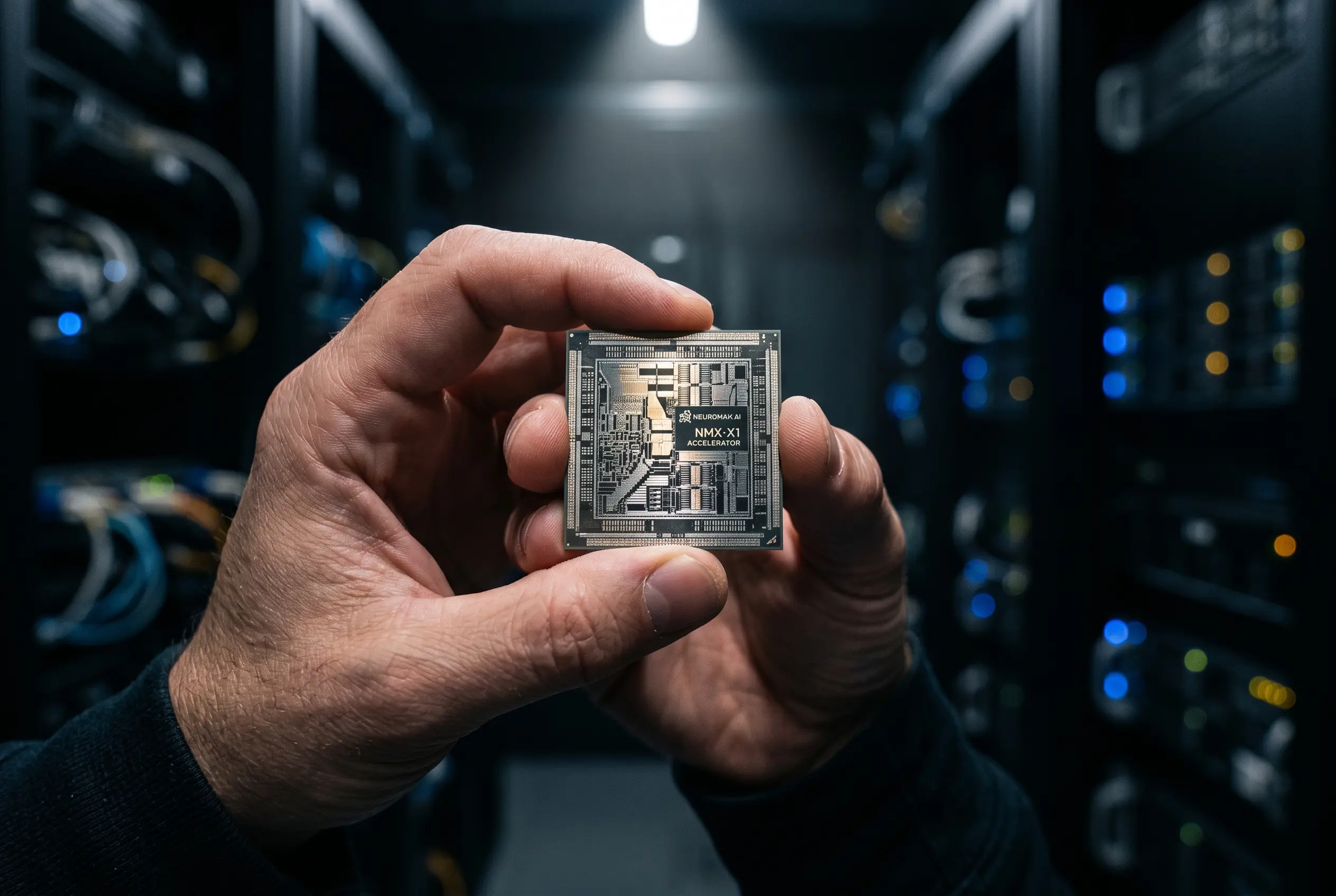
Tenstorrent was founded in Toronto in 2016 by Ljubisa Bajic, Milos Trajkovic, and Ivan Hamer, and built around RISC-V cores and chiplet-based designs. The startup sells AI accelerators, computing systems, and developer boards, with a product family that includes its Blackhole architecture and PCIe accelerator cards. The pitch is a lower-cost, open-architecture alternative to Nvidia, with a developer-friendly software stack built on the open instruction set that Nvidia does not use.
The startup’s credibility in the silicon world rests heavily on its chief executive, Jim Keller. Keller joined as CTO in 2020 and later became CEO, bringing a résumé that includes lead architect roles on AMD’s Zen processors, Apple’s A-series chips, and Tesla’s Autopilot silicon, plus a senior engineering stint at Intel. He has been blunt about the limits smaller players face.
You can’t beat Nvidia if you use HBM. High-bandwidth memory costs create a wall for competitors who try to match Nvidia’s stack head-on.
Jim Keller, Tenstorrent’s CEO, said in a Bloomberg interview in December that competitors who rely on high-bandwidth memory will struggle to match Nvidia’s stack. Tenstorrent’s answer to the memory wall is an architecture that leans on standard DRAM and chiplet packaging, in place of the high-bandwidth memory that powers Nvidia’s hardware. The bet is that the efficiency gap on the silicon side is closeable, and that customers will trade a few percentage points of peak performance for a hardware stack they can source from a non-Nvidia supplier.
Jim Keller’s prior roles
| Company | Role |
|---|---|
| DEC | Engineer |
| SiByte | Lead architect |
| Broadcom | Engineering |
| PA Semi | Lead architect |
| Apple | Lead architect, A4/A5 |
| AMD | Lead architect, Zen |
| Tesla | VP, Autopilot hardware |
| Intel | SVP, silicon engineering |
| Tenstorrent | CTO, then CEO |
The Road That Led Here
Tenstorrent’s fundraising trajectory has been steep. The startup raised more than $693 million in a Series D in 2024 at a valuation reported between $2 billion and $2.6 billion, then pursued a fresh round of roughly $800 million at a $3.2 billion valuation earlier this year. Its backers include Samsung and Bezos Expeditions, among others. A $10 billion acquisition price would represent a multiple of even the most recent private mark, the kind of step-up that tends to draw closer regulatory and shareholder scrutiny once a deal moves from talk to contract.
Tenstorrent first surfaced as an acquisition target in mid-May, when Bloomberg reported both Intel and Qualcomm had been circling, with talks described as preliminary. That earlier coverage put a possible valuation “at more than $5 billion,” depending on how the AI chip sector is read. A month later, The Information’s reporting places the price range at more than double that figure, a fresh indicator of how quickly the AI infrastructure cohort has been repriced. The market is moving in real time, and the gap between May’s “more than $5 billion” and June’s “between $8 billion and $10 billion” is a window into that pace.
Qualcomm’s AI Pivot Is Already Showing
The Tenstorrent talks would not be Qualcomm’s first AI deal of 2026. The company acquired AlphaWave IP earlier this year to bolster its data-center networking stack. The ByteDance order, if it lands at the scale Bloomberg reported, would put Qualcomm inside the small club of merchant suppliers shipping custom inference silicon to a hyperscaler. The ByteDance deal covers custom application-specific integrated circuits, not the general-purpose accelerators Qualcomm has been pitching with AI200 and AI250.
That pipeline matters because the AI200 and AI250 target inference workloads, leaving the training market to Nvidia. Tenstorrent, by contrast, has pitched itself at both training and inference, and leans on an open RISC-V architecture. That architecture has drawn interest from hyperscalers and governments as Nvidia’s grip on the market loosens.
The strategic argument for Qualcomm is that the two product families address different parts of the AI silicon stack. A combined roadmap would let the company pitch hyperscalers, governments, and enterprise buyers a more complete stack than either side could offer on its own, with a path to compete for the training workloads the AI200 and AI250 alone do not cover.
The Hurdles in Front of a Deal
Three things could derail the talks. Tenstorrent is also weighing a fresh fundraise, so the startup has a real alternative to selling, and its bankers are still in conversation with both Qualcomm and other suitors. Neither side has confirmed the discussions publicly, which means every reported number is a “person familiar” snapshot, not a filed term sheet. And a price “between $8 billion and $10 billion” is a $2 billion band, a gap that itself signals how far apart the parties may still be on what Tenstorrent is worth.
Even if the deal closes, integrating a RISC-V-based AI chip team into a company built around Arm-based mobile silicon is a multi-year engineering and cultural lift. Nvidia remains the dominant force in AI hardware, and the open question is whether a combined Qualcomm-Tenstorrent roadmap can produce a credible alternative. Tenstorrent’s preference for standard DRAM, and Jim Keller’s stated skepticism about HBM-based competitors, suggest the merged team would push an alternative hardware stack. The deal, by itself, does not answer that.
Frequently Asked Questions
How much is Qualcomm paying for Tenstorrent?
The Information reported a price range of $8 billion to $10 billion. The number is a discussion range, not a signed figure, and may or may not include performance-based milestone payments.
What does Tenstorrent make?
Tenstorrent designs AI accelerators, computing systems, and developer tools built around RISC-V cores and chiplet-based architectures, with products that include its Blackhole architecture and PCIe accelerator cards.
Who is Jim Keller?
Keller is Tenstorrent’s CEO and a veteran chip architect whose past roles include lead architect on AMD’s Zen processors, Apple’s A-series chips, and Tesla’s Autopilot silicon.
Has the deal closed?
No. The Information reported the talks are in early stages, no agreement has been reached, and both the valuation and structure could still change.
Is Intel also bidding?
Bloomberg reported in May that both Intel and Qualcomm had shown early-stage interest. Neither company has publicly confirmed the talks.


Google Opens Gmail to Voice and Gates Docs Live

Lenovo Prices the IdeaPad Vibe Against Apple’s $699 Neo

Xbox Caps Game Pass Cloud Gaming at 15 Hours

GTA 6 DualSense Controllers Follow Sony’s Usual $84.99 Script

South Korea Retail Investors Face Reckoning After KOSPI AI Rally Collapses

Surrey AI Maps Three Heart Attack Paths and Their Molecular Roots

Germany Locks Neutral Apple ATT Prompts Across Most of Europe

Apple’s 5% EU Fee Quietly Rewrites Alternative App Store Math

Apple’s EU Fee Truce Cuts Complexity but Leaves Rivals Fuming

Pixel 11 Pro Fold Trades Thinness for Durability and Seven-Year Stay

Oracle Cuts 21,000 Jobs in a Year, Cites AI in 10-K Filing

Fable 5 and Mythos 5 Return as US Lifts Anthropic Export Controls

SpaceX’s Google Deal Turns a Rocket Company Into a Cloud Landlord

CD Projekt Red Co-CEO: Redemption Arc Isn’t Done, Witcher 4 in 2027

XPL Rallies 30% Ahead of Plasma One Card Tier Launch

Google Search Profiles Build a Follow Graph Inside Discover

DGO App Brings Rs 549 Mobile Pass for FIFA World Cup 2026 in Nepal

Moonshot AI Targets $30 Billion in China’s Fastest AI Funding Sprint

Oppo’s ColorOS 17 Eligibility List Leaves A-Series Buyers Behind

Microsoft Xbox Layoffs Start in July as Sharma Slams 3% Margin
-
 AI2 months ago
Oracle Cuts 21,000 Jobs in a Year, Cites AI in 10-K Filing
-
 AI2 months ago
Fable 5 and Mythos 5 Return as US Lifts Anthropic Export Controls
-
 AI3 months ago
SpaceX’s Google Deal Turns a Rocket Company Into a Cloud Landlord
-
 GAMING2 months ago
CD Projekt Red Co-CEO: Redemption Arc Isn’t Done, Witcher 4 in 2027
-
 CRYPTO3 months ago
XPL Rallies 30% Ahead of Plasma One Card Tier Launch
-
 NEWS3 months ago
Google Search Profiles Build a Follow Graph Inside Discover
-
 APPS3 months ago
DGO App Brings Rs 549 Mobile Pass for FIFA World Cup 2026 in Nepal
-
 AI3 months ago
Moonshot AI Targets $30 Billion in China’s Fastest AI Funding Sprint