
AI
FactoryTalk VisionAI Adds VisionStream and VisionLink Capabilities
Rockwell’s FactoryTalk VisionAI adds VisionStream and VisionLink, letting plants run AI inspection on existing FTP-enabled cameras without rip-and-replace.

Rockwell Automation’s FactoryTalk VisionAI is gaining two features that let manufacturers bring AI inspection to cameras they already own. The 13 July 2026 update introduces VisionStream, an auto-training system that learns from live production data, and VisionLink, a retrofit path that pulls existing FTP-enabled third-party cameras into the VisionAI stack running on Rockwell edge hardware.
The release keeps VisionAI’s no-code stance: quality personnel and plant operators can train and deploy AI inspection models without specialised machine vision expertise. For plants that already run a mixed vendor camera fleet, VisionLink is the part that changes the cost of upgrading.
What VisionStream and VisionLink Add
Rockwell framed both new features inside its existing FactoryTalk VisionAI platform, which the company first unveiled in November 2024 at Automation Fair in Anaheim, California. VisionStream and VisionLink ship together in the latest release, and the company did not break them out as standalone SKUs.
VisionStream is the auto-training half of the update. It “automatically learns product characteristics from live production data and detects defects without requiring manual image labelling,” per Rockwell’s July 2026 update for VisionStream and VisionLink. That matters because traditional rule-based vision systems need labelled image libraries and ongoing maintenance as products change.
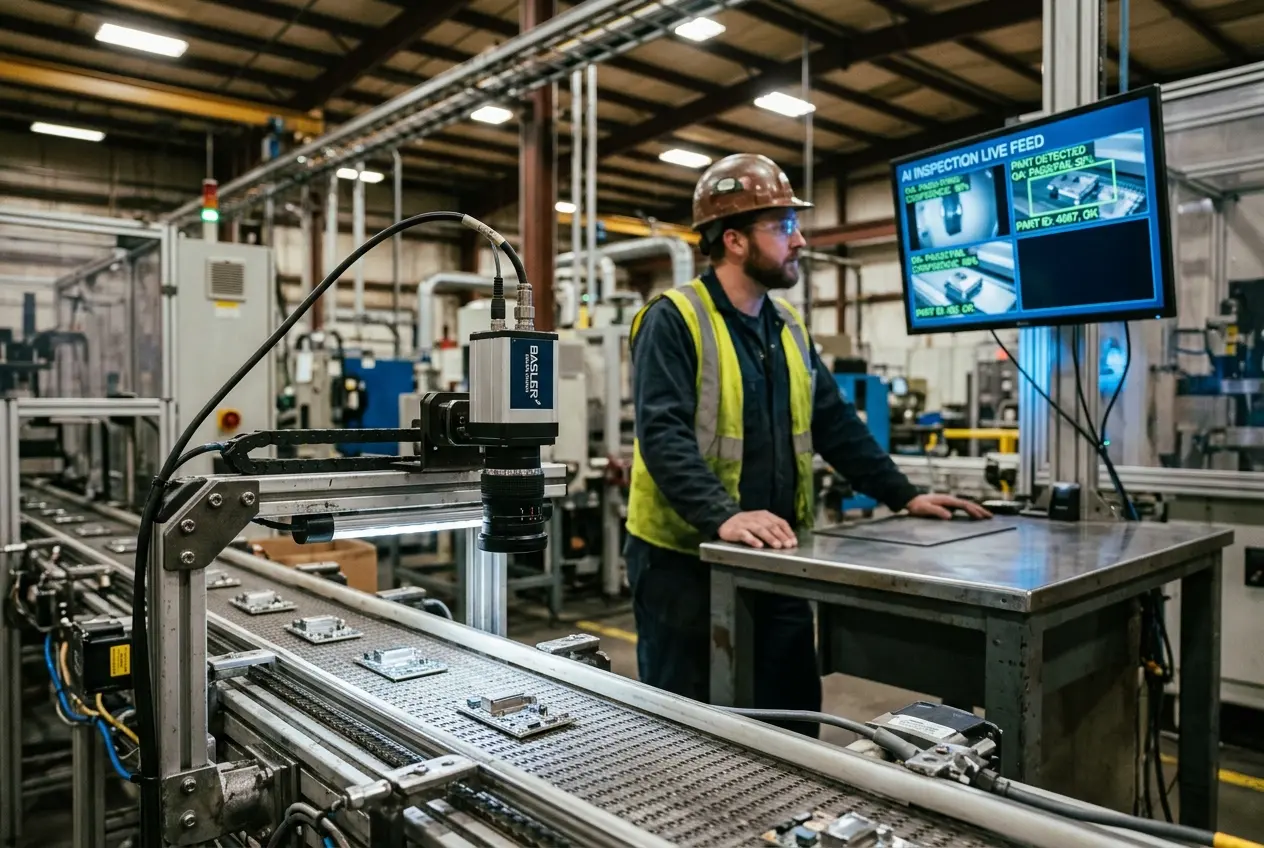
VisionLink is the camera retrofit half. According to Rockwell, the feature “adds AI inspection capabilities to existing FTP-enabled third-party vision cameras, helping manufacturers improve inspection performance while extending the value of installed equipment.” The technical path is straightforward: third-party cameras feed images over FTP to FactoryTalk VisionAI running on Rockwell edge hardware, and the AI inference happens there. The cameras themselves do not need to be replaced.
| Feature | What it does | Where it runs |
|---|---|---|
| VisionStream | Auto-trains defect detection from live production data | Existing FactoryTalk VisionAI edge setup |
| VisionLink | Pulls FTP-enabled third-party cameras into AI inspection | Third-party FTP cameras plus Rockwell edge hardware |
A No-Code Bet for the Plant Floor
Rockwell is making a specific wager with VisionAI: that AI on the factory floor can be operated by the people who already run lines, without specialised machine vision training. The platform is built as a no-code environment where quality personnel and plant operators can train, deploy and manage AI-based inspection models. Rockwell’s own positioning in the release frames the goal as helping manufacturers “simplify vision inspection deployment, improve quality control and extend the value of existing vision investments.” That last clause is what VisionLink is built to monetise.
The bet has a clear cost. Running no-code AI on top of installed cameras still requires Rockwell edge hardware, the FactoryTalk Hub cloud portal, and integration with the company’s control systems. Buyers still have to adopt Rockwell’s stack, even with no-code AI on top. Jan Van Den Bossche, regional vice president for software and control in EMEA, put the trade in the release in his own words: “Manufacturers are increasingly looking for practical ways to adopt AI while maximizing the value of their existing automation investments. With VisionStream and VisionLink, FactoryTalk Analytics VisionAI makes AI-powered inspection more accessible by reducing deployment complexity, enabling self-training capabilities and allowing manufacturers to enhance existing vision systems with advanced AI inspection and analytics.”
Plugging AI Into the Cameras You Already Own
VisionLink is the headline piece for plants sitting on mixed-vendor camera fleets. The feature targets FTP-enabled third-party vision cameras of any brand, and the cameras stay in place.
The practical chain is built around three nodes. A third-party camera publishes images over FTP. FactoryTalk VisionAI picks them up at the edge. AI inference runs on Rockwell edge hardware, with cloud backup, advanced analytics and management sitting on the FactoryTalk VisionAI deployment and feature documentation. Rockwell’s release frames this as a way to “extend the lifecycle of installed vision assets without replacing existing hardware.”
The economic pitch for the buyer is that extending the lifecycle of installed vision assets costs less than a rip-and-replace cycle. Plants that already spend on edge hardware, controls, and cloud management are the natural buyers. Plants that do not are not really being addressed by VisionLink at all.
- Logix controllers
- ASEM IPC industrial PCs
- Rockwell visualization technologies for closed-loop quality
- FactoryTalk Hub cloud manufacturing portal
- Third-party FTP-enabled vision cameras via VisionLink
Three Integration Points Behind VisionAI
VisionAI does not ship as a standalone product. It plugs into Rockwell’s control and software stack at three specific points, and those integration points are what make VisionLink’s camera-agnosticism usable in the field.
On the control side, FactoryTalk VisionAI integrates with Logix controllers and Rockwell visualization technologies to support closed-loop quality processes. The November 2024 release explicitly called out premier integration with Rockwell control systems, and the July 2026 release keeps that positioning unchanged. AI inference on the edge triggers downstream control actions, which is what closed-loop quality means in practice on a packaging or assembly line. Closed-loop quality is Rockwell’s term for AI outputs that drive immediate line corrections, with the feedback loop returned to the controls instead of stopping at an inspection record. FactoryTalk Hub, the cloud manufacturing portal, handles model training, deployment, and management for both VisionStream and the existing VisionAI stack.
On the hardware side, the November 2024 release confirmed VisionAI runs on standard Rockwell industrial PCs, including the ASEM IPC line, paired with Logix PLCs. That is the physical box where VisionLink’s third-party camera feeds land and where VisionStream’s models run at production speed. The original release also described the hardware as “off-the-shelf components,” signalling that VisionAI is meant to slot into existing industrial PC fleets instead of requiring specialised vision servers. Real-time inspections at production speeds were part of the original positioning, and the July 2026 release does not retract that.
On the cloud side, model training, deployment, and management run through the FactoryTalk Hub cloud manufacturing portal. SOC 2 compliant cloud technology was part of the original launch, and the architecture is unchanged in the July 2026 update. For plants already paying for FactoryTalk Hub, VisionStream and VisionLink are an add-on; for plants that are not, that line item enters the trade.
From Anaheim 2024 to Today’s Release
FactoryTalk VisionAI itself is not new. Rockwell first introduced it on November 14, 2024, at Automation Fair in Anaheim, California, with five original features: advanced anomaly detection, remote visibility and configuration, out-of-the-box analytics, premier integration with Rockwell control systems for closed-loop quality, and scalable hardware that ran on off-the-shelf components.
FactoryTalk Analytics VisionAI empowers manufacturers to detect even the most subtle anomalies in product quality, enabling them to take corrective action quickly.
Arvind Rao, vice president of industry solutions at Rockwell Automation, in the November 2024 launch announcement for VisionAI.
The original VisionAI was positioned to find defects that rule-based systems missed, with remote management and built-in dashboards. The Automation Fair launch set the product as part of Rockwell’s broader software lineup at the November 2024 event. The technology sat on SOC 2 compliant cloud and was built in partnership with Elementary, which ARC Advisory described as a vision AI company and Rockwell Automation partner.
What VisionStream and VisionLink add is the gap between detection and deployment. The original VisionAI needed trained models, even if those models were no-code to use. VisionStream collapses the training step by learning from the live line. VisionLink collapses the hardware step by accepting third-party cameras. The architecture is unchanged: edge-based inferencing handles the real-time call, while cloud-based model training, deployment and management run through the FactoryTalk Hub cloud manufacturing portal.
Rockwell’s broader context makes the scale clear. The company “employs approximately 26,000 problem solvers dedicated to our customers in more than 100 countries as of fiscal year end 2025,” per its About page on the press release. Headquartered in Milwaukee, Wisconsin, the company’s distribution and integration reach is what makes a VisionLink pitch land: the retrofit story only works if Rockwell can deliver edge hardware, integration services, and the cloud portal to a plant that already runs non-Rockwell cameras.
The Trade Rockwell Is Asking Buyers to Make
VisionStream and VisionLink are framed as accessibility upgrades, and on those terms they are. No specialised machine vision expertise required for training. Existing cameras can stay in place. Edge inference, cloud management, and closed-loop quality control are bundled. For a controls engineer or a quality manager at a plant with a mixed-vendor camera fleet, this is a real reduction in deployment friction compared to either writing custom inspection models or replacing cameras outright. The accessibility argument is the whole point of the release.
The other side of the trade is Rockwell’s stack. VisionAI runs on Rockwell edge hardware, integrates with Logix controllers and ASEM IPCs, and is managed through the FactoryTalk Hub cloud portal. VisionLink accepts third-party cameras on the input side, but the AI inference, the analytics, and the cloud management remain Rockwell’s territory. Plants already running Rockwell controls will find this incremental. Plants without that base will find VisionLink’s camera-agnosticism ending at the lens. Rockwell’s release directs buyers to the FactoryTalk VisionAI product page for deployment details.
Frequently Asked Questions
What does VisionStream do in FactoryTalk VisionAI?
VisionStream auto-trains FactoryTalk VisionAI by learning product characteristics directly from live production data and detecting anomalies without manual image labelling, according to Rockwell Automation’s 13 July 2026 release.
Does FactoryTalk VisionAI work with non-Rockwell cameras?
Yes. VisionLink, added in the same release, accepts images from existing FTP-enabled third-party vision cameras and feeds them into FactoryTalk VisionAI running on Rockwell edge hardware. The cameras themselves do not need to be replaced.
When was FactoryTalk VisionAI first launched?
Rockwell Automation introduced FactoryTalk VisionAI on November 14, 2024, at Automation Fair in Anaheim, California. The VisionStream and VisionLink update is dated 13 July 2026.
What hardware does FactoryTalk VisionAI require?
The original VisionAI release specified ASEM IPCs and Logix PLCs, with cloud management through the FactoryTalk Hub. VisionLink accepts third-party FTP-enabled cameras on the input side and runs AI inference on Rockwell edge hardware.


South Korea Retail Investors Face Reckoning After KOSPI AI Rally Collapses

Surrey AI Maps Three Heart Attack Paths and Their Molecular Roots

Germany Locks Neutral Apple ATT Prompts Across Most of Europe

Apple’s 5% EU Fee Quietly Rewrites Alternative App Store Math

Apple’s EU Fee Truce Cuts Complexity but Leaves Rivals Fuming

Pixel 11 Pro Fold Trades Thinness for Durability and Seven-Year Stay

Mayo AI Flags HCM Obstruction From Everyday Ultrasound Videos

Indian Brands Quietly Scale Landmark Screens and Home Tech

Navin Vatsa Turns Grief Into a Lifetime of Quiet Seeing

Google Bets Pixel 11 Agentic AI Will Redefine Phones

Oracle Cuts 21,000 Jobs in a Year, Cites AI in 10-K Filing

Fable 5 and Mythos 5 Return as US Lifts Anthropic Export Controls

SpaceX’s Google Deal Turns a Rocket Company Into a Cloud Landlord

CD Projekt Red Co-CEO: Redemption Arc Isn’t Done, Witcher 4 in 2027

XPL Rallies 30% Ahead of Plasma One Card Tier Launch

Google Search Profiles Build a Follow Graph Inside Discover

DGO App Brings Rs 549 Mobile Pass for FIFA World Cup 2026 in Nepal

Moonshot AI Targets $30 Billion in China’s Fastest AI Funding Sprint

Oppo’s ColorOS 17 Eligibility List Leaves A-Series Buyers Behind

Microsoft Xbox Layoffs Start in July as Sharma Slams 3% Margin
-
 AI2 months ago
Oracle Cuts 21,000 Jobs in a Year, Cites AI in 10-K Filing
-
 AI2 months ago
Fable 5 and Mythos 5 Return as US Lifts Anthropic Export Controls
-
 AI3 months ago
SpaceX’s Google Deal Turns a Rocket Company Into a Cloud Landlord
-
 GAMING2 months ago
CD Projekt Red Co-CEO: Redemption Arc Isn’t Done, Witcher 4 in 2027
-
 CRYPTO3 months ago
XPL Rallies 30% Ahead of Plasma One Card Tier Launch
-
 NEWS3 months ago
Google Search Profiles Build a Follow Graph Inside Discover
-
 APPS3 months ago
DGO App Brings Rs 549 Mobile Pass for FIFA World Cup 2026 in Nepal
-
 AI3 months ago
Moonshot AI Targets $30 Billion in China’s Fastest AI Funding Sprint