
NEWS
Samsung Liquid Cooling Research Targets Galaxy AI Heat

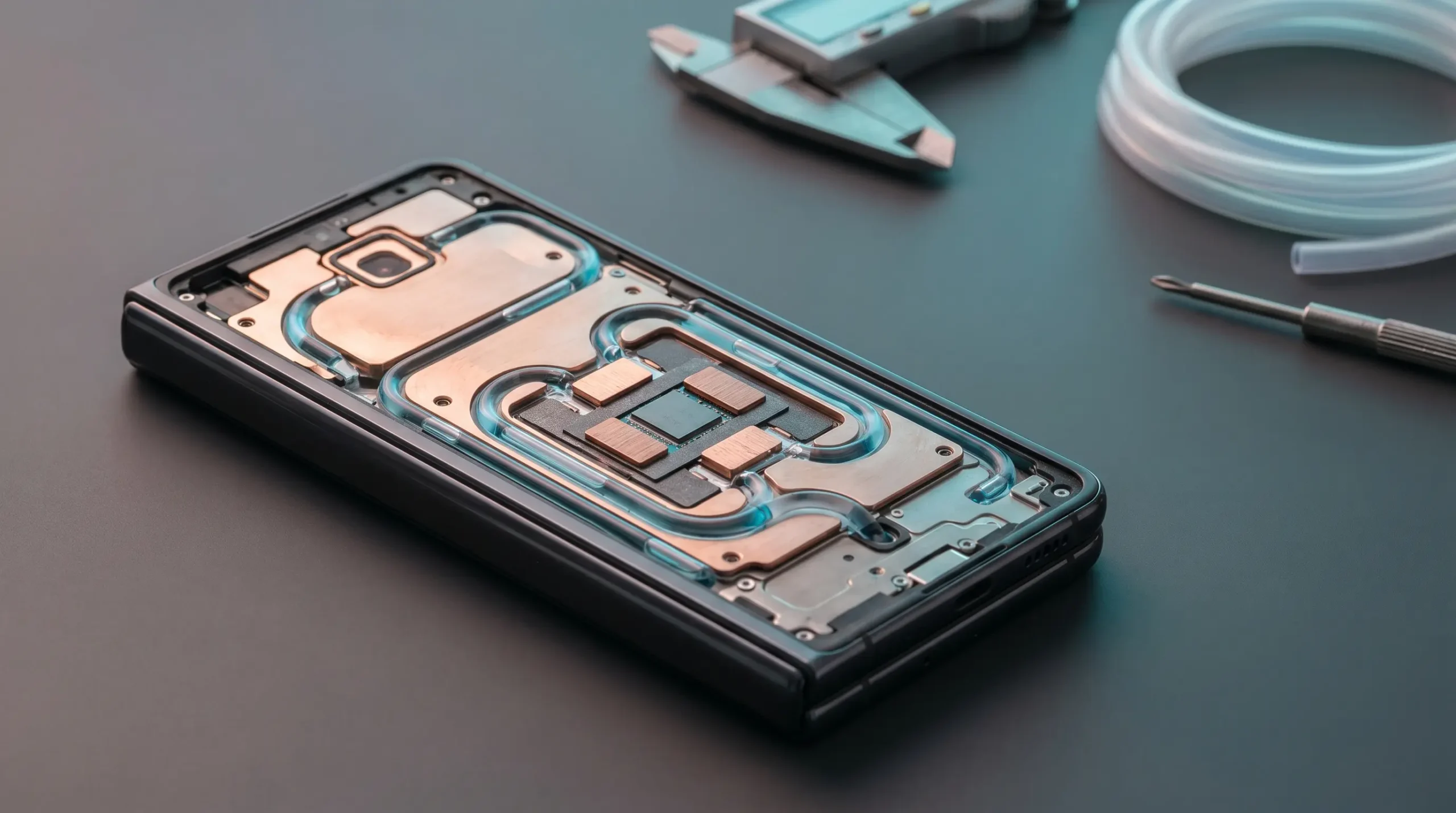
Samsung liquid cooling research matters because the South Korean electronics maker’s Galaxy phones are already moving from short performance bursts to sustained artificial intelligence (AI, software that runs trained models for tasks such as image editing and assistants) and gaming workloads. As of publication, the company has announced vapor-chamber upgrades, not an active liquid-cooled Galaxy; the reported work points to what may follow if thin phones keep running hotter for longer.
The hard part starts after the obvious comparison with gaming phones. RedMagic, the gaming-phone brand, can sell fan ducts and a performance-first body; the Galaxy line has to keep water resistance, battery space, camera hardware and a silent pocket device while chasing the same thermal ceiling.
The Report Lands After Samsung Already Reworked Galaxy Thermals
A May 31, 2026 report says Samsung has formed a research team under its Production Technology Research Institute, a manufacturing-research arm, to study active liquid and air cooling for future Galaxy hardware. The company has not announced a launch plan, a model name or a shipping window, so the right read is exploratory rather than imminent.
The timing still lands cleanly. The Galaxy S26 Ultra thermal management page says the phone uses a new vapor chamber design and claims 21% greater thermal performance; that is the tell: passive cooling is running out of easy room, even before active cooling leaves the lab.
Samsung’s own launch material tied that thermal work to heavier silicon. Its Galaxy S26 series launch specifications list a redesigned vapor chamber, Snapdragon 8 Elite Gen 5 for Galaxy or Exynos 2600 in different markets, and ingress protection 68 (IP68, a lab rating for dust-tight protection and freshwater submersion up to 1.5 meters for up to 30 minutes).
RedMagic Set the Benchmark Samsung Would Have to Civilize
RedMagic’s advantage is that it can be loud, literal and unapologetically gaming-coded. The RedMagic 11 Pro cooling specification says its AquaCore system combines flowing liquid cooling, a 13,116 mm2 vapor chamber, liquid metal and a 24,000 RPM waterproof turbo fan.
Galaxy buyers have different defaults. They expect a premium slab that survives rain, records video, fits wireless accessories and does not whine during a meeting. A sealed loop is the interesting middle path because it can move heat away from the system-on-a-chip (SoC, the processor package that combines computing, graphics and AI engines) without opening the body to external airflow.
| Cooling Path | Official Hardware or Status | Active Element | Trade-Off Samsung Must Solve |
|---|---|---|---|
| Galaxy S26 Ultra | Redesigned vapor chamber and thermal interface material | None disclosed | Quiet and sealed, but still limited by passive heat spreading |
| RedMagic 11 Pro | Flowing liquid cooling, 13,116 mm2 vapor chamber, liquid metal and turbo fan | Liquid circulation plus forced airflow | Accepts gaming-phone thickness, ducts and moving parts |
| Reported Future Galaxy Research | Closed liquid loop and active air options under study | No shipping hardware announced | Must protect water resistance, repairability and battery volume |
AI Turns Cooling Into a Daily Reliability Problem
Thermal throttling used to be a gamer complaint. The phone got hot after a long match, frame rates dipped, and the chip backed down. AI makes the load less predictable because it can appear in the camera, keyboard, gallery, calls, notes and background suggestions.
Qualcomm, the mobile chip supplier behind Snapdragon, points in the same direction. Its Snapdragon 8 Elite Gen 5 platform brief lists a 4.74 GHz peak central processing unit (CPU, the general compute core) clock, a 20% CPU performance uplift, a 35% CPU power-efficiency gain, a 23% graphics uplift and a 37% faster Hexagon neural processing unit (NPU, the AI engine that accelerates model workloads).
The hidden issue is touch temperature. A cooler chip can still mean a warmer hand if the design simply moves heat into the frame faster, so active liquid cooling would only matter for Galaxy if it sustains work without making the back glass and side rails feel like the cost of the feature.
A Sealed Loop Beats a Fan on Galaxy Priorities
Active air cooling is easier to picture because fans have been in gaming phones for years. It is also the harder sell for a Galaxy S device, since a vent asks the design team to make room for air channels, filters or seals, then asks users to accept noise and moving parts.
A closed liquid loop would fit Samsung’s priorities better if engineers can make it thin, cheap and durable enough. The coolant never needs to touch the outside world. Heat can move from the processor area toward a larger part of the chassis while the acoustic profile stays silent.
- Water resistance: the system has to preserve Samsung’s IP68 claim without turning every port, seam or gasket into a weak point.
- Battery space: pumps, tubing and reinforced channels compete with battery volume, camera stacks, wireless charging coils and antennas.
- Service life: a mainstream flagship needs years of drops, pocket lint, hot cars, charging cycles and repair visits, not a lab demo that works once.
Repair is the sleeper problem. A passive vapor chamber can be sealed into the internal stack; an active loop adds parts that may need testing after a cracked back panel, battery swap or board replacement.
That is why the research label matters. Gaming brands can use exotic cooling as a visible badge, but Galaxy would win only if the phone stays fast, quiet and sealed while users forget the cooling system exists.
Samsung Already Treats Cooling as a Platform Problem
The phone report also fits a broader Samsung pattern. In 2025, Samsung announced thin-film Peltier cooling work with Johns Hopkins Applied Physics Laboratory, saying the project improved Peltier-device efficiency by nearly 75% and reduced the required material to about one-thousandth of conventional levels.
That project targeted refrigerators rather than handsets, so it should not be mistaken for a Galaxy roadmap. Still, it shows how the company thinks about thermal design: materials, packaging, system layout and manufacturing have to move together. A smartphone loop would face the same chain of questions at a smaller scale.
For a mass-market phone, manufacturing beats magic. Samsung would need supply-chain repeatability, drop-test durability, a repair story, carrier certification and no obvious hit to margin before a liquid loop could move from research bench to retail shelf.
The Engineering Test Is Boring by Design
A Galaxy flagship cannot win by becoming a gaming phone with a different badge. The brand’s premium promise is consistency: fast on a commute, quiet in a conference room, safe in a sink splash and stable while recording video in sunlight.
That makes active liquid cooling a second-order bet. The target is silent sustained performance, which means a processor that holds speed longer and a product plan with room for more local AI, higher camera throughput and console-style gaming.
There is also a restraint signal here. Samsung could ship another larger vapor chamber and call it progress, as it did with the last two S-series generations, but researching an active loop suggests the passive path may be getting expensive in space, weight and diminishing gains.
If the research stays in the lab, the S26 Ultra’s vapor chamber remains the state of Galaxy thermal design. If Samsung brings a silent sealed loop to a future flagship, RedMagic’s gaming experiment will have become mainstream phone infrastructure.


South Korea Retail Investors Face Reckoning After KOSPI AI Rally Collapses

Surrey AI Maps Three Heart Attack Paths and Their Molecular Roots

Germany Locks Neutral Apple ATT Prompts Across Most of Europe

Apple’s 5% EU Fee Quietly Rewrites Alternative App Store Math

Apple’s EU Fee Truce Cuts Complexity but Leaves Rivals Fuming

Pixel 11 Pro Fold Trades Thinness for Durability and Seven-Year Stay

Mayo AI Flags HCM Obstruction From Everyday Ultrasound Videos

Indian Brands Quietly Scale Landmark Screens and Home Tech

Navin Vatsa Turns Grief Into a Lifetime of Quiet Seeing

Google Bets Pixel 11 Agentic AI Will Redefine Phones

Oracle Cuts 21,000 Jobs in a Year, Cites AI in 10-K Filing

Fable 5 and Mythos 5 Return as US Lifts Anthropic Export Controls

SpaceX’s Google Deal Turns a Rocket Company Into a Cloud Landlord

CD Projekt Red Co-CEO: Redemption Arc Isn’t Done, Witcher 4 in 2027

XPL Rallies 30% Ahead of Plasma One Card Tier Launch

Google Search Profiles Build a Follow Graph Inside Discover

DGO App Brings Rs 549 Mobile Pass for FIFA World Cup 2026 in Nepal

Moonshot AI Targets $30 Billion in China’s Fastest AI Funding Sprint

Oppo’s ColorOS 17 Eligibility List Leaves A-Series Buyers Behind

Microsoft Xbox Layoffs Start in July as Sharma Slams 3% Margin
-
 AI2 months ago
Oracle Cuts 21,000 Jobs in a Year, Cites AI in 10-K Filing
-
 AI2 months ago
Fable 5 and Mythos 5 Return as US Lifts Anthropic Export Controls
-
 AI3 months ago
SpaceX’s Google Deal Turns a Rocket Company Into a Cloud Landlord
-
 GAMING2 months ago
CD Projekt Red Co-CEO: Redemption Arc Isn’t Done, Witcher 4 in 2027
-
 CRYPTO3 months ago
XPL Rallies 30% Ahead of Plasma One Card Tier Launch
-
 NEWS3 months ago
Google Search Profiles Build a Follow Graph Inside Discover
-
 APPS3 months ago
DGO App Brings Rs 549 Mobile Pass for FIFA World Cup 2026 in Nepal
-
 AI3 months ago
Moonshot AI Targets $30 Billion in China’s Fastest AI Funding Sprint