
CRYPTO
Warsh’s First FOMC Tilts Hawkish as Bitcoin Slips Below $65K
Warsh’s first FOMC kept rates at 3.5%-3.75% but raised 2026 PCE inflation to 3.6% from 2.7%. Bitcoin briefly fell to $64,800 before settling near $65,300.

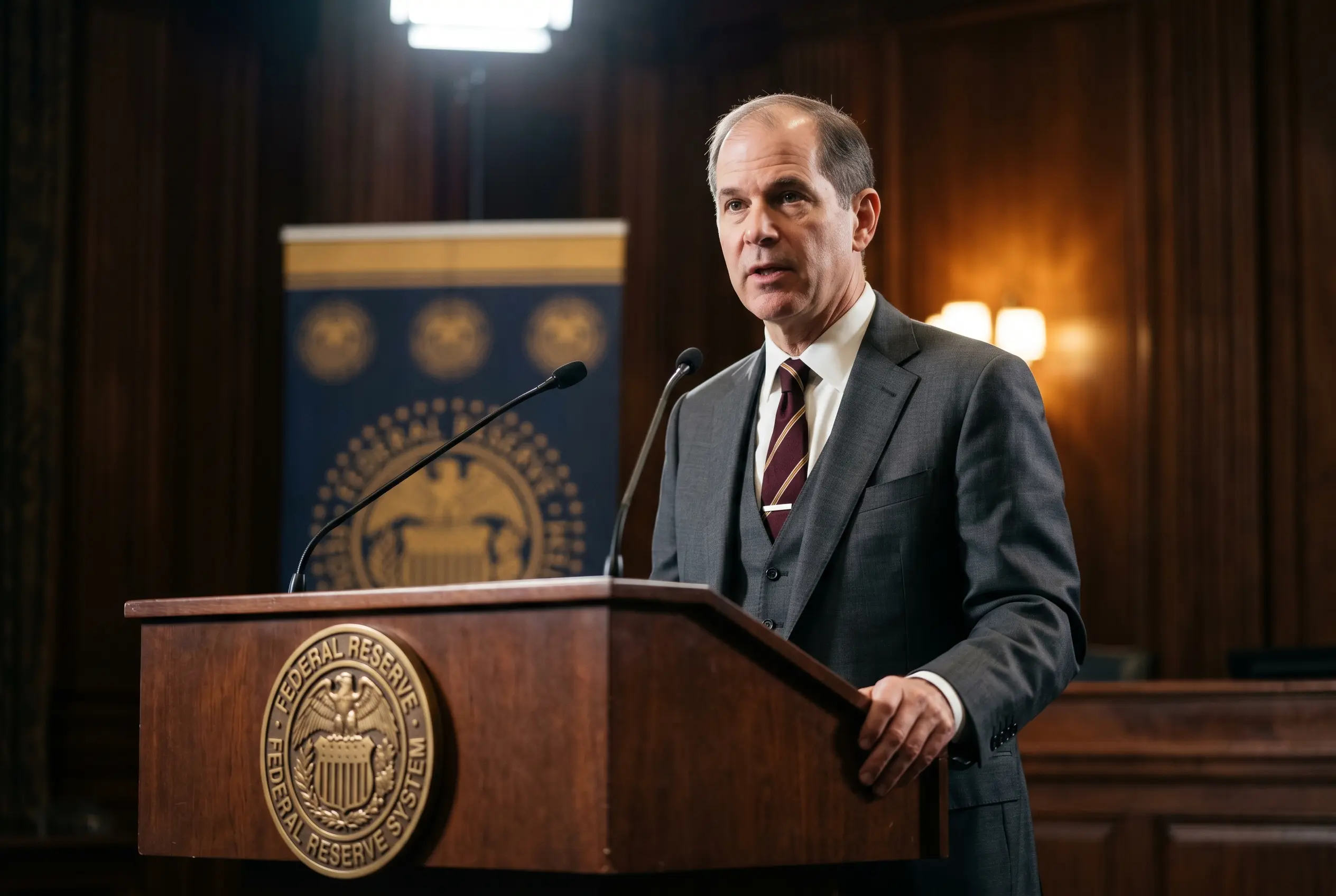
Federal Reserve Chair Kevin Warsh held his first FOMC meeting on June 17, keeping the benchmark rate at 3.5% to 3.75%. The unanimous 12-0 vote masked a more hawkish turn in the quarterly projections that accompanied it. The median 2026 federal funds rate forecast climbed to 3.8% from 3.4% in March, and the PCE inflation projection jumped to 3.6% from 2.7%.
Bitcoin traded near $66,000 before the announcement, fell to $64,800 in the minutes after, and settled around $65,300, down just over 1% on the day but still up 5% for the week. Equities bore more of the reaction: the S&P 500 closed down 1.19% and the Nasdaq fell 1.32%. The two-year Treasury yield jumped 11 basis points to 4.153%, and traders lifted the implied probability of a July rate hike to 18% on CME FedWatch. Bitcoin’s third Iran truce fade had already left the largest cryptocurrency capped below $67,000 in the days before the meeting. The new Fed’s first message to markets was clear: the inflation fight is back in the foreground.
The Dot Plot Flips Hawkish
The vote to hold rates was unanimous, but the projections told a different story. Of the 18 officials who submitted a Summary of Economic Projections, nine penciled in a federal funds rate above the current 3.5% to 3.75% range by the end of 2026. That puts at least one rate hike on the table for the current year. The median 2026 rate now sits at 3.8%, up a quarter point from the March projection, and the 2027 and 2028 medians also climbed, to 3.6% and 3.4%, respectively.
Warsh himself did not submit a projection, and he confirmed at his press conference that he was the missing dot. “I have refrained from offering projections of my own, consistent with my long-held views on the SEP, at least as currently structured,” he said. His absence, in a committee of 18, leaves the central tendency tilted toward a higher terminal rate than markets had prepared for, and the Summary of Economic Projections table shows dots for 2026 clustered between 3.375% and 4.375%, wide enough to accommodate either no change or a sequence of hikes.
The dispersion inside the committee is the story. Eight officials see the policy rate at 3.625% or below by year-end, while five put it at 4.125% or above. That spread is what pushed the median upward. Powell voted alongside Warsh on Wednesday despite a year of internal dissents from members who had favored cuts. The change of tone inside the committee is now visible in the projections.
- 2026 median: 3.8% (up from 3.4% in March)
- 2027 median: 3.6% (up from 3.1% in March)
- 2028 median: 3.4% (up from 3.1% in March)
- Longer run: 3.1% (unchanged)
A Shorter Statement With No Forward Guidance
The policy statement itself changed too. Warsh called the new text “a bit shorter, a bit simpler” and said it dispenses with “older language.” The biggest cut is forward guidance, the language the committee has used to telegraph its next move.
“Absent, also, is so-called forward guidance, which we agreed was not well suited to the current policy conjuncture,” Warsh said. The change reflects his long-standing public criticism of how the Fed has talked about its own policy, and it shifts the burden of expectation-setting onto the SEP and onto the chair’s press conference. The Fed’s FOMC statement from June 17 runs several paragraphs shorter than its March counterpart. Markets will now read the projections and the chair’s words more closely than they read the statement itself.
Warsh’s Five Task Forces
Warsh used his first press conference as chair to launch five internal task forces that will review how the central bank operates. The groups will examine Fed communications, the central bank’s balance sheet, its use of data sources, the impact of artificial intelligence and other emerging technologies on jobs and productivity, and the broader inflation framework. Each panel has a “straightforward charge,” Warsh said: ask hard questions, examine current practice, consider alternatives. He framed the panels as a way to build a Federal Reserve that is “clear-eyed about its mission, fit for purpose, and focused on the future.” The reviews go to the heart of how the Fed operates.
The reviews target parts of the institution that have drawn public criticism. The balance sheet task force will examine the “ample reserves regime” and weigh its risks and benefits, language the Fed has used to describe post-quantitative-tightening operating conditions. The communications review is more pointed: Warsh said the Fed has “missed” the message on inflation for five years, and “we’re going to fix that.”
The task forces are part of a long-term institutional rebuild rather than a near-term policy lever. Their conclusions will feed back into how the Fed discusses, sets, and implements policy over Warsh’s four-year term, which runs through May 21, 2030, per Brookings’ profile of Warsh’s first months. Warsh took office on May 22, after a Senate confirmation vote of 54-45 on May 13. The reviews will not change next month’s rate decision, but they will shape every statement that follows.
- Communications
- Balance sheet
- Data sources
- Jobs, productivity, and AI
- Inflation framework
Bitcoin Slips as Stocks and Yields Reprice
Bitcoin’s reaction to the Fed meeting was muted by its own recent standards. The largest cryptocurrency had been capped below $67,000 since a third Iran truce attempt failed to draw a sustained bid. It traded near $66,000 ahead of the announcement, fell to $64,800 within minutes of the release, and recovered to around $65,300 by the close of the New York session, a decline of just over 1% for the day.
Stocks sold off more sharply. The S&P 500 closed down 1.19% at 7,421.76, the Nasdaq Composite fell 1.32% to 26,027.21, and the Dow Jones Industrial Average dropped 0.96% to 51,494.99. Two-year Treasury yields jumped 11 basis points to 4.153%, and the ten-year yield added four basis points to 4.469%. The bond market was pricing in slower cuts and a higher terminal rate. Rosenblatt Securities’ Michael James, an equity sales trader, said the Fed’s statement and Warsh’s comments carried “clearly hawkish” language.
In crypto, the week-on-week numbers still looked healthy. Bitcoin was up 5% over the prior seven days. Ethereum gained 7.6% to $1,763, and Solana rose 13% to $73 over the same period, a recovery that had been underway before Wednesday’s pullback. Powell’s last Fed warning before Warsh took over had already foreshadowed a stickier inflation backdrop.
CME FedWatch had traders pricing a roughly 40% chance of rates holding steady by year-end on Tuesday. By the close on Wednesday, that probability was down to 15.7%. October is now the first meeting where traders see better-than-even odds of a hike, at 60.7%, per CNBC’s read of the tool. The July meeting, once a non-event in market positioning, now carries an 18% implied probability of a hike. The Crypto Fear and Greed Index sat at 22, deep in extreme fear territory, with the Fear and Greed Index holding at 22 even as Bitcoin rebounded off its intraday low.
| Asset | June 17 Move |
|---|---|
| Bitcoin (BTC) | ~$65,300, down just over 1% (up 5% on week) |
| Ethereum (ETH) | $1,763 (up 7.6% on week) |
| Solana (SOL) | $73 (up 13% on week) |
| S&P 500 | 7,421.76, down 1.19% |
| Nasdaq Composite | 26,027.21, down 1.32% |
| 2-year Treasury yield | 4.153%, up 11 bp |
| 10-year Treasury yield | 4.469%, up 4 bp |
The Inflation Forecast Reshapes the Path
The headline number from Wednesday was the rate path. The larger move was the inflation projection. The FOMC now expects PCE inflation of 3.6% for 2026, up from 2.7% in March, and core PCE of 3.3%, up from a prior 2.7%.
That is the largest upward revision in headline PCE for the current year in any recent SEP round, and it lands against a backdrop where the U.S. consumer price index grew at a 4.2% annual rate in May. Officials now see inflation running hotter for longer, with the path back to the 2% target stretching past 2027. Warsh tied the revision to data dependence and refused to move the target itself. “That is the Federal Reserve’s long-held objective of 2%. The ‘two’ is the left of the decimal point. For now, ‘zero’ is to the right,” he said.
For the new chair, the fight against inflation is a long institutional project. The committee dropped forward guidance to keep its options open, and the SEP now does most of the talking. The dot plot’s 3.8% median for 2026 sits above the current 3.5% to 3.75% target range. Powell’s year of dissent over cuts is now part of the record, and the next SEP, due in September, will show whether the committee’s median has shifted further.
The commitment to deliver is strong, unanimous, and unambiguous, and that’s I think an important message we’ve missed for five years, and we’re going to fix that.
Warsh said those words at his first press conference as chair on Wednesday.
The Crypto Read on Warsh’s First Fed
For crypto, the new chair’s first meeting reads as a regime signal more than an immediate price event. Warsh has framed the fight against inflation as a multi-year institutional rebuild, and the five task forces, the rewritten statement, and the inflation projection all point in the same direction. The Fed is less willing to pre-commit and more willing to keep policy restrictive until the data cooperates.
Rosenblatt Securities’ James called the tilt “clearly hawkish” and pointed to “the Fed’s focus on the commitment to deliver price stability and the commentary about inflation.” Goldman Sachs Asset Management’s Kay Haigh, the firm’s global co-head and CIO of fixed income and liquidity solutions, summed up the new reality. The Fed “can just about avoid hikes,” Haigh said, “but the path is narrow and there will be a high premium on the incoming inflation data.” For Bitcoin and the rest of the crypto market, the next FOMC meeting is scheduled for July 29. The dot plot’s 3.8% median for 2026 sits above the current 3.5% to 3.75% target range, and the curve has begun to price the consequences.
Frequently Asked Questions
Why did Bitcoin drop on Warsh’s first Fed meeting?
Bitcoin fell from about $66,000 to $64,800 in the minutes after the Fed’s June 17 decision, then recovered to roughly $65,300 by the close. The move was driven by a more hawkish dot plot, with nine of 18 officials now penciling in at least one rate hike in 2026, and a sharp upward revision to the 2026 PCE inflation forecast.
What is the Fed’s new inflation forecast?
The Fed now projects PCE inflation of 3.6% for 2026, up from 2.7% in March, and core PCE of 3.3%, up from 2.7%. The 2027 PCE projection rose to 2.3% from 2.2%, while the longer-run PCE forecast remains at 2.0%.
Will the Fed hike rates in July 2026?
CME FedWatch put the implied probability of a July rate hike at 18% after the meeting, up from earlier expectations. October is now the first meeting where traders see better-than-even odds of a hike, at 60.7%.
What are Warsh’s five task forces?
Warsh announced five internal review groups at his first press conference as chair: communications, the Fed’s balance sheet, data sources, the impact of AI and emerging technologies on jobs and productivity, and the broader inflation framework.
How does Warsh’s Fed differ from Powell’s?
Warsh has dropped forward guidance from the FOMC statement, declined to submit his own dot plot projection, and launched five internal task forces to review how the Fed operates. He has framed the inflation fight as a long-term institutional rebuild and committed publicly to the 2% target.
Disclaimer: This article is for informational purposes only and does not constitute financial, investment, or trading advice. Cryptocurrency and monetary policy decisions carry significant risk, including the loss of principal. Figures and projections cited are accurate as of publication on June 18, 2026. Consult a qualified financial professional before making investment decisions.


South Korea Retail Investors Face Reckoning After KOSPI AI Rally Collapses

Surrey AI Maps Three Heart Attack Paths and Their Molecular Roots

Germany Locks Neutral Apple ATT Prompts Across Most of Europe

Apple’s 5% EU Fee Quietly Rewrites Alternative App Store Math

Apple’s EU Fee Truce Cuts Complexity but Leaves Rivals Fuming

Pixel 11 Pro Fold Trades Thinness for Durability and Seven-Year Stay

Mayo AI Flags HCM Obstruction From Everyday Ultrasound Videos

Indian Brands Quietly Scale Landmark Screens and Home Tech

Navin Vatsa Turns Grief Into a Lifetime of Quiet Seeing

Google Bets Pixel 11 Agentic AI Will Redefine Phones

Oracle Cuts 21,000 Jobs in a Year, Cites AI in 10-K Filing

Fable 5 and Mythos 5 Return as US Lifts Anthropic Export Controls

SpaceX’s Google Deal Turns a Rocket Company Into a Cloud Landlord

CD Projekt Red Co-CEO: Redemption Arc Isn’t Done, Witcher 4 in 2027

XPL Rallies 30% Ahead of Plasma One Card Tier Launch

Google Search Profiles Build a Follow Graph Inside Discover

DGO App Brings Rs 549 Mobile Pass for FIFA World Cup 2026 in Nepal

Moonshot AI Targets $30 Billion in China’s Fastest AI Funding Sprint

Oppo’s ColorOS 17 Eligibility List Leaves A-Series Buyers Behind

Microsoft Xbox Layoffs Start in July as Sharma Slams 3% Margin
-
 AI2 months ago
Oracle Cuts 21,000 Jobs in a Year, Cites AI in 10-K Filing
-
 AI2 months ago
Fable 5 and Mythos 5 Return as US Lifts Anthropic Export Controls
-
 AI3 months ago
SpaceX’s Google Deal Turns a Rocket Company Into a Cloud Landlord
-
 GAMING2 months ago
CD Projekt Red Co-CEO: Redemption Arc Isn’t Done, Witcher 4 in 2027
-
 CRYPTO3 months ago
XPL Rallies 30% Ahead of Plasma One Card Tier Launch
-
 NEWS3 months ago
Google Search Profiles Build a Follow Graph Inside Discover
-
 APPS3 months ago
DGO App Brings Rs 549 Mobile Pass for FIFA World Cup 2026 in Nepal
-
 AI3 months ago
Moonshot AI Targets $30 Billion in China’s Fastest AI Funding Sprint